Somber and Sensible Adornments

Gutta-percha hand and wreath mourning brooch, Circa 1870-1880.

Gutta-percha is a natural latex material derived from the sap of Palaquium trees. It has a rubber-like consistency but is tougher and more durable than typical latex. It was first introduced to Europe in the 1840s after the British surgeon William Montgomerie brought samples of it from Southeast Asia, where it was used by indigenous people for making handles and waterproof containers, for instance. The material quickly gained popularity in the West for its unique combination of toughness, flexibility, and water resistance. Early uses included medical instruments, walking stick handles, and insulating underwater telegraph cables.

Gutta-percha found a prominent place in jewelry, particularly mourning jewelry. The Victorian fascination with mourning—especially after the death of Great Britain’s Prince Albert in 1861—created a demand for somber yet elegant adornments. It was molded into brooches, lockets, and bracelets, often featuring intricate floral or Gothic-inspired designs. Gutta-percha’s dark, matte finish made it an ideal material for mourning jewelry, as it symbolized grief and modesty whilst being affordable compared to traditional materials like jet. Such pieces could also be purchased, premade and reasonably priced, at local mercantiles—unlike gold jewelry containing a lock of the deceased’s hair, which took time to produce by a jeweler. The gutta-percha pieces, therefore, were available for wear at funerals held a few days after death. The lightweight nature of gutta-percha and its ability to be carved into fine detail further solidified its status as a popular choice for commemorative and mourning pieces.

The following are examples from my collection of this type of mourning adornment.

Gutta-percha mourning locket with interior compartment for hair or a photo, circa 1875-1880.
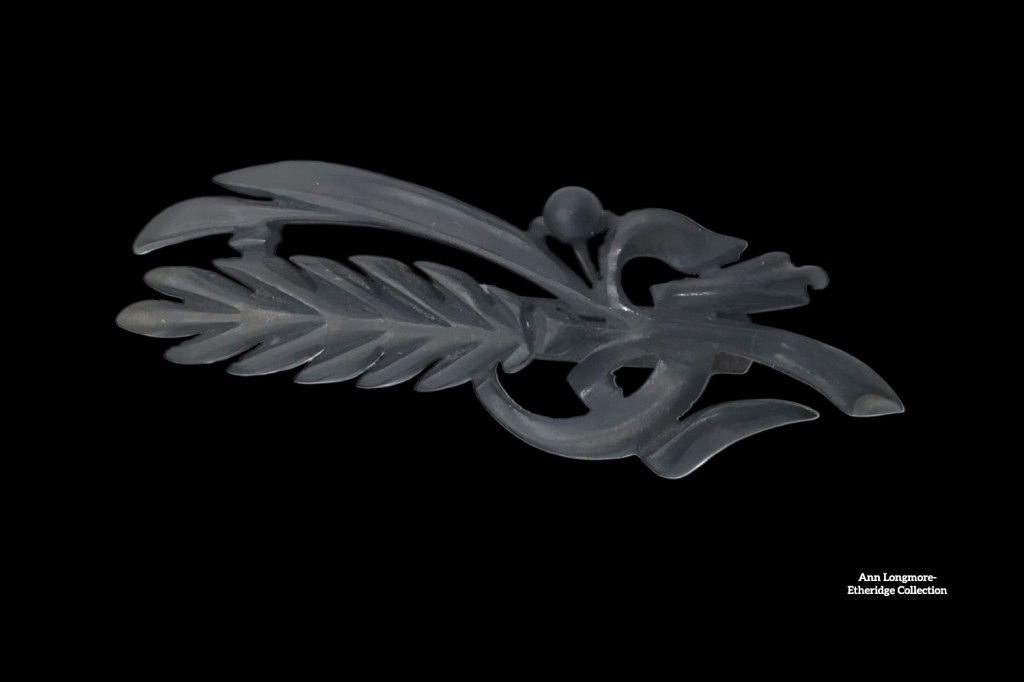
Gutta-percha scythe and wheatsheaf brooch, circa 1875.
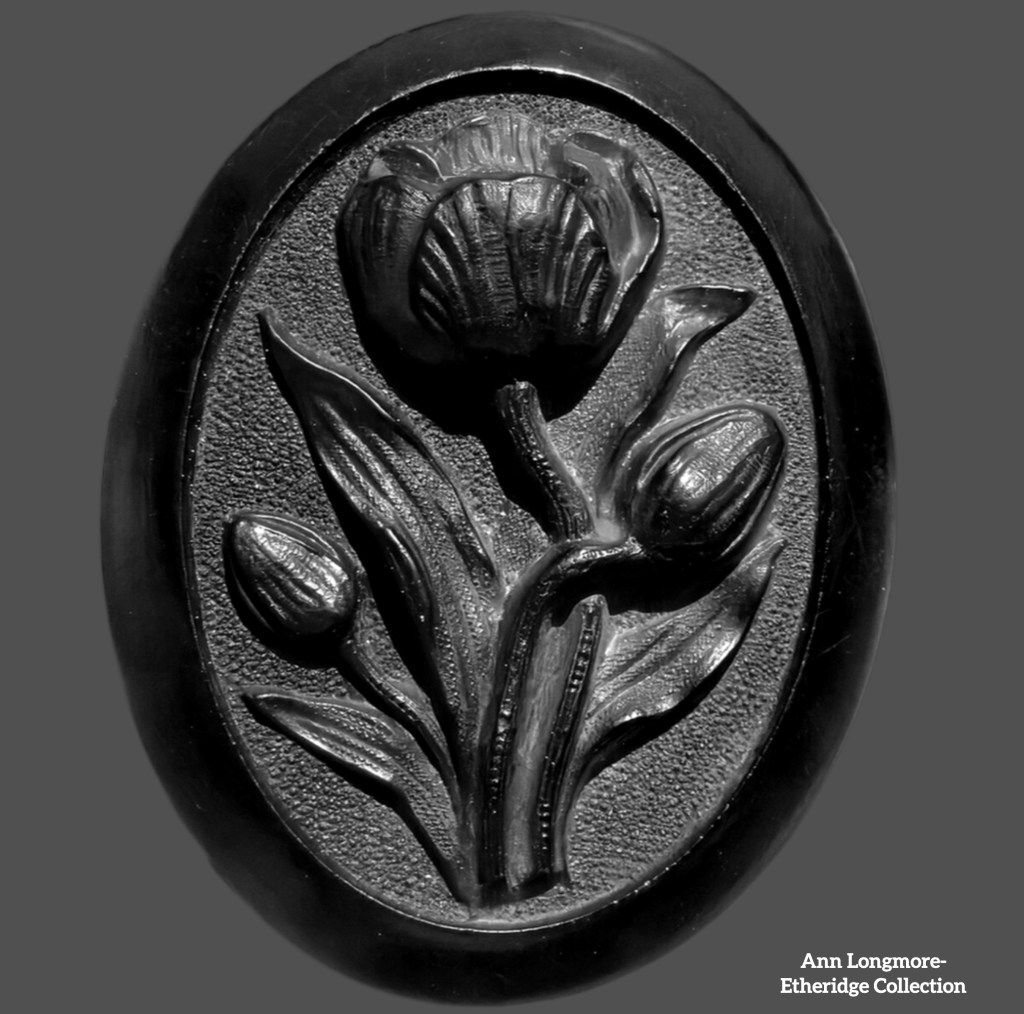
Gutta-percha tulip mourning brooch, circa 1885.

Cherub with a swag of flowers mourning brooch, 1865.

Large gutta-percha floral cross pendant, circa 1875.

Dutch gutta-percha equine brooch, circa 1885.

Irish gutta-percha mourning brooch, Circa 1880.
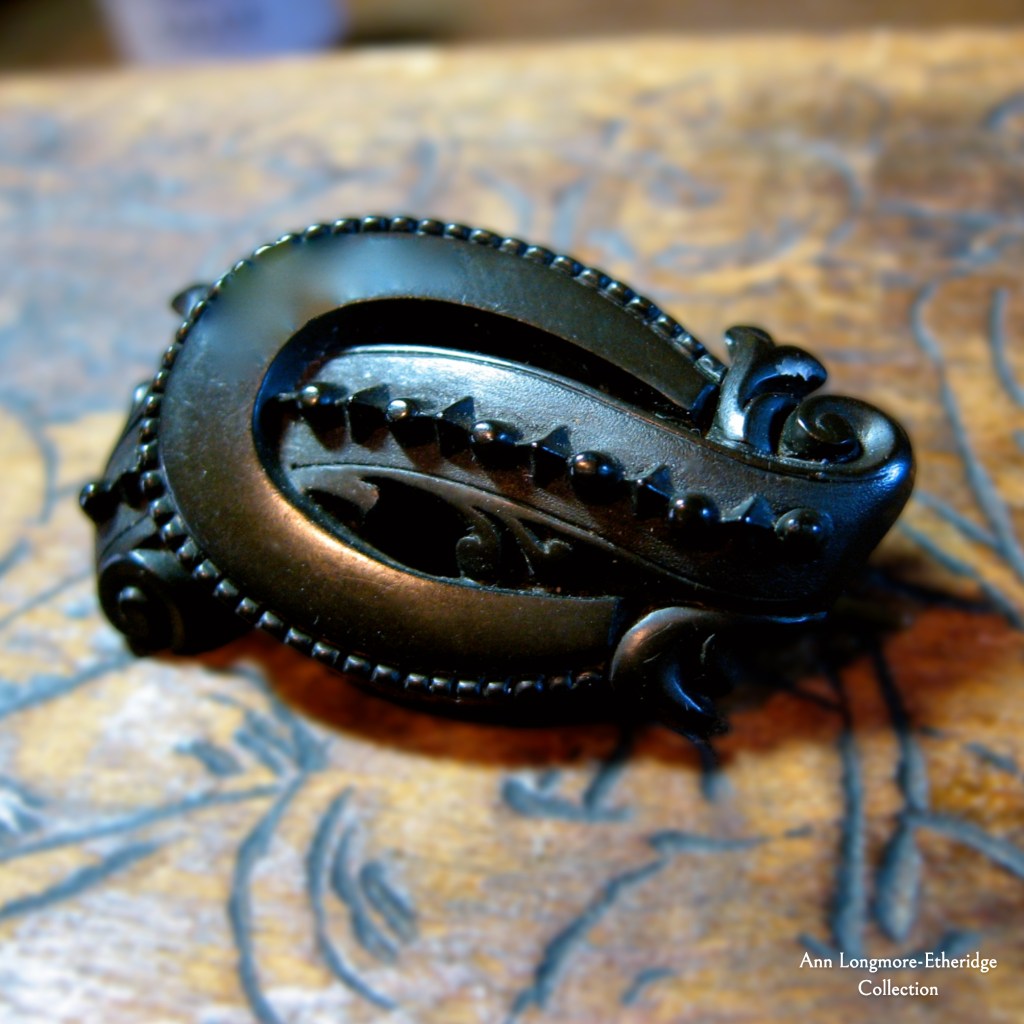
Horseshoe gutta-percha mourning brooch, circa 1870
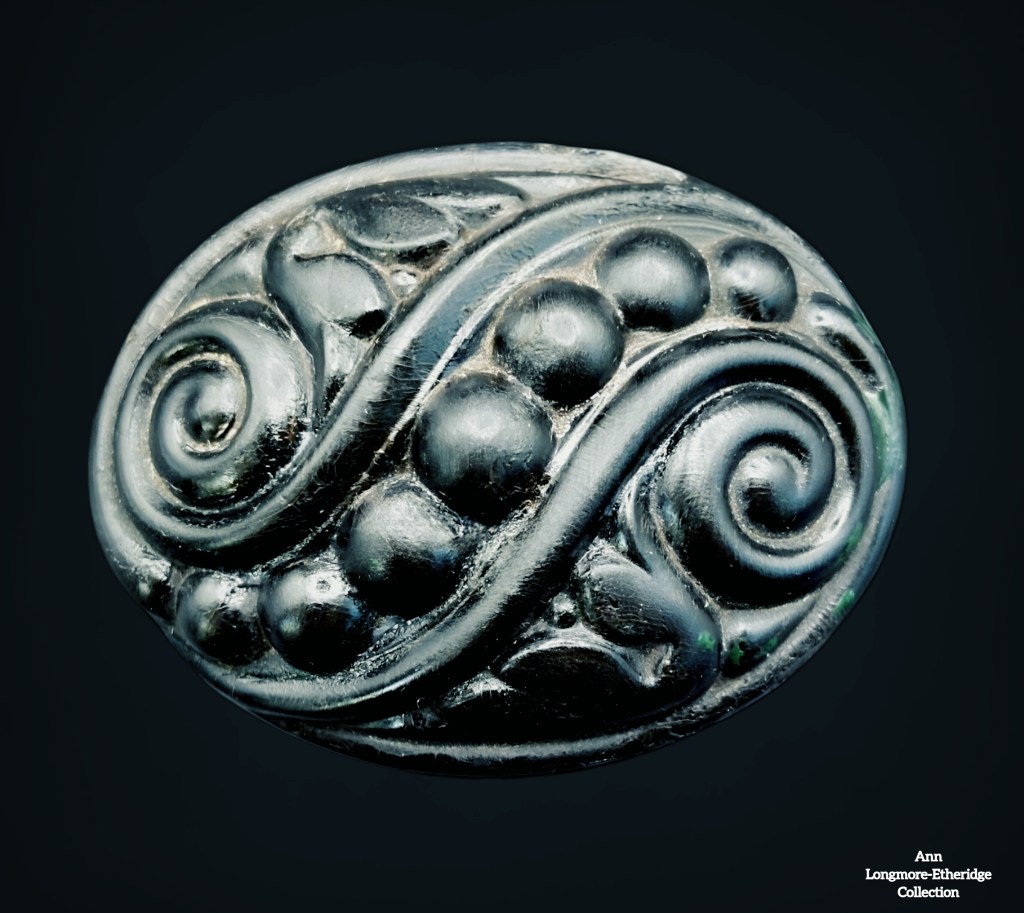
Swirling vines and dots gutta-percha mourning brooch, late 1800s.

Gutta-percha widowed bird mourning brooch, circa 1875.

Gutta-percha Isle of Man morning brooch, circa 1890.

Gutta-percha missing acorn brooch, 1860s.

Gutta-percha mourning brooch, 1870s.

Gutta-percha cameo brooch, 1860s-70s.

Ω
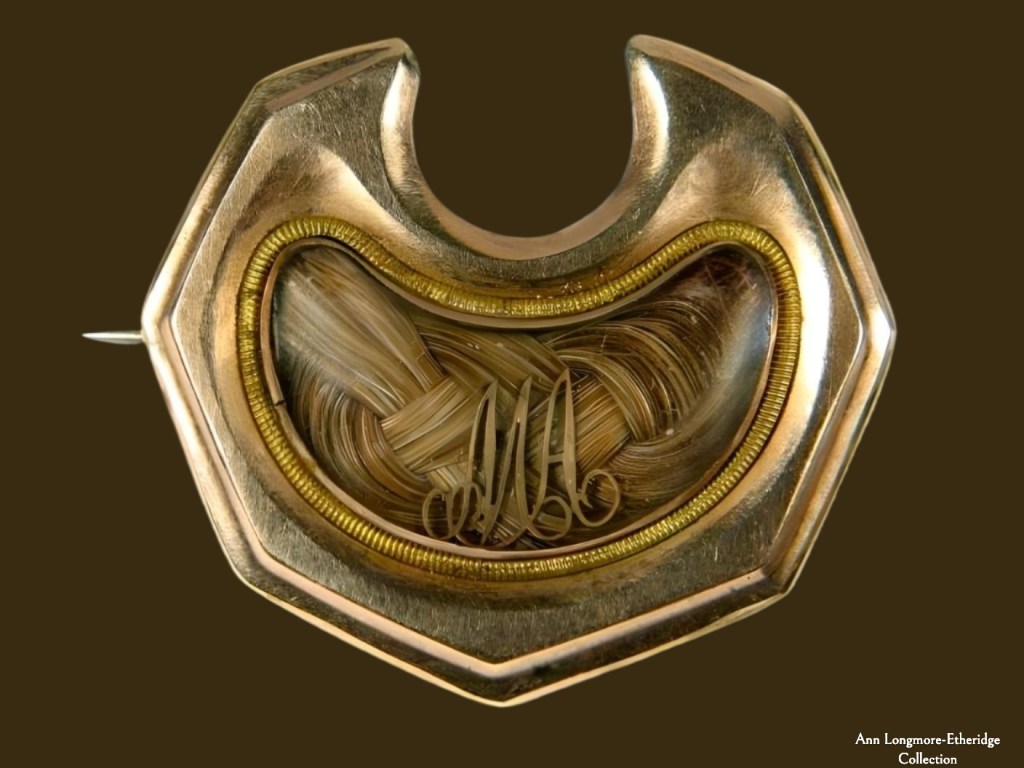
Life’s End at Stodday Lodge

“The Monthly Magazine or the British Register, Part one for 1809,” references the 14 December, 1808, death commemorated by this brooch: “At Stodday Lodge, near Lancashire, Mrs. Arthington, relict of Thomas A. esq. of Leeds, 52.”

The Arthingtons were Quakers, and Mary’s interment at the Friends Burying Ground “at the Moor Side near Lancaster” was arranged by the Friends. A request exists from one George Barrow to Robert Dean, “Grave-Maker,” sent two days after Mary’s death, ordering Dean to “make a Grave on or before next Third Day…and therein lay the Body of Mary Arthington of Lancaster…aged about 51 years.”

According to Quarkeriana, Vol. I, April 1894, Moorside, also known as Golgotha, was “about a mile from Lancaster…in which there have been over 100 interments…. Tradition says that formerly there were many stones removed by the desire of the Yearly Meetings Committee that once visited the meeting. One, a large, heavy stone chest, still remains, which is said to have been too large to move.” If Mary Arthington had a gravestone at the burying ground, sadly, it is long gone.

Below this entry, Robert Dean attests, “The Body above mentioned was buried twentieth day of Twelfth Month, 1808.”

The reverse of the brooch, engraved with, “Mary Arthington, died at Stodday Lodge dec 14th, 1808”. Ann Longmore-Etheridge Collection

Mary was born 28 May, 1757, the daughter of Robert and Jane Lawson, who were deceased by the date of Mary’s second union. When she married Thomas Arthington, a “common brewer,” in York on 14 July, 1785, she was known as Mary Whalley, the widow of Joseph, “late of Lancaster in the county of Lancaster, merchant.”

Mary married Joseph Whalley on 9 May, 1781, at the Quaker meeting house in Yealand Conyers, Lancashire. He was the son of Joshua Whalley, who was present at the marriage, and Bridget, his wife, who was already dead. Both Robert and Jane Lawson were also present, placing their own deaths (and Joshua Whalley’s) between June 1781 and June 1785.

A Quaker wedding, circa 1790.

Thomas Arthington was the son of Robert and Phoebe Arthington, born at Armley, Leeds Parish, Yorkshire, 5 December, 1743. His father had also been a common brewer, and like Mary, both Thomas’s parents were dead by 1785.

The Quaker document, while formulaic, is still so detailed that the wedding of the 28-year-old Mary and 42-year-old Thomas can almost be envisioned: “The said Thomas Arthington and Mary Whalley appeared in publick assembly [at the] Meeting House at Wray in the said county of Lancaster. And the said Thomas Arthington, taking the said Mary Whalley by the hand, did openly and solemnly declare as followeth, “Friends, in the fear of the Lord and before this assembly, I take this my friend, Mary Whalley, to be my wife, promising through divine assistance to be unto her a loving and faithfull husband, until it shall please the Lorde to separate us by death.” Mary then repeated the same to Thomas, whilst holding his hand.

Stodday Lodge, photographed in 2006. © Mr Chris Thoume. Source: Historic England Archive. This photograph was taken for the Images of England project.

The house where Mary Arthington died, Stodday Lodge, is a secluded dwelling set in wooded gardens near the old village of Stodday, four miles south of the city of Lancaster. Today, Stodday Lodge is a Grade II listed building known as Lunecliffe Hall. British Listed Buildings describes it as a “small country house, now house and office. Late C18 and early C19, with later additions. Sandstone ashlar, with ashlar dressings. Slate roof…entrance hall has Venetian-style panelled and glazed screens to rear and left, with fluted pilasters, moulded architraves with fluted keystones, and 2-light stained glass windows.” (The entire report on the house is here: www.britishlistedbuildings.co.uk/en-383029-lunecliffe-hal… )

Ω