Carte de visite from the Ann Longmore-Etheridge Collection.
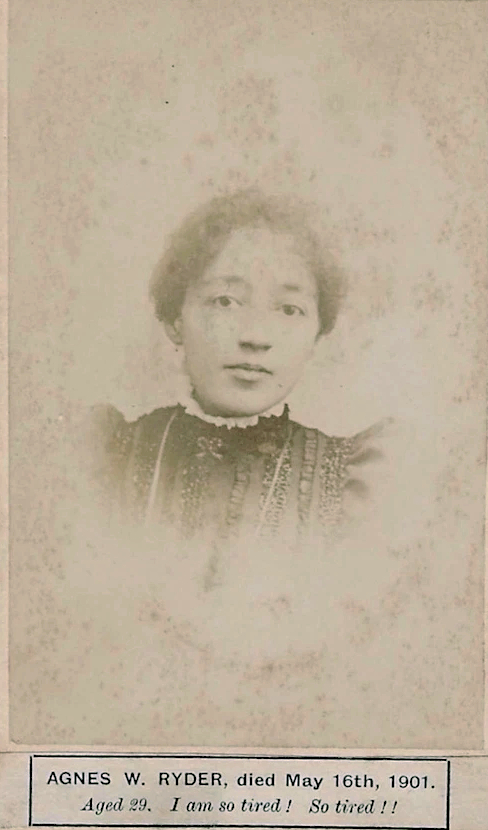
Agnes Warner Rider, pictured above, died on 16 May, 1901, at the age of 29. Presumably, her final words, as printed on this albumen carte de visite, were “I’m so tired. So tired!”
Agnes was born 18 January, 1872, in Southwark, London, to Charles Ryder (1846-1907), a printshop manager, and his wife Hannah Bramley (1847-1919), who both hailed from Loughborough, Leicestershire. Agnes, along with her other siblings, was baptised on 19 January, 1874, at Saint George the Martyr, Queen Square, Camden. At that time, her family lived at 10 Dunford Road, Holloway, London, in a small terraced home that still stands today.
The 1891 Census reveals that Agnes was the eldest surviving child in a family that included siblings Archie Hammond, Dudley Charles, Gertrude, Isabel, Henry Granville, Grace Hannah, and John Basil. Baptismal records indicate there was also a sister called Martha, born in 1878, one named Elizabeth Helen, born in 1868, and another called Marguerite, born in 1870. These three girls do not appear to have outlived childhood.
When the 1901 Census was taken, Agnes had but little time to live. She is listed as the eldest of a group of six children still in the home, along with Archie, Dudley, Henry, Grace, and John. One worked as a milliner, one as a dressmaker, and one as a merchant’s assistant. Archie had already married and become a young widower.
This census also reveals this clue as to why pretty, brown-eyed Agnes had not married or held a job: “Curvature of the spine since birth” was scribbled at the far right of the enumeration page.
In the Victorian era, spinal curvatures, like scoliosis and kyphosis, were prevalent. There were misconceptions about the causes of scoliosis, sometimes linking it to moral failings or perceived societal problems rather than solely medical conditions. Victorian attitudes toward spinal deformities reflected the broader societal views on disability, ranging from pity and fear to marginalization. Those with such conditions might be seen as “others” and face challenges in social and economic participation.
Illustrations from a 1916 publication on treatments for scoliosis. Wikimedia Commons.
Treatment options for spinal curvature were varied and often experimental. Doctors utilized braces and modified corsets for correction. Traction and immobilization techniques were employed to reduce the curve, sometimes with limited success and potential complications, like paralysis.
In the mid-19th century, surgeons began exploring surgical options like percutaneous myotomies (muscle and tendon cutting) and later, spinal fusions to address deformities. However, these procedures carried significant risks, including infections and recurrence. Some practitioners advocated for gymnastic exercises to strengthen back muscles and treat deformities, believing it was more effective than solely relying on braces.
While spine curvature was not often fatal, it depends on severity and type. In severe cases, it can lead to respiratory complications, cardiovascular issues, nerve damage, reduced mobility, and significant pain. Some or all of these could lend weight to Agnes’s departing words, “I’m so tired….”
Agnes Warner Ryder was buried on 22 May, 1901, at Highgate Cemetery, Camden. Her grave, Square 19, Grave 33932, remains unmarked.
This fine 1/6th-plate daguerreotype is of Caroline Hulda Felt, born 24 April, 1830, in Stow, Middlesex County, Massachusetts, United States. The portrait was probably taken on her eighteenth birthday in 1848.
Caroline, whose freckles and adolescent acne are visible, is wearing a gown well-suited for a willowy teenager: a gentle fan-fold bodice leads to a V-waist that creates the silhouette of a long, slender torso and sloping shoulders. Her bell-shaped skirt is gathered at the natural waist and is supported by multiple corded petticoats. By 1848, high necklines were the fashion for daywear, and Caroline’s appears edged with crocheted lace, as do her tight undersleeves. Whilst the material of her gown (probably silk) is patternless, the dress features attractive sleeve caps that echo the point of her bodice and are decorated prettily with buttons, embroidery, and fringe.
Caroline’s hair is twisted into a series of braids visible at the sides of her face and coiled around the back of her head. She also has two long, tight sausage curls dangling to touch her shoulders. The only jewelry Caroline wears is a plain band on the middle finger of her left hand. (Remember, daguerreotypes are reverse images.)
Caroline was the daughter of John Felt and his wife Huldah. According to The Felt Genealogy: A Record of the Descendants of George Felt of Casco Bay, John Felt was “born in Packersfield, Sept. 22 1798; died in Jaffrey, N. H., May 23, 1887. He married in Stow, Mass., March 29, 1825, Huldah Hobart Conant, daughter of John and Maria (Houghton) Conant. She was born in Stow, Oct. 3, 1803, and died in Jaffrey, May 27, 1867. Mr. Felt removed to Jaffrey in April, 1825, then after two years to Stow, but in 1831 he removed back to Jaffrey, where the remainder of his life was passed. He was a farmer, a prominent citizen, and filled nearly every office in his town, and was for five successive years a Representative in the State Legislature, and for many years a justice of the peace; a man in whose ability and integrity the public had full confidence.”
The Felt Genealogy goes on to note that “In October, 1860, he fell from a tree while gathering apples and received injuries that left him enfeebled and crippled for life, and for twenty-seven years, though shut out from the active duties of life, bore his sufferings with exemplary patience and cheerfulness, and never lost his interest in the affairs of the outside world. In politics, he was a whig and afterwards a Republican.”
The Felts first child, a daughter, was born 13 June, 1826, and died the following day. After this tragedy, however, the couple was blessed with a number of surviving children—among them John Conant, born in 1827, who became a dentist, a member of the Masonic Order, a justice of the peace, and a selectman in the town of Orange. Sarah Maria was born in 1828; Caroline arrived in 1830; Martha Ward was born in 1836, married Marett Evicth, a manufacturer of wooden mantels and other items, and lived in Philadelphia, Pennsylvania; and William Henry Harrison, who was born in 1841, but died young, in 1860, aged 19.
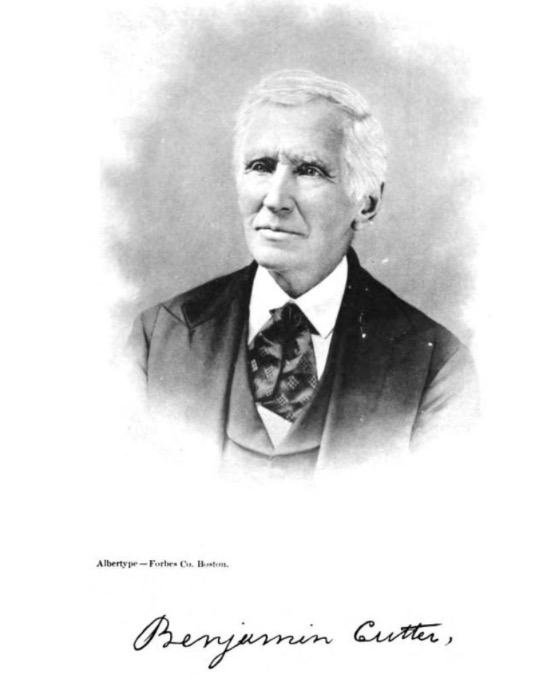
On 18 April, 1850, just a few days before her twentieth birthday, Caroline married Julius Cutter of Jaffrey, New Hampshire. They had likely known each other since childhood. Julius was born on November 28, 1824, to farmer Benjamin Cutter and Grata Cutter (nee Hunt). In the History of the Town of Jaffrey, New Hampshire, published in 1881, the author, William B. Cutter, thanks “Benjamin Cutter, Esq., a venerable citizen, now over 88 years of age, who has furnished much that is valuable from actual knowledge, being born and having always lived in town.”
Caroline’s father-in-law, Benjamin Cutter.
The text notes that “Benjamin Cutter has pursued the manufacture of leather in Jaffrey: first, in the original establishment erected by his father, and afterward, the building now occupied by his son Julius for the same purpose. He has been a prominent leading man in town affairs; for many years town-clerk, justice of the piece, and is now (1880) president of Manadnock National Bank, East Jaffrey. For several years he has been engaged in antiquarian research, and has a more extensive knowledge of the history of his native town than any other man living.”
One of Benjamin’s children, and Julius’s elder sister, was Sarah Augusta Cutter, who became wife of Dr. William Johnson Campbell, died at age 26, and of whom, it was noted, “[She] left manuscripts, poetically written, that have never been published. She possessed a ‘philosophic mind, and though she wrote poetry it was with a philosophic expression.'”
Another sister, Adaliza (1823-1852), married medical man Dr. Gurley A. Phelps. She also wrote poetry, but her work saw post-mortem publication in a 300-page volume compiled by her friends. Her husband said of her that “[S]he burst forth in a poet’s song—a simple expression of what she lived, she felt,” and who wrote “…not to be admired, but to be loved.” With both sisters dabbling in poetry, one wonders whether Caroline composed verses, too.
Julius and Caroline had two daughters: Emma Maria Cutter Mitchell (b. 7 June, 1853) and Alice E. Cutter (b. 1857).
At the time of Julius’s marriage to Caroline, he headed a leather tannery; by the following December, the Fitchburg Sentinel reported he had a boiler (presumably for the tannery) made by a Fitchburg fabricator. He was later was assessed for taxes in 1862 as a maker of buggy harnesses. At some point soon thereafter, Julius became a farmer who was iterated on the 1880 Census living with Caroline, his father, his eldest daughter, and his niece.
Main Street, Jaffrey, New Hampshire, circa 1905.The town was settled in 1758, incorporated in 1773 by Governor John Wentworth, and named for George Jaffrey, a member of a wealthy Portsmouth family. The Meetinghouse (below) was built in 1775.(Colorized postcard, “View from Cutter’s Hotel, Jaffrey, N.H.,” circa 1905.)
Julius died of pneumonia on 2 May, 1890, with his brother-in-law Dr. Gurley signing the death certificate. The executor of his Will was his daughter Emma, who attested she was “received of the estate of Julius Cutter one dollar and other valuable considerations, being my share in full of his estate,” and his wife Caroline, who attested to the same.
Widowed, Caroline lived for some time in Cambridge, Middlesex County, Massachusetts, with her younger daughter until Alice’s death in 1916. Caroline passed away 18 January, 1921, aged 90, in Cambridge. Her daughter Emma died of “senile dementia” and arteriosclerosis at an institution called Beverly Heights in Wilton, New Hampshire, on 3 October, 1937, at age 84.
Caroline’s simple obituary in the 19 January, 1921 edition of the Boston Globe.“CUTTER—In Cambridge, Jan. 18 at the home of her daughter Mrs. John Mitchell, Caroline H. Cutter, widow of Julius Cutter Esq. of Jaffrey, N.H., in her 91st year. Funeral in Jaffrey, Thursday, Jan. 20.
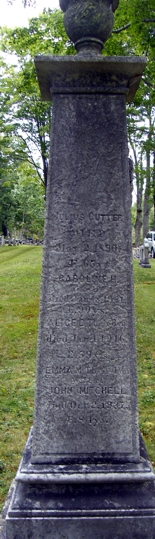
Caroline and her daughters were laid to rest in Cutter’s Cemetery, Jaffrey. An article about this place was written by Robert Stephanson in 2011 and published on JaffreyHistory.org. In it, Stephanson writes that the burying ground “…lies at the edge of the Jaffrey Center village on Harkness Road quite close to Route 124. In days past this section of Jaffrey could just as well be named ‘Cutterville’ because of the preponderance of Cutters, Cutter homesteads and Cutter businesses within earshot…. The cemetery was laid out …in 1836 in accordance with the wishes of John Cutter… [1765-1835] who lived beside the site chosen. His house, the largest in the village, still stands. At the start and for nearly a century the cemetery was for the Cutter family alone.”
Unfortunately, I have not been able to fill out Caroline’s life more fully. If more information is found, I will update this post.
Julius and Caroline Cutter’s tombstone in Cutter Cemetery, Jeffrey, New Hampshire.
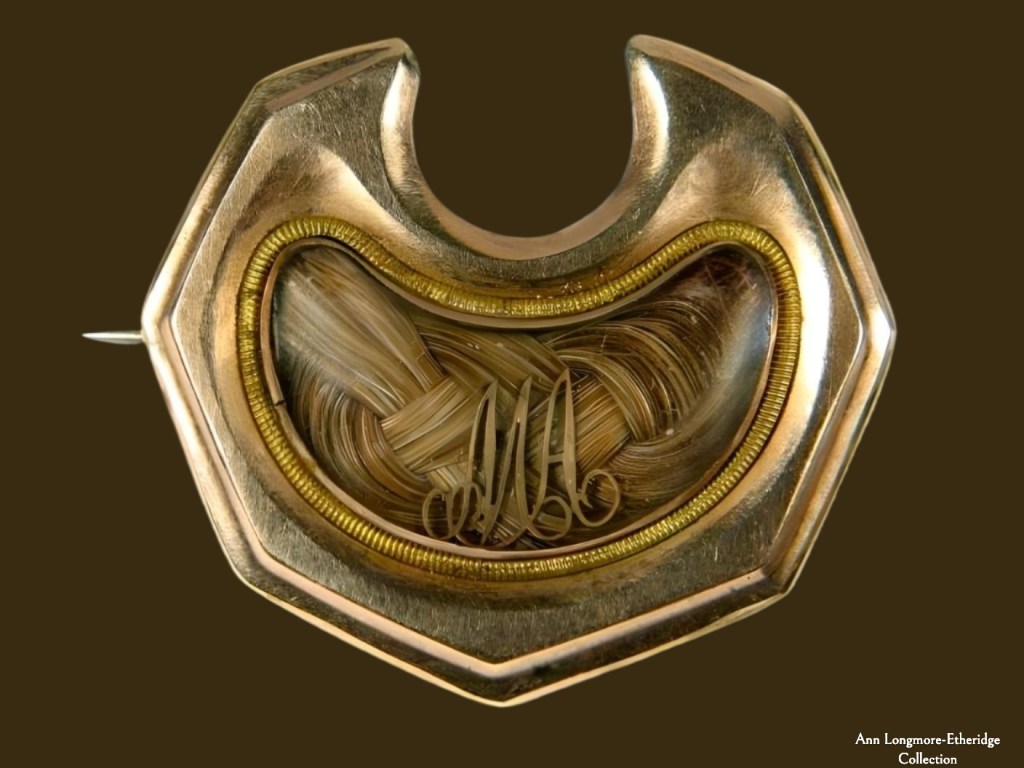
“The Monthly Magazine or the British Register, Part one for 1809,” references the 14 December, 1808, death commemorated by this brooch: “At Stodday Lodge, near Lancashire, Mrs. Arthington, relict of Thomas A. esq. of Leeds, 52.”
The Arthingtons were Quakers, and Mary’s interment at the Friends Burying Ground “at the Moor Side near Lancaster” was arranged by the Friends. A request exists from one George Barrow to Robert Dean, “Grave-Maker,” sent two days after Mary’s death, ordering Dean to “make a Grave on or before next Third Day…and therein lay the Body of Mary Arthington of Lancaster…aged about 51 years.”
According to Quarkeriana, Vol. I, April 1894, Moorside, also known as Golgotha, was “about a mile from Lancaster…in which there have been over 100 interments…. Tradition says that formerly there were many stones removed by the desire of the Yearly Meetings Committee that once visited the meeting. One, a large, heavy stone chest, still remains, which is said to have been too large to move.” If Mary Arthington had a gravestone at the burying ground, sadly, it is long gone.
Below this entry, Robert Dean attests, “The Body above mentioned was buried twentieth day of Twelfth Month, 1808.”
The reverse of the brooch, engraved with, “Mary Arthington, died at Stodday Lodge dec 14th, 1808”. Ann Longmore-Etheridge Collection
Mary was born 28 May, 1757, the daughter of Robert and Jane Lawson, who were deceased by the date of Mary’s second union. When she married Thomas Arthington, a “common brewer,” in York on 14 July, 1785, she was known as Mary Whalley, the widow of Joseph, “late of Lancaster in the county of Lancaster, merchant.”
Mary married Joseph Whalley on 9 May, 1781, at the Quaker meeting house in Yealand Conyers, Lancashire. He was the son of Joshua Whalley, who was present at the marriage, and Bridget, his wife, who was already dead. Both Robert and Jane Lawson were also present, placing their own deaths (and Joshua Whalley’s) between June 1781 and June 1785.
A Quaker wedding, circa 1790.
Thomas Arthington was the son of Robert and Phoebe Arthington, born at Armley, Leeds Parish, Yorkshire, 5 December, 1743. His father had also been a common brewer, and like Mary, both Thomas’s parents were dead by 1785.
The Quaker document, while formulaic, is still so detailed that the wedding of the 28-year-old Mary and 42-year-old Thomas can almost be envisioned: “The said Thomas Arthington and Mary Whalley appeared in publick assembly [at the] Meeting House at Wray in the said county of Lancaster. And the said Thomas Arthington, taking the said Mary Whalley by the hand, did openly and solemnly declare as followeth, “Friends, in the fear of the Lord and before this assembly, I take this my friend, Mary Whalley, to be my wife, promising through divine assistance to be unto her a loving and faithfull husband, until it shall please the Lorde to separate us by death.” Mary then repeated the same to Thomas, whilst holding his hand.
The house where Mary Arthington died, Stodday Lodge, is a secluded dwelling set in wooded gardens near the old village of Stodday, four miles south of the city of Lancaster. Today, Stodday Lodge is a Grade II listed building known as Lunecliffe Hall. British Listed Buildings describes it as a “small country house, now house and office. Late C18 and early C19, with later additions. Sandstone ashlar, with ashlar dressings. Slate roof…entrance hall has Venetian-style panelled and glazed screens to rear and left, with fluted pilasters, moulded architraves with fluted keystones, and 2-light stained glass windows.” (The entire report on the house is here: www.britishlistedbuildings.co.uk/en-383029-lunecliffe-hal… )






 "Your Dying Charlotte"