“Curvature of the Spine Since Birth”

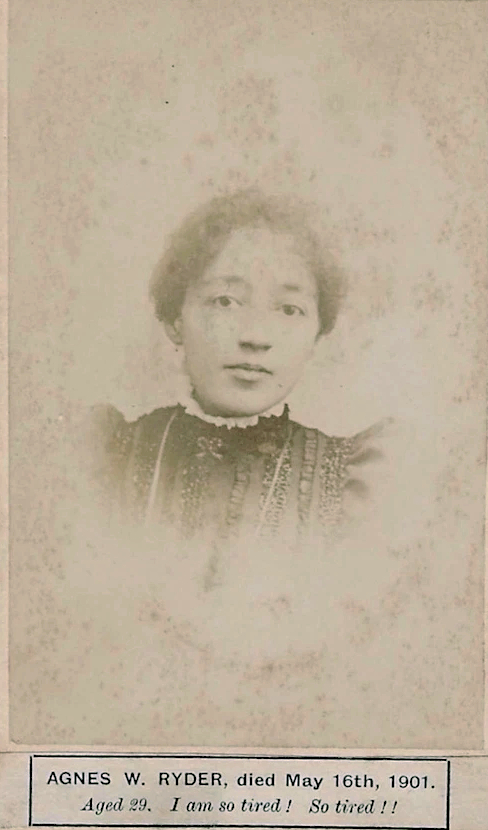
Carte de visite from the Ann Longmore-Etheridge Collection.

Agnes Warner Rider, pictured above, died on 16 May, 1901, at the age of 29. Presumably, her final words, as printed on this albumen carte de visite, were “I’m so tired. So tired!”

Agnes was born 18 January, 1872, in Southwark, London, to Charles Ryder (1846-1907), a printshop manager, and his wife Hannah Bramley (1847-1919), who both hailed from Loughborough, Leicestershire. Agnes, along with her other siblings, was baptised on 19 January, 1874, at Saint George the Martyr, Queen Square, Camden. At that time, her family lived at 10 Dunford Road, Holloway, London, in a small terraced home that still stands today.

The 1891 Census reveals that Agnes was the eldest surviving child in a family that included siblings Archie Hammond, Dudley Charles, Gertrude, Isabel, Henry Granville, Grace Hannah, and John Basil. Baptismal records indicate there was also a sister called Martha, born in 1878, one named Elizabeth Helen, born in 1868, and another called Marguerite, born in 1870. These three girls do not appear to have outlived childhood.

When the 1901 Census was taken, Agnes had but little time to live. She is listed as the eldest of a group of six children still in the home, along with Archie, Dudley, Henry, Grace, and John. One worked as a milliner, one as a dressmaker, and one as a merchant’s assistant. Archie had already married and become a young widower.

This census also reveals this clue as to why pretty, brown-eyed Agnes had not married or held a job: “Curvature of the spine since birth” was scribbled at the far right of the enumeration page.

In the Victorian era, spinal curvatures, like scoliosis and kyphosis, were prevalent. There were misconceptions about the causes of scoliosis, sometimes linking it to moral failings or perceived societal problems rather than solely medical conditions. Victorian attitudes toward spinal deformities reflected the broader societal views on disability, ranging from pity and fear to marginalization. Those with such conditions might be seen as “others” and face challenges in social and economic participation.

Illustrations from a 1916 publication on treatments for scoliosis. Wikimedia Commons.

Treatment options for spinal curvature were varied and often experimental. Doctors utilized braces and modified corsets for correction. Traction and immobilization techniques were employed to reduce the curve, sometimes with limited success and potential complications, like paralysis.

In the mid-19th century, surgeons began exploring surgical options like percutaneous myotomies (muscle and tendon cutting) and later, spinal fusions to address deformities. However, these procedures carried significant risks, including infections and recurrence. Some practitioners advocated for gymnastic exercises to strengthen back muscles and treat deformities, believing it was more effective than solely relying on braces.

While spine curvature was not often fatal, it depends on severity and type. In severe cases, it can lead to respiratory complications, cardiovascular issues, nerve damage, reduced mobility, and significant pain. Some or all of these could lend weight to Agnes’s departing words, “I’m so tired….”

Agnes Warner Ryder was buried on 22 May, 1901, at Highgate Cemetery, Camden. Her grave, Square 19, Grave 33932, remains unmarked.

Ω
A Close Brush With Fame

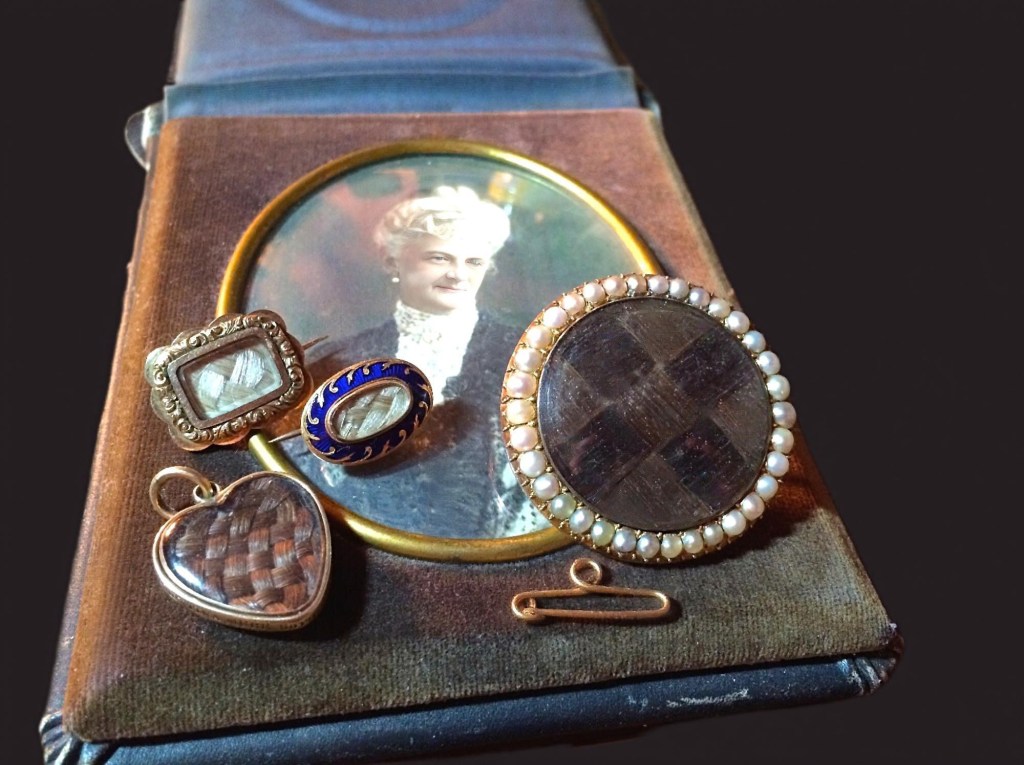
These are four brooches from my collection, each with a “fame adjacent” history. The large one at right holds the hair of wealthy City of London merchant Jonathan Wilson and Ursula Pinckback Wilson, his wife. The small brooch on the left commemorates Sophia Vansittart, sister of Nicholas Vansittart, Baron Bexley, Chancellor of the Exchequer for King George IV.

Sophia Vansittart

The small blue enamel brooch holds the hair of Englishman Joshua Brooks, who dined at Mt. Vernon with George and Martha Washington, and the fourth, heart-shaped, is Scottish and holds the hair of Helen Clementina Duff Muir. Her sister was Lord Byron’s childhood sweetheart, Mary Duff Coe.

Ω

Somber and Sensible Adornments

Gutta-percha hand and wreath mourning brooch, Circa 1870-1880.

Gutta-percha is a natural latex material derived from the sap of Palaquium trees. It has a rubber-like consistency but is tougher and more durable than typical latex. It was first introduced to Europe in the 1840s after the British surgeon William Montgomerie brought samples of it from Southeast Asia, where it was used by indigenous people for making handles and waterproof containers, for instance. The material quickly gained popularity in the West for its unique combination of toughness, flexibility, and water resistance. Early uses included medical instruments, walking stick handles, and insulating underwater telegraph cables.

Gutta-percha found a prominent place in jewelry, particularly mourning jewelry. The Victorian fascination with mourning—especially after the death of Great Britain’s Prince Albert in 1861—created a demand for somber yet elegant adornments. It was molded into brooches, lockets, and bracelets, often featuring intricate floral or Gothic-inspired designs. Gutta-percha’s dark, matte finish made it an ideal material for mourning jewelry, as it symbolized grief and modesty whilst being affordable compared to traditional materials like jet. Such pieces could also be purchased, premade and reasonably priced, at local mercantiles—unlike gold jewelry containing a lock of the deceased’s hair, which took time to produce by a jeweler. The gutta-percha pieces, therefore, were available for wear at funerals held a few days after death. The lightweight nature of gutta-percha and its ability to be carved into fine detail further solidified its status as a popular choice for commemorative and mourning pieces.

The following are examples from my collection of this type of mourning adornment.

Gutta-percha mourning locket with interior compartment for hair or a photo, circa 1875-1880.

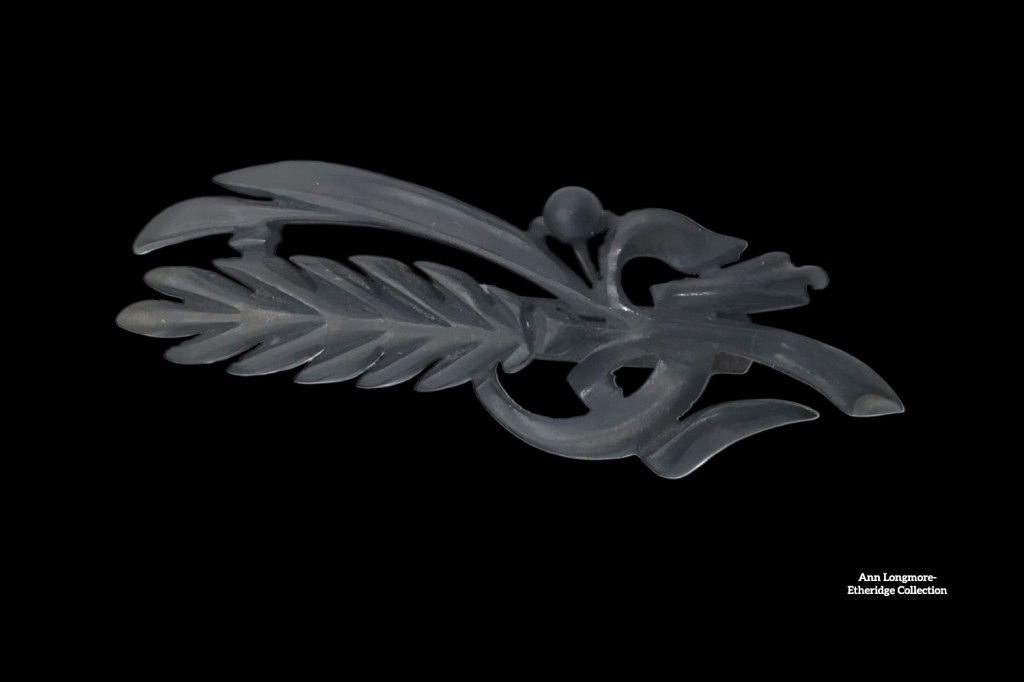
Gutta-percha scythe and wheatsheaf brooch, circa 1875.

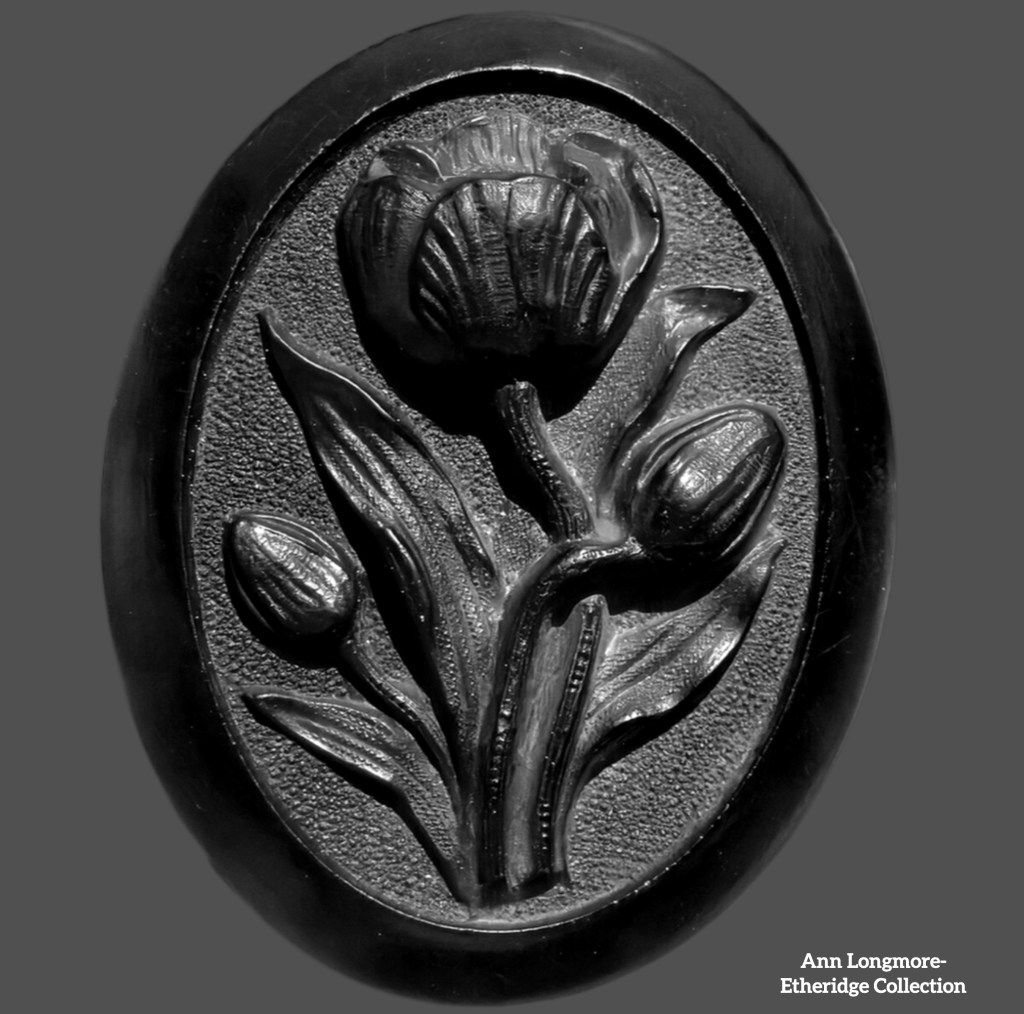
Gutta-percha tulip mourning brooch, circa 1885.

Cherub with a swag of flowers mourning brooch, 1865.

Large gutta-percha floral cross pendant, circa 1875.

Dutch gutta-percha equine brooch, circa 1885.

Irish gutta-percha mourning brooch, Circa 1880.

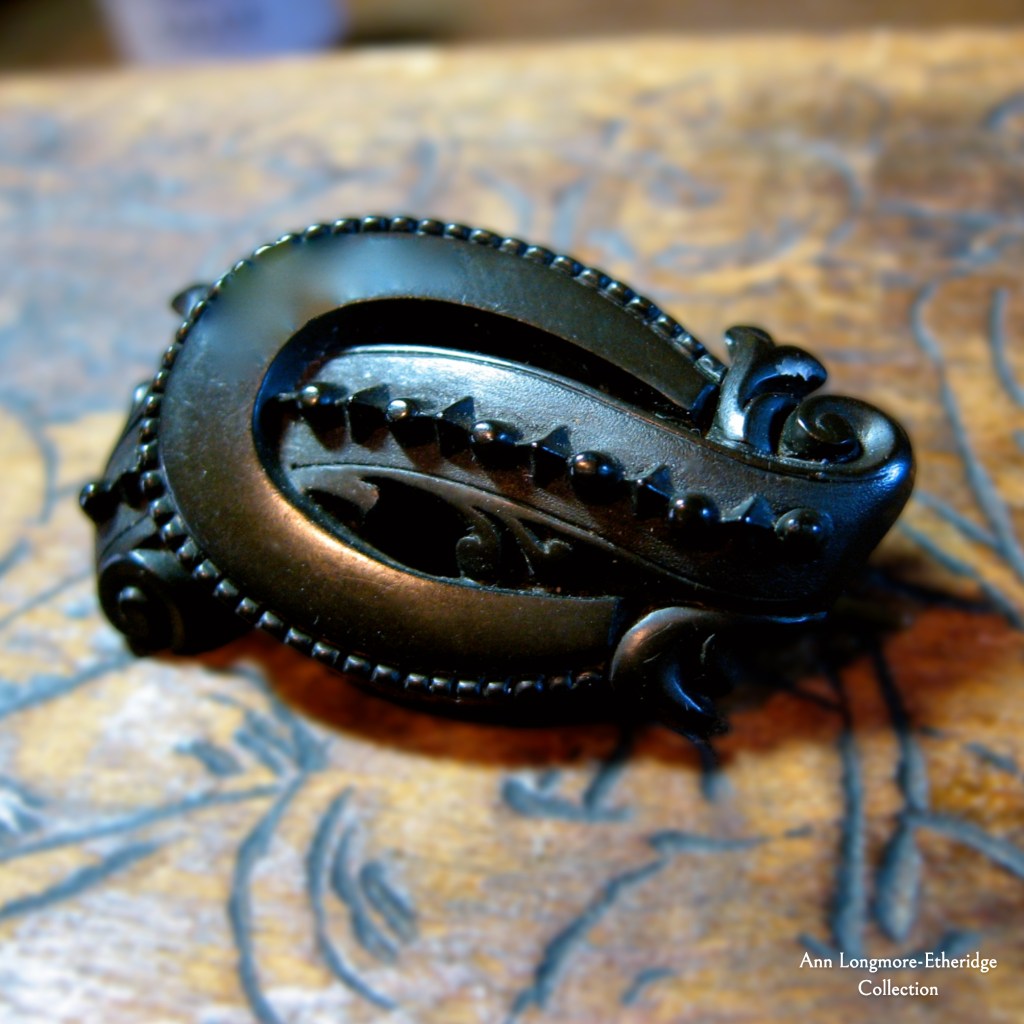
Horseshoe gutta-percha mourning brooch, circa 1870

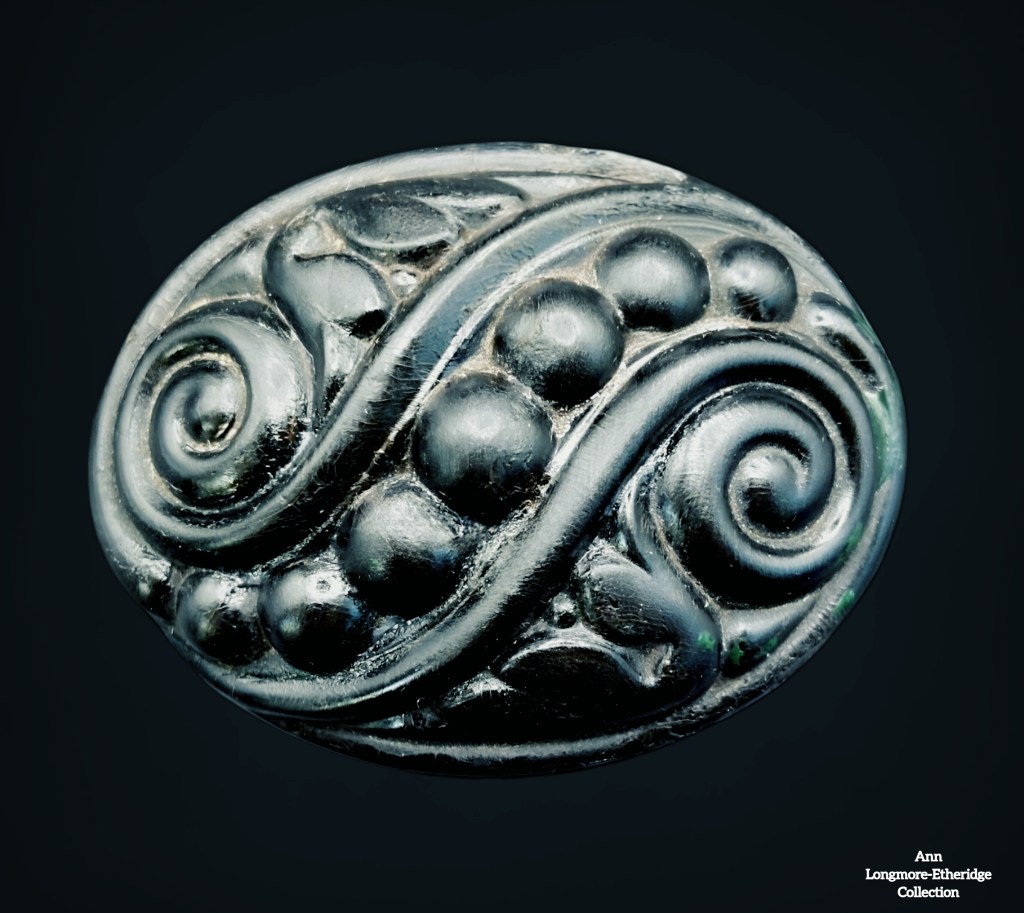
Swirling vines and dots gutta-percha mourning brooch, late 1800s.

Gutta-percha widowed bird mourning brooch, circa 1875.

Gutta-percha Isle of Man morning brooch, circa 1890.

Gutta-percha missing acorn brooch, 1860s.

Gutta-percha mourning brooch, 1870s.

Gutta-percha cameo brooch, 1860s-70s.

Ω

Our Darlings Rest Amongst the Flowers that Bloometh Over There

Mourning images from my collection.

14155000700_c0eeba020f_o
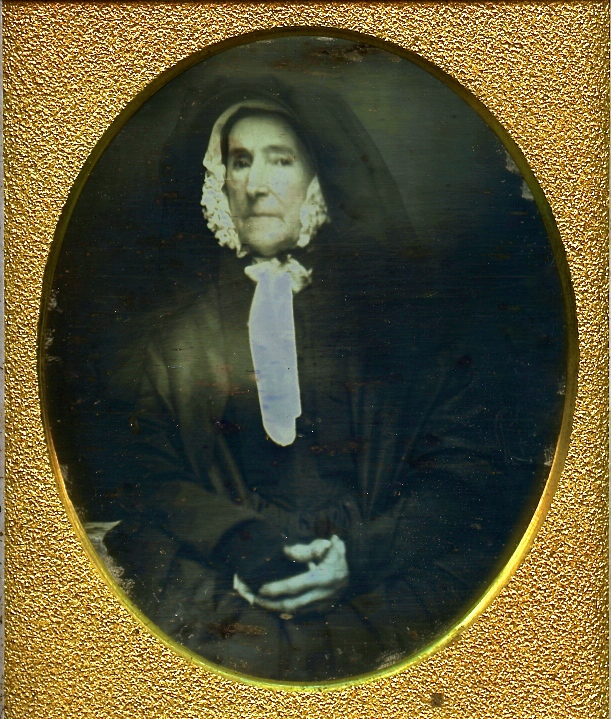
In this early 1/4th-plate daguerreotype, taken about 1845, a sad, proud widow peers at us through what seems to be a hole in time.

20040418006_495a4057a7_o
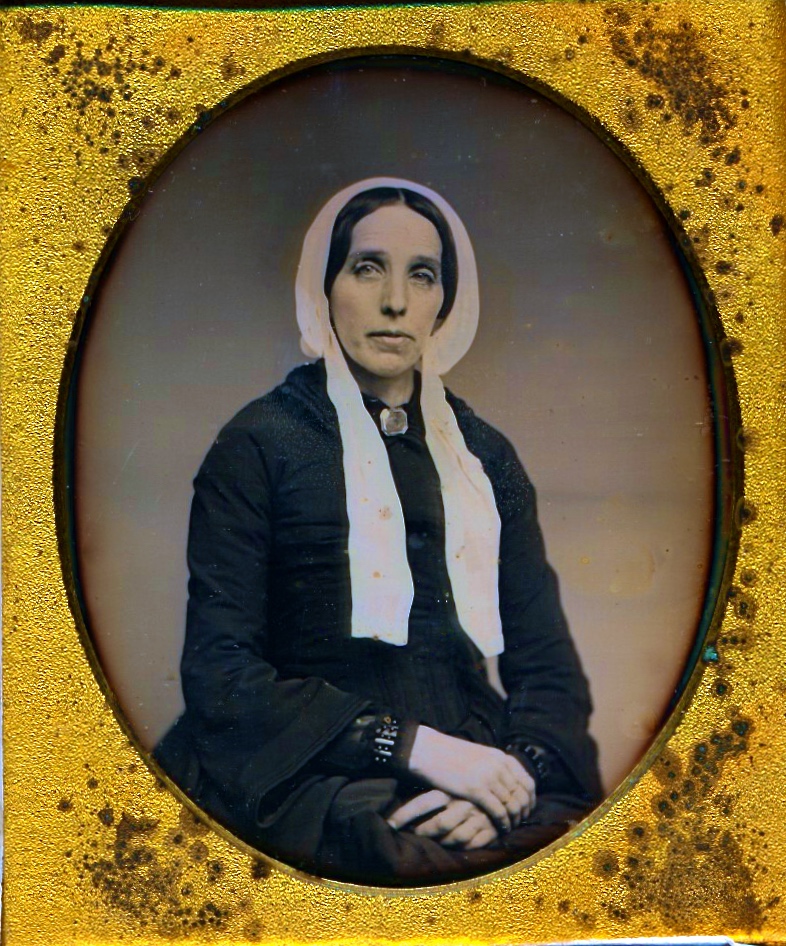
The sitter wears a white widow’s cap, a hair mourning brooch, and jet bracelets. The back of the plate is inscribed with the numbers “48-36-42,” the meaning of which is unknown. This 1/6th-plate daguerreotype dates to circa 1855.

8720607261_1a0a893a02_b
This hand-tinted 1/9th-plate Ambrotype was created in about 1858. The beautiful woman so stunningly colored by the photographer is almost certainly not a widow like the two ladies above. Widows, even in deepest mourning, wore white crape caps, bonnet ruches, or other touches of white, to indicate their status.

Continue reading “Our Darlings Rest Amongst the Flowers that Bloometh Over There”

Preternaturally Lovely: Britain’s Queen Alexandra of Denmark

4908949356_80b166bd20_o.jpg
Albumen carte de visite (CDV) of future Queen Alexandra when Princess of Wales, taken at Sandringham in 1863. This image was marketed by the London Stereoscopic & Photographic Company, 54 Cheapside and 110 Regent Street. There is also a sticker on CDV’s reverse: “Juvenile Book Depot and Passport Agency, C. Goodman, bookseller and stationer, 407 Strand.” Ann Longmore-Etheridge Collection.

33715445136_0a713ae6a6_o
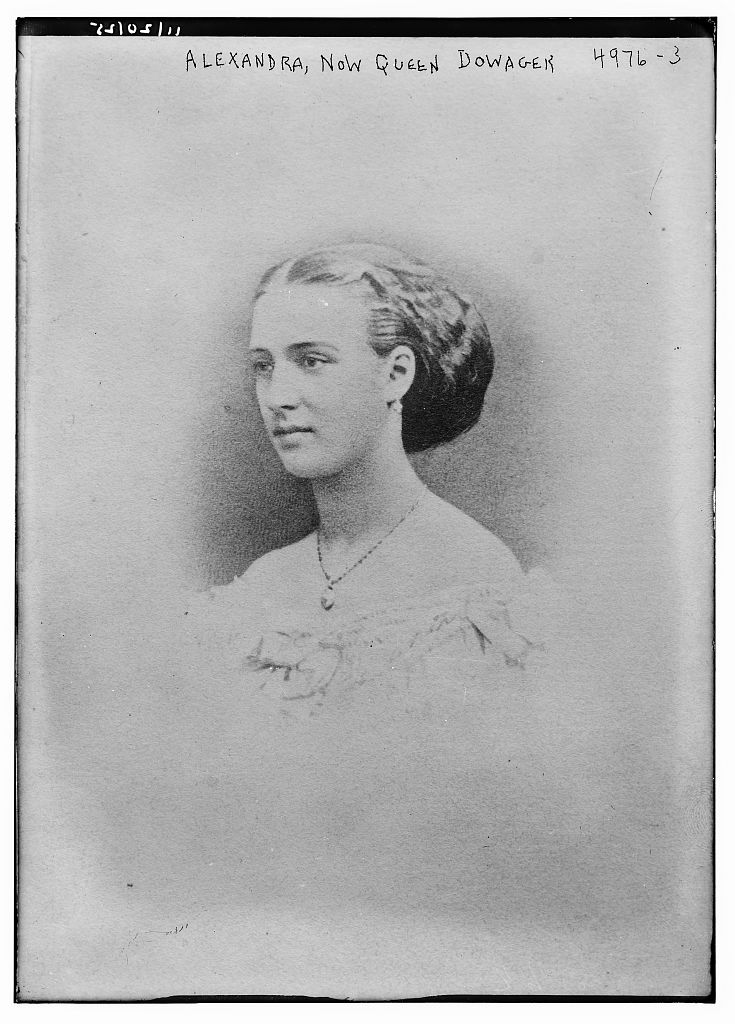
Princess Alexandra Caroline Marie Charlotte Louise Julia of Denmark as a young woman, circa 1860. She was born 1 December, 1844, in the Yellow Palace in Copenhagen, the daughter of Prince Christian of Schleswig-Holstein-Sonderburg-Glücksburg (later King Christian IX of Denmark) and Princess Louise of Hesse-Kassel. Her upbringing was not extravagant and she remained close to her parents and siblings, even after marrying Albert Edward, Prince of Wales, eldest son of Queen Victoria and Prince Albert, and taking up her new life in Great Britain. Library of Congress.

174206-1306235169
September 1862: A group photograph to mark the engagement between the Prince of Wales and Princess Alexandra. Included are members of the Princess’s family including Prince Christian of Denmark, later King Christian IX; Princess Louise, later Queen of Denmark; Leopold, Duke of Brabant; Marie Henriette, Duchess of Brabant; and Princess Dagmar of Denmark. According to an 1879 issue of the magazine Harpers Bazaar, “A younger generation are fond of recalling the April morning when the young Princess of Wales reached England. The boat touched the shore, and the multitude crowding the quay saw a mere slip of a girl nervously clinging to the railing on the deck, and looking with a pale, pretty face at the new country, her dress plain almost to shabbiness, and her bonnet of so old-fashioned a make that a London milliner was hurriedly telegraphed to for a more lilting head-gear for the future queen’s entry into London. A wave of applause and cheers went up as the Prince of Wales embraced his betrothed and conducted her to the shores of her new home. The same day she was driven through London in great state, and a lady near enough socially to be good authority has told us of her pretty, girlish timidity when the crowd stared at her, with cheers and wild demonstrations of delight.” Courtesy Royal Collection.

Continue reading “Preternaturally Lovely: Britain’s Queen Alexandra of Denmark”

The First Photographed Frostie

Last week, a storm brought 10 inches of snow to Western Maryland and turned my mind to snowmen of old.

DXIlkTUW0AA4wV8
A woman builds a snowman whilst a man shovels snow. Courtesy National Museum of Wales.

In all probabilty, humans have sculpted snowmen for millenia. In 2007, Bob Eckstein, the author of The History of the Snowman: From the Ice Age to the Flea Market, told NPR that in writing his book, “I wanted to make it clear that snowman-making actually was a form of folk art. Man was making folk art like this for ages, and…maybe it’s one of man’s oldest forms of art…. [T]he further back you go, you find that people were really fascinated with snowmen.”

Eckstein says that building snowmen was “a very popular activity in the Middle Ages…after a snow came down and dumped all these free-art supplies in front of everyone’s house.” The earliest known representation of a snowman dates to that era, drawn in a 1380 A.D. Book of Hours. A century later, in 1494, Michelangelo was commissioned by Piero di Lorenzo de’ Medici, the Gran Maestro of Florence, to practice his art with snow. According to art historian Giorgio Vasari, “de’ Medici had him make in his courtyard a statue of snow, which was very beautiful.” Sadly, no one drew it for posterity.

In 1510, a Florentine apothecary, Lucas Landucci confided in his diary that he had seen “a number of the most beautiful snow-lions, as well as many nude figures…made also by good masters.” Another notable snowmen outbreak occurred just a year later, when folk in Brussels built more than 100 of them “in a public art installation known as the Miracle of 1511,” notes Atlas Obscura. “Their snowmen embodied a dissatisfaction with the political climate, not to mention the six weeks of below-freezing weather. The Belgians rendered their anxieties into tangible, life-like models: a defecating demon, a humiliated king, and womenfolk getting buggered six ways to Sunday. Besides your typical sexually graphic and politically riled caricatures, the Belgian snowmen, Eckstein discovered, were often parodies of folklore figures, such as mermaids, unicorns, and village idiots.”

Continue reading “The First Photographed Frostie”

Funeral Fragments

“When old Francis died in 1913, Dad sent him off in a hearse pulled by four black horses followed by mutes carrying ostrich feather wands and a procession of friends and family in the deepest mourning possible.”—Barbara Nadel

6297270408_005fc6f399_b
An invitation to the funeral of Ruth Evelyn Cooper, who died of pneumonia in the aftermath of influenza. She was one of upwards of 50 million people whose deaths were associated with the 1918 influenza pandemic. Ruth was born 21 June, 1898; she was the daughter of mail carrier George F. and Clara Good Cooper of Murrell, Ephrata Township, Lancaster County, Pennsylvania.

9587428394_61b9ea0e3c_k
This glass slide captures one moment in the lengthy funeral proceedings of Queen Victoria, as her coffin wended its way through London, 2 February, 1901. The slide is unmarked save for the handwritten inscription, “The Queen’s Coffin.” It does not appear to be part of a commercial set and may be a personal remembrance of the day taken by someone in the crowd. (Note the two boys looking down on the passing procession from the high wall on the right.)

14260852403_752914a036_h
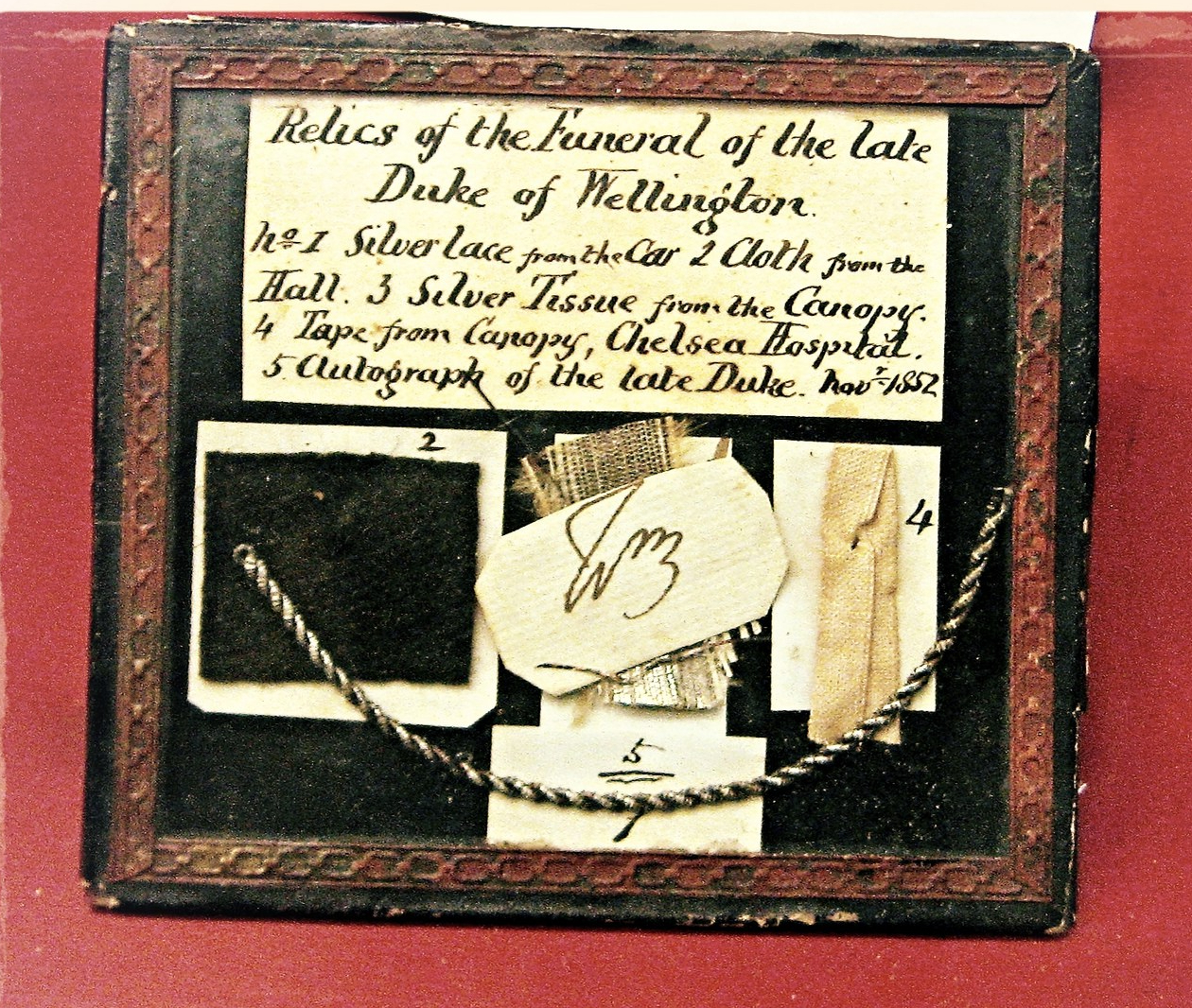
This photo shows ephemera from the funeral of Arthur Wellesley, 1st Duke of Wellington (1 May 1769–14 Sept., 1852). It resides in the museum of Carisbrooke Castle, Isle of Wight, England. The duke was beloved for leading the defeat of Napoleon’s forces at Waterloo, 18 June, 1818. He went on to become a prime minister and is still considered to be one of Great Britain’s chiefest politicians. The handwritten note reads: “Relics of the Funeral of the late Duke of Wellington. No.1 Silver lace from the car. 2. Cloth from the Hall. 3. Silver Tissue from the Canopy. 4. Tape from the Canopy, Chelsea Hospital. 5. Autograph of the late Duke, Nov. 1852.”

Continue reading “Funeral Fragments”

Comet Brooches: A Legacy of the 19th Century’s Sidereal Wanderers

“This great comet has fled from the gaze of man, and thirty generations of astronomers will pass away before it will submit itself to human scrutiny.” —H.A. Howe

6929420575_a846084621_b
Halley’s Comet brooch, 1835. Ann Longmore-Etheridge Collection.

This piece from my collection is an antique English, 9-carat gold comet mourning pin. It is beautifully made, with a hand-chased stylized tail, black enamel embellishment, and a glittering foiled paste stone in silver settings, clearly displaying a black spot to simulate the open culet of a diamond.

The unusual shape of the brooch commemorates the return of Halley’s Comet in 1835. Although this piece neither contains a loved one’s hair nor bears an inscription, the use of black enamel almost certainly associates it with loss during the comet pass year.

Halley’s Comet is named after English astronomer Edmond Halley, who studied previous sightings and correctly predicted its 1758 apparition. The comet returns every 75 years, with its last apparition in 1986 and its next to come in 2061. I will be 98, if I live to see it.

The first report of the comet is from its pass above China in 467 B.C. (Centuries later, during another apparition, the Chinese would call it by the beautifully evocative name, “Broom Star.”) The British Museum, London, holds other documentation in the form of cuneiform tablets describing the comet’s appearance over Babylonia in late September, 164 B.C.

Continue reading “Comet Brooches: A Legacy of the 19th Century’s Sidereal Wanderers”

Remembering the Christmas Truce of 1914

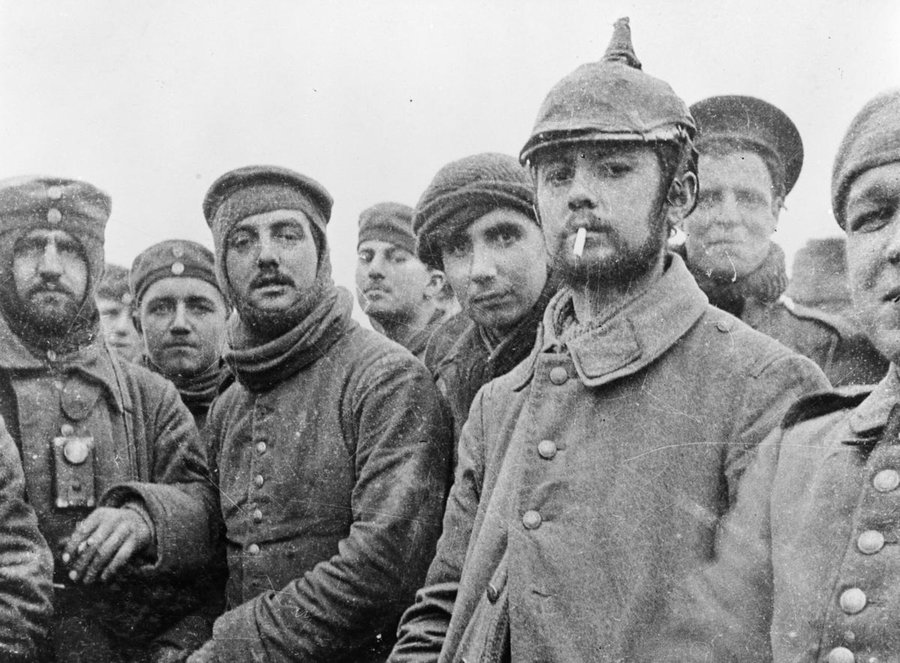
During World War I, soldiers on both sides ceased dealing death for one joyous Christmas Day.

ww1-xmas-1_custom-38641966b11e147a12de9127e356b676a7f80272-s900-c85
Camaraderie outside the trenches, Christmas Day 1914. A beautifully colorized version of this photo can be found here.

It came and then was gone, but for a while, death held no dominion on the battlefields of France. Soldiers on both sides were entrenched, following killing orders from generals and cousin kings. “You no shoot, we no shoot,” the signs Germans troops held up supposedly read. So, the British did not shoot. Instead, they all met in the middle—a muddy No Man’s Land. They decorated tiny Yule trees and exchanged cigarettes, cigars, tinned foods, and even helmets. They buried their dead; they sang carols and played football, too.

According to historian Gerard DeGroot, a professor at the Unversity of St. Andrews, “The truce was, first and foremost, an act of rebellion against authority. In the trenches, though peace on earth seemed a ridiculous fantasy, impromptu ceasefires had been occurring as early as December 18. The British High Command, alarmed that the holiday might inspire goodwill, issued a stern order against fraternization. Officers were warned that yuletide benevolence might ‘destroy the offensive spirit in all ranks’. Christmas, in other words, was to be a killing time.

“The Germans, however, were stubbornly festive. In an effort to bolster morale, truckloads of Christmas trees were sent to the Kaiser’s forces. All along the line, Germans were acting in a bizarrely peaceful fashion. Guns fell silent. Candles and lanterns taunted British snipers. Late on Christmas Eve, Germans singing ‘Stille Nacht’ [‘Silent Night’] echoed across no man’s land. The British, initially perplexed, soon joined in.”

Continue reading “Remembering the Christmas Truce of 1914”

This is His Orphan: What it Shows and What it Doesn’t

daga1IMG
Widow and Orphan, Albumen Carte de Visite, Circa 1868. Ann Longmore-Etheridge Collection.

This English carte de visite (CDV) is one of the most popular in my collection, if Flickr views and Pinterest re-pins equate to evidence, that is. It shows a young British widow—identifiable as such by the white ruching on her black bonnet—squatting in the background, having just propelled her black-clad daughter toward the photographer. The widow stares forward forlornly, her hand over her mouth, indicating without words her shock and concern for their future. It is a candid, painfully honest pose, and one rarely seen in types of images. She is no “Hidden Mother,” but a vital element of a tableau meant to convey the message, “This is his orphan.”

The reverse stamp on the CDV reads “T. Bennett, Photographer, 46 Foregate Street and Church Street, Malvern.” According to research conducted by the creator of Photographers of Great Britain and Ireland, 1840-1940, Thomas Bennett “opened his first studio in Worcester in 1856. At different times, he operated at five studios in Worcester and three in Malvern under his own name and the business continued under the name of Bennett & Son and Bennett & Sons until at least 1916.”

“The 1861 census records the [Bennett] family living at his shop at 46 Foregate, Worcester, where he is described as a Lay Clerk (of the church) and photographer. His firm Thomas Bennett and Son is thought to have been established about 1856. His branch in Great Malvern was possibly the second photographic studio” in that town—this information gleaned from the Malvern Records Office. Bennett threw open the doors of his Malvern studio in 1868 and the CDV of mother and daughter could not have been taken long afterward.

Continue reading “This is His Orphan: What it Shows and What it Doesn’t”