
This gorgeous and all-but-pristine daguerreotype portrays Charles Wilber Pressey, most likely at the age of 21. Handsome, jaunty, and possessed of a fetching chapeau, the image may have been taken to reflect Pressey’s official coming of age. He was born in 7 June, 1835, in Sandown, New Hampshire. If my supposition is correct, this image can be dated to the summer of 1856.
The Presseys were New Hampshire natives, having descended from the immigrant John Pressey who arrived in Hampton, New Hampshire, in about 1650. Charles Pressey’s birthplace is in the southeast of Rockingham County, named for Sandown on England’s Isle of Wight. Today’s population is about 6,000. It was smaller in Pressey’s time, although the tranquility and introspection was most likely the same.
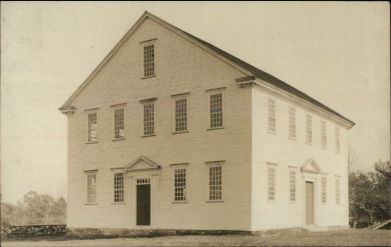
The most prominent structure in Sandown was the Meeting House, built by the first minister of Sandown, the Reverend Josiah Cotton, in 1774, and was a focal point for both civic and religious activities. Today, this simple, sturdy building is preserved on the National Register of Historic Places.
“While the town as a whole has been largely ignored by the outside world, its meetinghouse has gained a marked degree of notoriety. Sandown is credited by many with possessing the finest meetinghouse in New Hampshire—and there are those who would go so far as to say the finest in America,” wrote Richard Holmes in A View from Meeting House Hill. “The praise of outsiders, while always appreciated, is not the chief reason that the townspeople honor this building. To the residents of Sandown, this old building is the encapsulation of their town’s entire history, for within its walls has passed the pageant of the community’s past. For 155 years, the good men and women of Sandown gathered at this building to set their own taxes and to draft their own laws. This building was, to a great extent, the capitol of a small, semi-autonomous republic operating inside New Hampshire.”
Little is known of Charles Pressey’s father, Henry Moulton Pressey, save the barest bones. He was born 7 August, 1806, in Sandown, to Peter Pressey and Bettey Moulton. Peter Pressey died insolvent in October 1823, with debts to a long list of local citizens. Settling the estate included the sale of $280 in real estate to satistfy Peter’s creditors.
On 25 November, 1830, in Freemont, Rockingham County, Henry Pressey married Mary Ingalls (1805-1858), called “Polly.” Their first child was Mary Eliza, born in about 1833 with Charles Wilber following two years after. Another son, Albert A., was born in 1844.
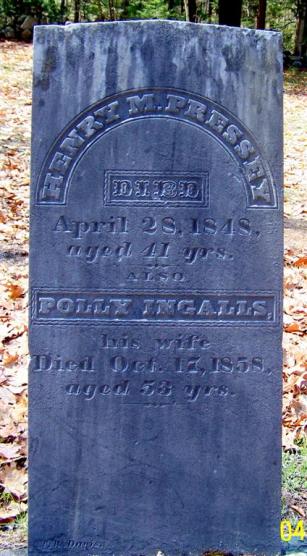
Henry Pressey died 28 April, 1848, at the age of 41, likely of Tuberculosis (TB). Two years later, when the 1850 Census was enumerated, Charles and Albert, along with their mother, dwelt with maternal grandparents Samuel and Betsy Ingalls—both born in 1775 in New Hampshire—on a farm in Sandown. The location in 1850 of Charles’s sister Mary is not known, but neither she nor his mother Polly lived out the decade. Their lives were eaten away by TB, known then as the “White Death” and “Consumption.” Mary died 11 October, 1855, and Polly passed away 17 October, 1858. Sandwiched between those two deaths was 7 June, 1856—Charles’s 21st birthday. It is possible that the daguerreotype in my collection marks this attainment and may have been made as a gift for Polly.
To sit for his picture, Charles likely traveled to Exeter, where John Plumbe, Jr., set up a studio and school in the early 1840s. Barbara Rimkunas wrote in the “Historically Speaking” column of the Exeter News-Letter of 17 September, 2013, “In 1841, advertisements for ‘Mr. Plumbe, Professor of Photography’ began running in the Exeter News-Letter. Mr. Plumbe ‘proposes to instruct a limited number of Ladies and gentlemen in this beautiful and valuable art, who will be furnished with complete sets of the improved patent apparatus, by means of which any one may be enabled to take a likeness in an ordinary room without requiring any peculiar adjustment of the light.’ The technology must have seemed near-miraculous to many people, since Mr. Plumbe had to explain that ‘the process is simple; it requires no acquaintance with chemistry and no knowledge of drawing or painting, for the light engraves itself upon the prepared plate.’…. Exeter’s early photographers—Thomas Boutelle, George Sawyer, the Davis Brothers, and William Hobbs—set up shops all along Water Street.”
Pressey chose as his bride Clementine Wood Sleeper, a cousin and a widow one year older, who brought a young son to the marriage.
The 1860 Census, taken in July, placed Charles Pressey at a Sandown box mill, while his 16-year-old younger brother dwelt with his Ingalls grandparents on their farm. If Charles was living away from his remaining family, he would not be alone for long. His eye had alighted on a pretty cousin who had suffered a tragic blow and Charles was resolved to marry her.
Clementine Wood Sleeper was a young widow one year older. Called “Clemmie” by her family, she was born 3 April, 1834, the daughter of Joseph Gardner and Polly Pressey Wood, a paternal relation of Charles Pressey—and one of those to whom his grandfather Peter had once owed money.

In 1855, Clementine married as her first husband Joseph C. Sleeper, son of James and Sally Sleeper of Sandown. The young couple had a child, Edwin Sidney Sleeper, born in Freemont, New Hampshire, 12 November, 1856. Clementine’s husband committed suicide at the Matteson House, a high-class hotel in Chicago, Illinois, on 9 January, 1858. Why he was in that city and what drove him to his desperate act is unknown.
It is likely that Charles and Clementine had known each other all their lives—they were related and their hometown was small. Whether Charles had feelings for Clementine before or during her marriage to Joseph Sleeper is speculation, as is that a man like Charles, who had lost so many of his own family so tragically, might be drawn to comfort a grieving widow, then woo her.
However it came to pass, Clementine Sleeper married Charles Pressey on 28 November, 1860, in the town of Hampstead, which borders Sandown. Charles adopted little Edwin Sleeper as his own. For the rest of Edwin’s life he used the surname Pressey and Charles was always stated as his father, not his stepfather. Many years later, he would be listed in the 1916 Who’s Who in New England as Edwin Sidney Pressey.
“A reference to the roster of the regiment will show that it included many men who were too young to enter the service at the outbreak of hostilities, but who had since become of military age.”
Although a Charles A. Pressey served as sergeant in Company A, Regular Army 19th Infantry, a Charles O. Pressey joined Company I, Indiana 9th Infantry, and a plain Charles Pressey of Company G, 10th Maine Infantry, died during the Battle of Antietam, our Charles Wilber Pressey did not join up during the U.S. Civil War. For a Union man, conscription did not exist until the Draft Act of 1863, but even then single men were conscripted before husbands. Moreover, all drafted men could hire a substitute or pay $300 in lieu of service.
However, Charles’s brother Albert did enlist. On 26 September, 1862, at Concord, the 19-near-old became a private in Company K, 15th New Hampshire Infantry, headed by Colonel John W. Kingman, which mustered for a nine-month stint of service. Charles McGregor, company historian, noted in his Regimental History of the Fifteenth New Hampshire Volunteers, “This was the very darkest period of the war. It was the first regiment of New Hampshire’s quota in response to President Lincoln’s call for 300,000 nine months’ men. A reference to the roster of the regiment will show that it included many men who were too young to enter the service at the outbreak of hostilities, but who had since become of military age…. It is understood that the nine months’ men were raised for a special purpose—as an auxiliary to our struggling armies already in the field, and to enable them to strike the rebellion a staggering and fatal blow.”
Company K went south to Louisiana—probably as foreign a place to Sandown as Albert Pressey could have imagined. The company became part of Sherman’s Division, Department of the Gulf, and participated in the 48-day siege and military assault on Port Hudson in the the summer of 1863, which was the Union’s final engagement in the campaign to recapture the Mississippi.

After Port Hudson surrendered, the men of the 15th New Hampshire “boarded the steamer City of Madison for Cairo, Illinois, thence to Chicago,” wrote McGregor. “From Chicago and through New York, the regiment enjoyed a continuous ovation. Arrived at Concord at about noon of Saturday, the 8th, and was mustered out on the 13th of August.”
A few months later, on 26 November, Albert wed Amelia A. Moore, daughter of John and Alice Moore, in the town of Derry, near Sandown, and would spend the first part of their married lives there. The couple had a farm and a baby daughter, Mary Ann, by 1870. They would have at least five more children, but only three survived infancy—Lyndall E. (1872-1964), William M. (1874-1942), and Bertha M. (b. 1882). Later, Albert Pressey worked as a stableman in Haverhill, Massachusetts, and eventually moved to a Hampstead farm established by his son William. He received a Civil War veteran’s pension and died aged 77 on 9 August, 1920.
“The child is restless at first, but later becomes listless; the features are drawn and shrunken and the face often has the appearance of extreme age.”
In 1867, Charles and Clementine welcomed their first child, a son named Henry Mahlon Pressey, but the boy died aged one year, five months, and 17 days on 15 September, 1868. It was a horrible and heartbreaking twist of fate, and for Charles, it may have painfully echoed the death of the baby’s namesake. Little Henry’s death record states that he perished of Cholera Infantum, an acute infectious enteritis where death comes after severe diarrhea and vomiting leads to extreme fluid and electrolyte depletion.
The disease’s progress was described in The Eclectic Practice of Medicine with Especial Reference to the Treatment of Disease, written in 1910 by Dr. Finley Ellingwood: “The diarrhea is at first muco-purulent, soon becoming watery, and amounts to purging. The stools are voided with force, and vary in number from ten to fifty in twenty-four hours, and are alkaline in reaction. Vomiting occurs, and may soon become nearly incessant.
“The pulse is rapid and weak; the temperature taken in the rectum may be found to be as high as 105° to 106° F., while the peripheral temperature may be low. The tongue becomes red and dry; there is intense thirst. The urine is scanty or it may be suppressed. The skin has a mottled appearance from poor capillary circulation; the extremities are usually cold. The child is restless at first, but later becomes listless; the features are drawn and shrunken and the face has often the appearance of extreme age. The eyelids are but partly closed, the mouth is open, and the fontanels are depressed. Not only is prostration present from the beginning, but signs of profound toxemia are are marked. Toward the end of fatal cases the breathing is irregular and the head retracted; the temperature is sub-normal, or there may be hyperpyrexia. Death may occur in twenty-four hours.”

Their baby was gone, but the theme of resurgence strongly marked the chapters of Charles Pressey’s life. By the 8 June enumeration of the 1870 Census there was a new son, Charles Park Pressey (b. 25 November, 1869). In 1872, the Presseys—a unit of four again—moved the short distance to Hampstead where their boy, known as Park, would thrive, where they took up farming, and where they would become established as well-respected and noted citizens.
In 1880, the census enumerated Charles and Clementine on their farm with Edwin, aged 23, and Park, aged 10. Also living with them was Clementine’s father Joseph A. Wood, aged 77; her mother Polly, aged 76; and her brother Clarence, who was aged 28 and a commercial miller.
In February 1880, there was a rare glimpse of Clementine Pressey chaperoning the town youth at a meeting of The Ladies’ Sociable where there were “various games, charades, recitations, readings, and singing,” according to A Memorial of the Town of Hampstead, New Hampshire, Vol. II, by Harriette Noyes.
During the years 1880 to 1900, Pressey was elected a member of the Trustees of Hampstead High School and after his election on 31 December, 1884, became a deacon of the Congregational Church. His company, C. W. Pressey & Co.,was a general lumber business and manufactured wooden boxes in the town from about 1872 to 1892. In 1900, he was elected a Rockingham County commissioner.
Charles made an appearance in a June 1890 court case concerning the town of Hampstead’s ability to establish a new cemetery. The New Hampshire Reports, Vol. LXVI’s summary of Eastman v. Hampstead reveals that a four-acre lot was purchased and the deed delivered to the town. However, when the selectmen went to lay out the new cemetery they found that “across the highway, on land owned by Charles W. Pressey, one of the cemetery committee, was a dwelling-house occupied by George Wyman. Wyman had a contract with Pressey for the purchase of the house and land, and objected to the laying out of the cemetery within 20 rods [110 yards] of it. At this time, Pressey notified the selectmen of Wyman’s objection, and informed them that he could not consent to laying out the cemetery within 20 rods of the dwelling-house.”

The issue was resolved by paying Pressey and Wyman $100 for a release to build the graveyard no closer than ten rods to the house and the laying out progressed with lots no closer than 20 rods. The money was fronted by Selectman Josiah Eastman on behalf of the cemetery committee, but the bad blood this created became evident when the town refused to reimburse Eastman for his expense. The court ruled in Eastman’s favor, writing, “It is noted that Pressey was estopped to withhold his consent to use the land as a cemetery, and therefore the release was without consideration. This objection is not tenable. Wyman had a contract for the purchase of the Pressey land and was the equitable owner. It was Wyman, not Pressey, who objected…. There was no estoppel. The plaintiff is entitled to judgement for $100 and interest from the date of the writ.”
It is possible that the fine photo of the Pressey home was taken by Park, who was fascinated by old houses all his life.
Both Charles and Clementine’s sons were exceedingly well educated—so much so it seems Charles wanted to give them the underpinings for success he’d lost when his own father died.
Park Pressey was schooled in the public and high schools of Hampstead, as well as the Exeter Phillips Academy, a residential school founded in 1781 known for academic excellence and a distinguished faculty. Park also attended Williams College, Williamstown, Massachusetts, from which he graduated in 1893. Later in life, he became the manager of the Boston Branch of the Educational Register Company. He was the author of The Vocational Reader (Beacon Vocational Series) and a regular contributor to Youth’s Companion and St. Nicholas Magazine. Park was also an avid photographer.
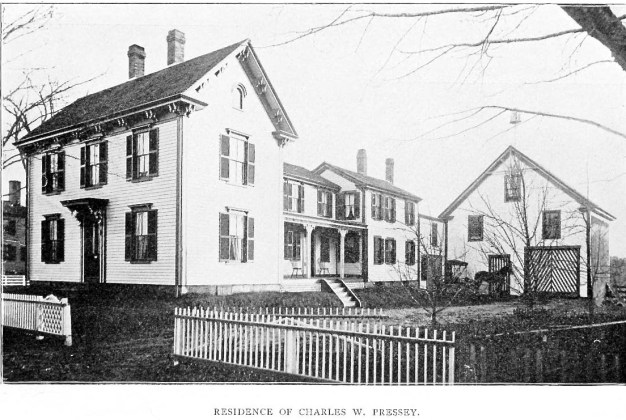
It is probable that the fine photograph of the Pressey home above was taken by Park, who was fascinated with old houses all his life. A local architecture scrapbook compiled by Park between 1896 and 1910 exists in the Historic Society of New England containing “well-illustrated news clippings relating to architectural and historical subjects pertaining to Boston, with some coverage of Andover, Amesbury, Salem, Bedford, Marblehead, Malden, Portsmouth, NH and other communities.”
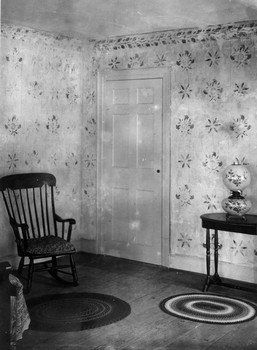
Park also obtained the Halliday Historic Photograph Company Collection, lauded as an “unrivaled” documentary source of old New England homes by The Bulletin of the Society for the Preservation of New England, December 1916. “Sometime after Mr. Halliday’s death in 1904 the collection of negatives came to the possession of Mr. C. Park Pressey, who has still further enlarged it. It would be difficult to overestimate the value of such a collection as this, as an astonishing number of the houses represented have been destroyed and many of these photographs are the best or only record.” The society eventually purchased the collection.
Park married late in life—in 1926 in Belmont, Massachusetts. The 1930 Census enumerated him back in Hampstead, aged 60, with his wife Anne D., aged 39, and daughter Carol Anne (1928-11 Sept. 2011), aged 1. His occupation was given as publisher and photographer.
By the late 1950s, Park devoted himself to preserving old houses and other structures, writing tracts such as Have you seen this Old House? Or Priscilla’s Quest for a Family Roof-Tree, and articles such as “Old New England Canals” in Old Time New England in 1956.
He would die in 1963 in Lynn, Massachusetts.
Park’s daughter Carol married Anthony P. DiPesa (d. 11 Nov. 2007) and had five children. She was buried in Puritan Lawn Memorial Park, Peabody, Massachusetts.

Edwin Pressey attended district and Hampstead High schools, graduated from Williams College in 1885, and from Union Theological Seminary, New York, in 1888. He earned a Ph.D. from Illinois Wesleyan University in 1904. He authored the book History, Philosophy and Practical Use of Mental Healing in 1910. (Did his interest spring from a need to understand the suicide of his biological father?) Edwin also lectured on Biblical archeological developments. His chief recreation, he told Who’s Who, was tramping.
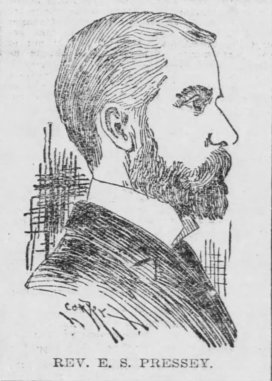
On 23 August, 1887, Edwin married Orrie Belle, daughter of William C. Little and Julia Harris Haseltine. The bride was a music teacher. The couple had had two children—Sidney Leavitt (b. 1888) and Julia Clementine Pressey (b. 1895).
During his early years in the ministry, Edwin served as pastor of Congregational churches at Brooklyn, New York; Springfield, Vermont; and Glenwood, Illinois. Next, he became pastor of the St. Anthony Park Congregational Church in St. Paul, Minnesota. The 3 March, 1897, St. Paul Globe contained an article on Edwin’s installation, as well as a sketched portrait. “Last night marked an epoch in the history of [the church], which will long be remembered by the members…. The church interior was ablaze with light in honor of the occasion, and was very prettily decorated with festoons of smilax and cut flowers,” the newspaper noted. After the official service was concluded, “the evening was spent in a social way, and Rev. Pressey was given an informal welcome to his new charge.”
The years that followed were crowded with sermons, weddings, christenings, funerals, and conferences. Orrie Pressey was also deeply involved in her husband’s work. The 4 April, 1905, issue of the Minneapolis Journal noted, for example, that when the Congregational Missionary Society next met, “Mrs. Edwin Pressey and Mrs. W. Hays will speak on ‘The Ancient Religions of Japan,’ and ‘Why America is Interested in Japan.’”
“Education was the one major activity to which the country has thus far not systematically applied ingenuity to the solution of its problems.”
As Charles and Clementine had done for Edwin and Park—doubtless recognizing the brilliance of both boys—so Edwin and Orrie did for Sidney and Julia. The children were incredibly gifted. By 1910, Sidney was training to become a psychologist. (Were these the continued ripples of Joseph Sleeper’s long-ago suicide?) His 1918 draft registration stated he was a “mental test expert” in a psychiatric hospital in Boston.
Sidney Pressey was a noted professor of psychology at Ohio State University from 1921 to 1959. A cognitive psychologist, he is credited with inventing in the mid-1920s the first teaching machine, which presented students with multiple-choice questions. Sidney is quoted in a 1932 article in School and Society, “Education was the one major activity to which the country has thus far not systematically applied ingenuity to the solution of its problems;” his teaching machine was an attempt at doing so. After retiring, he continued to publish on the topic of cognitive psychology. He wrote several books, including a influential textbook Psychology and the New Education in 1937. Sidney Pressey died 1 July, 1979.
Edwin, Orrie, and Julia Pressey were enumerated in Orange, Massachusetts, in 1910 and in Belmont, Massachusetts in 1920, at which time Edwin served as pastor of the Plymouth Congregational Church. Julia graduated from Smith College, Northampton, Massachussetts, in 1918 then enrolled in the Wisconsin Library School, where she did field work in Harry Houdini’s home town of Appleton in the winter of 1922 and graduated in May of that year. On 14 October, 1924, Kansas’s Emporia Gazette noted, “A demonstration of the use of the catalog will be given by Miss Julia Pressey, head cataloguer at the Kellogg Library.”
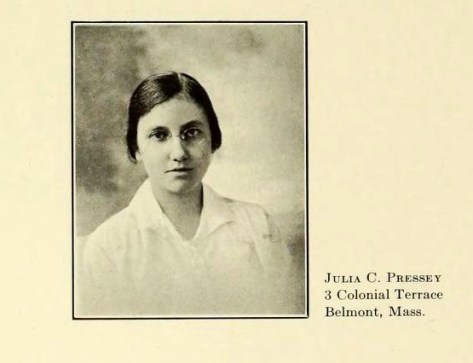
Sometime between 1925 and 1930, Julia received a post as assistant professor of library science at the Atlanta Library School, Atlanta, Georgia. Edwin Pressey had retired and both parents moved with her there. (Later Julia would become a faculty member at Emory University.) Orrie Pressey died sometime between late 1930 and 1940 in Atlanta.
After her mother’s passing, Julia donated a quilt made by Orrie in the late 1800s to the National Museum of American History, which describes it thus: “Crazy-patched square and rectangular blocks were assembled to make Orrie Little’s Parlor Throw. The four corner blocks are made entirely of ribbons. A variety of silks, satins and velvets were used for the other blocks. The lining is a brown-and-black stripe printed fabric. The binding is made of 12 different ¾-inch ribbons, seamed to the lining and whip-stitched to the front. Embroidery is used to embellish the edges of the patches and along the bound edge.”

During the war years and through the end of the decade, Julia was head of the Decimal Classification Section of the U.S. Library of Congress in Washington, D.C. Various University of Illinois alumni newsletters highlight her activities—for example, lecturing to students at a Catholic University evening class on cataloging and classification and serving as a committee member to resolve classification problems at the a national gathering of the Assembly of Librarians of the Americas.

From the end of the Second World War to the close of the 1940s, Edwin Pressey lived with his son Sidney in Columbus, Ohio, near to the university where Sidney taught. Edwin’s passing was noted in this tiny obituary that ran in the 29 November Mansfield, Ohio, News-Journal.
As for Julia, I can find little about her life during the 1950s and 1960s. She never married and died 1 July, 1976, in Pomona, California, at the age of 81.
Clementine Pressey lived long enough to see her husband’s coffin carried from their parlour to his newly dug grave in Lakeview Cemetery.
Back to the beginning now—or at least the end of the beginning.
By 1910, Charles Pressey had largely retired—the census of that year noted he performed odd jobs. His last census appearance was in 1920, when he was enumerated with Clementine in their home on Main Street in Hampstead. Charles died there 26 April, 1927, of pneumonia ten days in duration that began from a cold. He was 92.
Clementine Pressey lived long enough to see her husband’s coffin carried from their parlour to his newly dug grave in Lakeview Cemetery. She would soon join him there—surviving her husband by only three days. Clementine died 29 April, age 93, of a heart attack brought on by cold and bronchitis. She was buried beside him on 1 May.
Just as I finished this article, I located a second photo of Charles Wilber Pressey that dates to about 1903. I freely admit that my eyes filled with tears. He is older, weathered, but recognizably that handsome young man of the summer of ’56. Ω




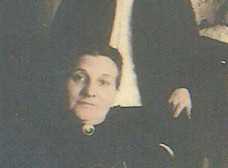
 Louisa Linebaugh Getter died 22 April, 1923, age 75 years, seven months, and 11 days, in Ellerton. She was buried 25 April, 1923, at Ellerton Cemetery. On her death certificate, the cause given is hyperthyroidism (Graves Disease), in which the thyroid kicks into overproduction causing weight loss, trembling hands, extreme tachycardia, anxiety, muscle weakness, and—worst of all—insomnia. The sufferers of Graves Disease can die, literally, of exhaustion, or can pass away suddenly from heart failure. How horrible the disease can be is something I understand, for I suffered from it when I was in my mid-twenties. Today there is a cure. In Louisa’s time, there was not.

 "Your Dying Charlotte"