A Widower’s Search for Solace

“Some of my best friends have told me that I need not expect to be happy anymore unless I would marry again and have advised me to do so.”

page1
Letter from Joseph Brown to Emeline Hoffman, page one. Ann Longmore-Etheridge Collection.

Myersville, July 10th, 1852

Dear Emeline,

I hope you will not think hard of me for thus approaching you so unexpectedly, as my mind has bin [sic] for some time a good deal taken up with you in regard to coming to see you in order to have some private conversations with you, not knowing at all whether my company would be agreeable or not, but take this plan of ascertaining something about the state of your mind.

Dear Emma, you are well acquainted with me and know all about my situation. You know that I have bin unfortunate in the loss of a very dear and kind companion, one in who my whole soul delighted to honor and respect. But she has gone I trust from a world of trouble and sorrow to one of happiness and joy, and I can have no more comfort nor consolation from her anymore, only with a firm hope and expectation of meeting her again in those blissful regions where parting shall be no more. I can do no more than to respect her memory, which I will ever do.

We read in the Bible that it is not good for man to be alone. I have realized that to be a very true saying indeed. I was once as happy as any person could be in the enjoyment in the company of my much-lamented Mary, but how different my case. With all I have I have no enjoyment & some of my best friends have told me that I need not expect to be happy anymore unless I would marry again and have advised me to do so, although I do not wish to do so for some time yet. But I have come to the conclusion to do so providing I can suit myself. I now feel like a lost sheep, lonely and without anyone to cheer me or comfort me, and if it was not for the comforts and the consolations of religion, I would often times have to despair in sorrow. But thanks be to God that he still comforts and consoles me. I find that I can never be happy again in this world without fixing my affection on one again in who I am satisfied will be a kind companion to me, and dear Emeline, you appear to the only one I can have any idea of going to see at the present and of fixing my affection upon.

Continue reading “A Widower’s Search for Solace”

In Honor of Juneteenth, Three Images from My Collection

I own just a few early photographs of African-Americans, for they are scarce and much sought after. I present them with love.

18472494001_5f2b547cf6_o
A gelatin silver bromide print of a beautiful African-American woman wearing full mourning. Despite her loss, she was clearly a survivor. Circa 1900.
daga1IMG
Of this enchanting young Creole woman, I know only that she was from New Orleans, Louisiana, and her name was probably Jois. This was likely a wedding photo. Ambrotype, circa 1855.
21506079371_ed5484c3f4_h
Mrs. Della Powell, post-mortem albumen print, 1894, photographed by William Carroll, Walnut Ridge, Arkansas. Formerly in the collection of Ben Zigler and now in mine, this rare post-mortem image of an African-American woman, who may have begun her life as a slave, was published in the 2004 book “Mourning Jewelry and Art” by Maureen DeLorme.

Ω

Preternaturally Lovely: Britain’s Queen Alexandra of Denmark

4908949356_80b166bd20_o.jpg
Albumen carte de visite (CDV) of future Queen Alexandra when Princess of Wales, taken at Sandringham in 1863. This image was marketed by the London Stereoscopic & Photographic Company, 54 Cheapside and 110 Regent Street. There is also a sticker on CDV’s reverse: “Juvenile Book Depot and Passport Agency, C. Goodman, bookseller and stationer, 407 Strand.” Ann Longmore-Etheridge Collection.
33715445136_0a713ae6a6_o
Princess Alexandra Caroline Marie Charlotte Louise Julia of Denmark as a young woman, circa 1860. She was born 1 December, 1844, in the Yellow Palace in Copenhagen, the daughter of Prince Christian of Schleswig-Holstein-Sonderburg-Glücksburg (later King Christian IX of Denmark) and Princess Louise of Hesse-Kassel. Her upbringing was not extravagant and she remained close to her parents and siblings, even after marrying Albert Edward, Prince of Wales, eldest son of Queen Victoria and Prince Albert, and taking up her new life in Great Britain. Library of Congress.
174206-1306235169
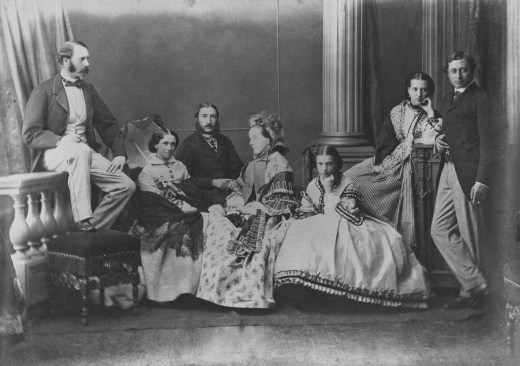
September 1862: A group photograph to mark the engagement between the Prince of Wales and Princess Alexandra. Included are members of the Princess’s family including Prince Christian of Denmark, later King Christian IX; Princess Louise, later Queen of Denmark; Leopold, Duke of Brabant; Marie Henriette, Duchess of Brabant; and Princess Dagmar of Denmark. According to an 1879 issue of the magazine Harpers Bazaar, “A younger generation are fond of recalling the April morning when the young Princess of Wales reached England. The boat touched the shore, and the multitude crowding the quay saw a mere slip of a girl nervously clinging to the railing on the deck, and looking with a pale, pretty face at the new country, her dress plain almost to shabbiness, and her bonnet of so old-fashioned a make that a London milliner was hurriedly telegraphed to for a more lilting head-gear for the future queen’s entry into London. A wave of applause and cheers went up as the Prince of Wales embraced his betrothed and conducted her to the shores of her new home. The same day she was driven through London in great state, and a lady near enough socially to be good authority has told us of her pretty, girlish timidity when the crowd stared at her, with cheers and wild demonstrations of delight.” Courtesy Royal Collection.

Continue reading “Preternaturally Lovely: Britain’s Queen Alexandra of Denmark”

“With Great Sorrow I Address You”

“Platitudes for the fallen officer were given in great numbers and the correspondent concluded with a highly personal plea: ‘Poor Joe! May the turf lie lightly on his manly breast.’”

48-pa-gilmour-joseph-major-e1524491399469
Major Joseph Gilmour, 48th Pennsylvania

“In the spring of 1864, the pages of Schuylkill County’s most important newspaper was filled with information of exciting events from America’s increasingly bloody civil war. But amid the news of battlefield drama also came the sorrowful news of local soldiers cut to pieces during hellish combat in the rolling hills of the Virginia countryside.”

Read more via Wynning History’s “With great sorrow I address you” – A heartbreaking letter to the father of a fallen Civil War soldier. Ω

“Come up if Possible. No Time to Add More”

A black-bordered invitation brought ill tidings of a father’s death.

daga1IMG
Funeral invitation on mourning stationery. Ann Longmore-Etheridge Collection

Mr. Glenn Putman,

You are respectfully invited to attend the funeral of Cornelius H. Putman, Esq., from the residence of his son-in-law, Gardiner Blood, No. 10 Market Street, on Friday next, the 15th inst., at 3 o’clock P.M.

Amsterdam, N.Y., Aug. 13, 1873

Dear Brother,

I telegraphed you today to 348 West 53 Street and send you this also, in hopes it will reach you in time. Come up if possible. No time to add more.

Yours aff.,

Effingham

Cornelius Hendrick Putman, esq., was born in Caughnawaga, Montgomery County, New York, 28 August, 1796, to Cornelius Hendrick Putman (1761-1798) and his wife Mariah Quackenboss (1758-1834). The Putman family descended from Rutgerus Putman, born in 1510 in Hamm, Westphalia, Germany, and died in 1575 in Lipstadt. The family moved to Holland, where, in 1645, Johannes Putman was born, probably in Leyden. He emigrated to what would become Schenectady, Albany County, New York, dying there 9 February, 1690.

On 24 October, 1820, Cornelius Putman married Gazena Vissher Mabee (23 Feb., 1801-20 Feb., 1861), born in New York on 24 October, 1820, and christened in the Reformed Dutch Church, Fonda, Montgomery County. Gazena was the daughter of Simon Mabee and Gazena Visscher. In August 1834, Cornelius was chosen as president of Montgomery County’s Democratic Young Men. Two years later, on the Whig ticket, he ran for but lost, the position of state representative for the 15th District of the county. After this attempt at politics, he spent his professional career as a lawyer.

The Putmans had a number of children, all born in Glen: Glenn—to whom this communication was sent and who was apparently named for the hometown (1822-1880); Maria (24 Feb., 1824-24 Feb., 1884), who married farmer and grocer Benjamin Mount (27 Nov., 1820-25 Mar., 1882); Alonzo Cornelise (Oct. 1826-29 Aug., 1892), who married Harriet Maria Van Rensselaer and, secondly, Annie E. MacFarlan; Gazena Elizabeth (1831-1908), who married Gardiner Blood (12 Mar., 1829-29 Nov., 1892); and Effingham Howard (1834-1885)—the author of this missive, whose wife was Anne C., née unknown.

Continue reading ““Come up if Possible. No Time to Add More””

“Everybody Loved Her”: The Mysterious Death of Iola Haley Newell

“Her husband was the only one in the room, and he was asleep.”—Louisville Courier-Journal

ambro
The reverse inscription of this albumen print reads, “My Dear Sister Iola Haley Newell in her coffin, who passed away Oct. 31st 1901 in Somerset, KY. The two ladies you can see in the looking-glass are Dr. Joe Owens’ wife & Alma Owens Tibbals, two of Iola’s dear friends…. Iola Morgan, born Feb 5, 1924, named after Iola Haley. She died 3 years before I was born. Also Perry & Dorothea Haley’s daughter named after Iola Haley, too. (Everybody loved her.)” Ann Longmore-Etheridge Collection.

The earthly remains of Iola M. Haley Newell are buried in Somerset City Cemetery, Somerset, Kentucky, within the casket seen above. It was almost certainly white, with a crackled paint finish and colored velvet covering the pallbearers′ handles. The rest of the gently sunlit parlor held rich photographic detail. The fireplace was surrounded by colorful Victorian art nouveau tiles. On the wall, above the harp-shaped floral tribute, a paper or cardboard image of a blooming plant proclaimed, “The Year of Flowers.” Reflected in the mirror, along with two female mourners, were more images also possibly culled from “The Year of Flowers.” Behind the black-clad ladies was the staircase to the home’s upper floor.

It is a wistfully beautiful image: A bright-colored room, burgeoning with flowers in recognition of a beloved daughter, sister, friend, and bride of little more than a year, dead before age 30. The most likely causes of Iola’s demise should have been pregnancy complications or childbirth. However, there is no record of a child born alive or dead—and if the latter, we would expect to see the stillborn infant in the casket, beside its mother.

It is also clear from the photo that Iola was not the victim of a wasting disease, rather of something that cut her down in otherwise acceptable health. Her husband, Dr. John B. Newell, survived Iola narrowly, dying a year-and-a-half later. Newell worked in a field of medicine—dentistry—whose practitioners could be easily exposed to Tuberculosis and other contagious diseases. Another possible cause for one, or both, of the couple’s deaths was typhoid. An epidemic occurred in Pulaski County in 1920, and since the disease can be waterborne, contaminated waterways may have existed in the area in the decade before, when the couple was yet alive.

Continue reading ““Everybody Loved Her”: The Mysterious Death of Iola Haley Newell”

Harriet, Jeff, Aunty, and Anna

“I was not surprised when we received the notice of Aunty’s death. From what you had written to me I was expecting it.”

8606590430_3a57bbf01b_z
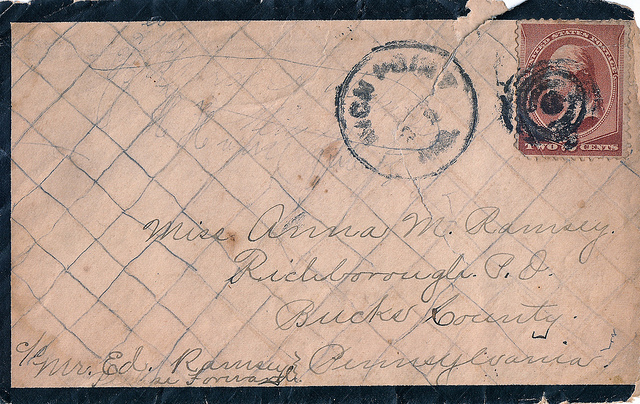
A mourning stationery envelope addressed to Anna M. Ramsey. Ann Longmore-Etheridge Collection.

To: Miss Anna M. Ramsey
Richborough P.D.
Bucks County
Pennsylvania
C/O Mr. Ed Ramsey
Please forward

High Point
April 27th ‘84

Dear Cousin Anna,

Yours of April 4 received. Was so glad to hear from you. I had looked for a letter for some time from Aunty. But have treasured up my last one from her. Anna, I sympathize deeply with your in your affliction. Your loss is her gain. But it is so hard to part with those we love so dearly but Aunty has only passed from this wicked world to a brighter and better one beyond. But oh the loneliness and sadness in the home without a mother or father. My heart aches for you, well I do remember the bitter pangs of suffering I passed through when I had to give up my dear mother. It seemed as though all the sunshine had gone out of the world. To this day I grieve for her. But time changes all things and we must be reconciled.

8605484017_8a93a9d8e5_z
Page one of the black-edged letter written on mourning stationery to Anna Ramsey.

I was not surprised when we received the notice of Aunty’s death. From what you had written to me I was expecting it. But felt very sad indeed. I wanted to come east last fall to see you all once more but Jeff was sick so long and so bad that we could not leave him. I think from what you tell me about Aunty she must have been (in her sickness) very much like cos Kate Hume (McNair). She did not suffer pain but had that distress feeling and sick at her stomach. She had a cancerous tumor.

Continue reading “Harriet, Jeff, Aunty, and Anna”

Funeral Fragments

“When old Francis died in 1913, Dad sent him off in a hearse pulled by four black horses followed by mutes carrying ostrich feather wands and a procession of friends and family in the deepest mourning possible.”—Barbara Nadel

6297270408_005fc6f399_b
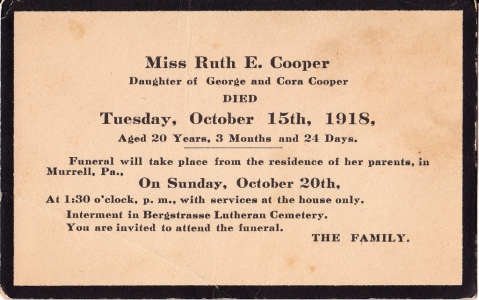
An invitation to the funeral of Ruth Evelyn Cooper, who died of pneumonia in the aftermath of influenza. She was one of upwards of 50 million people whose deaths were associated with the 1918 influenza pandemic. Ruth was born 21 June, 1898; she was the daughter of mail carrier George F. and Clara Good Cooper of Murrell, Ephrata Township, Lancaster County, Pennsylvania.
9587428394_61b9ea0e3c_k
This glass slide captures one moment in the lengthy funeral proceedings of Queen Victoria, as her coffin wended its way through London, 2 February, 1901. The slide is unmarked save for the handwritten inscription, “The Queen’s Coffin.” It does not appear to be part of a commercial set and may be a personal remembrance of the day taken by someone in the crowd. (Note the two boys looking down on the passing procession from the high wall on the right.)
14260852403_752914a036_h
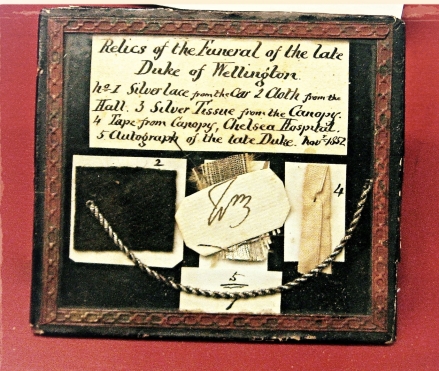
This photo shows ephemera from the funeral of Arthur Wellesley, 1st Duke of Wellington (1 May 1769–14 Sept., 1852). It resides in the museum of Carisbrooke Castle, Isle of Wight, England. The duke was beloved for leading the defeat of Napoleon’s forces at Waterloo, 18 June, 1818. He went on to become a prime minister and is still considered to be one of Great Britain’s chiefest politicians. The handwritten note reads: “Relics of the Funeral of the late Duke of Wellington. No.1 Silver lace from the car. 2. Cloth from the Hall. 3. Silver Tissue from the Canopy. 4. Tape from the Canopy, Chelsea Hospital. 5. Autograph of the late Duke, Nov. 1852.”

Continue reading “Funeral Fragments”

Comet Brooches: A Legacy of the 19th Century’s Sidereal Wanderers

“This great comet has fled from the gaze of man, and thirty generations of astronomers will pass away before it will submit itself to human scrutiny.” —H.A. Howe

6929420575_a846084621_b
Halley’s Comet brooch, 1835. Ann Longmore-Etheridge Collection.

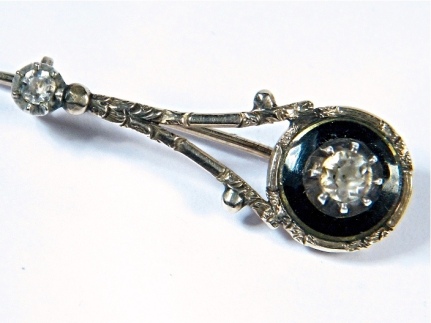
This piece from my collection is an antique English, 9-carat gold comet mourning pin. It is beautifully made, with a hand-chased stylized tail, black enamel embellishment, and a glittering foiled paste stone in silver settings, clearly displaying a black spot to simulate the open culet of a diamond.

The unusual shape of the brooch commemorates the return of Halley’s Comet in 1835. Although this piece neither contains a loved one’s hair nor bears an inscription, the use of black enamel almost certainly associates it with loss during the comet pass year.

Halley’s Comet is named after English astronomer Edmond Halley, who studied previous sightings and correctly predicted its 1758 apparition. The comet returns every 75 years, with its last apparition in 1986 and its next to come in 2061. I will be 98, if I live to see it.

The first report of the comet is from its pass above China in 467 B.C. (Centuries later, during another apparition, the Chinese would call it by the beautifully evocative name, “Broom Star.”) The British Museum, London, holds other documentation in the form of cuneiform tablets describing the comet’s appearance over Babylonia in late September, 164 B.C.

Continue reading “Comet Brooches: A Legacy of the 19th Century’s Sidereal Wanderers”

This is His Orphan: What it Shows and What it Doesn’t

daga1IMG
Widow and Orphan, Albumen Carte de Visite, Circa 1868. Ann Longmore-Etheridge Collection.

This English carte de visite (CDV) is one of the most popular in my collection, if Flickr views and Pinterest re-pins equate to evidence, that is. It shows a young British widow—identifiable as such by the white ruching on her black bonnet—squatting in the background, having just propelled her black-clad daughter toward the photographer. The widow stares forward forlornly, her hand over her mouth, indicating without words her shock and concern for their future. It is a candid, painfully honest pose, and one rarely seen in types of images. She is no “Hidden Mother,” but a vital element of a tableau meant to convey the message, “This is his orphan.”

The reverse stamp on the CDV reads “T. Bennett, Photographer, 46 Foregate Street and Church Street, Malvern.” According to research conducted by the creator of Photographers of Great Britain and Ireland, 1840-1940, Thomas Bennett “opened his first studio in Worcester in 1856. At different times, he operated at five studios in Worcester and three in Malvern under his own name and the business continued under the name of Bennett & Son and Bennett & Sons until at least 1916.”

“The 1861 census records the [Bennett] family living at his shop at 46 Foregate, Worcester, where he is described as a Lay Clerk (of the church) and photographer. His firm Thomas Bennett and Son is thought to have been established about 1856. His branch in Great Malvern was possibly the second photographic studio” in that town—this information gleaned from the Malvern Records Office. Bennett threw open the doors of his Malvern studio in 1868 and the CDV of mother and daughter could not have been taken long afterward.

Continue reading “This is His Orphan: What it Shows and What it Doesn’t”