
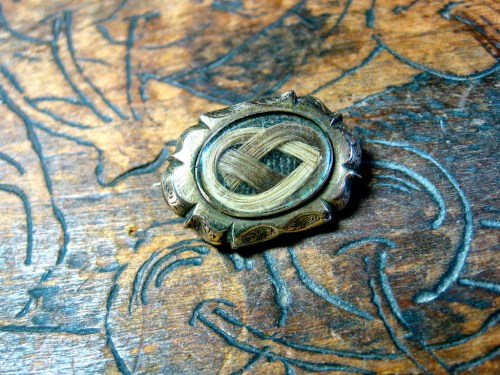


Some pieces of mourning jewelry offer enough facts to fill volumes. Others are stealthy and secretive, unwilling to share the stories of the dead or their grief-stricken survivors.
All of this historic context, moreover the genetic material of their ancestress, was not valued by her descendants, who found her mourning brooch too disgusting to keep.

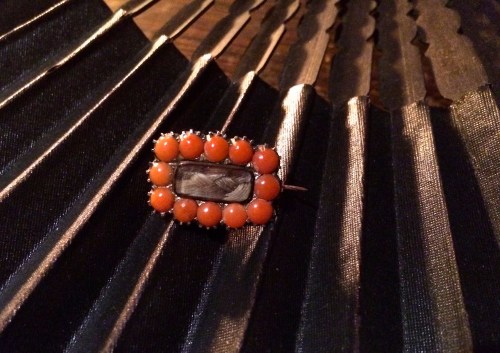
In about 1996, while trawling for hair-work brooches on eBay with a tax return smoldering in my pocket, I found a listing with a ridiculously blurry photo of what looked like—just maybe—a Regency-Era mourning brooch. The accompanying item description encapsulated the prevailing 20th-Century attitude toward mourning jewelry. As I recall, it read something very close to “We found this pin that belonged to grandma. It has hair in it! Eww! Get it out of our house!” I obliged for about $40; no other bidders were willing to take the chance with that kind of sales photo. One- by three-quarters-inch in size, this type of small brooch was known as a “lace pin” and used to secure veils, ribbons, pelerines, and other accessories. They were also worn by men as lapel pins.
The 210-hundred-year-old gem that I received was made of 10-karat or higher plain and rose gold with completely intact niello and inset faceted jet cabochons. (Niello is a black metallic alloy of sulfur, copper, silver, and usually lead, used as an inlay on engraved metal.) The brooch was in pristine condition, bearing the inscription “Mary Palmer. Ob. 3 July 1806, aet. 38.” The abbreviation “Ob.” is from the Latin obitus—“a departure,” which has long been a euphemism for death. “Aet.” is from the Latin aetatis—“of age.”
Victoria’s grief drove into high gear the already strong public market for jewelry to be at worn during all stages of mourning.

At the close of the 18th century and the early years of the 19th, memorial pieces with hair were generally small, delicate, and graceful. However, the oncoming Victorian era would turn “the entire ritual of mourning into a public display, and the jewelry changed accordingly, becoming larger, heavier, and more obvious,” wrote the curators of the Springfield, Illinois-based Museum of Funeral Customs in Bejeweled Bereavement: Mourning Jewelry—1765-1920.

In December 1861, Queen Victoria’s beloved consort, Prince Albert of Saxe-Coburg-Gotha, died of what is thought to have been typhoid fever. Married for twenty-one years, their happy union resulted in the birth of nine children. The forty-two-year-old prince’s demise shattered Victoria. For the rest of her life, the queen wore mourning and required many courtiers who served her and who attended court functions to do the same.
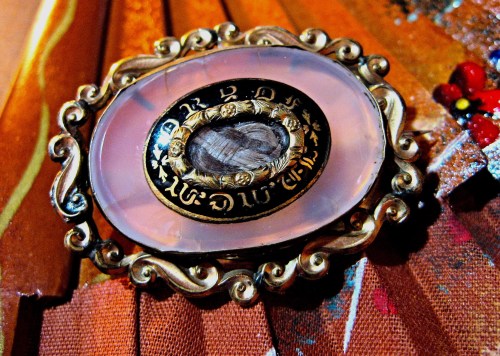
Victoria’s grief drove into high gear the already strong public market for jewelry to be worn during all stages of mourning. For example, in the first nine months, the only acceptable jewelry was made of black glass, dyed pressed animal horn, gutta-percha (a latex plastic derived from tropical evergreens), vulcanite and ebonite (rubber treated with sulfur and heat), bog oak (fossilized peat), or carved from jet (a fossilized wood that washes up on west coast Yorkshire beaches, and was extracted from shale seams, particularly around between Robin Hood’s Bay and Boulby). In later stages of mourning, gold or pinchbeck (a composite metal) and hair-work jewelry commemorating the deceased was worn. Many of these items bore the motto “In Memory Of” and featured heavy black enameling.
“Live a good life. If there are gods and they are just, then they will not care how devout you have been, but will welcome you based on the virtues you have lived by. If there are gods, but unjust, then you should not want to worship them. If there are no gods, then you will be gone, but will have lived a noble life that will live on in the memories of your loved ones.”―Marcus Aurelius

We see the still, worn body of old lady, prepared for burial by her family and laid out, most likely, upon her own bed.
This photograph may have been both this woman’s first and her last. She was likely a child in the 1790s and a young wife and mother when Jane Austen wrote her literary oeuvre. The story of her life unfolded during the waning of one century and the child years of another. For many, by the time this post-mortem ambrotype was taken, familiar patterns of life had been radically altered by the industrial revolution. The War of 1812 and the Napoleonic Wars had rolled by like awful storms. The British Queen would shortly lose her dearest love and plunge herself into perpetual mourning. America was spilling out across a vast continent and tensions were escalating to the point of eruption between its North and South. War was a dark cloud on the horizon, threatening the young men of her family, but mercifully, she never saw it blot out the sun.

A note tucked inside the case of this 1/6th-plate reads, “Grandmother Whitney—mother of Samuel. Born between 1775 & 1780.” The plate is stamped “Melainotype for Neff’s Pat 19 Feb 56.”
In John Towler’s 1864 opus on what was then state-of-the-art photographic technology, The Silver Sunbeam, he writes, “The melainotype takes its name from the black background upon which it is taken…. Very thin plates of sheet-iron are covered with a protective varnish or Japan, of which one is of a rich black or brown-black color, highly polished, and without flaw, for the reception of the collodion and the collodion picture. Glass in this sort of picture is entirely dispensed with, and so is also the black Japan, the black velvet, and paper. This type is by far the easiest and the quickest to take, and in general the most satisfactory when taken. Melainotype plates of all the variable photographic sizes, and of variable qualities, can be obtained from the photographic warehouses.” Ω


The historical importance of March 1843 daguerreotype was forgotten until now.

A new image of John Quincy Adams, America’s sixth president, will be presented for sale by the auction house Sotheby’s later this year. The March 1843 daguerreotype, which Quincy Adams gifted to a friend, remained in the recipient’s family through the generations although its historical importance was forgotten. The image was made during a sitting with early photographers Southworth & Hawes that yielded at least two daguerreotypes. A copy of the other now resides in the collection of the New York Metropolitan Museum.

There is a third, badly damaged daguerreotype of Quincy Adams held by the Smithsonian’s National Portrait Gallery. Adams disliked it, noting in his diary that he thought it “hideous” because it was “too close to the original.” More than a hundred years later, in 1970, the daguerreotype was bought for 50 cents in an antique shop. After identification, it was eventually donated it to the nation.
Continue reading “Sit Down, John: An Adams Image Rediscovered”
“Life asked death, ‘Why do people love me but hate you?’ Death responded, ‘Because you are a beautiful lie and I am a painful truth.’”—Author Unknown

Lavada May Dermott, seen above laid out in her parents’ home, surrounded by funeral flowers, was born 9 May, 1888, in Goshen, Belmont County, Ohio, to Charles Evans Dermott (1849-1907) and his wife, Sarah Jane Stewart (1853-1936). Sarah was the daughter of Eleazar Evan Stewart (1834-1910) and Honor Brown (1835-1914).
Lavada’s parents married in Goshen 26 January, 1871. They first make an appearance as a family unit on the 1880 Census of that township. Evans Dermott—he went by his middle name—listed his occupation as “huxter.” His father, Irish-born farmer William Dermott (1811-1896) was also a part of the household—his wife, Eliza Kelly (1813-1879), having died the year before.
Evans and Sarah had together four children: William Wilber (1871-1947), Charles E. Dermott (19 June, 1881-23 September, 1944), Lavada, and Lillie F. Dermott (1895-1987). On 20 May, 1900, the eldest son, William, married Grace Stanley King. William spelled the family name as Der Mott and is buried thusly in Forest Rose Cemetery, Lancaster, Ohio. By 1910, the Der Motts lived in Cleveland, Ohio. William became a garment cutter for a clothing company and eventually was the manager of a clothing store. He worked in that position as late as 1940. They had two children: Neil (b. 1902) and William P. (b. 1903).
“Warm the palette by placing it on the hob, or before the fire for a few minutes, and you will soon find that the curl becomes loose and may be lifted off with the edge of a knife.”
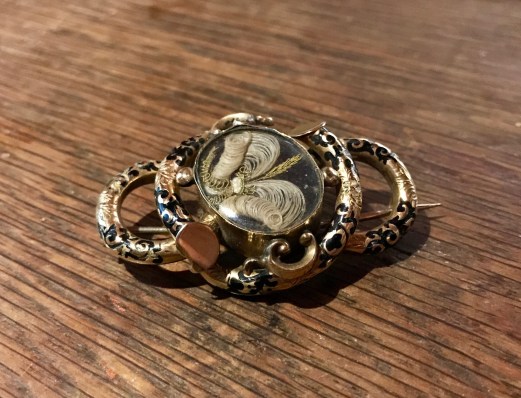
I purchased this mourning brooch in Edinburgh, Scotland, in 1993. It was the foundation of my collection and, at the time, was actually was my second choice—the first being a smaller, plainer piece with a simply coiled blond lock, probably dating from the 1820s or 1830s. The brooch looked more “human” to me, but the shop owner enticed me toward a different brooch, assuring me it was unusual. It dates from the late 1840s to early 1850s.
The body is 14-karat gold or higher with a tube hinge, C-clasp, and a pin that is longer than the length of the brooch—all evidence that an item that was indeed crafted in the 18th or 19th centuries. The hair memento compartment is set amidst a tempestuous lovers’ knot untamed by the somber black enamel embellishment. Inside the glass-capped compartment is a piece of black cloth on which palette-worked gray hair has been affixed. The design is known as Prince of Wales feathers and is decorated with a pearl band, as well as a stalk of barley and ribbon made from gold wire thread.
The Prince of Wales feathers for the Edinburgh brooch were carefully crafted by a professional hairworker. For an exploration of how it was made, one can turn to no better source than the Collector’s Encyclopedia of Hairwork Jewelry: Identification and Values by C. Jeanenne Bell, which contains a full reprint of Alexanna Speight’s 1877 booklet, A Lock of Hair. The booklet contains instructions for palette work that were aimed at the Victorian lady who aspired to a new and noble handwork. Taking up the hobby, as Bell notes, would not only give her “the satisfaction of working with the hair of her loved ones, but it also assured her that the precious locks would not be substituted for, or augmented with, another’s”—an ignoble deed undertaken by unscrupulous memorial jewelry makers and feared to occur with regularity.

The subject of this CDV is Eliza Schuyler Kuypers, wife of Ethan Alphonso Allen (8 February, 1818-27 November, 1889). Eliza’s husband was the grandson of the American patriot, farmer, philosopher, deist, and writer Ethan Allen (1737-1789) and his second wife Frances Montressor (1770-1834), through their son Ethan Voltaire Allen (1789-1845) and wife Mary Susanna Johnson (26 Sept., 1797-1 November, 1818).
Eliza, born in 1820, was the great-granddaughter of Elizabeth Schuyler (1771-1801) and her husband Rev. Gerardus Arentz Kuypers of Curacao, Dutch West Indies, who had been born on the island in December 1766 and later came to Hackensack, New Jersey, then to Rhinebeck, New York, to minister to the Dutch community there. Eliza’s grandfather was their son, also named Gerardus Arentz Kuypers (1787-1833), who was educated at Hackensack, and then studied theology under his father. He was licensed to preach in 1787 and served as a collegiate pastor in Paramus, New Jersey. In 1780, he moved to New York City to preach in the Dutch language. In 1791, he earned a Master of Arts degree from the College of New Jersey, as well as a Doctor of Divinity from Rutgers in 1810. It is noted that he suffered from asthma but died of “ossification” of the heart 28 June, 1833.

Eliza was the daughter of his son, Dr. Samuel S. Kuypers (8 March, 1795-10 January, 1870) and Amelia Ann VanZant (1794-1864). Dr. Kuypers was an alumnus of Rutgers and a member of the Medical Society of the County of New York from 1820 until his death.
In the CDV image above, Eliza is most probably wearing mourning after her mother’s death in the penultimate year of the Civil War. Amelia VanZant Kuyper’s demise was announced in the New York Times of 8 January, 1864, as follows: “On Thursday, Jan. 7…in the 70th year of her age. The relatives and friends of the family are respectfully invited to attend the funeral from her late residence, No. 142 2d-av., on Sunday, Jan. 10, at 3 o’clock p.m. without further invitation.”
Continue reading “The Patriot’s In-Law: Eliza Schuyler Kuypers”
“For to him above all was life was good,
Above all he commanded, her abundance full-handed.”—Rudyard Kipling, 1910

In 1910, Dr. William L. Bates of Sioux City, Iowa, took the boat The Florida on a meandering holiday. One of his stops was Windsor, Ontario, Canada. While there, he photographed the Windsor Post Office, located at Ouellette Avenue and Pitt Street. Bates found the public building draped in mourning after the death of British King Edward VII, who had passed away 6 May. A ladder was propped against one side of the building indicating that the mourning swags were in of the process of being raised, so likely this image was captured within a day or so of the king’s demise.
King Edward VII was born Prince Albert Edward, Prince of Wales, second child and eldest son of Queen Victoria and Prince Albert of Saxe-Coburg and Gotha, on the morning of 9 November, 1841. “Our little boy is a wonderfully strong and large child, with very large dark blue eyes, a finely formed but somewhat large nose, and a pretty little mouth,” wrote Victoria to her uncle, Leopold, King of the Belgians, on 29 November. “I hope and pray he may be like his dearest Papa.”
Sadly, “Bertie,” as he was known amongst his family, was little like his erudite, brilliant, moral father or his paragon elder sister, Princess Vicky. Bertie strove to please his parents, who had devised a strict educational program for the heir to the throne, but the boy could never rise to the tonnage of their expectation. Once the grown prince matriculated to Oxford and Cambridge, however, he performed well as a student, giving the lie to his family’s belief that he was somewhat mentally deficient.
“Oh, Mrs. Crane, he looked so pretty. He looked as if he was asleep and dreaming a very pleasant dream.”

I have in my collection this incomplete letter from the mid- to late 1800s written by an American woman named Julie who had endured the loss of her fiancé, Freddie. Julie’s letter was for another woman—her elder and probably close family friend, Mrs. Crane.
Julie and Freddie were young, possibly in their teens. Julie was quite literate, but her writing contains numerous errors, phonetic spellings, and a general disuse of commas, full stops, and quotations that is endemic to the era. I have corrected her mistakes and added modern punctuation in the quotes below.
“I sat and looked at him all night,” Julie wrote at the top of the single page, recalling the aftermath of the passing. “So many spoke of his smiling and happy beautiful countenance even in death. He looked too beautiful to bury.” She then hopped backward in time, writing, “He was sensible until two minutes before he died, but whether he realized he was really dying, I know not.”
Next she confides in Mrs. Crane, “About two hours before he died, I sat crying and he looked at me. I said, ‘Freddie darling, how can I give you up?’ He raised his hand and said ‘Oh, Julie, don’t.’”
Don’t? Don’t weep? Don’t imply that he was dying? Don’t tarnish his “good death” with female hysteria? Perhaps Freddie’s command was more prosaic: The dying man needed to move his bowels. “[H]e wanted to get on the chamber [pot] and I asked him if I should tell his mother. He said, ‘Mother is weak.’ I said, ‘Freddie, shall I help you?’ He said, ‘Yes, please,’ so I [assisted] him,” she next wrote. Of all the letter’s painful details, this strikes deepest—a heartbreaking intimacy, demanded by circumstance, between a couple who may never have seen each other unclothed.
 "Your Dying Charlotte"