As the Northern Hemisphere explodes with green life, let’s take a look back at rebirth celebrations of yesteryear.
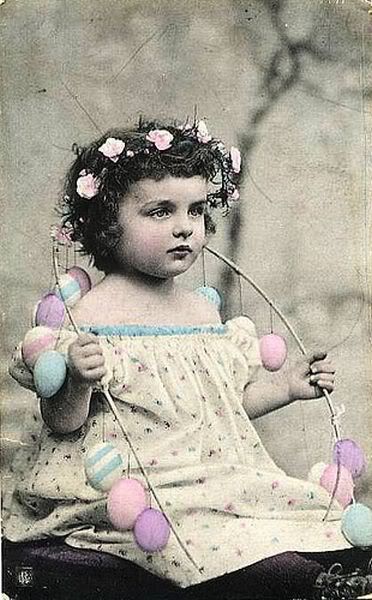
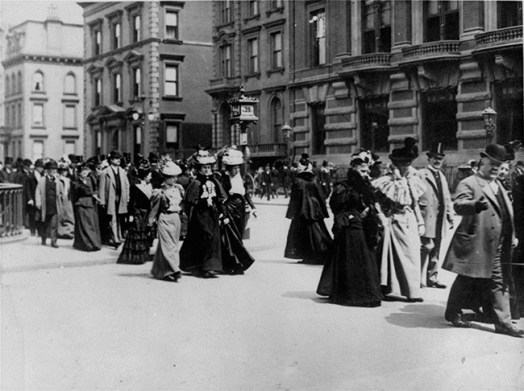
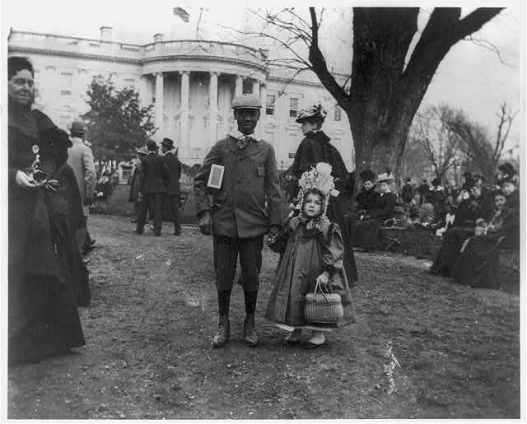
A beautiful early Easter image, probably 1890s.The 1898 5th Avenue Easter Parade, New York City, New York. Courtesy Wikimedia Commons.Children at the 1898 White House Easter Egg Roll. Courtesy Library of Congress.
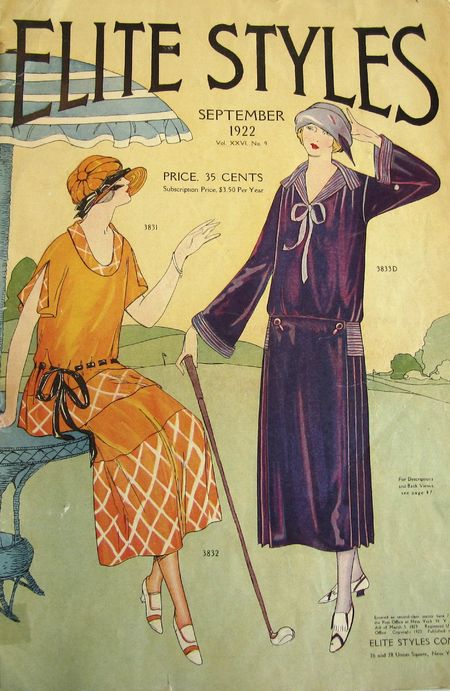
Vintage Patterns Wikia has released a catalog of more than 83,000 vintage sewing patterns. Costuming enthusiasts can use the reference numbers to search for extant patterns on sites like eBay.
Elite Styles Company, September 1922.Pictorial Printed Patterns, October 1931.Praktische Damen-und Kinder-Mode No. 26; 1935-36.
Last week, a storm brought 10 inches of snow to Western Maryland and turned my mind to snowmen of old.
A woman builds a snowman whilst a man shovels snow. Courtesy National Museum of Wales.
In all probabilty, humans have sculpted snowmen for millenia. In 2007, Bob Eckstein, the author of The History of the Snowman: From the Ice Age to the Flea Market, told NPR that in writing his book, “I wanted to make it clear that snowman-making actually was a form of folk art. Man was making folk art like this for ages, and…maybe it’s one of man’s oldest forms of art…. [T]he further back you go, you find that people were really fascinated with snowmen.”
Eckstein says that building snowmen was “a very popular activity in the Middle Ages…after a snow came down and dumped all these free-art supplies in front of everyone’s house.” The earliest known representation of a snowman dates to that era, drawn in a 1380 A.D. Book of Hours. A century later, in 1494, Michelangelo was commissioned by Piero di Lorenzo de’ Medici, the Gran Maestro of Florence, to practice his art with snow. According to art historian Giorgio Vasari, “de’ Medici had him make in his courtyard a statue of snow, which was very beautiful.” Sadly, no one drew it for posterity.
In 1510, a Florentine apothecary, Lucas Landucci confided in his diary that he had seen “a number of the most beautiful snow-lions, as well as many nude figures…made also by good masters.” Another notable snowmen outbreak occurred just a year later, when folk in Brussels built more than 100 of them “in a public art installation known as the Miracle of 1511,” notes Atlas Obscura. “Their snowmen embodied a dissatisfaction with the political climate, not to mention the six weeks of below-freezing weather. The Belgians rendered their anxieties into tangible, life-like models: a defecating demon, a humiliated king, and womenfolk getting buggered six ways to Sunday. Besides your typical sexually graphic and politically riled caricatures, the Belgian snowmen, Eckstein discovered, were often parodies of folklore figures, such as mermaids, unicorns, and village idiots.”
“Her husband was the only one in the room, and he was asleep.”—Louisville Courier-Journal
The reverse inscription of this albumen print reads, “My Dear Sister Iola Haley Newell in her coffin, who passed away Oct. 31st 1901 in Somerset, KY. The two ladies you can see in the looking-glass are Dr. Joe Owens’ wife & Alma Owens Tibbals, two of Iola’s dear friends…. Iola Morgan, born Feb 5, 1924, named after Iola Haley. She died 3 years before I was born. Also Perry & Dorothea Haley’s daughter named after Iola Haley, too. (Everybody loved her.)” Ann Longmore-Etheridge Collection.
The earthly remains of Iola M. Haley Newell are buried in Somerset City Cemetery, Somerset, Kentucky, within the casket seen above. It was almost certainly white, with a crackled paint finish and colored velvet covering the pallbearers′ handles. The rest of the gently sunlit parlor held rich photographic detail. The fireplace was surrounded by colorful Victorian art nouveau tiles. On the wall, above the harp-shaped floral tribute, a paper or cardboard image of a blooming plant proclaimed, “The Year of Flowers.” Reflected in the mirror, along with two female mourners, were more images also possibly culled from “The Year of Flowers.” Behind the black-clad ladies was the staircase to the home’s upper floor.
It is a wistfully beautiful image: A bright-colored room, burgeoning with flowers in recognition of a beloved daughter, sister, friend, and bride of little more than a year, dead before age 30. The most likely causes of Iola’s demise should have been pregnancy complications or childbirth. However, there is no record of a child born alive or dead—and if the latter, we would expect to see the stillborn infant in the casket, beside its mother.
It is also clear from the photo that Iola was not the victim of a wasting disease, rather of something that cut her down in otherwise acceptable health. Her husband, Dr. John B. Newell, survived Iola narrowly, dying a year-and-a-half later. Newell worked in a field of medicine—dentistry—whose practitioners could be easily exposed to Tuberculosis and other contagious diseases. Another possible cause for one, or both, of the couple’s deaths was typhoid. An epidemic occurred in Pulaski County in 1920, and since the disease can be waterborne, contaminated waterways may have existed in the area in the decade before, when the couple was yet alive.
I own a stereoview card, one half which is seen above, that may portray mourners of President Franklin Pierce. To accompany this image, I am reblogging an excellent look at Pierce’s life and burial place by Gravely Speaking.
A sign outside the gates of the Old North Cemetery announces the burial of the most New Hampshire native son within its fencing. The sign outlines the major accomplishments of Franklin Pierce:
FRANKLIN PIERCE
1804 – 1869
Fourteenth President of the United States
(1853 -1857)
Lies buried in nearby Minot enclosure.
Native son of New Hampshire,
Graduate of Bowdoin College,
Lawyer, effective political leader,
Congressman and U.S. Senator,
Mexican War veteran, courageous
Advocate of States’ rights,
He was popularly known as
“Young Hickory of the Granite Hills.”
While the sign outlines Pierce’s political accomplishments, there is nothing about his personal life. Franklin Pierce was born in Hillsborough, New Hampshire. He married Jane Appleton, the daughter of a Congregational minister. Jane and Franklin were nearly polar opposites. Franklin was outgoing and gregarious. Jane was shy and suffered from depression. Jane was pro-temperance and devoutly religious. Jane was from a family that…
“I was not surprised when we received the notice of Aunty’s death. From what you had written to me I was expecting it.”
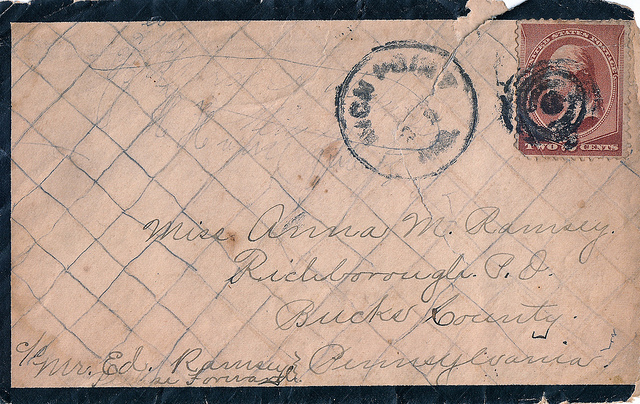
A mourning stationery envelope addressed to Anna M. Ramsey. Ann Longmore-Etheridge Collection.
To: Miss Anna M. Ramsey Richborough P.D. Bucks County Pennsylvania C/O Mr. Ed Ramsey Please forward
High Point April 27th ‘84
Dear Cousin Anna,
Yours of April 4 received. Was so glad to hear from you. I had looked for a letter for some time from Aunty. But have treasured up my last one from her. Anna, I sympathize deeply with your in your affliction. Your loss is her gain. But it is so hard to part with those we love so dearly but Aunty has only passed from this wicked world to a brighter and better one beyond. But oh the loneliness and sadness in the home without a mother or father. My heart aches for you, well I do remember the bitter pangs of suffering I passed through when I had to give up my dear mother. It seemed as though all the sunshine had gone out of the world. To this day I grieve for her. But time changes all things and we must be reconciled.
Page one of the black-edged letter written on mourning stationery to Anna Ramsey.
I was not surprised when we received the notice of Aunty’s death. From what you had written to me I was expecting it. But felt very sad indeed. I wanted to come east last fall to see you all once more but Jeff was sick so long and so bad that we could not leave him. I think from what you tell me about Aunty she must have been (in her sickness) very much like cos Kate Hume (McNair). She did not suffer pain but had that distress feeling and sick at her stomach. She had a cancerous tumor.
A visit to the Renwick Gallery of the Smithsonian American Art Museum, Washington, D.C., to view the fiendishly intriguing Nutshell Studies of Unexplained Death.
‘The Barn,” or “The Hanging Farmer,” a Nutshell Study created in about 1946.
Frances Glessner Lee (1878–1962), regarded as the “mother” of forensic science, was also the first female U.S. police captain, although the title was honorary. In 1936, Glessner Lee came by a sizable inheritance—her father was cofounder of the International Harvester Company—and she used it to help build a Department of Legal Medicine at Harvard Medical School. It was during the decade afterward that Glessner Lee crafted many of the 20 known Nutshell murder dioramas.
Corine May Botz wrote in The Nutshell Murders of Unexplained Deaths that “[Lee] took a special interest in training police officers because, as the first to arrive on the scene of a crime, they had to recognize and preserve evidence critical to solving the case. At the time, most police officers inadvertently botched cases by touching, moving, or failing to identify evidence. Lee was also extremely interested in better integrating the work of, and communication among medical experts, police officers, forensic investigators and prosecutors.”
In the Nutshell Study above, farmer Eben Wallace was found hanged in his barn. His wife told police, “When things did not suit Eben he would go out into the barn, stand on a bucket, put a noose around his neck, and threaten suicide. I always talked him out of it. On this afternoon, he made the usual threats, but this time I did not follow him to the barn right away. When I did, I found him hanging there with his feet through a wooden crate.”
Callithumpian band? Wholesale arrests? Mayor Ephraim Smyser Hugentugler? Enjoy this retelling of a shambolic day in York, Pennsylvania, by historian James Rada, Jr.
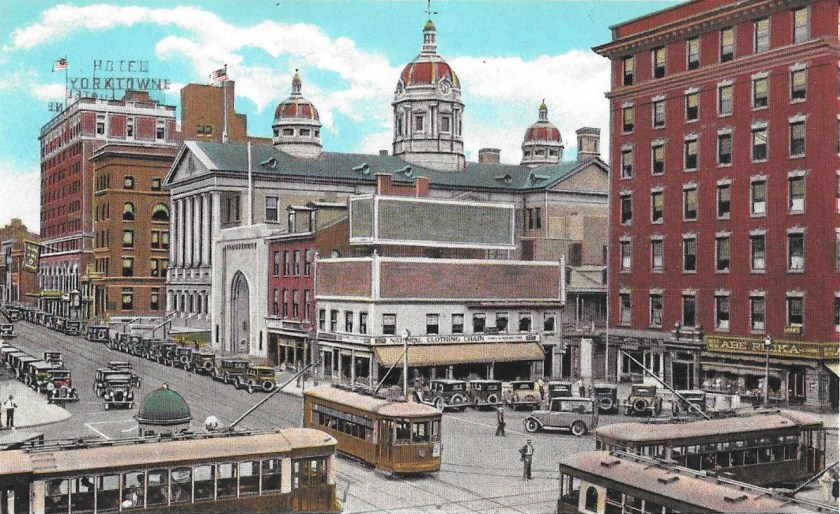
Continental Square in York, Pa. Courtesy of the York History Center.
The metallic reverberating sound of gongs repeatedly sounded throughout downtown York, Pa., in August of 1925. It was a sound people recognized as the alert on a fire truck. Somewhere in York, a fire was burning.
“During the disturbance patrons of theaters, hurriedly snatched their wraps and fled from the amusement places to ‘go to the fire.’ Others telephoned or went to their homes,” The York Dispatch reported.
People attending a municipal band concert at Farquhar Park heard the gongs over the music and streamed out of the park, seeking the fire or their homes to make sure that it wasn’t burning.
The problem was that there was no fire. “A callithumpian band mounted on a truck which also carried, despite their objections the bride and bridegroom, coursed about downtown streets for about an hour last evening,” The York…
“When old Francis died in 1913, Dad sent him off in a hearse pulled by four black horses followed by mutes carrying ostrich feather wands and a procession of friends and family in the deepest mourning possible.”—Barbara Nadel
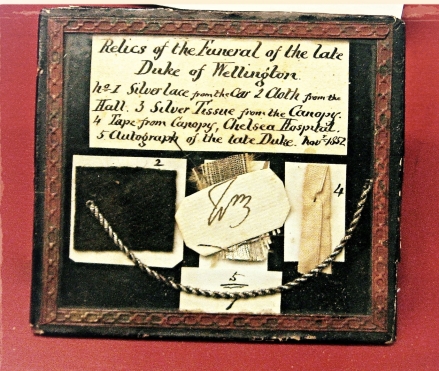
An invitation to the funeral of Ruth Evelyn Cooper, who died of pneumonia in the aftermath of influenza. She was one of upwards of 50 million people whose deaths were associated with the 1918 influenza pandemic. Ruth was born 21 June, 1898; she was the daughter of mail carrier George F. and Clara Good Cooper of Murrell, Ephrata Township, Lancaster County, Pennsylvania.This glass slide captures one moment in the lengthy funeral proceedings of Queen Victoria, as her coffin wended its way through London, 2 February, 1901. The slide is unmarked save for the handwritten inscription, “The Queen’s Coffin.” It does not appear to be part of a commercial set and may be a personal remembrance of the day taken by someone in the crowd. (Note the two boys looking down on the passing procession from the high wall on the right.)This photo shows ephemera from the funeral of Arthur Wellesley, 1st Duke of Wellington (1 May 1769–14 Sept., 1852). It resides in the museum of Carisbrooke Castle, Isle of Wight, England. The duke was beloved for leading the defeat of Napoleon’s forces at Waterloo, 18 June, 1818. He went on to become a prime minister and is still considered to be one of Great Britain’s chiefest politicians. The handwritten note reads: “Relics of the Funeral of the late Duke of Wellington. No.1 Silver lace from the car. 2. Cloth from the Hall. 3. Silver Tissue from the Canopy. 4. Tape from the Canopy, Chelsea Hospital. 5. Autograph of the late Duke, Nov. 1852.”
“This great comet has fled from the gaze of man, and thirty generations of astronomers will pass away before it will submit itself to human scrutiny.” —H.A. Howe
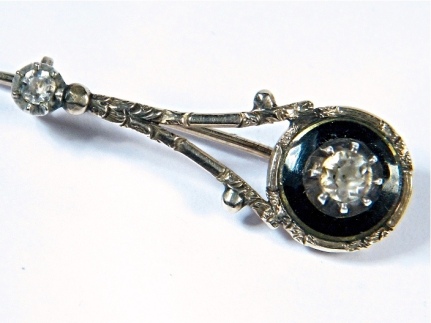
Halley’s Comet brooch, 1835. Ann Longmore-Etheridge Collection.
This piece from my collection is an antique English, 9-carat gold comet mourning pin. It is beautifully made, with a hand-chased stylized tail, black enamel embellishment, and a glittering foiled paste stone in silver settings, clearly displaying a black spot to simulate the open culet of a diamond.
The unusual shape of the brooch commemorates the return of Halley’s Comet in 1835. Although this piece neither contains a loved one’s hair nor bears an inscription, the use of black enamel almost certainly associates it with loss during the comet pass year.
Halley’s Comet is named after English astronomer Edmond Halley, who studied previous sightings and correctly predicted its 1758 apparition. The comet returns every 75 years, with its last apparition in 1986 and its next to come in 2061. I will be 98, if I live to see it.
The first report of the comet is from its pass above China in 467 B.C. (Centuries later, during another apparition, the Chinese would call it by the beautifully evocative name, “Broom Star.”) The British Museum, London, holds other documentation in the form of cuneiform tablets describing the comet’s appearance over Babylonia in late September, 164 B.C.




 Continental Square in York, Pa. Courtesy of the York History Center.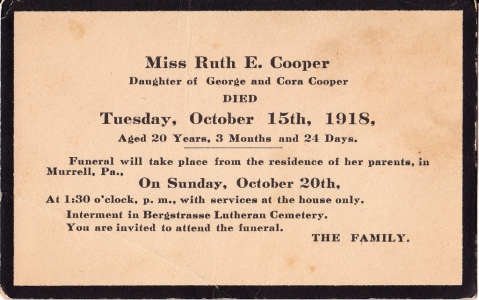



 "Your Dying Charlotte"