“There Lived an Old Man in Our Little Place”

Every village has its quirky characters. My own, Myersville, Maryland, was once home to a cantankerous teacher, reverend, and still-breaker nicknamed “Buffalo Bill.”

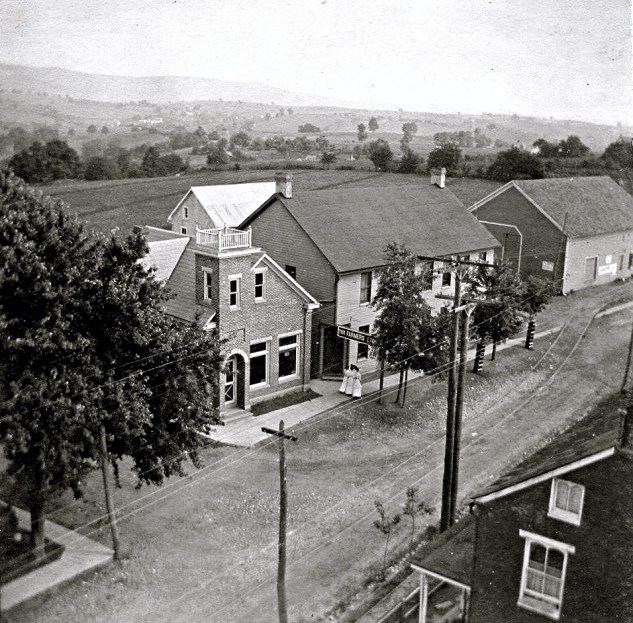
21494943410_24cc065112_o
Main Street and Wolfsville Road, Myersville, Maryland, circa 1905. Courtesy Myersville and Wolfsville Area Historical Society.

Myersville—Emphasizing the need for lights in the streets of Myersville, there was a stoning encounter on Saturday night, when Robert J. Ridgely, a school teacher at Burkittsville and a resident of Myersville, was stoned by four or five young men of the town. Reports have it that Mr. Ridgely stoned back, but as the teacher could not be located this morning, this could not be verified.

img-1
Frederick News, 6 October, 1915

Mr. Ridgley has an ugly cut over one eye, which bled profusely, and Wilber Shepley, one of those in the in the party stoning Mr. Ridgley, also has a cut, probably inflicted by a stone, although one report has it that Mr. Shepley sustained the cut by striking a telephone pole, while running.

“The stoning incident has aroused a number of people in the town, and it is stated that there is a stronger sentiment for electric lights, many residents claiming the affair would not have happened had the town been well lighted.”

The victim in this article, Robert Johnson Ridgley was born in Myersville in January 1867 to William Worth Ridgley (1822-1901) and his wife Martha Matilda Johnson (1834-1920). (Note: The family name is spelled variously as Ridgely, Ridgeley, and Ridgley. For consistency only, I am using the latter.) William Ridgley was well-known in the area for his success as a farmer although he was blind. His tenacity and determination were inherited by his son.

As an adult, Robert Ridgley received a scholarship from the Maryland State Normal School in Baltimore, later rechristened Towson University, starting his studies in September 1895. Before that, he was a teacher at Loys Public School. After his father’s death, he lived with his mother and a servant, Susan Shank, the latter of whom worked for Ridgley until at least until 1940. Keeping a long-term, live-in servant of this type is a positive testimony to Ridgely’s character, which was sometimes maligned by his fellow Myersvillians.

Continue reading ““There Lived an Old Man in Our Little Place””
Mayhem, Mishaps, Murders, and Misdeeds

Whenever the modern world seems unprincipled and bleak, take comfort. It ran amok in the old days, too, as these Victorian news clippings attest.

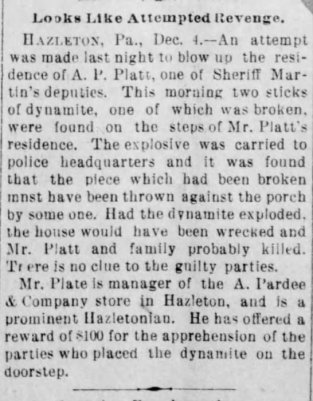
img-15
York, Pennsylvania Gazette, Sunday, 5 December, 1897

“Looks Like Attempted Revenge”

“Hazelton, Pa., Dec. 4.—An attempt was made last night to blow up the residence of A. P. Platt, one of Sheriff Martin’s deputies. This morning, two sticks of dynamite, one of which was broken, were found on the steps of Mr. Platt’s residence. The explosive was carried to police headquarters and it was found that the piece which had been broken must have been thrown against the porch by someone. Had the dynamite exploded, the house would have been wrecked and Mr. Platt and family probably killed. There is no clue to the guilty parties.

“Mr. Platt is the manager of the A. Pardee & Company store in Hazelton, and is a prominent Hazletonian. He has offered a reward of $100 for the apprehension of the parties who placed the dynamite on the doorstep.”

victorian+ornaments+image+graphicsfairy2

img-16
Ottawa, Kansas Daily Republic, Monday, 4 October, 1886

“A Narrow Escape”

“Chicago, Oct. 2.—A number of very narrow escapes from death by fire occurred at No. 90 East Chicago avenue early this morning. The building is a two-story frame owned by John Johnson and occupied in the basement by Miss Julia Hogan as a restaurant; first floor as a saloon kept by Roose & Steuberg, and the second floor by John Johnson and family. Officer Moore saw the flames leaping from of the rear of the building, turned in the alarm and then ran to the scene to arouse the inmates. He rushed to Johnson’s rooms and seized two of the children, who were in a back room, and were nearly suffocated. In coming downstairs, he fell and injured his left hand and arm, but the children were not injured. Mrs. Johnson caught up the baby and escaped in her night dress, followed by her sister and husband. In Miss Hogan’s restaurant, in the basement, were sleeping Julia Hogan and Mary Esperson, Helen Larsel and Louise Norin. The last named, the cook, was aroused by the heat and smoke, which came from the kitchen. She called the proprietress, and they tried to gather some valuables, but the flames spread so rapidly that a retreat was necessary. Miss Hogan was compelled to run through the flames, and her arms were severely burned in attempting to save a dress, in the pocket of which was $56. The damage to the building was slight.”

victorian+ornaments+image+graphicsfairy2

Continue reading “Mayhem, Mishaps, Murders, and Misdeeds”

“Everybody Loved Her”: The Mysterious Death of Iola Haley Newell

“Her husband was the only one in the room, and he was asleep.”—Louisville Courier-Journal

ambro
The reverse inscription of this albumen print reads, “My Dear Sister Iola Haley Newell in her coffin, who passed away Oct. 31st 1901 in Somerset, KY. The two ladies you can see in the looking-glass are Dr. Joe Owens’ wife & Alma Owens Tibbals, two of Iola’s dear friends…. Iola Morgan, born Feb 5, 1924, named after Iola Haley. She died 3 years before I was born. Also Perry & Dorothea Haley’s daughter named after Iola Haley, too. (Everybody loved her.)” Ann Longmore-Etheridge Collection.

The earthly remains of Iola M. Haley Newell are buried in Somerset City Cemetery, Somerset, Kentucky, within the casket seen above. It was almost certainly white, with a crackled paint finish and colored velvet covering the pallbearers′ handles. The rest of the gently sunlit parlor held rich photographic detail. The fireplace was surrounded by colorful Victorian art nouveau tiles. On the wall, above the harp-shaped floral tribute, a paper or cardboard image of a blooming plant proclaimed, “The Year of Flowers.” Reflected in the mirror, along with two female mourners, were more images also possibly culled from “The Year of Flowers.” Behind the black-clad ladies was the staircase to the home’s upper floor.

It is a wistfully beautiful image: A bright-colored room, burgeoning with flowers in recognition of a beloved daughter, sister, friend, and bride of little more than a year, dead before age 30. The most likely causes of Iola’s demise should have been pregnancy complications or childbirth. However, there is no record of a child born alive or dead—and if the latter, we would expect to see the stillborn infant in the casket, beside its mother.

It is also clear from the photo that Iola was not the victim of a wasting disease, rather of something that cut her down in otherwise acceptable health. Her husband, Dr. John B. Newell, survived Iola narrowly, dying a year-and-a-half later. Newell worked in a field of medicine—dentistry—whose practitioners could be easily exposed to Tuberculosis and other contagious diseases. Another possible cause for one, or both, of the couple’s deaths was typhoid. An epidemic occurred in Pulaski County in 1920, and since the disease can be waterborne, contaminated waterways may have existed in the area in the decade before, when the couple was yet alive.

Continue reading ““Everybody Loved Her”: The Mysterious Death of Iola Haley Newell”

Murder in Miniature

A visit to the Renwick Gallery of the Smithsonian American Art Museum, Washington, D.C., to view the fiendishly intriguing Nutshell Studies of Unexplained Death.

39362300261_a7c21aaae9_k
‘The Barn,” or “The Hanging Farmer,”  a Nutshell Study created in about 1946.

Frances Glessner Lee (1878–1962), regarded as the “mother” of forensic science, was also the first female U.S. police captain, although the title was honorary. In 1936, Glessner Lee came by a sizable inheritance—her father was cofounder of the International Harvester Company—and she used it to help build a Department of Legal Medicine at Harvard Medical School. It was during the decade afterward that Glessner Lee crafted many of the 20 known Nutshell murder dioramas.

Corine May Botz wrote in The Nutshell Murders of Unexplained Deaths that “[Lee] took a special interest in training police officers because, as the first to arrive on the scene of a crime, they had to recognize and preserve evidence critical to solving the case. At the time, most police officers inadvertently botched cases by touching, moving, or failing to identify evidence. Lee was also extremely interested in better integrating the work of, and communication among medical experts, police officers, forensic investigators and prosecutors.”

In the Nutshell Study above, farmer Eben Wallace was found hanged in his barn. His wife told police, “When things did not suit Eben he would go out into the barn, stand on a bucket, put a noose around his neck, and threaten suicide. I always talked him out of it. On this afternoon, he made the usual threats, but this time I did not follow him to the barn right away. When I did, I found him hanging there with his feet through a wooden crate.”

Continue reading “Murder in Miniature”