Generations

The sap of another generation,
fingering through a broken tree
to push fresh branches
towards a further light,
a different identity.
—John Montague, “The Living and The Dead”

17059299707_6a48bb8d01_z
Elder and infant, albumen paper print, Ann Longmore-Etheridge Collection.

This wonderful outdoor image, circa 1910, shows a bonneted babe sitting in a wicker pram on an early spring day in the eastern United States. The child’s pudgy hand appears lightly pinched, rather than held, by the arthritic fingers of his or her grandmother—perhaps great-grandmother. The old woman, who was probably born in the 1830s, is magnificent with her weathered face and carefully coiffed, almost ruched white hair in contrast to her elaborate dark clothing. She seems quite elderly, but sturdy and strong. A house, possibly the family home, can be glimpsed through the leafless trees behind her.
14368768625_994dff5239_z
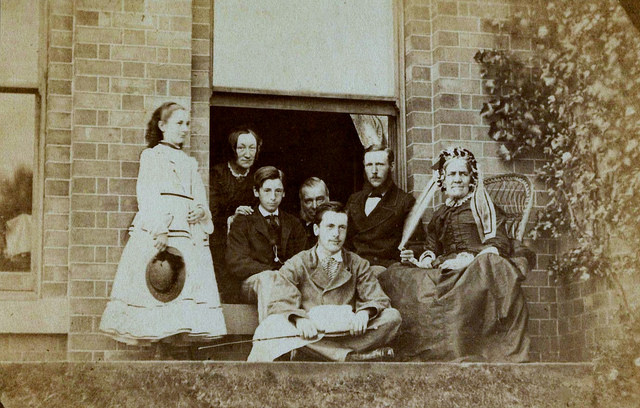
British albumen carte de visite, circa 1866. Ann Longmore-Etheridge Collection.

The next image is of a multigenerational British family posed on a ground-floor window ledge on a pleasant day during the mid-1860s. Grandmother, who is dressed in black-and-white widow’s clothing, sits in wicker chair, whilst Father and Mother lean into the picture from inside the home. Mum’s hand rests possessively on the shoulder of her youngest son, whilst the eldest brother perches on the sill and the middle son sits cross-legged below him. The daughter of the house, a tween in a jaunty summer dress, looks very much a mini-me of her mother.

14388887053_f7a101a1cb_z
Family in mourning, British albumen carte de visite, circa 1862. Ann Longmore-Etheridge Collection.

The third image, which is marked “J. McCornick, Photographer, 3 The Bridges, Walsall,” is more somber. One subject is a young girl of about 12 years beside an elderly gentleman who is likely her grandfather. The seated female may be the girl’s mother or her grandmother—it is hard to be sure, although they are clearly related.

The members of this family group are dressed in mourning, but nothing more of the nature of their loss can be supposed, except that the mother or grandmother was not mourning for her husband. The prevailing custom for widows’ bonnets was to include a white inset to frame the face.

Grandfather, whose hand appears to rest protectively on the small of his granddaughter’s back, holds in his other hand some type of folded document or wallet. The message he conveyed with this prop is now inscrutable, but it would have been understood by the carte de visite’s viewers.

The final image is a four-generation portrait, identified on the reverse as “Elizabeth Stokesbury, age 79 years; Clarissa Stokesbury, age 51 years; Extonetta Book, age 29 years; Esther Cook Book, age 3 years.”

daga1IMG
The sitters were photographed circa 1902 in Chariton, Lucas County, Iowa. Ann Longmore-Etheridge Collection.

At the far left is Elizabeth Clark (11 April 1824-5 Oct. 1910), born in Fayette County, Ohio, to Welsh native Joshua Clark (1795-29 March 1830) and his wife Mary Blaugher (1795-16 March 1879).

Elizabeth Clark married farmer John S. Stokesbury (7 Sept. 1819-12 May 1867), the son of Robert Stokesbury (1790–1839) and Anna Baughman (1794–1870). In 1850, the Stokesburys farmed in Jefferson, Green County, Iowa; by 1860 they had moved to a new farm in the county of Wayne. The couple had eleven children to assist them: Robert (b. abt. 1842); Angeline (b. abt. 1844); Mary Ann (b. abt. 1846); Joseph (b. abt. 1848); Sarah (b. abt. 1850); Clarissa (12 Sept. 1851-8 March 1935); Harvey (b. abt. 1853); John (b. abt. 1859); Elizabeth Ann (28 June 1861-9 Aug 1946); Clark D. (b. abt. 1863); and Launa (1865-1939).

At age 16, Clarissa, second from left, married a cousin, Jesse Bush Stokesbury (24 Jan. 1843-18 Dec. 1918), the son of James Madison Stokesbury (1813–1869) and Phoebe Painter (1819–1902). By 1870, Clarissa and Jesse had migrated to Chariton, Iowa, where, the family farm was enumerated on the 1870 Census. However, their days on the land were ended by 1880, when Jesse was recorded on the census as a laundry man, and on the 1900 Census he was enumerated as a day laborer. His widowed mother-in-law, Elizabeth Stokesbury, was also in residence, along with her youngest children.

Clarissa and John had the following sons and daughters: Bryant W. (b. abt. 1868); Hillary Edwin (13 April 1870-8 Feb. 1950); Theodosia (b. abt 1872); and Extonetta (b. Dec. 1873), second from right in the photograph, who was known as “Nettie.”

On 24 November, 1898, Nettie married harness maker and saddler John Atwater Book (Sept. 1864-17 April 1924), son of Harlan and Emmaline Book. By 1900, the Books and their first child, Esther Cook (far right—and yes, Cook Book) all lived with Jesse and Clarissa Stokesbury. Nettie and John had two more children: Sarah E. (b. 6 Feb. 1902); and Jesse H. (b. 24 Dec. 1903). Sarah married Loren L. Adams on 12 September, 1935; Jesse married Fae Arza Wicks in June 1929. He died in January 1970 in Seymour, Indiana, and was buried at Chariton Cemetery.
s-l1600-1
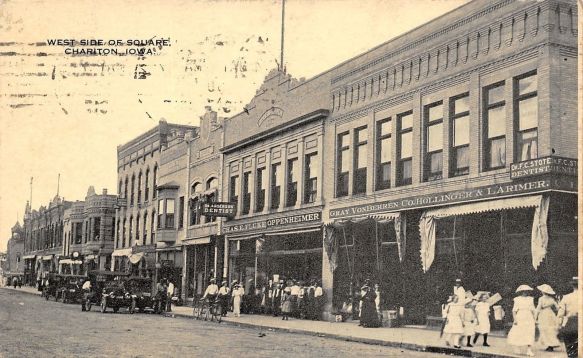
The west side of Chariton’s main square, real photo postcard, circa 1915. Ann Longmore-Etheridge Collection.

Nettie’s brother Edwin Stokesbury, who became a broom maker and married Ollie B. Ritter on 20 February, 1894, had set up house in Chariton by 1900. The couple had four children, but shortly thereafter the marriage failed. Ollie married as her second husband a man named Van Trump and Edwin’s children took their step-father’s surname. By 1920, widowed Clarissa and her son Edwin lived together.

In 1920, Esther Book worked as a bookkeeper in a Chariton store along with sister Sarah. On the 1930 Census, Nettie, Esther, and Sarah were enumerated in one household, with Nettie working as a sales lady in a variety store; Esther worked as a bookkeeper in a bank and Sarah was a tailoress in a dry goods store.

img-1

The Des Moines Register of 25 December, 1935, featured a testimonial advertisement by Nettie in which she was quoted, “I like the simplicity of operating the Colonial Furnace and the way it holds fire. The damper enables one to feed the fire so that no smoke, soot, or gas escapes into the rooms. And I like the draft in the feed door, which can be opened to prevent puffing.”

Extonetta Book died on 8 May, 1962, and was buried in Chariton Cemetery. It appears that her daughter Esther never married. She worked for many years as the secretary  of the Farmers Mutual Insurance Association and died 25 March, 1965, three years after her mother. Esther is also buried in Chariton Cemetery. Ω

The Miracle of Mr. Guppy

Clearly, I had to win the auction—the wishes of Mr. Guppy, whoever he had been, seemed evident.

9365969171_94fd059910_k
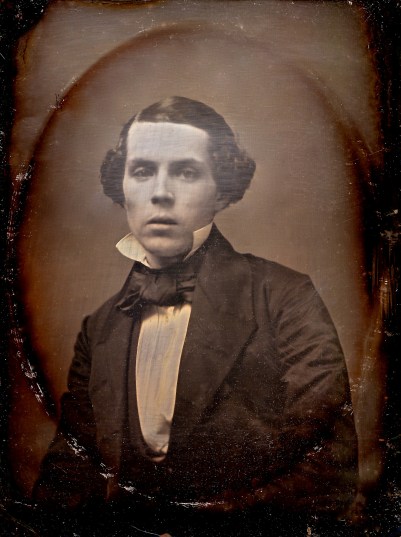
An unmarked 1860s albumen carte de visite of an 1850s daguerreotype of an unknown man. Ann Longmore-Etheridge Collection.

In July 2013, I purchased this carte de visite (CDV), which I recognized as an 1860s copy of an earlier daguerreotype. The subject reminded me of the English actor Burn Gorman in his role as Mr. Guppy in the 2005 BBC adaptation of Charles Dickens’ Bleak House. There was no inscription to identify the sitter, so in my Flickr photostream I titled the image “Mr. Guppy” and went on.

In January 2014, I stumbled across the auction of a 1/4-plate daguerreotype that left me gobsmacked. It was Mr. Guppy. The original image.

A conversation with the seller elucidated that the daguerreotype came from a Vermont estate, but there had been no accompanying CDV. The seller was equally surprised at the strange twist of fate.

Clearly, I had to win the auction—the wishes of Mr. Guppy, whoever he had been, seemed evident. I did not fail him; today, the daguerreotype and CDV are united in my care.

11890908765_3e2e0c0551_k
The original 1/4th-plate daguerreotype of “Mr. Guppy.” Ann Longmore-Etheridge Collection.

The daguerreotype’s brass mat is stamped “Jaquith, 98 Broadway.” According to Craig’s Daguerreian Registry, this was the gallery of Nathaniel Jaquith, who was active from 1848 to 1857 at that address.

Nathaniel Crosby Jaquith was born 30 April, 1816, in Medford, Middlesex County, Massachusetts, and died 24 June, 1879, in Elizabeth, Union County, New Jersey. He is buried in Green-Wood Cemetery, Brooklyn, New York. Jaquith was the brother-in-law Henry Earle Insley, also a daguerreian photographer, and he was the grandson of Nathan Jaquith, a private in Captain Timothy Walker’s Company, Colonel Greene’s Regiment, during the American Revolution, and the great-grandson of Benjamin Jaquith, who was also a private in that unit. Before taking up the new art of daguerrotyping in 1841, Jaquith operated a shop at 235 Greenwich Street, New York City, where he sold “Cheap and Fashionable Goods.”

img
An advertisement for Jaquith’s from the 16 August, 1841, New-York Tribune.

When I received the daguerreotype, I found the image packet had old seals, but there were wipe marks on the plate. My supposition is that whoever wanted the daguerreotype duplicated handed it to the copyist, who broke the original seals and removed the metal plate from the packet, as the CDV shows the tarnish halo surrounding the sitter. The copyist may also have cleaned tarnish that had developed on the subject’s face during the two-plus decades since the portrait had been taken. I am likely to be only the second person to break the packet seals in some 140 years.

For an excellent description of the elements of a daguerreotype packet, visit the Library Company of Philadephia’s online exhibit, “Catching a Shadow: Daguerreotypes in Philadelphia 1839-1860.” Ω

Louisa Linebaugh: Moving on from Myersville

At the start of the decade, she lived in a bustling family with every indication of prosperity, as her exuberant mid-1860s teenage fashion shows.

5532505937_97d637ff35_b
Written on reverse: “Louisa Linebaugh, Myersville, Maryland,” albumen carte de visite, circa 1963. Ann Longmore-Etheridge Collection.

Louisa Caroline Linebaugh was a distant cousin of mine through several of my maternal lines (Dutrow and Summers). She was born 11 September, 1846, in the small rural town of Myersville, Frederick County, Maryland, the daughter of wagonmaker, wheelwright, and farmer Jonathan Linebaugh (1807-1864) and his wife Catharine Shank (1813-1871), whom he married 10 April, 1835. Catharine was the daughter of Jacob Shank (1781-1867) and Catharine Dutrow (1785-1839).

Myersville, Maryland, has been my home for more than 20 years and was also that of my grandfather, Roy Cyrus Garnand, and many generations before him. Until the 21st Century, it was a contentedly rural place—and still remains mostly so, despite the growth of Frederick City and Myersville’s inclusion amongst the bedroom communities of both Washington, D.C., and Baltimore.

An early 20th Century topographical ode says of the town: “I turn away a moment to a landscape lovelier still, Where bloom the fields that circle ’round historic Myersville, And far beyond the village fair the mountains lift again, The blue peaks rising high above the rich and fruitful plain.” (Middletown Valley in Song and Story by Thomas C. Harbaugh, 1910.)

Some of my maternal ancestors were Swiss and Germans who came to Maryland in the 1700s. In 1707, the Swiss explorer Franz-Louis Michel traveled through the area, drew up a map, then went back to Switzerland. Hard on his trail was another Swiss explorer, Christoph von Graffenreid, who also mapped parts of the region. The activities of both these adventurers and their positive descriptions of the fertile land may have directly influenced my Swiss fourth-great-grandfather Georg Gernandt to set sail in late 1737 from Rotterdam to Philadelphia on the ship St. Andrew Galley. After landing on 24 September, Georg took the oath of allegiance and made his way through Pennsylvania to what is now Myersville, knowing that Lord Baltimore had officially thrown open the area for settlement in 1732. Another Swiss fourth-great-grandfather, Johann Jacob Werenfels, was born in Basel 28 January, 1731. He came alone to Philadelphia in 1749 aboard The Crown, which docked in Philadelphia on 30 August, 1749. Werenfels lived for a while in Berks County, Pennsylvania, where he met his bride Hannah Hartman. They later came to Frederick County. Jacob and Hannah Werenfels were the parents of 11 children and are buried in the middle of a wheat field on their farm south of modern-day Wolfsville.

linebaughmoravianphoto
An antique postcard of the Moravian Church in Oley where the Leinbachs worshipped.

The Linebaughs can be traced to Germany, where they generally used the spelling Leinbach. Johannes Leinbach was born in today’s Langenselbold, Isenberg, Hessen—then the princedom of the Count of Isenburg-Birstein—on 9 March, 1674, and is believed to have emigrated to America in 1723. By his death on 27 November, 1747, he was in Oley Township, Berks County, Pennsylvania—the father of at least seven children and a respected member of the Moravian Christian sect with its five guiding principles of simplicity, happiness, unintrusiveness, fellowship, and service. Leinbach’s eldest son, Friedrich Johan, was born July 15, 1703, in Germany, before his family emigrated, and died 6 July, 1784 in Graceham, Frederick County. John Linebaugh, as he became known, was the Linebaughs’ first ancestor in Maryland.

52ed0fe5-1943-4cd5-95a3-e91145d6f7a3
Alice America Linebaugh (1852-1926), circa 1870.

Louisa was one of nine children, all born in Myersville. The others were Sarah Ann (1836-1908), John Henry (1837-1911), Mary Elizabeth (1839-?), Ann Rebecca (1842-1843), Catherine Magdalena (1844-1889), Charlotte Maria (1849-1938), Alice America (1852-1926), and Howard Newton (1856-1900).

The years between 1860 an 1870 altered everything Louisa knew. At the start of the decade, she lived in a bustling family with every indication of prosperity—even in wartime, as her exuberant mid-1860s teenage fashion shows. But shortly after this carte de visite (CDV) was taken, on 26 December, 1864, her father died at the age of 57, and the family in Myersville rapidly dispersed.

p0572
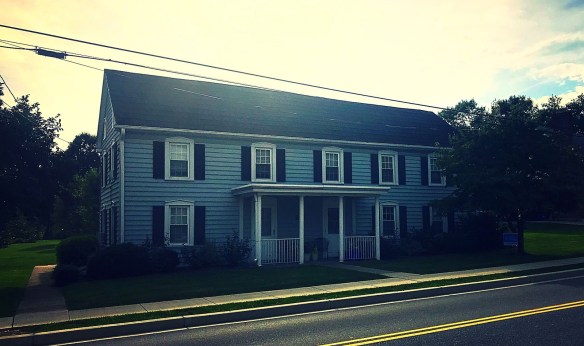
The home of the Linebaugh family in Myersville, courtesy of the Frederick County Historical Society.

One of those who left Maryland behind was Louisa’s eldest brother, John Henry. When the Civil War began, the young man was attending Dickenson College in Carlisle, Pennsylvania, in hope of becoming a teacher. He may be the Henry Linebaugh who served in the 7th Maryland Infantry. Or the truth may be that he was a reporter during the war, which was proposed by his descendant Pat Mulso, the executive director of the Freeborn County Historical Museum in Albert Lea, Minnesota.

“The story passed down is that John was a reporter during the war and unpopular in his version of journalism and his death had to be staged to save his life. Whether this is true or not, he did serve in the Civil War and he did leave his native state of Maryland after the war and moved to Ohio where he married my great-grandmother, Margaret Jane Patten. He taught school in Richmond, Ind., and walked home to Liberty, Ohio, on the weekends to be with his family,” wrote Mulso in a 10 April, 2010, article in the Albert Lea Tribune. “After getting established, he built a home in Ellerton, Ohio, located a few miles south of Liberty. He became a justice of the peace, a wagon maker, a funeral director, a steam mill sawmill owner, and operator and owned many farms in the area. He employed several workers and kept a daily journal of the daily events involving his business and life in general. I guess you could say that he was quite an entrepreneur in his time, but he had no success in collecting the debts owed him so my great-grandmother would have to hitch up the buggy and go collect the debts, of course, for a percentage of the money collected as her pay. They raised a large family with many tragedies occurring during the times, but were a very close and hard-working family.”

Back in Myersville, by 1870, only widowed mother Catharine and Louisa remained in the family home. Within a year of the 1870 census’s enumeration, her mother was dead, aged 58. Catharine Shank Linebaugh was buried beside her husband in the cemetery of St. Paul’s Lutheran Church, directly across the street from my present home.

16029176479_dc108de4fd_b
A section of Myersville’s Main Street, in which the Linebaughs lived, taken circa 1910 from the belfry of St. Paul’s Lutheran Church. Louisa would have known the pictured houses well, as they all date from her years as a town resident.

Apparently feeling no personal or financial reason to stay in Myersville, Louisa chose to emigrate to Ohio to join John Henry and his family. Once there, she met and married Henry Benton Getter (1850-1935). Henry was the son of George Getter (1805–1875) and his wife Mary Elizabeth Wertz (1808-1901). Getter was born 9 Oct 1850, in Ellerton, Ohio.

The young couple established a family farm in Jefferson, Ohio, and had the following children: Cora May (1875-1911), Florence Estella, (1877-1951), Ida Kate (1879-1964), Bessie Olive (1881-1958), Herman Cleveland (1884-1955), Carrie Effie (1888-1973), and Carl Victor (1890-1967).

After loading this CDV to my Flickr photostream, I connected with another Linebaugh relation who provided a transcript of a letter by Louisa’s son, Reverend Herman Getter of Emmanuel Lutheran Church, New Philadelphia, Ohio. It reads, in part: “Thru the kind Providence of God these two families became friends and grandfather George Getter married Mary Wertz about the year 1828. To their union were born 13 children—11 boys and two girls. Henry, being the next to the youngest, is my father. He was born on the old Getter homestead 7 miles south-west of Dayton, 4 miles South of National Soldiers home, in the year 1850…. My mother’s father [Jonathan Linebaugh] was a very pious man, having preached in the Church of the Brethren for a number of years. After the death of my mother’s parents [she came] to Ohio and made her home with her brother in Montgomery Co. not far distant from my father’s home. They afterward became acquainted and were married in the year 1874. Seven children were born to them 5 girls and two boys. I being the fifth oldest.

“My father’s people have always been a thrifty agriculture people…. Thru hard labor, they drained the swamps and cleared the forests, and made them to blossom like the rose. Surely God has given to none more noble ancestors, and finer [illegible] parents, than are mine. Happy and grateful am I that they are both living and enjoying the best of health. They reside on the old Getter homestead, having purchased it some years ago.

9d917011-ac7b-477f-ae33-36c8e60a9ab6
Louisa Linebaugh Getter in middle age.

“It was near this place where I was born on September 18, 1884. My parents being staunch Lutherans, I was baptized in infancy by the Sainted Rev. Albright who was at that time preaching in Salem’s Lutheran Church in the village of Ellerton. Early in life, I was taught to love the church and her teachings and was a regular attendant at Sunday School and Church Services. Many a time I would rather have gone fishing and swimming than attend church on a hot Summer’s day, but knew better than even suggest going, for Father was very rigid in this respect.”

The flavor of what Louisa’s Ellerton farm life was like can be glimpsed in a letter in the collection of the University of Alabama sent in April 1895 from  Ellerton resident Amanda Donatien to her sister Bell Cahill in Dayton. “We will not come over Easter. The horses has [sic] been working hard the last two weeks and besides, I think it your turn to come see me…. I have a lot of work to do right now. I am making soap this week,” Amanda noted. “Bell, I will come as soon as I can and when I do I will bring you some sewing to do. Now you must be ready to do it. Get your thimble ready. If I had any chance to send you some fresh eggs before Easter, I would do so.” Amanda concluded by saying that she must stop writing because her son was waiting to take the pencil to school.

getterLouisa Linebaugh Getter died 22 April, 1923, age 75 years, seven months, and 11 days, in Ellerton. She was buried 25 April, 1923, at Ellerton Cemetery. On her death certificate, the cause given is hyperthyroidism (Graves Disease), in which the thyroid kicks into overproduction causing weight loss, trembling hands, extreme tachycardia, anxiety, muscle weakness, and—worst of all—insomnia. The sufferers of Graves Disease can die, literally, of exhaustion, or can pass away suddenly from heart failure. How horrible the disease can be is something I understand, for I suffered from it when I was in my mid-twenties. Today there is a cure. In Louisa’s time, there was not.
Twelve years after his mother’s passing, the New Philadelphia Daily Times of 16 August, 1935, carried an item notifying parishioners that Rev. Getter had gone to Dayton to be at the bedside of his critically ill father. After a fortnight, on 29 August, Getter died in Dayton Hospital. Rev. Getter’s father was laid to rest beside his mother in Ellerton. Ω

29078300087_36581896e3_h
The former Linebaugh home in 2018.