“Curvature of the Spine Since Birth”

Carte de visite from the Ann Longmore-Etheridge Collection.

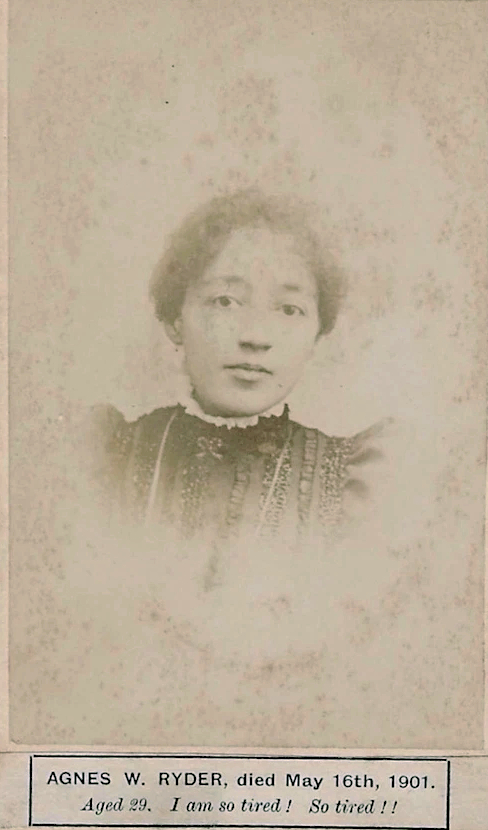
Agnes Warner Rider, pictured above, died on 16 May, 1901, at the age of 29. Presumably, her final words, as printed on this albumen carte de visite, were “I’m so tired. So tired!”

Agnes was born 18 January, 1872, in Southwark, London, to Charles Ryder (1846-1907), a printshop manager, and his wife Hannah Bramley (1847-1919), who both hailed from Loughborough, Leicestershire. Agnes, along with her other siblings, was baptised on 19 January, 1874, at Saint George the Martyr, Queen Square, Camden. At that time, her family lived at 10 Dunford Road, Holloway, London, in a small terraced home that still stands today.

The 1891 Census reveals that Agnes was the eldest surviving child in a family that included siblings Archie Hammond, Dudley Charles, Gertrude, Isabel, Henry Granville, Grace Hannah, and John Basil. Baptismal records indicate there was also a sister called Martha, born in 1878, one named Elizabeth Helen, born in 1868, and another called Marguerite, born in 1870. These three girls do not appear to have outlived childhood.

When the 1901 Census was taken, Agnes had but little time to live. She is listed as the eldest of a group of six children still in the home, along with Archie, Dudley, Henry, Grace, and John. One worked as a milliner, one as a dressmaker, and one as a merchant’s assistant. Archie had already married and become a young widower.

This census also reveals this clue as to why pretty, brown-eyed Agnes had not married or held a job: “Curvature of the spine since birth” was scribbled at the far right of the enumeration page.

In the Victorian era, spinal curvatures, like scoliosis and kyphosis, were prevalent. There were misconceptions about the causes of scoliosis, sometimes linking it to moral failings or perceived societal problems rather than solely medical conditions. Victorian attitudes toward spinal deformities reflected the broader societal views on disability, ranging from pity and fear to marginalization. Those with such conditions might be seen as “others” and face challenges in social and economic participation.

Illustrations from a 1916 publication on treatments for scoliosis. Wikimedia Commons.

Treatment options for spinal curvature were varied and often experimental. Doctors utilized braces and modified corsets for correction. Traction and immobilization techniques were employed to reduce the curve, sometimes with limited success and potential complications, like paralysis.

In the mid-19th century, surgeons began exploring surgical options like percutaneous myotomies (muscle and tendon cutting) and later, spinal fusions to address deformities. However, these procedures carried significant risks, including infections and recurrence. Some practitioners advocated for gymnastic exercises to strengthen back muscles and treat deformities, believing it was more effective than solely relying on braces.

While spine curvature was not often fatal, it depends on severity and type. In severe cases, it can lead to respiratory complications, cardiovascular issues, nerve damage, reduced mobility, and significant pain. Some or all of these could lend weight to Agnes’s departing words, “I’m so tired….”

Agnes Warner Ryder was buried on 22 May, 1901, at Highgate Cemetery, Camden. Her grave, Square 19, Grave 33932, remains unmarked.

Ω
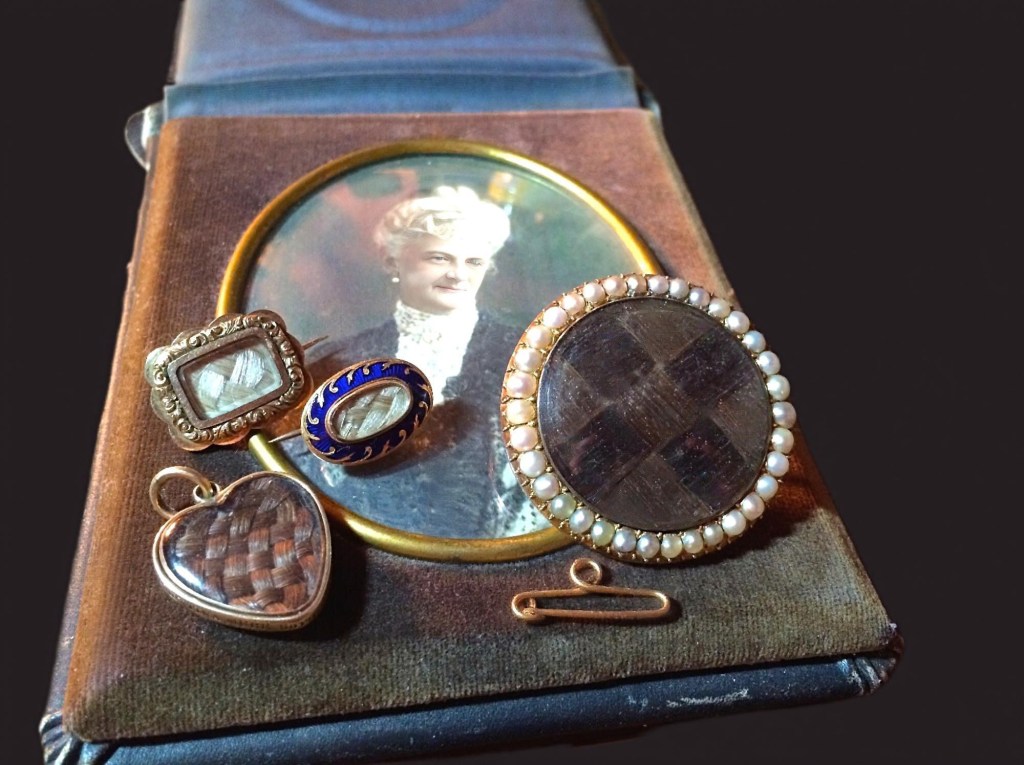
A Close Brush With Fame

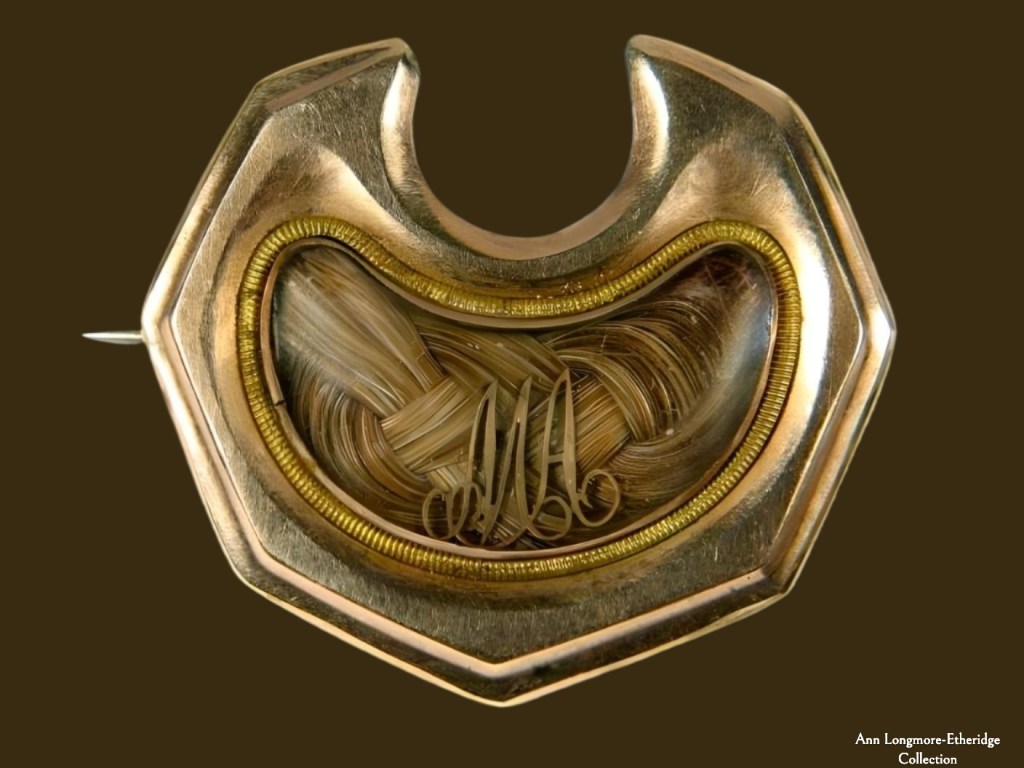
These are four brooches from my collection, each with a “fame adjacent” history. The large one at right holds the hair of wealthy City of London merchant Jonathan Wilson and Ursula Pinckback Wilson, his wife. The small brooch on the left commemorates Sophia Vansittart, sister of Nicholas Vansittart, Baron Bexley, Chancellor of the Exchequer for King George IV.

Sophia Vansittart

The small blue enamel brooch holds the hair of Englishman Joshua Brooks, who dined at Mt. Vernon with George and Martha Washington, and the fourth, heart-shaped, is Scottish and holds the hair of Helen Clementina Duff Muir. Her sister was Lord Byron’s childhood sweetheart, Mary Duff Coe.

Ω

Somber and Sensible Adornments

Gutta-percha hand and wreath mourning brooch, Circa 1870-1880.

Gutta-percha is a natural latex material derived from the sap of Palaquium trees. It has a rubber-like consistency but is tougher and more durable than typical latex. It was first introduced to Europe in the 1840s after the British surgeon William Montgomerie brought samples of it from Southeast Asia, where it was used by indigenous people for making handles and waterproof containers, for instance. The material quickly gained popularity in the West for its unique combination of toughness, flexibility, and water resistance. Early uses included medical instruments, walking stick handles, and insulating underwater telegraph cables.

Gutta-percha found a prominent place in jewelry, particularly mourning jewelry. The Victorian fascination with mourning—especially after the death of Great Britain’s Prince Albert in 1861—created a demand for somber yet elegant adornments. It was molded into brooches, lockets, and bracelets, often featuring intricate floral or Gothic-inspired designs. Gutta-percha’s dark, matte finish made it an ideal material for mourning jewelry, as it symbolized grief and modesty whilst being affordable compared to traditional materials like jet. Such pieces could also be purchased, premade and reasonably priced, at local mercantiles—unlike gold jewelry containing a lock of the deceased’s hair, which took time to produce by a jeweler. The gutta-percha pieces, therefore, were available for wear at funerals held a few days after death. The lightweight nature of gutta-percha and its ability to be carved into fine detail further solidified its status as a popular choice for commemorative and mourning pieces.

The following are examples from my collection of this type of mourning adornment.

Gutta-percha mourning locket with interior compartment for hair or a photo, circa 1875-1880.

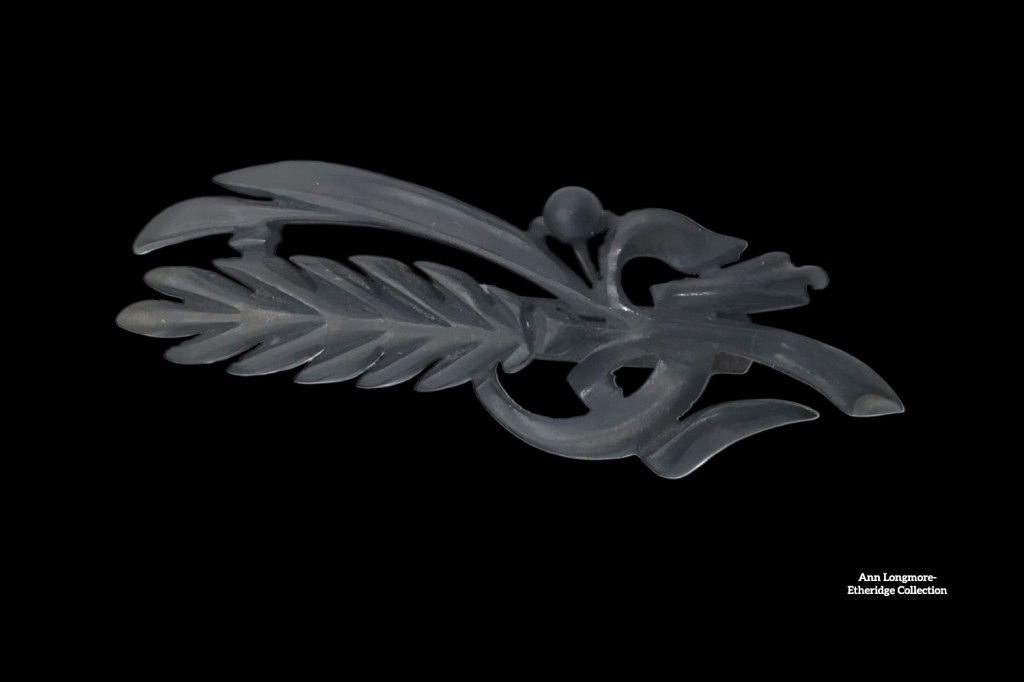
Gutta-percha scythe and wheatsheaf brooch, circa 1875.

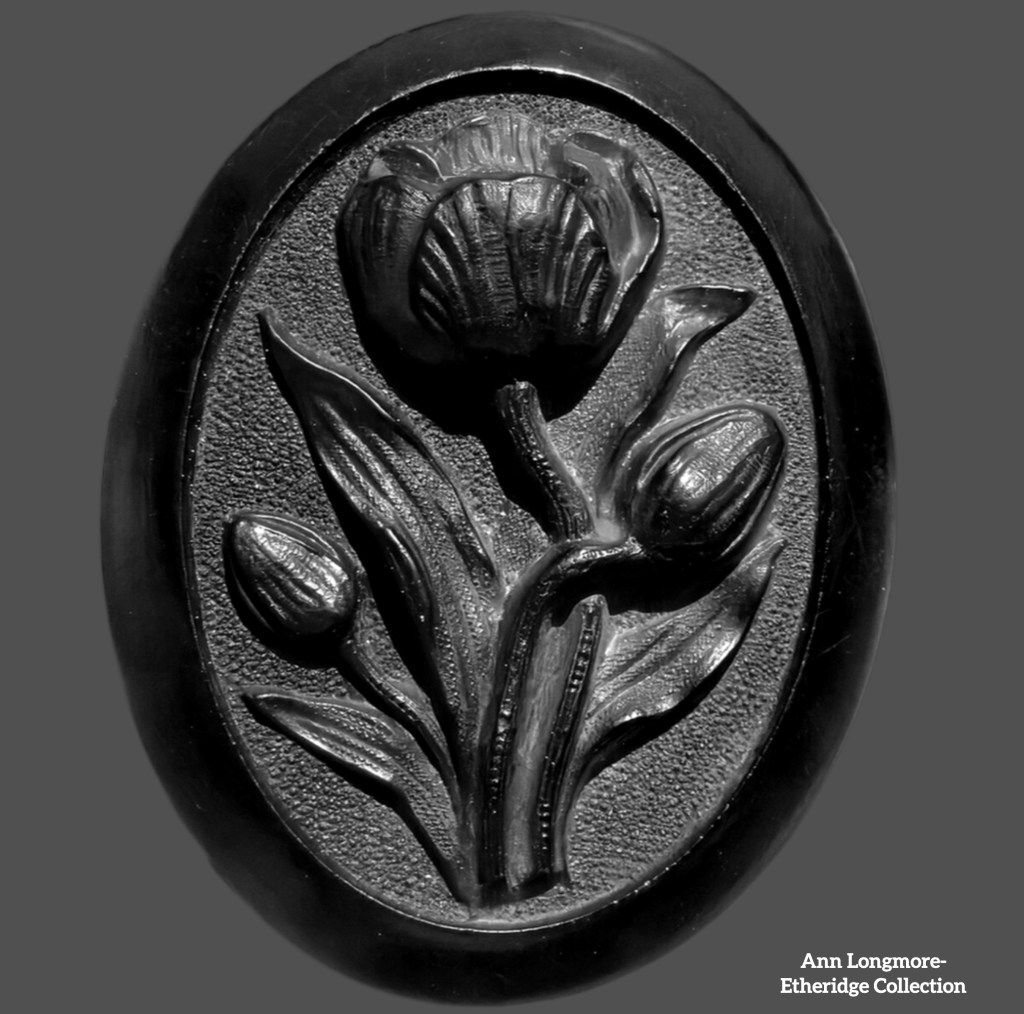
Gutta-percha tulip mourning brooch, circa 1885.

Cherub with a swag of flowers mourning brooch, 1865.

Large gutta-percha floral cross pendant, circa 1875.

Dutch gutta-percha equine brooch, circa 1885.

Irish gutta-percha mourning brooch, Circa 1880.

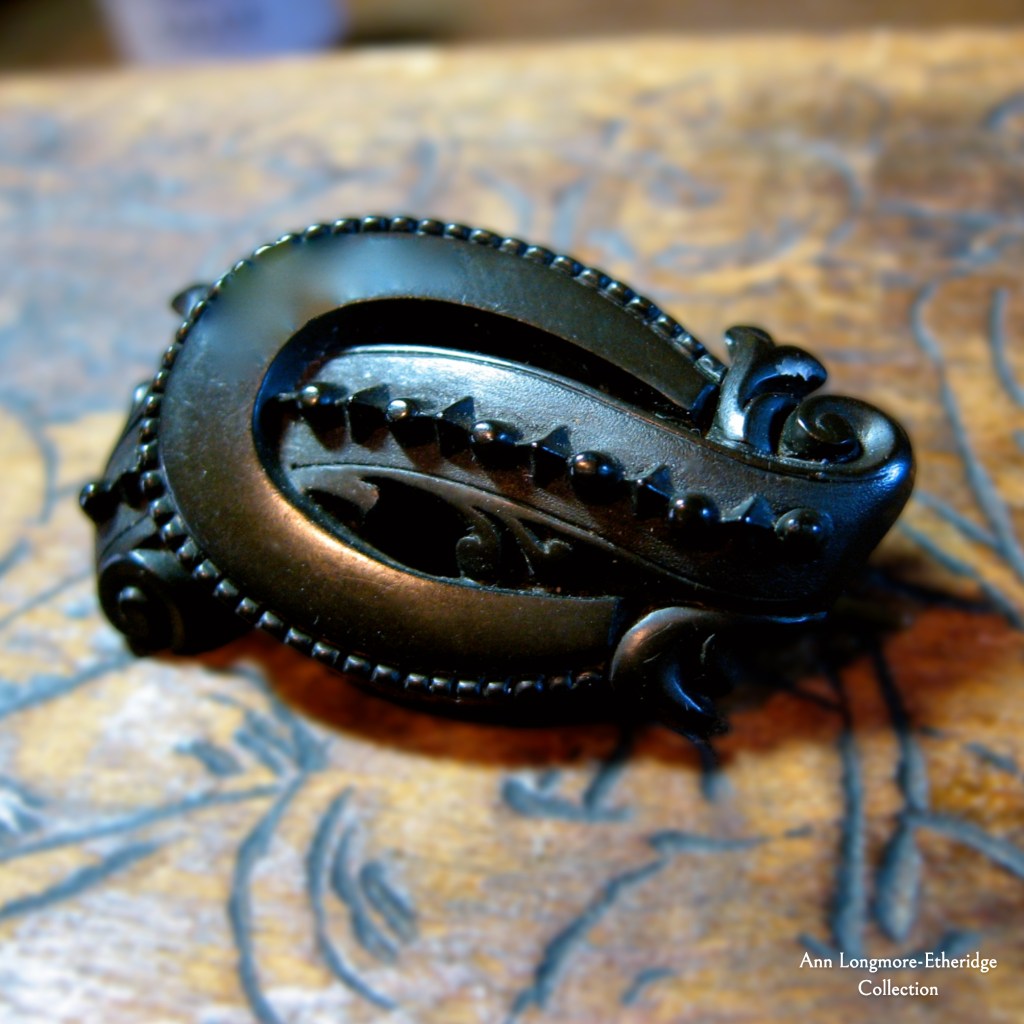
Horseshoe gutta-percha mourning brooch, circa 1870

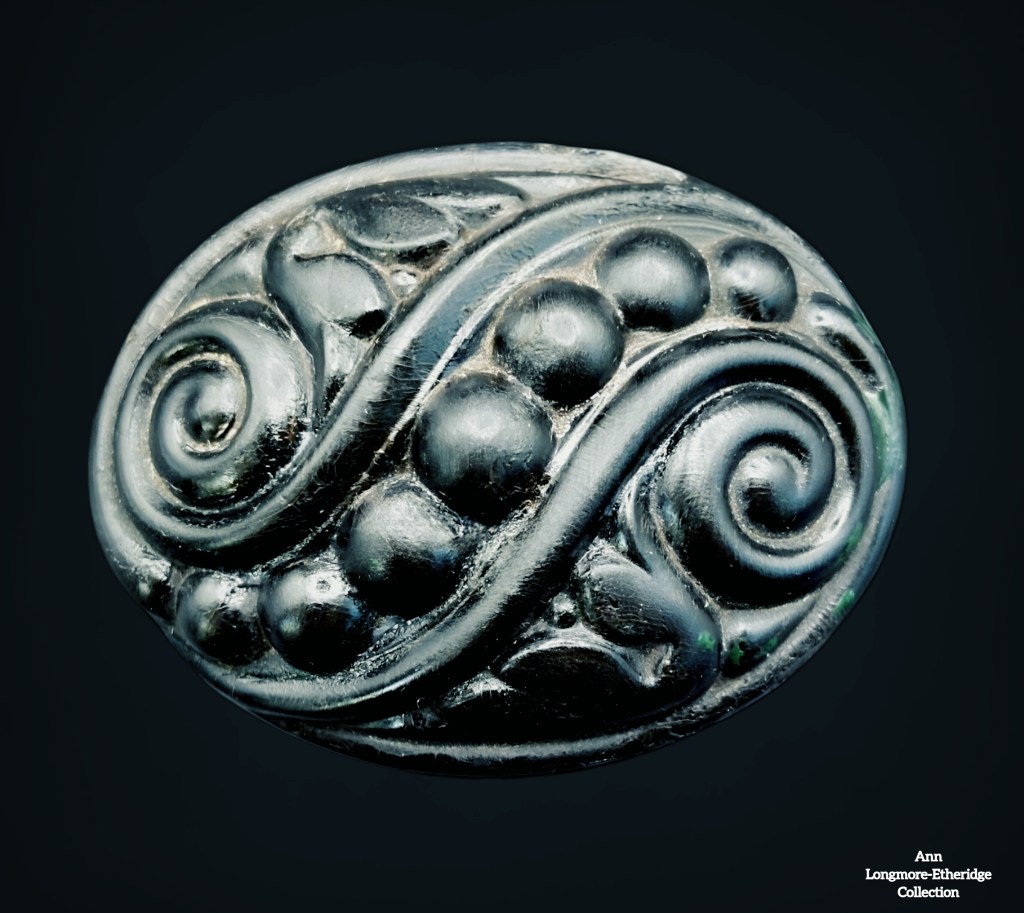
Swirling vines and dots gutta-percha mourning brooch, late 1800s.

Gutta-percha widowed bird mourning brooch, circa 1875.

Gutta-percha Isle of Man morning brooch, circa 1890.

Gutta-percha missing acorn brooch, 1860s.

Gutta-percha mourning brooch, 1870s.

Gutta-percha cameo brooch, 1860s-70s.

Ω

Life’s End at Stodday Lodge

“The Monthly Magazine or the British Register, Part one for 1809,” references the 14 December, 1808, death commemorated by this brooch: “At Stodday Lodge, near Lancashire, Mrs. Arthington, relict of Thomas A. esq. of Leeds, 52.”

The Arthingtons were Quakers, and Mary’s interment at the Friends Burying Ground “at the Moor Side near Lancaster” was arranged by the Friends. A request exists from one George Barrow to Robert Dean, “Grave-Maker,” sent two days after Mary’s death, ordering Dean to “make a Grave on or before next Third Day…and therein lay the Body of Mary Arthington of Lancaster…aged about 51 years.”

According to Quarkeriana, Vol. I, April 1894, Moorside, also known as Golgotha, was “about a mile from Lancaster…in which there have been over 100 interments…. Tradition says that formerly there were many stones removed by the desire of the Yearly Meetings Committee that once visited the meeting. One, a large, heavy stone chest, still remains, which is said to have been too large to move.” If Mary Arthington had a gravestone at the burying ground, sadly, it is long gone.

Below this entry, Robert Dean attests, “The Body above mentioned was buried twentieth day of Twelfth Month, 1808.”

The reverse of the brooch, engraved with, “Mary Arthington, died at Stodday Lodge dec 14th, 1808”. Ann Longmore-Etheridge Collection

Mary was born 28 May, 1757, the daughter of Robert and Jane Lawson, who were deceased by the date of Mary’s second union. When she married Thomas Arthington, a “common brewer,” in York on 14 July, 1785, she was known as Mary Whalley, the widow of Joseph, “late of Lancaster in the county of Lancaster, merchant.”

Mary married Joseph Whalley on 9 May, 1781, at the Quaker meeting house in Yealand Conyers, Lancashire. He was the son of Joshua Whalley, who was present at the marriage, and Bridget, his wife, who was already dead. Both Robert and Jane Lawson were also present, placing their own deaths (and Joshua Whalley’s) between June 1781 and June 1785.

A Quaker wedding, circa 1790.

Thomas Arthington was the son of Robert and Phoebe Arthington, born at Armley, Leeds Parish, Yorkshire, 5 December, 1743. His father had also been a common brewer, and like Mary, both Thomas’s parents were dead by 1785.

The Quaker document, while formulaic, is still so detailed that the wedding of the 28-year-old Mary and 42-year-old Thomas can almost be envisioned: “The said Thomas Arthington and Mary Whalley appeared in publick assembly [at the] Meeting House at Wray in the said county of Lancaster. And the said Thomas Arthington, taking the said Mary Whalley by the hand, did openly and solemnly declare as followeth, “Friends, in the fear of the Lord and before this assembly, I take this my friend, Mary Whalley, to be my wife, promising through divine assistance to be unto her a loving and faithfull husband, until it shall please the Lorde to separate us by death.” Mary then repeated the same to Thomas, whilst holding his hand.

Stodday Lodge, photographed in 2006. © Mr Chris Thoume. Source: Historic England Archive. This photograph was taken for the Images of England project.

The house where Mary Arthington died, Stodday Lodge, is a secluded dwelling set in wooded gardens near the old village of Stodday, four miles south of the city of Lancaster. Today, Stodday Lodge is a Grade II listed building known as Lunecliffe Hall. British Listed Buildings describes it as a “small country house, now house and office. Late C18 and early C19, with later additions. Sandstone ashlar, with ashlar dressings. Slate roof…entrance hall has Venetian-style panelled and glazed screens to rear and left, with fluted pilasters, moulded architraves with fluted keystones, and 2-light stained glass windows.” (The entire report on the house is here: www.britishlistedbuildings.co.uk/en-383029-lunecliffe-hal… )

Ω

A Master Mariner’s Mourning Brooch

5675739677_57abaab2c5_o
Mourning Brooch for Master Mariner Joshua Goodale, who died March 1850, aged 74. This gold-plated brooch has seen some rough handling. The plate is worn on the bezel surrounding the glass-capped compartment and the pin is missing. Ann Longmore-Etheridge Collection.

Joshua Goodale, master mariner, merchant, and agent for Salem Iron Company, was born on 1 November, 1775, in Salem, Essex County, Massachusetts, and died 3 March, 1850, in Boston, Suffolk County, Massachusetts.

He was the son of Joshua Goodale (1753-1795), a blacksmith, and Mary Henfield (1752-1821). His siblings were: Lydia (b, abt. 1782), who married Solomon Towne; she married, secondly, Hale Late of Newbury; Poll (b. abt. 1784); Thankful (b. abt. 1787), who married Nathan Green on July 15, 1813; Hannah (b. abt. 1790); and Nathan (b. abt. 1793).

Goodale was already an old name in Salem by the time of Joshua’s birth. Robert Goodale with his wife Katherine Killam and three children came from England on the ship Elizabeth in 1634. After immigrating to Massachusetts, the couple had six more children.

According to the Pickering Genealogy: Being an Account of the First Three Generations of the Pickering Family of Salem, Mass., by Harrison Ellery and Charles Pickering Bowditch, “Mr. Goodale began his business life in the counting-room of the eminent merchant William Gray, and, in 1794, was sent by him to the West Indies as a supercargo. He afterward became the agent for the Salem Iron Company, and at one time was in New Orleans in business. On the decline of trade in Salem, he moved to Boston.

“Mr. Goodale was a man of spotless character, very temperate, and even abstemious in his habits. His form was erect, and his gait elastic to the last, while he retained the manners of a gentleman of the old school. He was inclined to reprove the errors of others, but always without harshness, and in a way peculiar to himself. At the time of his death, Mr. Goodale was the oldest member of the Park Street Church, Boston.”

On 22 October, 1804, in Danvers, Essex County, Massachusetts, Goodale married Rebecca Page, the daughter of Captain Samuel Page (1753–1814) and Rebecca Putnam (1755–1838) of Danvers, the small village next to Salem. One of Rebecca’s relations was Ann Putnam, a chief accuser during the witch hysteria of 1692-1693.

The couple had a number of children: Joshua Safford (b. 6 May 1808); Samuel Page (b. and d. 1810); Rebekah Putnam (b. 1811); Mary Henfield (b. 6 March1814); Samuel Page (b. 9 August 1818), and Eliza Ann (b. 1819), of whom the Pickering Genealogy notes, “[Goodale’s] portrait, which was painted while he was in New Orleans, is now in the possession of his daughter, Miss Eliza A. Goodale, of Highland Avenue, Newtonville, Mass.”

Of his wife, the Pickering Genealogy states, “Mrs. Goodale’s father was a Revolutionary patriot. He enlisted at the breaking of the Revolution, and took part in the battles of Lexington and of Monmouth and was with Washington at the crossing of the Delaware and at Valley Forge. He also served in the campaign of 1779 and was present with company at the storming of Stony Point. After the war, he became a successful merchant, filled many public offices, and was distinguished for his integrity and moral worth. Ω

Our Darlings Rest Amongst the Flowers that Bloometh Over There

Mourning images from my collection.

14155000700_c0eeba020f_o
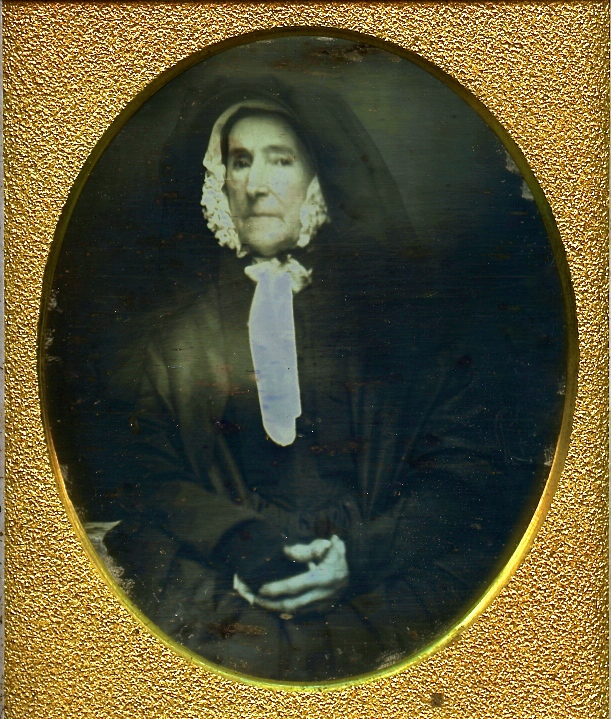
In this early 1/4th-plate daguerreotype, taken about 1845, a sad, proud widow peers at us through what seems to be a hole in time.

20040418006_495a4057a7_o
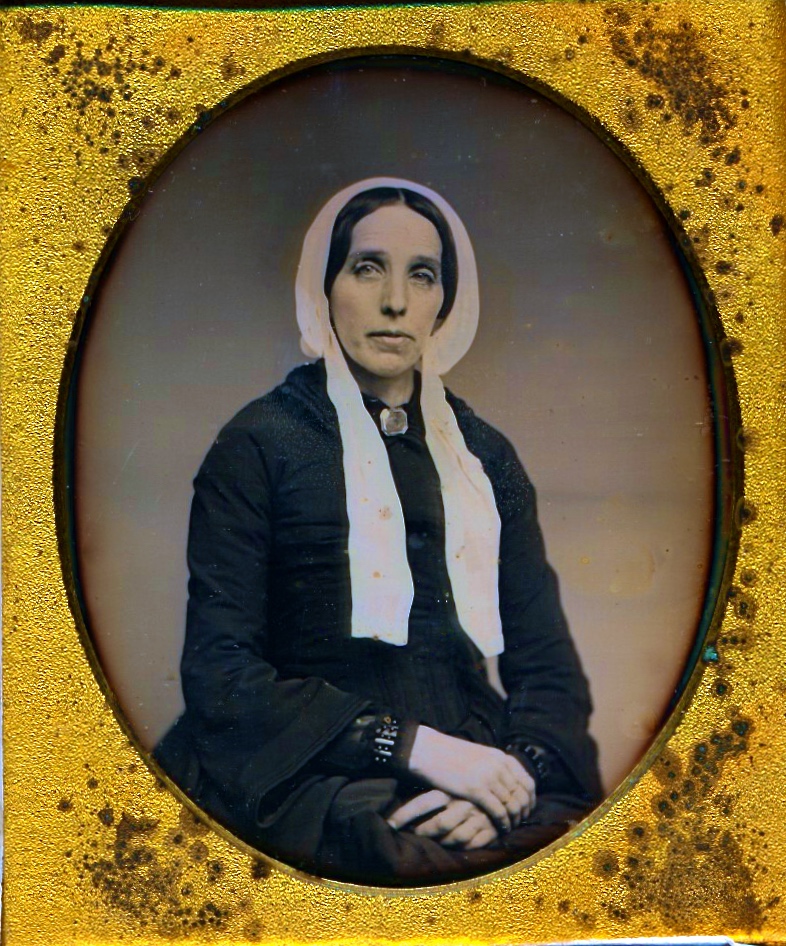
The sitter wears a white widow’s cap, a hair mourning brooch, and jet bracelets. The back of the plate is inscribed with the numbers “48-36-42,” the meaning of which is unknown. This 1/6th-plate daguerreotype dates to circa 1855.

8720607261_1a0a893a02_b
This hand-tinted 1/9th-plate Ambrotype was created in about 1858. The beautiful woman so stunningly colored by the photographer is almost certainly not a widow like the two ladies above. Widows, even in deepest mourning, wore white crape caps, bonnet ruches, or other touches of white, to indicate their status.

Continue reading “Our Darlings Rest Amongst the Flowers that Bloometh Over There”

The Memory of Mourning

ambro
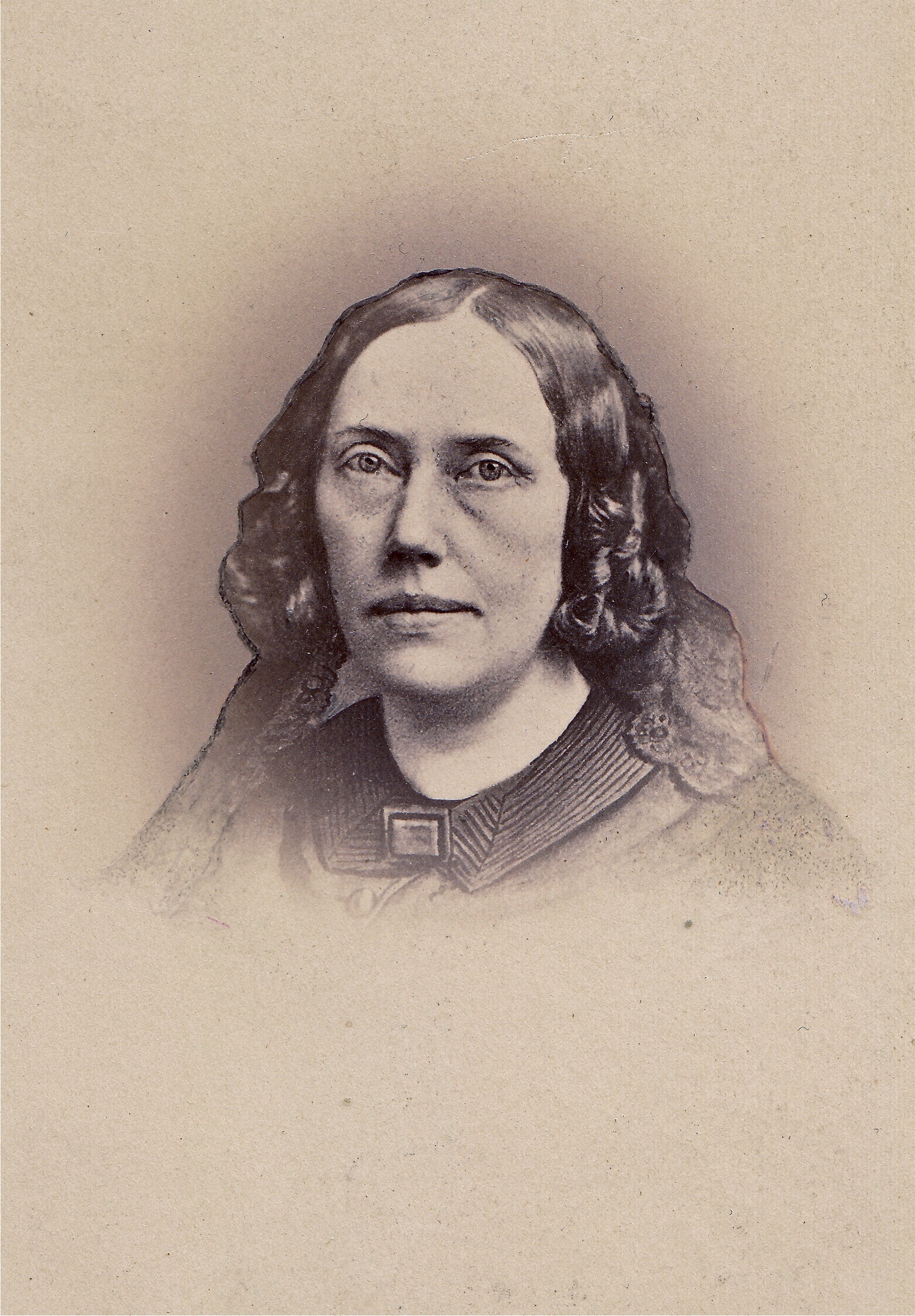
An albumen cabinet card copy of an earlier mourning image. It bears the mark “Broadbent & Taylor, 914 Chestnut Street, Philadelphia. S. Broadbent, W. Curtis Taylor.” Ann Longmore-Etheridge Collection.

This is a copy of an earlier photo–certainly either an ambrotype or daguerreotype. Photographers Broadbent and Taylor, or whoever owed this image, drew strengthening lines around the woman’s shoulders and head, as well as around her eyes and possibly lips. On the actual cabinet card, these lines are not really noticeable, but when blown up, they become quite evident.

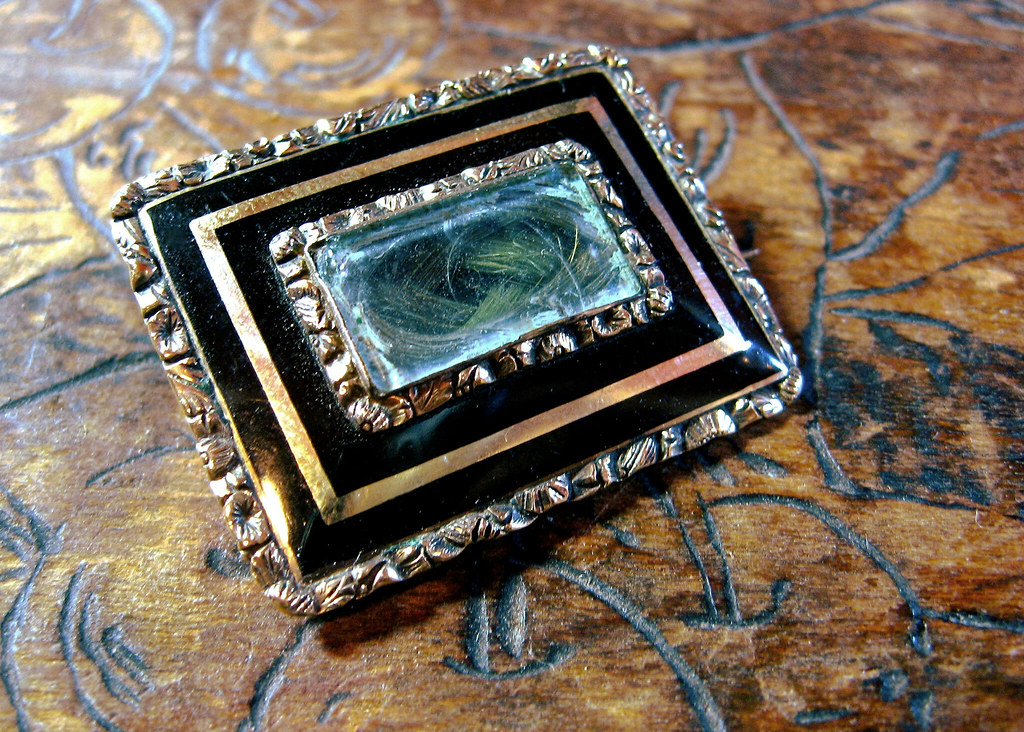
The sitter wears fashions that date the photograph to the 1850s. She wears a mourning brooch at her throat, its hair compartment and black enamel clearly visible. I have a similar brooch in my collection. The otherwise lovely piece below suffers from moisture damage. At some point in the past, water or humidity seeped into the brooch and now the hair is a shade of green, dyed by the metals that surround it. Ω

IMG_6070
Gold and black lacquer double mourning brooch inscribed “J & L Howlett,” circa 1855.

Like a Rainbow: Resurrecting Mary Avery White Forbes

15406826479_de5f06591b_b
Mary Avery White Forbes, colorized daguerreotype from the Jesse Cress Collection.

This glorious colorization by Sanna Dullaway returns vividly to life Mary White Avery Forbes, a 19th Century denizen of Westborough, Worcester County, Massachusetts. Her birth was recorded on 12 March, 1813, in Roxbury, to William White (1779-1848) and his wife Nancy Avery (17831865). In Mary’s time, Roxbury was already an ancient settlement first colonized by the Massachusetts Bay Colony in 1630; it is now one of the 23 official neighborhoods of Boston.

14837555242_733b2fa7c4_h
The original 1/6th-plate daguerreotype of Mary Forbes, Circa 1848, from the Jesse Cress Collection.

Mary’s future husband, Daniel Hall Forbes, born 5 September, 1808, in Westborough, was the son of Jonathan Forbes (1775-1861) and Esther Chamberlain (1770-1867). According to the 1892 Forbes and Forebush Genealogy: The Descendants of Daniel Forbush, Jonathan Forbes “always resided in the Forbes homestead, West Main Street…. He taught school when a young man. He was a captain as early as 1813, when he was elected deacon of the Evangelical Church, holding the latter office 48 years. He held most of the town offices and was a natural leader in church and town affairs. It is said he was always chairman of every committee in which he served.” The genealogy also notes, “His children, Susannah, Julia, Jonathan, Jr., and Daniel were all baptized Oct. 29, 1808.”

The group baptism was a sign of commitment to Christianity that the Forbes family kept alive for multiple generations. When he died more than four decades later, Daniel, the month-old infant christened that day, would leave hundreds of dollars to missionary societies. His daughter would die in a far away country, serving God’s cause.

Continue reading “Like a Rainbow: Resurrecting Mary Avery White Forbes”

“All Tombs Around Are in Its Splendor Lost”

The remarkable gothic revival, self-designed memorial to Victorian teenage paragon Charlotte Canda was a much-visited tourist attraction during the Victorian age.

12750966893_41fc754b74_o
Monument to Charlotte Canda, Green-Wood Cemetery, Brooklyn, New York. One half of a stereoscopic card, circa 1880. “Published by E. & H. T. Anthony & Co., Emporium of American and Foreign Stereoscopic views, chromos, albums, Magic Lanterns, and slides, 591 Broadway, opposite Metropolitan Hotel, New York.” Ann Longmore-Etheridge Collection.

Charlotte Canda (3 Feb., 1828-3 Feb., 1845) was the daughter of Frenchman Charles Francis A. Canda (1792-1866), of Amiens, Somme, Picardie, and Adele Louisa Theriott (1804-1871), whom he wed 10 May, 1824.

Charlotte’s mother’s ancestors were early French settlers of New York. Adele was the daughter of Gabriel L. Theriott and sister of Augustus B. Theriott (1808 – 1866), who inherited their father’s dry-goods business circa 1823 when he was still a teenager.

Screen Shot 2018-10-29 at 9.34.20 PM
New York Times, February 11, 1886.

It has been put forth that Charlotte’s father was an officer in Napoleon’s army and that he was a veteran of the Battle of Waterloo, after which he sailed for America. However, this is likely untrue. There was a Canda in the Battle of Waterloo, which occurred in June 1815, but that man was Charles’s brother, Louis-Joseph-Florimond Canda, who served many years as an officer in the French army, married Angeline, daughter of the Marquis De Balbi-Piovera from Genoa, immigrated to the United States, was an early settler of Chicago, and died there in 1886. The purported military backstories of both Candas are told almost identically in varying sources, indicating that Charles and Florimond have been conflated.

Continue reading ““All Tombs Around Are in Its Splendor Lost””

A Mirror Image of Mother

When Hannah McCracken Kelly died in 1855, she left two small children who would retain no memory of her and possess no photographic image other than this postmortem daguerreotype.

6973745659_6e44affef8_h
A 6th-plate, hand-tinted daguerreotype of “Hannah McCracken Kelly, our mother, taken after her death.” Ann Longmore-Etheridge Collection.

Hannah B. McCracken was the daughter of John and Mary McCracken (or Mecracken), who farmed in Claysville, Washington County, Pennsylvania, during the early 19th Century. Named after the “Great Compromiser” U.S. Senator Henry Clay (1777-1852), the town is located on the line of the Cumberland Road which forms its Main Street. Claysville is 18 miles east of Wheeling, West Virginia, and 10 miles west of Washington, Pennsylvania. The town was laid out in 1817 and remained unincorporated until 1832.

John McCracken was born about 1795 in Pennsylvania and died 28 December, 1865, in Claysville. His wife, Mary, the daughter of Samuel Caldwell of Buffalo Township, was born in about 1797 and died 4 August, 1878. The couple married in Washington County on 30 December, 1820. They are buried together in the old Purviance Cemetery, Claysville.

bruce-77
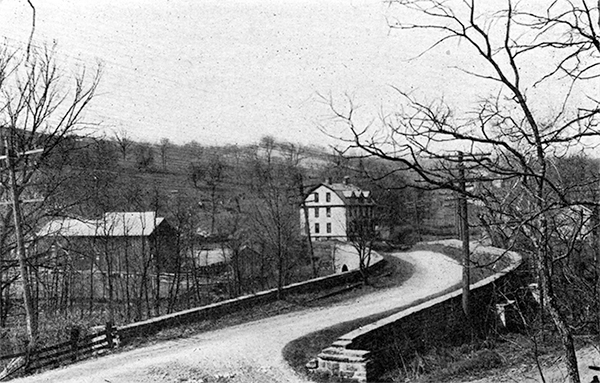
Claysville S-Bridge, built in 1815. The McCrackens and Kellys would have known this view. Photograph by John Kennedy Lacock and Ernest K. Weller, 1910.

Continue reading “A Mirror Image of Mother”