Harriet, Jeff, Aunty, and Anna

“I was not surprised when we received the notice of Aunty’s death. From what you had written to me I was expecting it.”

8606590430_3a57bbf01b_z
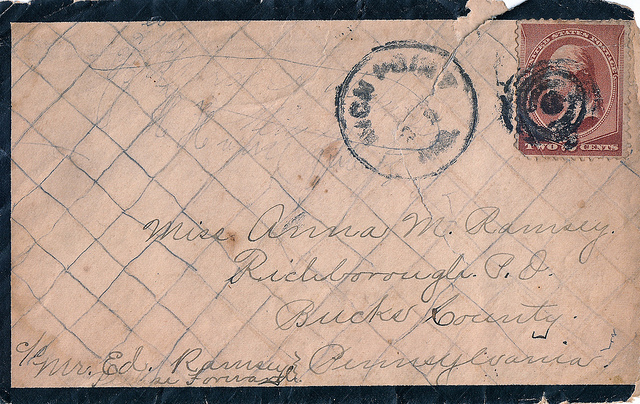
A mourning stationery envelope addressed to Anna M. Ramsey. Ann Longmore-Etheridge Collection.

To: Miss Anna M. Ramsey
Richborough P.D.
Bucks County
Pennsylvania
C/O Mr. Ed Ramsey
Please forward

High Point
April 27th ‘84

Dear Cousin Anna,

Yours of April 4 received. Was so glad to hear from you. I had looked for a letter for some time from Aunty. But have treasured up my last one from her. Anna, I sympathize deeply with your in your affliction. Your loss is her gain. But it is so hard to part with those we love so dearly but Aunty has only passed from this wicked world to a brighter and better one beyond. But oh the loneliness and sadness in the home without a mother or father. My heart aches for you, well I do remember the bitter pangs of suffering I passed through when I had to give up my dear mother. It seemed as though all the sunshine had gone out of the world. To this day I grieve for her. But time changes all things and we must be reconciled.

8605484017_8a93a9d8e5_z
Page one of the black-edged letter written on mourning stationery to Anna Ramsey.

I was not surprised when we received the notice of Aunty’s death. From what you had written to me I was expecting it. But felt very sad indeed. I wanted to come east last fall to see you all once more but Jeff was sick so long and so bad that we could not leave him. I think from what you tell me about Aunty she must have been (in her sickness) very much like cos Kate Hume (McNair). She did not suffer pain but had that distress feeling and sick at her stomach. She had a cancerous tumor.

Continue reading “Harriet, Jeff, Aunty, and Anna”

Beautiful, Bountiful Buttons

Gentle Readers, your Humble Proprietress is recovering from surgery and so shall share photographic images of antique and vintage buttons in lieu of a lengthy article.

38438539020_5f99b22a12_z
Metal and glass buttons from the Victorian and Edwardian eras.

Of buttons, Collector’s Weekly writes, “As long as human beings have needed to keep their clothing fastened, buttons have been there to do the work.” Buttons may be utilitarian, however, even well into the era of mass production, they were made to be reused on the garments of succeeding generations, resulting in little works of art that please collectors’s eyes today.

s-l1600-1
A small Victorian carved Mother of Pearl button featuring a steel-cut lizard, probably dating to the mid-1800s.

Many still recall our grandmothers’ button jars or boxes filled with delightful miniature wonders of carved shell, shiny metal augmented with brilliant cut-steel embellishments, luminous glass, light and fancifully shaped celluloid, and bakelite of eye-watering colors. I was born in 1963, my father in 1928, and my father’s mother in 1891. Some of my earliest memories are of Nanny, as I called her, sewing on a black Singer treadle machine richly decorated with Victorian gothic revival red and gold designs. As Nanny pumped the ornate foot panel in a soothing rhythm, I played in a pool of buttons scooped from the sewing machine’s cabinet drawers. I remember, especially, bakelite raspberries, as tart red as the real fruits, and a large navy blue button shaped like a bundle of roses. I have recently obtained a white version, seen below.

Continue reading “Beautiful, Bountiful Buttons”

Funeral Fragments

“When old Francis died in 1913, Dad sent him off in a hearse pulled by four black horses followed by mutes carrying ostrich feather wands and a procession of friends and family in the deepest mourning possible.”—Barbara Nadel

6297270408_005fc6f399_b
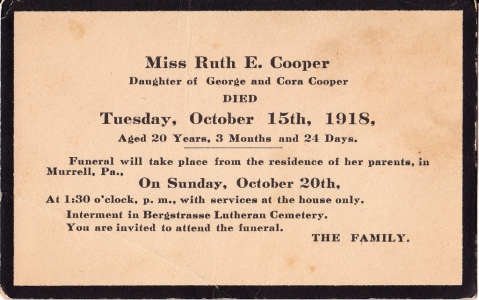
An invitation to the funeral of Ruth Evelyn Cooper, who died of pneumonia in the aftermath of influenza. She was one of upwards of 50 million people whose deaths were associated with the 1918 influenza pandemic. Ruth was born 21 June, 1898; she was the daughter of mail carrier George F. and Clara Good Cooper of Murrell, Ephrata Township, Lancaster County, Pennsylvania.
9587428394_61b9ea0e3c_k
This glass slide captures one moment in the lengthy funeral proceedings of Queen Victoria, as her coffin wended its way through London, 2 February, 1901. The slide is unmarked save for the handwritten inscription, “The Queen’s Coffin.” It does not appear to be part of a commercial set and may be a personal remembrance of the day taken by someone in the crowd. (Note the two boys looking down on the passing procession from the high wall on the right.)
14260852403_752914a036_h
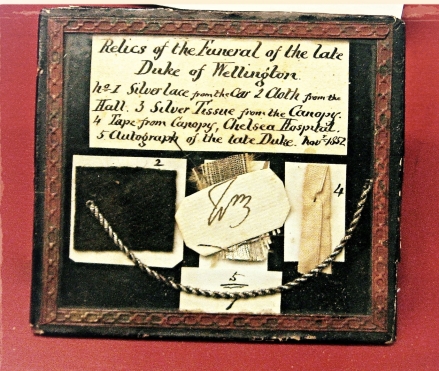
This photo shows ephemera from the funeral of Arthur Wellesley, 1st Duke of Wellington (1 May 1769–14 Sept., 1852). It resides in the museum of Carisbrooke Castle, Isle of Wight, England. The duke was beloved for leading the defeat of Napoleon’s forces at Waterloo, 18 June, 1818. He went on to become a prime minister and is still considered to be one of Great Britain’s chiefest politicians. The handwritten note reads: “Relics of the Funeral of the late Duke of Wellington. No.1 Silver lace from the car. 2. Cloth from the Hall. 3. Silver Tissue from the Canopy. 4. Tape from the Canopy, Chelsea Hospital. 5. Autograph of the late Duke, Nov. 1852.”

Continue reading “Funeral Fragments”

New Year’s Eve: Roaring End, Rowdy Beginning

New Year’s Eve was celebrated on 31 December for the first time in 45 B.C. when the Julian calendar came into effect.

anticipation 9
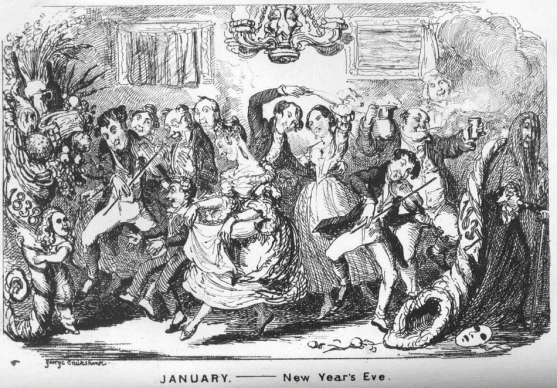
New Year’s Eve in the 19th Century was as jolly and booze-fueled as it is in the 21st. Here, Baby New Year 1838, the first born of the reign of young Queen Victoria, enters stage right as the black-draped old woman of 1837 departs stage left, taking with her the Georgian Era.
vintage-new-years-eve-celebrations-4
This New Year’s Eve party had it goin’ on. Conga lines—usually drunken Conga lines—became popular in the 1930s and remained so right through the 1950s. The Conga was originally a Cuban Carnival dance.
CXiMIVtUkAAT3eE
Nothing says Swinging ’60s New Year’s Eve like bullet-bra and hot-pants-wearing  go-go dancers workin’ it in a giant glass of champagne.

Continue reading “New Year’s Eve: Roaring End, Rowdy Beginning”

The McGrawville Experiment

In about 1849, a mother and child were photographed in a New York town where visionaries struggled to change the world.

music1IMG_0002
1/6th-plate daguerreotype from the Ann Longmore-Etheridge Collection.

A long inscription is penciled inside the case of this daguerreotype: “The picture of Flora and her mother, taken when she was three years old at McGrawville, Cortland Co., NY.

IMG_9675
The penciled inscription inside the daguerreotype case.

“I’ll think of thee at eventide/ When shines the star of love/ When Earth is garnished like a bride/ and all is joy a-bove/ and when the moon’s pale genial face/ is shed or [sic] land & sea/ and throughs [sic] around her soft light/ t’is then I think of thee. EM

“Flora & I are in the parlor as I write this, talking of the war, etc. etc. Henry …?… is buried Thursday Oct. 30th, ’62.”

The sentimental verse is likely based on “Better Moments,” by poet Nathaniel Parker Willis (1806-1867), printed in 7 July, 1827’s New-York Mirror and Ladies Literary Gazette, Volume IV, as well as and in the New Mirror’s Poems of Passion in 1843. Willis’s poem includes the lines: “I have been out at eventide/ Beneath a moonlit sky of spring/ When Earth was garnished like a bride/ And night had on her silver wing.” It is uncertain whether variants of Willis’s poem existed that included the stanza scriven in the case, or whether the writer “borrowed” a few lines of it for his or her own poetic creation.

Continue reading “The McGrawville Experiment”

LOL Cats of Yore

Long before Internet memes, the obsession with yowling, murderous, disdainful, aloof, and weirdly adorable felines produced trade cards that are still collected today.

1cats002
Adored today, cats were just as freakishly lovable to Victorians, as is proven by this circa-1890 blank advertising trade card.
24852460_10155936062904618_543411115094951409_n
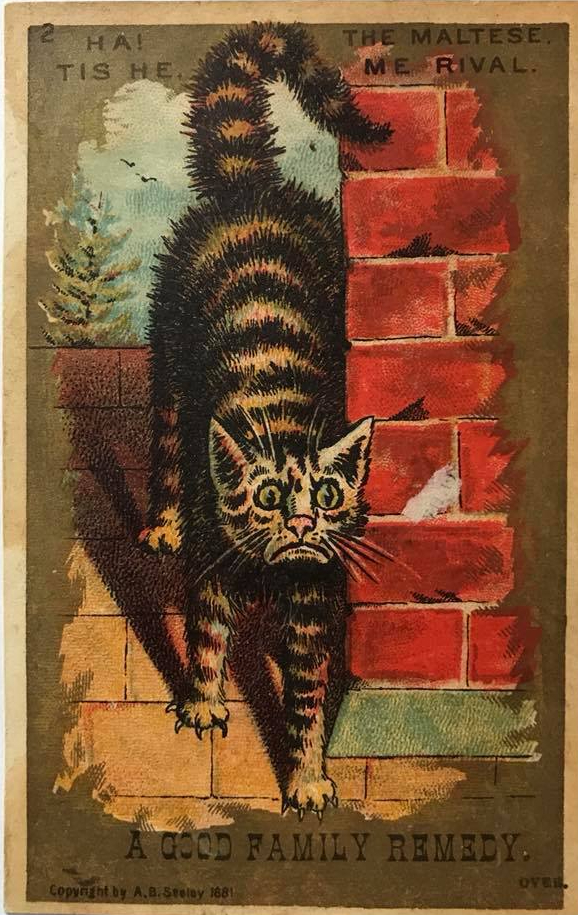
“Ha! Tis He. The Maltese. Me rival.” Remember the old saying, “Don’t forget to put the cat out”? There were once many more domestic felines who roamed the night, yodeling for love, murdering small animals, and creating loud mayhem when territorially challenged. This circa 1881 trade card was for Allen’s Lung Balsam, “For the cure of all affections of the lungs, throat and chest, such as consumption, colds, coughs, asthma, bronchitis, croup, whooping cough, pain or oppression of the chest, hoarseness, spitting of blood and all pulmonary diseases.” Drawn by A. B. Seeley. William H. Helfand Trade Card Collection.

Continue reading “LOL Cats of Yore”

The Silent Ones

Some pieces of mourning jewelry offer enough facts to fill volumes. Others are stealthy and secretive, unwilling to share the stories of the dead or their grief-stricken survivors.


IMG_9762
A large and beautifully carved Whitby jet mourning brooch for E.M.H., circa 1860. Purchased in Newbury, England.
IMG_6235
A tiny mourning or sentimental brooch, circa 1825, featuring the hair of two unknown individuals. What looks like finely woven hair inside some brooches is actually fabric called “checkered silk” inserted by the manufacturer, over which the hair relic was meant to be laid. Here, the contents of the viewing chamber clearly show the hair atop a scrap of this cloth.
8127639448_4fd319b4d1_k
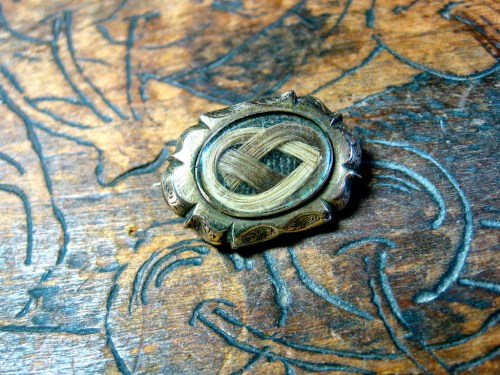
A Regency-era, gold eye-shaped memorial or sentimental brooch, circa 1800, purchased in Hungerford, England. It is more likely this is a lover’s-eye type brooch and not a mourning piece, although it is impossible to know with certainty. The brooch contains one person’s hair looped into a Celtic knot with similarly colored checkered silk behind it.
13969199482_7d0797583d_k
This mourning brooch, circa 1870-1875,  features Prince of Wales hair plumes of two individuals. It is a large brooch, measuring about 3 inches wide. The brooch is pinchbeck, but beautifully done and in immaculate condition. Sadly, there is no inscription. The date I assign is early 1870s, but this is provisional and based on what I can glean from references. It may be later; it may be earlier, but I doubt by more than five years in either direction. Purchased in Hungerford, England.
15409479607_63ac7e715f_k (1)
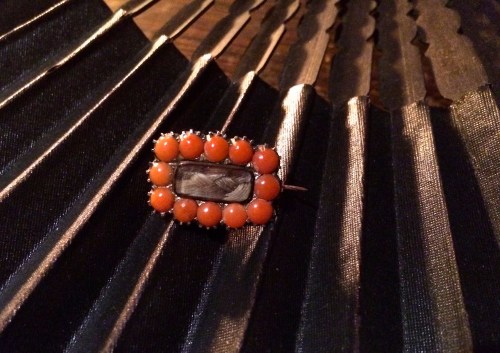
This English mourning or sentimental brooch of coral and Gold, circa 1820, contains what is likely braided locks from two people. While this may be a mourning item, coral was considered a protective substance for children. It may be that this tiny brooch, usually called a lace pin, may contain the hair of two siblings or of a child’s parents, or perhaps a child’s godparents.
7489896898_017e868b61_k
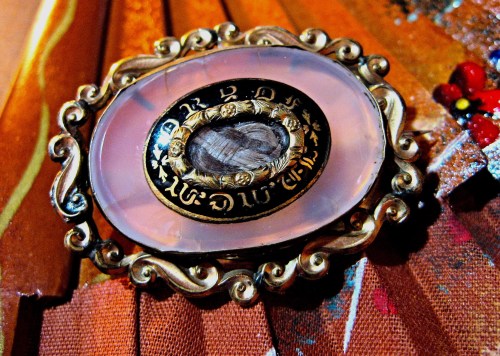
Agate mourning brooch of pinchbeck, agate, and black enamel, circa 1850. Inside is the interwoven hair of two deceased individuals. The gothic letters that encircle the viewing compartment read “In Memory Of,” a phrase used used throughout the 19th Century on mourning jewelry.

You’re A Grand Old Flag

Early images of the Stars and Stripes from the Jack and Beverly Wilgus Collection.

By Beverly Wilgus

BlueCoat_CW
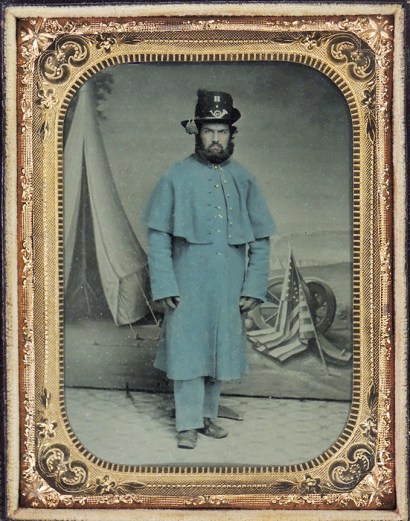
The earliest flag image in our collection is this ambrotype of a young Civil War soldier standing before a painted military backdrop of tents and an American flag. By necessity, it dates from the years of the conflict, between 1861 and 1864. He wears an enlisted man’s trousers, a blue-tinted cape coat, and a regulation enlisted man’s dress Hardee hat bearing the insignia “H” and “81” inside a brass infantry bugle. Five states had an 81st Infantry: Indiana, Illinois, Pennsylvania, Ohio, and New York. This fierce and determined Union soldier joined up from one of them. 
KittyFlags
This albumen stereoview card is from the 1871 “Kitty At Play” series by John P. Soule of Boston.

Continue reading “You’re A Grand Old Flag”

In Memory Of

Victoria’s grief drove into high gear the already strong public market for jewelry to be at worn during all stages of mourning.

IMG_3177
A selection of mourning jewelry from the Ann Longmore-Etheridge Collection. The difference is marked between the Regency and early Victorian pieces (far left and center) and the heavy black later Victorian items.

At the close of the 18th century and the early years of the 19th, memorial pieces with hair were generally small, delicate, and graceful. However, the oncoming Victorian era would turn “the entire ritual of mourning into a public display, and the jewelry changed accordingly, becoming larger, heavier, and more obvious,” wrote the curators of the Springfield, Illinois-based Museum of Funeral Customs in Bejeweled Bereavement: Mourning Jewelry—1765-1920.

AN00570342_001_l
Victoria in mourning. Courtesy British Museum.

In December 1861, Queen Victoria’s beloved consort, Prince Albert of Saxe-Coburg-Gotha, died of what is thought to have been typhoid fever. Married for twenty-one years, their happy union resulted in the birth of nine children. The forty-two-year-old prince’s demise shattered Victoria. For the rest of her life, the queen wore mourning and required many courtiers who served her and who attended court functions to do the same.

Victoria’s grief drove into high gear the already strong public market for jewelry to be worn during all stages of mourning. For example, in the first nine months, the only acceptable jewelry was made of black glass, dyed pressed animal horn, gutta-percha (a latex plastic derived from tropical evergreens), vulcanite and ebonite (rubber treated with sulfur and heat), bog oak (fossilized peat), or carved from jet (a fossilized wood that washes up on west coast Yorkshire beaches, and was extracted from shale seams, particularly around between Robin Hood’s Bay and Boulby). In later stages of mourning, gold or pinchbeck (a composite metal) and hair-work jewelry commemorating the deceased was worn. Many of these items bore the motto “In Memory Of” and featured heavy black enameling.

Continue reading “In Memory Of”

Gardeners Bring Cradle Graves Back From The Dead in Philadelphia

“Being a Grave Gardeners lets them contribute to a place that holds both personal and historic resonance.”

Grave-Gardners-2-768x531
Photo by Michael Bixler.

Through the stone gates of Woodlands Cemetery, a tranquil, verdant oasis thrives in the heart of University City. The Victorian necropolis, the last undeveloped parcel of the estate of botanist and plant collector William Hamilton, was preserved and a repurposed as a rural cemetery in 1840 as the city and University of Pennsylvania pushed westward. Today, The Woodlands is flourishing with the aid of creative placemaking and inventive programming.

The Grave Gardeners program is the most recent brainchild of Woodlands’ executive director Jessica Baumert and her staff. The cemetery is home to hundreds of “cradle graves,” tombs with both headstones and footstones connected by two low walls that create a bathtub-like basin. In the 1800s, family members of the deceased filled the French-style “cradles” with living, blooming coverlets of flowers. Cultivating these gardens on weekend outings to sylvan cemetery grounds like The Woodlands was a way of keeping a loved one’s memory alive. As descendants scattered and their memories of connections to Victorian ancestors faded, the gardens died out. The Woodlands’ Adopt-a-Grave program enlists the help of volunteers to revive these now scruffy patches of dirt and grass, one grave at a time.

To read this wonderful article in its entirety, click the link below.

Source: Gardeners Bring Cradle Graves Back From The Dead | Hidden City Philadelphia


Thank you to my dear cousin, Elizabeth Harrison, for calling this to my attention.