Mother Who?

The domestic dervish who authored this letter remains unknown.

15940859284_5b575cb9c3_h
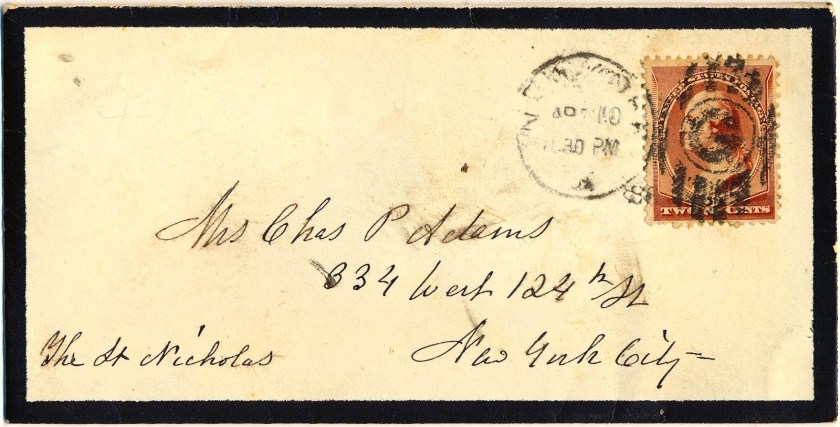
Mourning envelope containing a letter to Mrs. Charles P. Adams, 334 West 124th Street, New York City, postmarked 10 April, 1886. Ann Longmore-Etheridge Collection.

To: Mrs. Chas P Adams
334 West 124th St
New York City
The St Nicholas

The Windermere
April 10th 1886

Just a word Nela dear to tell you what I forgot to say yesterday—that Mrs. Pomeroy has been in town for a week, and is here for her health. So I fear she did not yet get your letter, and also that Grace and Fanny are going next week to Baltimore for a visit, so their house will be closed and any steps toward getting that drawing table must be taken without delay. I am sorry to trouble your mind with my matters, indeed your face full of care haunted me all night—but I can do nothing about the Bates property which others are holding.

And I wish of course to have the rooms as attractive as possible when parties look at them. A letter from Minnie W. to Julie—who is in town for a week—says she must give up her home for a while. I fear she intends renting it, and though hers is as large as mine, with only four bedrooms, it is a formidable rival with its pretty portieres and furniture. She has “lost seven letters since Xmas,” two of them contained checks! John W. is “investigating it.” So her letters to Julie are to be accounted for in that way. Julie is going to see her and has just gone to see “Mad Young Fulton” with the fee for the deposit as her last interview was unsatisfactory being “out of hours”—with the other parties waiting, therefore hurried. She received a letter from Mrs. Boyd this AM, offering her the Junior Department, with an assistant, at $400,” the decided wish of the Bishop and Hersey—“begging her not to disappoint them.” It is pleasant to have such an ultimatum if all else fails, and she need not decide now. But she prefers New York if it is possible to get something here. Don’t speak of these things until she or someone else tells you. You know she does not like to have her plans discovered and disseminated even in the family.

Continue reading “Mother Who?”

On This Day for Mothers

“Mothers, I believe, intoxicate us. We idolize them and take them for granted. We hate them and blame them and exalt them more thoroughly than anyone else in our lives. We sift through the evidence of their love, reassure ourselves of their affection and its biological genesis. We can steal and lie and leave and they will love us.”—Megan Mayhew Bergman

4715860088_170bbac360_o
From left, my grandmother, Lillian Marie Fox; my great-grandmother, Rebecca Murdock Fox; and my great aunt, Rebecca Fox, posed for this tintype in about 1901. Ann Longmore-Etheridge Collection.
11178332634_3e9d60169a_o
This tintype’s sitters were a beautiful turn-of-the-century mother and daughter who appear to be African-American. Courtesy Jack and Beverley Wilgus Collection.
5099229059_1a590a3bd5_o
An American mother sat outside with her children for this ambrotype taken on a clear day in about 1880. Ann Longmore-Etheridge Collection.
3360043331_837fa3d3cd_o
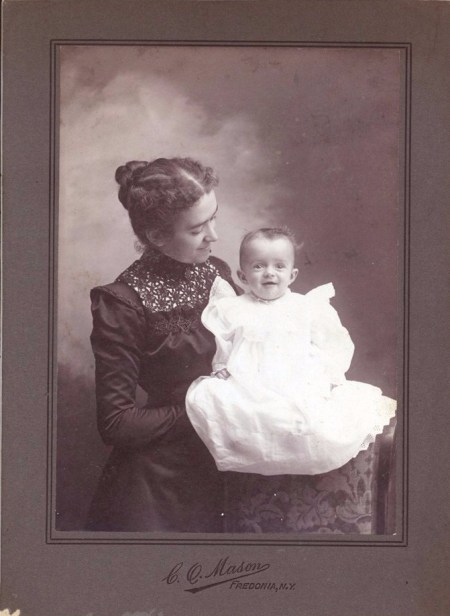
An adoring, late-Victorian mother and delighted child were the subjects of this albumen print on cardboard. Photo Courtesy Price and Zimmer Collection.
15981569687_60f65482d1_k
An unknown lady tenderly holds her baby in this circa-1875 carte de visite by Hills & Saunders, Oxford, England. Courtesy James Morley Collection.

Ω


I wish all mothers a happy day of love and peace. For all you have done and will do, you are saluted.

A Victorian Lady’s Guide to Hair Care

Here is a full and excellent article on how Victorian women cared for their hair by historian Mimi Matthews. Thrills and pomade await, gentle readers! Speed!

Mimi Matthews's avatarMimi Matthews

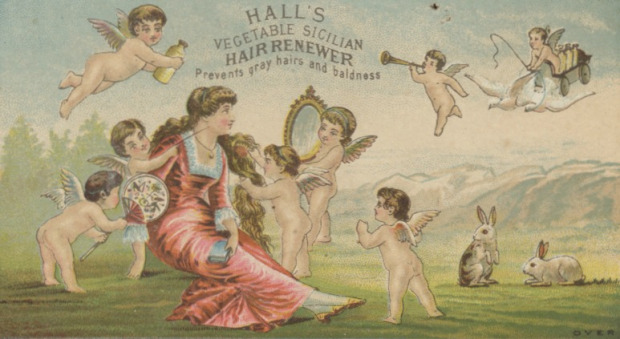
Hall's Vegetable Sicilian Hair Renewer, 19th Century Advertisement. Hall’s Vegetable Sicilian Hair Renewer, 19th Century Advertisement.

Since biblical times, a woman’s hair has been known as her crowning glory.  This was never more true than in the Victorian era – a span of years during which thick, glossy hair was one of the primary measures of a lady’s beauty.  But how did our 19th century female forebears maintain long, luxurious hair without the aid of special shampoos, crème rinses, and styling treatments?  And how did they deal with hair-related complaints such as an oily scalp, dry, brittle tresses, or premature greyness?

View original post 1,582 more words