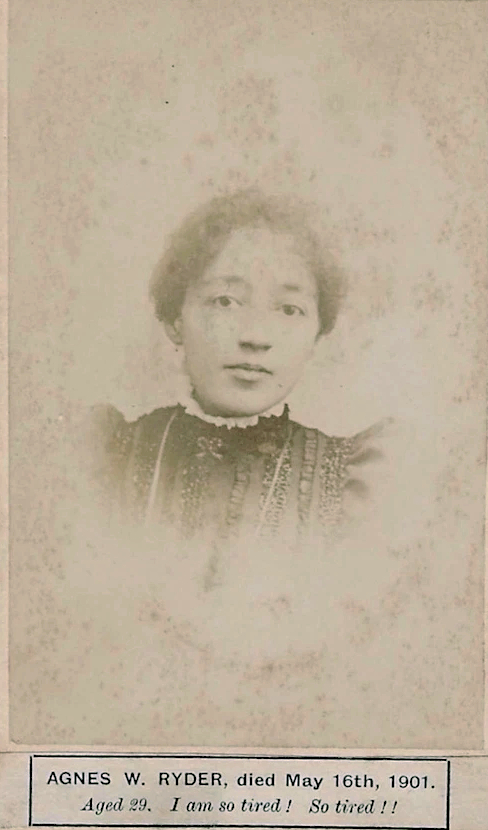
Carte de visite from the Ann Longmore-Etheridge Collection.
Agnes Warner Rider, pictured above, died on 16 May, 1901, at the age of 29. Presumably, her final words, as printed on this albumen carte de visite, were “I’m so tired. So tired!”
Agnes was born 18 January, 1872, in Southwark, London, to Charles Ryder (1846-1907), a printshop manager, and his wife Hannah Bramley (1847-1919), who both hailed from Loughborough, Leicestershire. Agnes, along with her other siblings, was baptised on 19 January, 1874, at Saint George the Martyr, Queen Square, Camden. At that time, her family lived at 10 Dunford Road, Holloway, London, in a small terraced home that still stands today.
The 1891 Census reveals that Agnes was the eldest surviving child in a family that included siblings Archie Hammond, Dudley Charles, Gertrude, Isabel, Henry Granville, Grace Hannah, and John Basil. Baptismal records indicate there was also a sister called Martha, born in 1878, one named Elizabeth Helen, born in 1868, and another called Marguerite, born in 1870. These three girls do not appear to have outlived childhood.
When the 1901 Census was taken, Agnes had but little time to live. She is listed as the eldest of a group of six children still in the home, along with Archie, Dudley, Henry, Grace, and John. One worked as a milliner, one as a dressmaker, and one as a merchant’s assistant. Archie had already married and become a young widower.
This census also reveals this clue as to why pretty, brown-eyed Agnes had not married or held a job: “Curvature of the spine since birth” was scribbled at the far right of the enumeration page.
In the Victorian era, spinal curvatures, like scoliosis and kyphosis, were prevalent. There were misconceptions about the causes of scoliosis, sometimes linking it to moral failings or perceived societal problems rather than solely medical conditions. Victorian attitudes toward spinal deformities reflected the broader societal views on disability, ranging from pity and fear to marginalization. Those with such conditions might be seen as “others” and face challenges in social and economic participation.
Illustrations from a 1916 publication on treatments for scoliosis. Wikimedia Commons.
Treatment options for spinal curvature were varied and often experimental. Doctors utilized braces and modified corsets for correction. Traction and immobilization techniques were employed to reduce the curve, sometimes with limited success and potential complications, like paralysis.
In the mid-19th century, surgeons began exploring surgical options like percutaneous myotomies (muscle and tendon cutting) and later, spinal fusions to address deformities. However, these procedures carried significant risks, including infections and recurrence. Some practitioners advocated for gymnastic exercises to strengthen back muscles and treat deformities, believing it was more effective than solely relying on braces.
While spine curvature was not often fatal, it depends on severity and type. In severe cases, it can lead to respiratory complications, cardiovascular issues, nerve damage, reduced mobility, and significant pain. Some or all of these could lend weight to Agnes’s departing words, “I’m so tired….”
Agnes Warner Ryder was buried on 22 May, 1901, at Highgate Cemetery, Camden. Her grave, Square 19, Grave 33932, remains unmarked.
This fine 1/6th-plate daguerreotype is of Caroline Hulda Felt, born 24 April, 1830, in Stow, Middlesex County, Massachusetts, United States. The portrait was probably taken on her eighteenth birthday in 1848.
Caroline, whose freckles and adolescent acne are visible, is wearing a gown well-suited for a willowy teenager: a gentle fan-fold bodice leads to a V-waist that creates the silhouette of a long, slender torso and sloping shoulders. Her bell-shaped skirt is gathered at the natural waist and is supported by multiple corded petticoats. By 1848, high necklines were the fashion for daywear, and Caroline’s appears edged with crocheted lace, as do her tight undersleeves. Whilst the material of her gown (probably silk) is patternless, the dress features attractive sleeve caps that echo the point of her bodice and are decorated prettily with buttons, embroidery, and fringe.
Caroline’s hair is twisted into a series of braids visible at the sides of her face and coiled around the back of her head. She also has two long, tight sausage curls dangling to touch her shoulders. The only jewelry Caroline wears is a plain band on the middle finger of her left hand. (Remember, daguerreotypes are reverse images.)
Caroline was the daughter of John Felt and his wife Huldah. According to The Felt Genealogy: A Record of the Descendants of George Felt of Casco Bay, John Felt was “born in Packersfield, Sept. 22 1798; died in Jaffrey, N. H., May 23, 1887. He married in Stow, Mass., March 29, 1825, Huldah Hobart Conant, daughter of John and Maria (Houghton) Conant. She was born in Stow, Oct. 3, 1803, and died in Jaffrey, May 27, 1867. Mr. Felt removed to Jaffrey in April, 1825, then after two years to Stow, but in 1831 he removed back to Jaffrey, where the remainder of his life was passed. He was a farmer, a prominent citizen, and filled nearly every office in his town, and was for five successive years a Representative in the State Legislature, and for many years a justice of the peace; a man in whose ability and integrity the public had full confidence.”
The Felt Genealogy goes on to note that “In October, 1860, he fell from a tree while gathering apples and received injuries that left him enfeebled and crippled for life, and for twenty-seven years, though shut out from the active duties of life, bore his sufferings with exemplary patience and cheerfulness, and never lost his interest in the affairs of the outside world. In politics, he was a whig and afterwards a Republican.”
The Felts first child, a daughter, was born 13 June, 1826, and died the following day. After this tragedy, however, the couple was blessed with a number of surviving children—among them John Conant, born in 1827, who became a dentist, a member of the Masonic Order, a justice of the peace, and a selectman in the town of Orange. Sarah Maria was born in 1828; Caroline arrived in 1830; Martha Ward was born in 1836, married Marett Evicth, a manufacturer of wooden mantels and other items, and lived in Philadelphia, Pennsylvania; and William Henry Harrison, who was born in 1841, but died young, in 1860, aged 19.
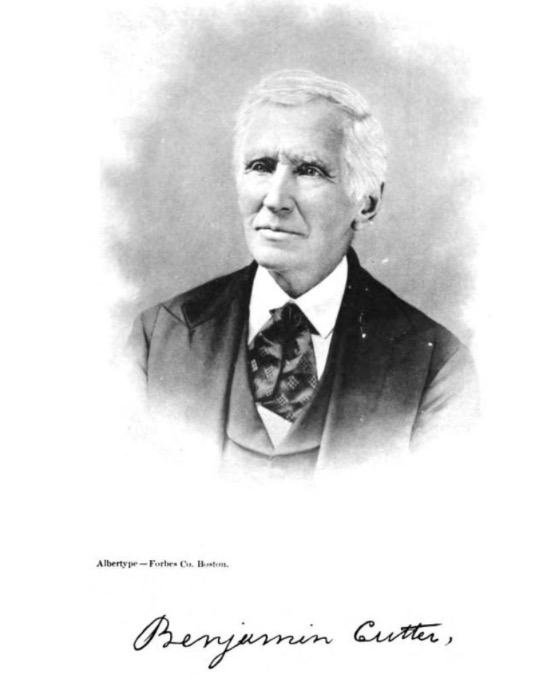
On 18 April, 1850, just a few days before her twentieth birthday, Caroline married Julius Cutter of Jaffrey, New Hampshire. They had likely known each other since childhood. Julius was born on November 28, 1824, to farmer Benjamin Cutter and Grata Cutter (nee Hunt). In the History of the Town of Jaffrey, New Hampshire, published in 1881, the author, William B. Cutter, thanks “Benjamin Cutter, Esq., a venerable citizen, now over 88 years of age, who has furnished much that is valuable from actual knowledge, being born and having always lived in town.”
Caroline’s father-in-law, Benjamin Cutter.
The text notes that “Benjamin Cutter has pursued the manufacture of leather in Jaffrey: first, in the original establishment erected by his father, and afterward, the building now occupied by his son Julius for the same purpose. He has been a prominent leading man in town affairs; for many years town-clerk, justice of the piece, and is now (1880) president of Manadnock National Bank, East Jaffrey. For several years he has been engaged in antiquarian research, and has a more extensive knowledge of the history of his native town than any other man living.”
One of Benjamin’s children, and Julius’s elder sister, was Sarah Augusta Cutter, who became wife of Dr. William Johnson Campbell, died at age 26, and of whom, it was noted, “[She] left manuscripts, poetically written, that have never been published. She possessed a ‘philosophic mind, and though she wrote poetry it was with a philosophic expression.'”
Another sister, Adaliza (1823-1852), married medical man Dr. Gurley A. Phelps. She also wrote poetry, but her work saw post-mortem publication in a 300-page volume compiled by her friends. Her husband said of her that “[S]he burst forth in a poet’s song—a simple expression of what she lived, she felt,” and who wrote “…not to be admired, but to be loved.” With both sisters dabbling in poetry, one wonders whether Caroline composed verses, too.
Julius and Caroline had two daughters: Emma Maria Cutter Mitchell (b. 7 June, 1853) and Alice E. Cutter (b. 1857).
At the time of Julius’s marriage to Caroline, he headed a leather tannery; by the following December, the Fitchburg Sentinel reported he had a boiler (presumably for the tannery) made by a Fitchburg fabricator. He was later was assessed for taxes in 1862 as a maker of buggy harnesses. At some point soon thereafter, Julius became a farmer who was iterated on the 1880 Census living with Caroline, his father, his eldest daughter, and his niece.
Main Street, Jaffrey, New Hampshire, circa 1905.The town was settled in 1758, incorporated in 1773 by Governor John Wentworth, and named for George Jaffrey, a member of a wealthy Portsmouth family. The Meetinghouse (below) was built in 1775.(Colorized postcard, “View from Cutter’s Hotel, Jaffrey, N.H.,” circa 1905.)
Julius died of pneumonia on 2 May, 1890, with his brother-in-law Dr. Gurley signing the death certificate. The executor of his Will was his daughter Emma, who attested she was “received of the estate of Julius Cutter one dollar and other valuable considerations, being my share in full of his estate,” and his wife Caroline, who attested to the same.
Widowed, Caroline lived for some time in Cambridge, Middlesex County, Massachusetts, with her younger daughter until Alice’s death in 1916. Caroline passed away 18 January, 1921, aged 90, in Cambridge. Her daughter Emma died of “senile dementia” and arteriosclerosis at an institution called Beverly Heights in Wilton, New Hampshire, on 3 October, 1937, at age 84.
Caroline’s simple obituary in the 19 January, 1921 edition of the Boston Globe.“CUTTER—In Cambridge, Jan. 18 at the home of her daughter Mrs. John Mitchell, Caroline H. Cutter, widow of Julius Cutter Esq. of Jaffrey, N.H., in her 91st year. Funeral in Jaffrey, Thursday, Jan. 20.
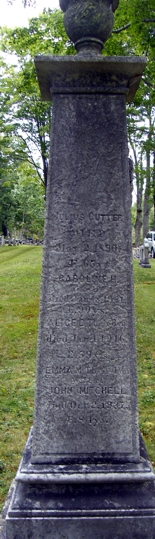
Caroline and her daughters were laid to rest in Cutter’s Cemetery, Jaffrey. An article about this place was written by Robert Stephanson in 2011 and published on JaffreyHistory.org. In it, Stephanson writes that the burying ground “…lies at the edge of the Jaffrey Center village on Harkness Road quite close to Route 124. In days past this section of Jaffrey could just as well be named ‘Cutterville’ because of the preponderance of Cutters, Cutter homesteads and Cutter businesses within earshot…. The cemetery was laid out …in 1836 in accordance with the wishes of John Cutter… [1765-1835] who lived beside the site chosen. His house, the largest in the village, still stands. At the start and for nearly a century the cemetery was for the Cutter family alone.”
Unfortunately, I have not been able to fill out Caroline’s life more fully. If more information is found, I will update this post.
Julius and Caroline Cutter’s tombstone in Cutter Cemetery, Jeffrey, New Hampshire.
Gutta-percha hand and wreath mourning brooch, Circa 1870-1880.
Gutta-percha is a natural latex material derived from the sap of Palaquium trees. It has a rubber-like consistency but is tougher and more durable than typical latex. It was first introduced to Europe in the 1840s after the British surgeon William Montgomerie brought samples of it from Southeast Asia, where it was used by indigenous people for making handles and waterproof containers, for instance. The material quickly gained popularity in the West for its unique combination of toughness, flexibility, and water resistance. Early uses included medical instruments, walking stick handles, and insulating underwater telegraph cables.
Gutta-percha found a prominent place in jewelry, particularly mourning jewelry. The Victorian fascination with mourning—especially after the death of Great Britain’s Prince Albert in 1861—created a demand for somber yet elegant adornments. It was molded into brooches, lockets, and bracelets, often featuring intricate floral or Gothic-inspired designs. Gutta-percha’s dark, matte finish made it an ideal material for mourning jewelry, as it symbolized grief and modesty whilst being affordable compared to traditional materials like jet. Such pieces could also be purchased, premade and reasonably priced, at local mercantiles—unlike gold jewelry containing a lock of the deceased’s hair, which took time to produce by a jeweler. The gutta-percha pieces, therefore, were available for wear at funerals held a few days after death. The lightweight nature of gutta-percha and its ability to be carved into fine detail further solidified its status as a popular choice for commemorative and mourning pieces.
The following are examples from my collection of this type of mourning adornment.
Gutta-percha mourning locket with interior compartment for hair or a photo, circa 1875-1880.
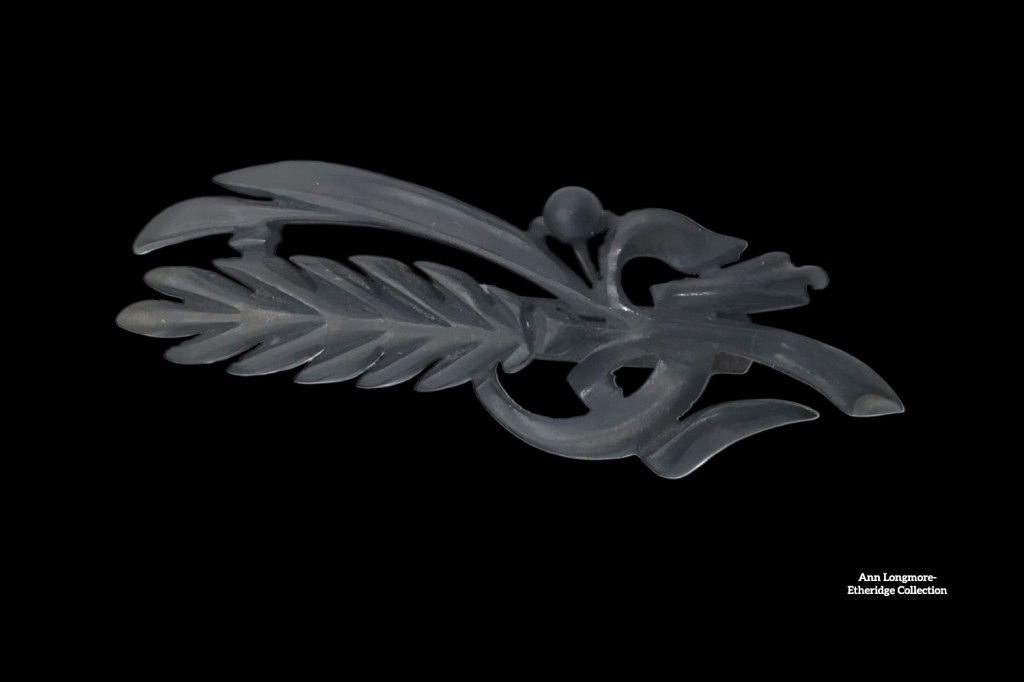
Gutta-percha scythe and wheatsheaf brooch, circa 1875.
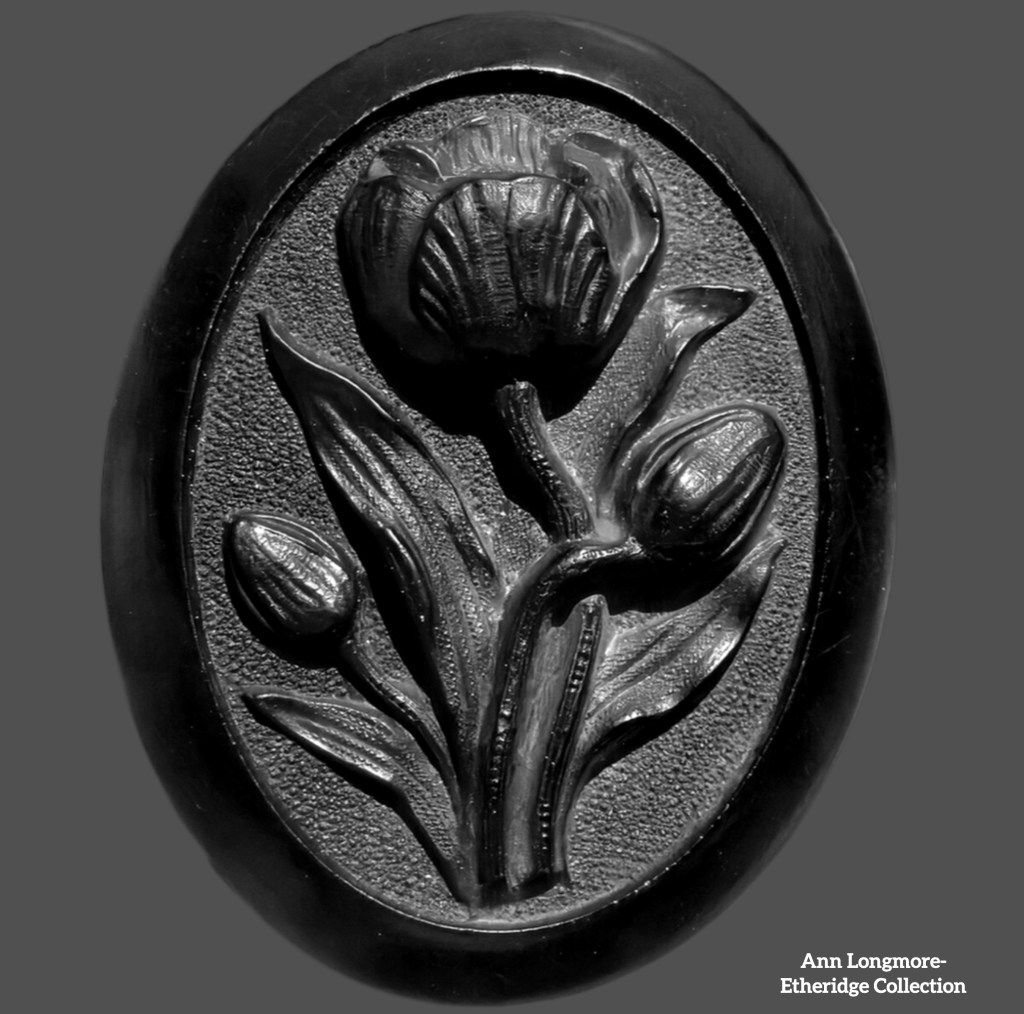
Gutta-percha tulip mourning brooch, circa 1885.
Cherub with a swag of flowers mourning brooch, 1865.
Large gutta-percha floral cross pendant, circa 1875.
Dutch gutta-percha equine brooch, circa 1885.
Irish gutta-percha mourning brooch, Circa 1880.
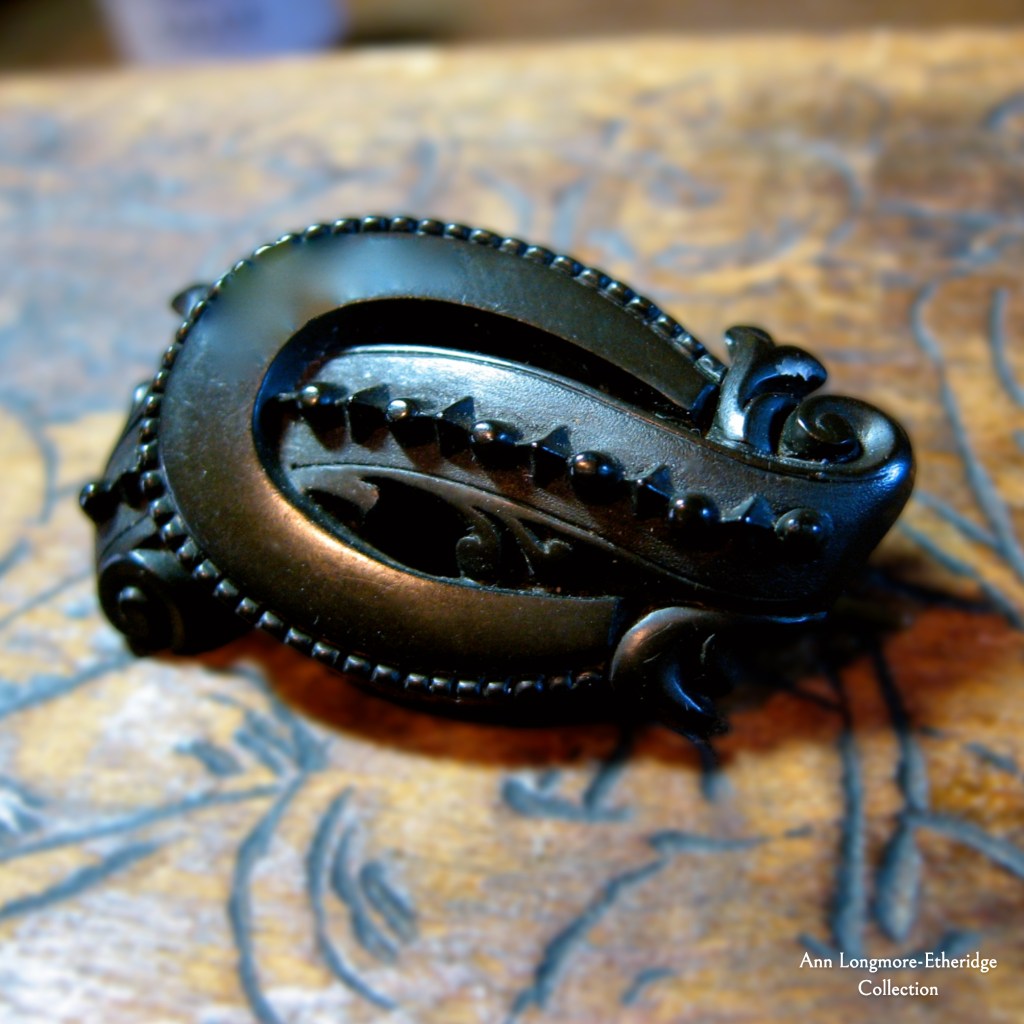
Horseshoe gutta-percha mourning brooch, circa 1870
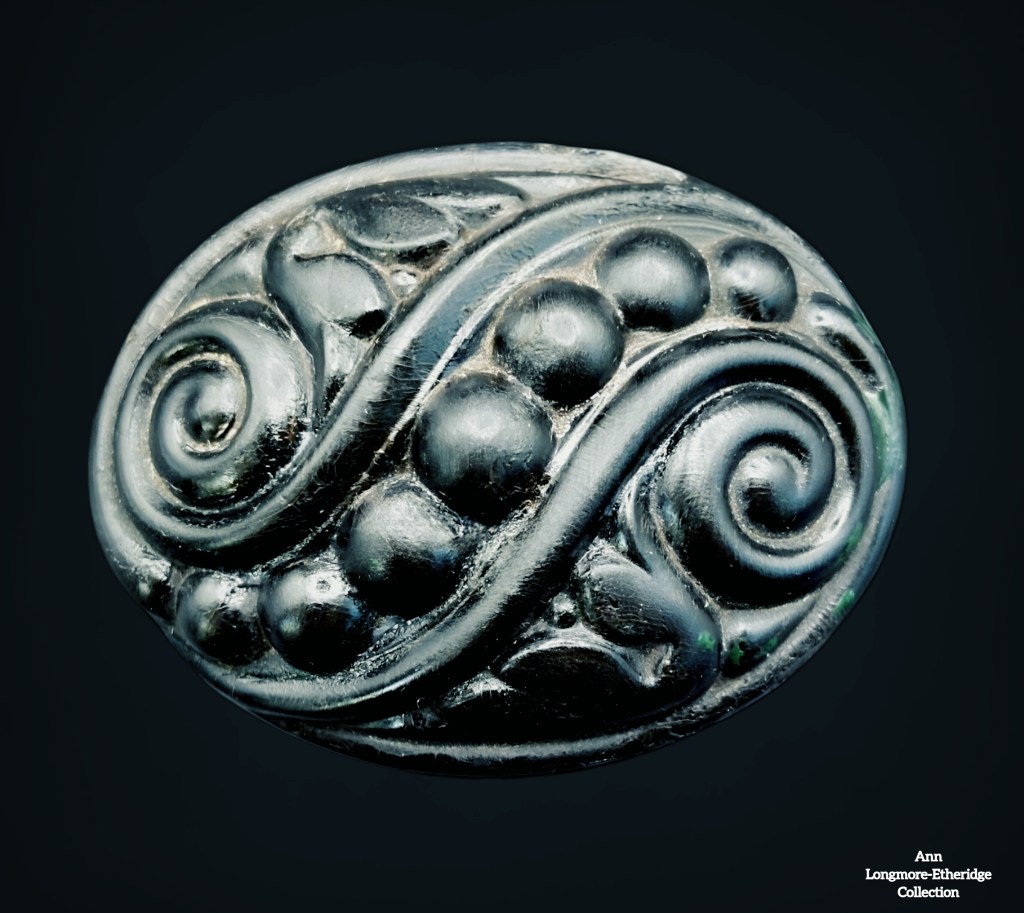
Swirling vines and dots gutta-percha mourning brooch, late 1800s.
Gutta-percha widowed bird mourning brooch, circa 1875.
Gutta-percha Isle of Man morning brooch, circa 1890.
1. Three in a row at an unknown American airport in the early 1950s.
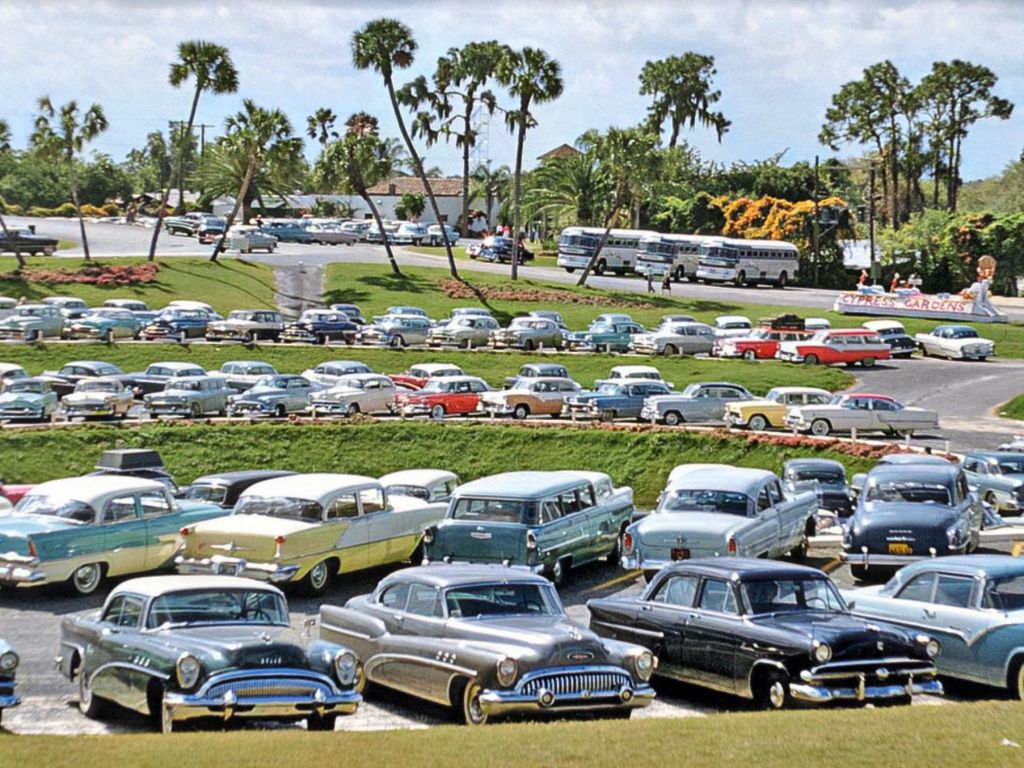
2. There are at least four blue cars in this Cyprus Gardens car park, Winter Haven, Florida, late 1950s.
3. Here’s a two-tone blue car receiving a Customs inspection at the Canadian border, circa 1950.
4. A powder-blue, early-1950s Dodge parked in a quiet suburban neighborhood.
5. A blue car speeds past Grauman’s Chinese Theatre, Los Angeles, 1957. The movie “Island in the Sun” was a spicy tale of interracial romance.
6. My scantily clad, hot-babe mother behind the wheel of her similar blue and white car in Silver Spring, Maryland, Summer 1958.
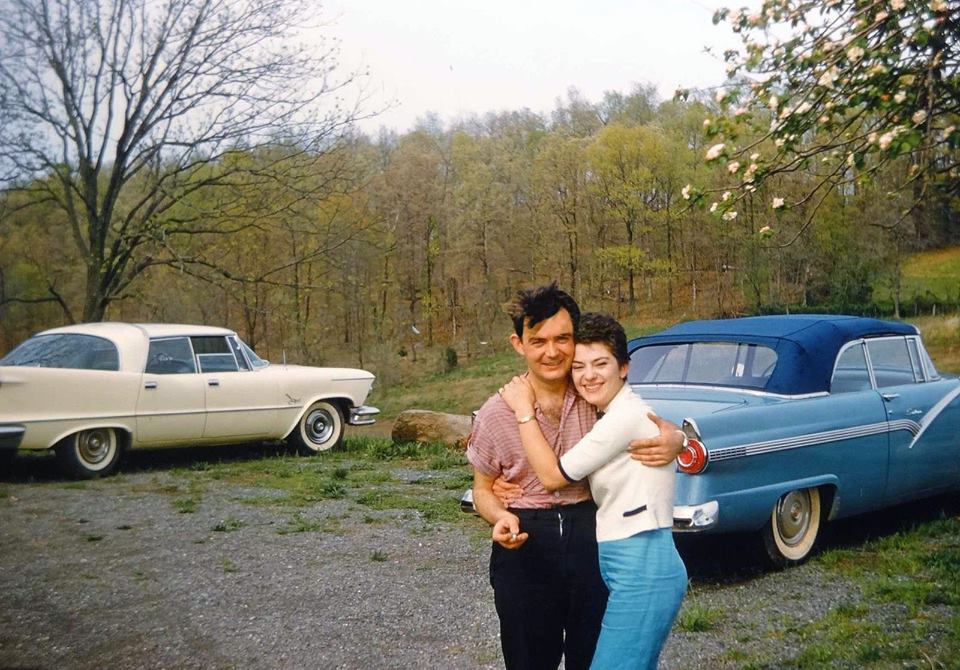
7. In their turquoise convertible, the kids were all right. 1950s.
8. Out and about, Christmas shopping in Long Beach, California, 1953.
9. This rather odd two-tone Buick and a sugary-blue Volkswagon parked at an Ottawa, Ontario Texaco, 1962.
10. Outside an auto shop on a cold and blustery day, somewhere in America where it snows, the mid-1950s.
11. A sad, blue example of the results of a snowy, blustery day. Taken somewhere in Washington State in the early 1950s.
12. A 1964 Chevrolet concept carshown by a 1964 concept wife.
13. This is a 1942 two-tone blue Chevrolet Fleetline is not a concept car, but those are definitely concept females.
14. A non-concept beauty stands beside her dark blue 1954 Oldsmobile.
15. The very definition of “cheesecake”. Late 1940s.
16. Because of black and white television, the children of the 1960s and ’70s saw the 1950s as a stiff, colorless, conformist era, but this brilliant coral dress and vibrant 1955 Pontiac Star Chief show the reality of the age.
17. In Winter 1954, this lovely lady in her rich-blue coat and bright red shoes posed with an old dull-blue 1941 Buick Convertable.
18. A teenager in yellow beside a mid-1960s Buick and multiple other blue cars at what might be another airport.
19. A pretty girl and her BFF Pontiac Sunbird, Eastern America, 1979.
20. An Atlantic City motel, a 1948 Buick, and the love of someone’s life.
21. Daddy’s darlings posing on his 1959 Ford Wagon.
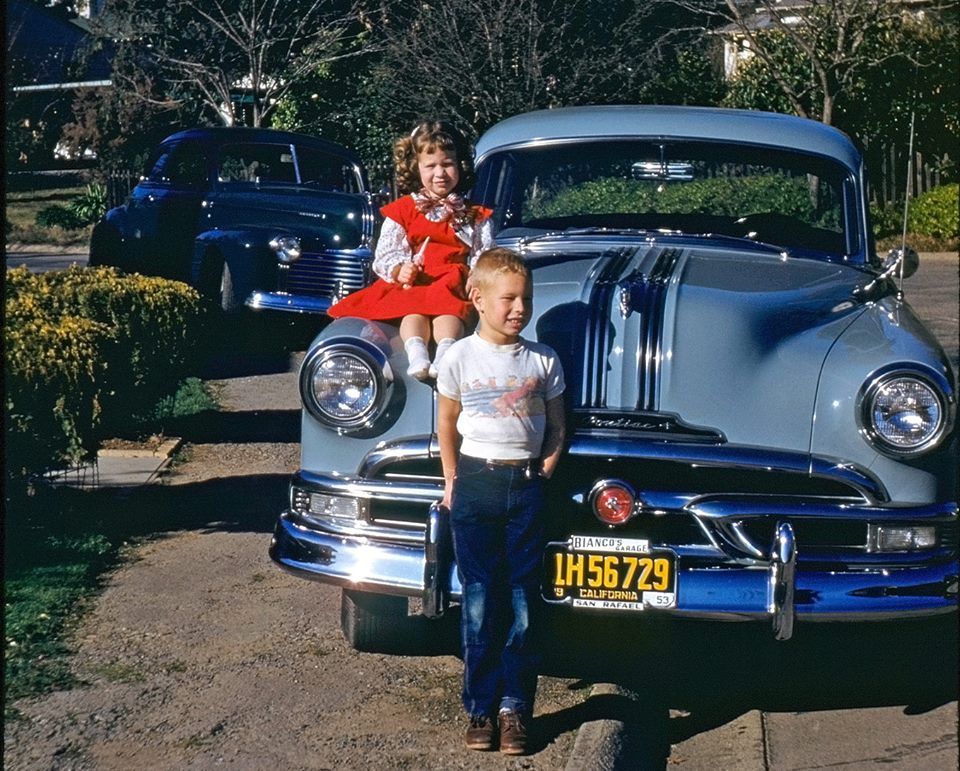
22. Brother, sister, and mechanical siblings (a 1953 Pontiac and older brother, a 1941 Pontiac) in Lakespur, California. Courtesy Shorpy.
23. Doing something dangerously stupid (also) in California, 1947.
24. Doing something dangerously stupid in Yosemite, California, 1956.
25. Doing something dangerously stupid in Wisconsin, the late 1940s.
26. Thinking about doing something dangerously stupid (I just know it), 1950s.
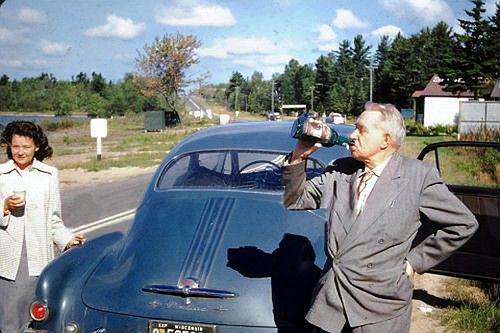
27. Too late. The dangerously stupid is already done. Avoid Grandpa and Grandma in their early 1950s Pontiac.
28. Well, okay…. Chevy Nova, circa 1980. Florida, I guess.
29. This must have been taken on the first day out because there was not a spot of bird poop or bug splat upon that new, shiny 1966 Ford F-100.
30. Standing awestruck after rolling their 1960 Olds Dynamic 88 four-door sedan through an unknown state’s historic covered bridge.
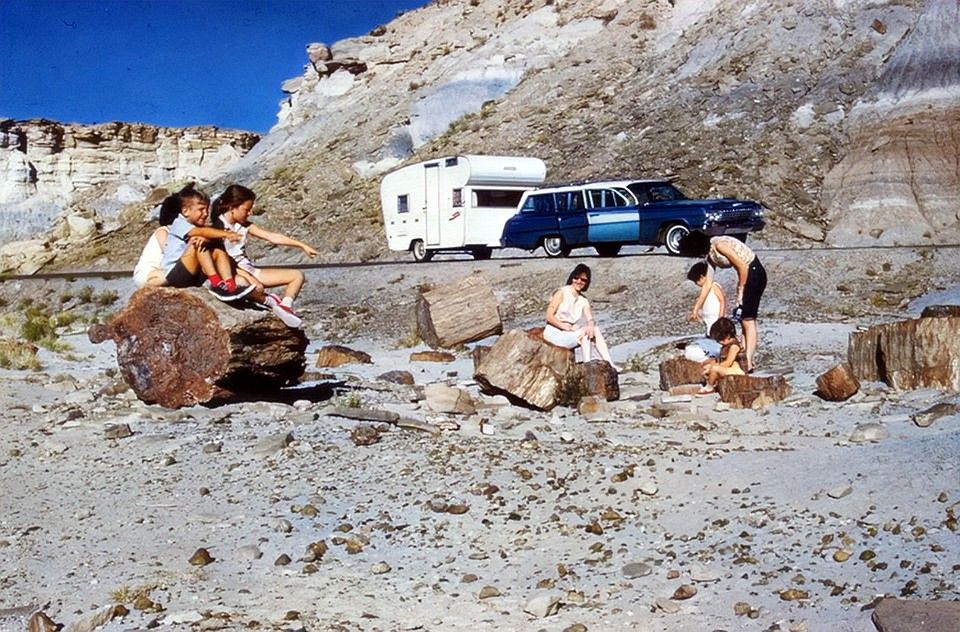
31. Lost in the desert, but there is plenty of wood to burn come winter, at least, 1960s.
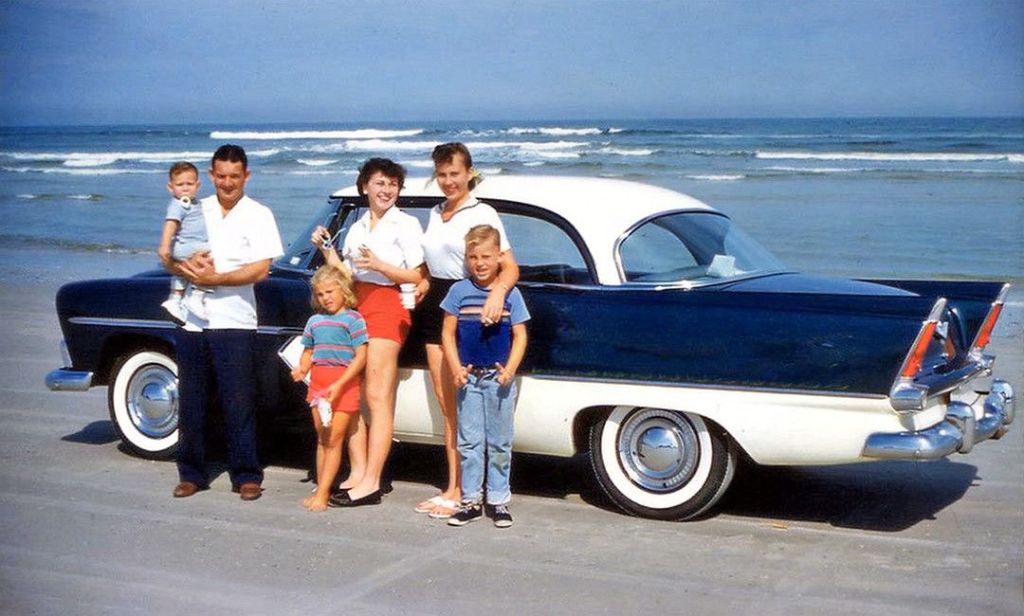
32. Ah, the days of damaging the environment with your heavy blue car while working on your skin cancer. Still, those were indeed happy times for all of us lucky enough to have them. One of my earliest memories is being parked on Daytona Beach and jumping waves with my father. Probably Florida, mid-1950s.
33. Nance Gail, West Chester Teen Queen of 1968, rides in an open-top blue 1968 Plymouth Fury in the Los Angeles Labor Day Parade.
34. Matching mid-1950s station wagon with luggage rack and camper with sunshade. I’ll be honest, I want to be there soooo bad.
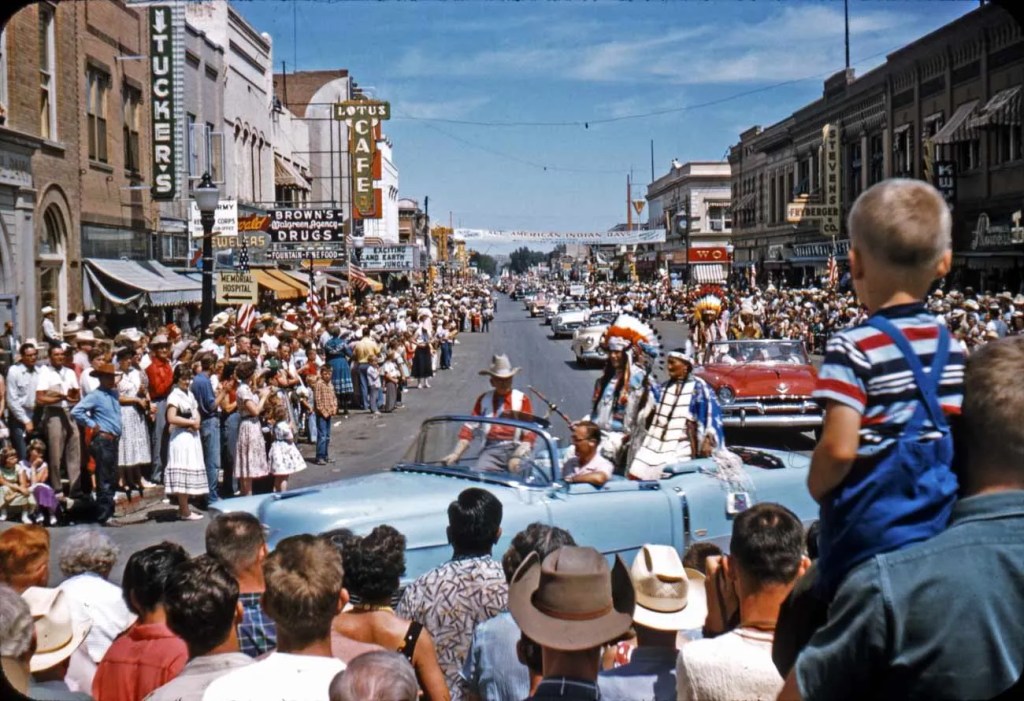
35. This Sheridan, Wyoming American Indian Day Parade in 1955 featured a blue open-top holding real Native Americans and fake Caucasian cowboys.
36. A 1955 blue Pontiac parked in front of Trader Bill’s Western & Indian Merchandise (and Novelties), Dallas, Texas.
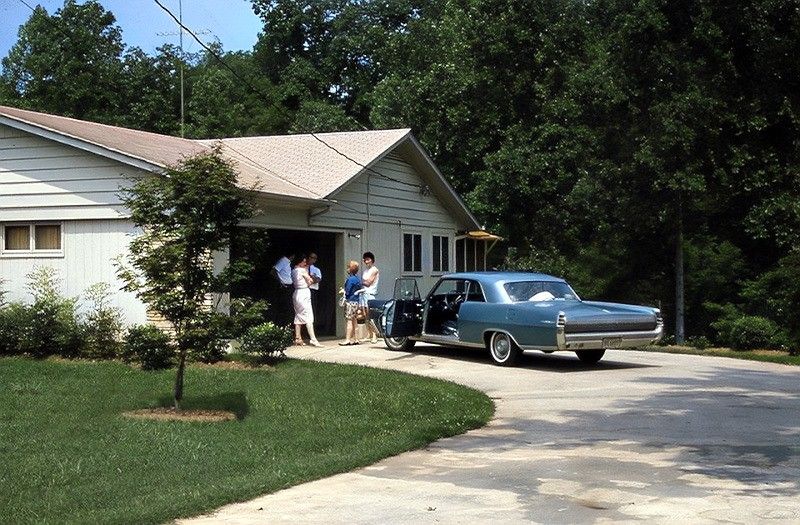
37. Tough negotiations underway in the drive of this suburban home, 1960s.
38. Three deeply suntanned dudes, a blue convertible, and a cheerful mobile home estate, back when retirement living on one was respectable, inexpensive, and fun. Somewhere in the American South (probably Florida), 1950s.
39. Guests arrive on a snowy day, perhaps for Christmas morning, early 1960s.
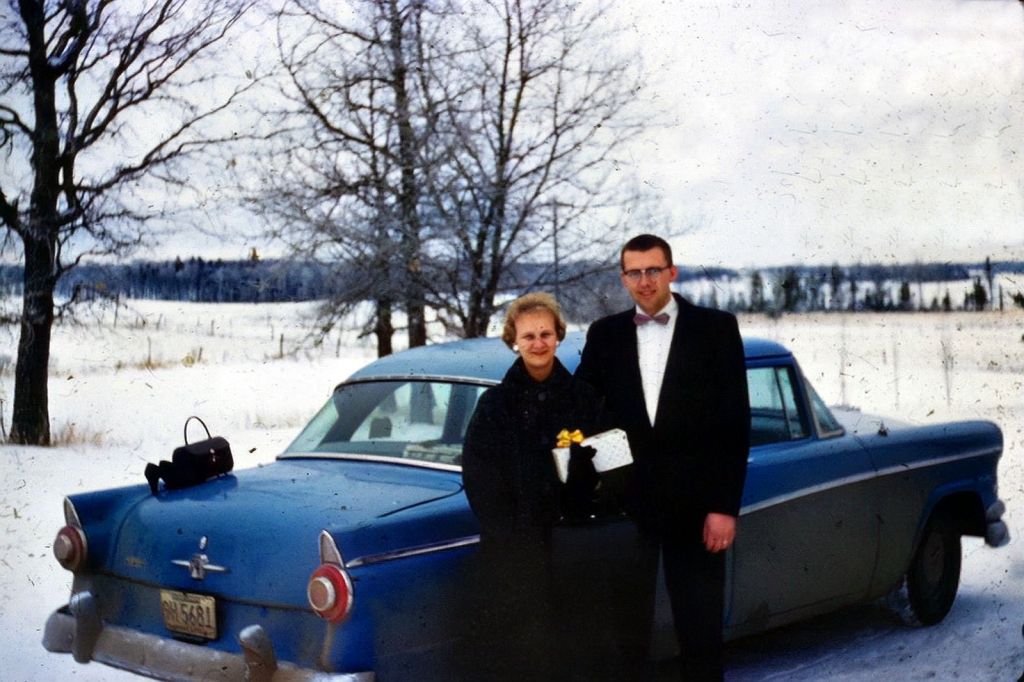
40. And finally, our blue car journey ends with this beautiful couple and their beautiful two-tone blue sedan. I hope their life together was very, very beautiful, too.
Hello, Gentle Readers. I’m sorry to have been away so long. I spent the COVID lockdown and a long summer of isolation writing a book that will hopefully be published in mid-2021. Now that is accomplished, I’m planning to start a new series of articles here. Thank you for your patience. In the meantime, enjoy this recent addition to my small collection of “hidden mother” photos. The original is a cased tintype from about 1862. (Colorized by by the AI program DeOldify). Ω
Because little can be seen of this nicely dressed infant’s hair, its sex cannot be deduced. Mum, crouching behind the chair, wears a bonnet that dates to perhaps 1861. Her forehead can just be seen beneath the bonnet’s brim and row of decorative flowers. One pagoda sleeve of her dress and one hand is visible at left.
“Officers and others familiar with the circumstances [think it] one of the most brutal and fiendish crimes in the history of this section of the state.”
Jane McPherson Bowers and her brother Thomas are buried in the graveyard behind Pleasant Walk Church.
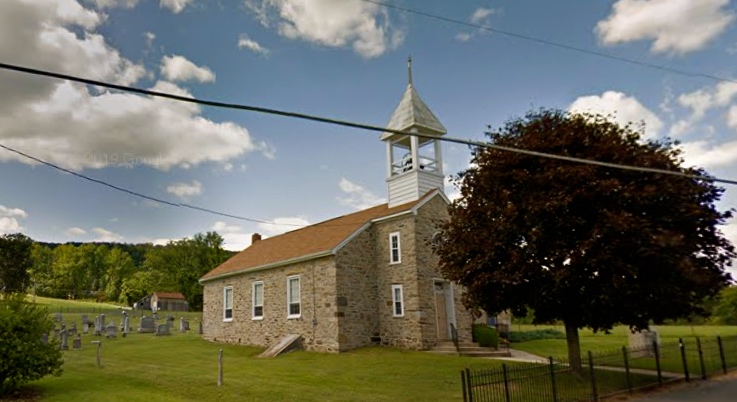
At Pleasant Walk United Methodist Church (formerly Mount Olive United Brethren), two miles from Myersville, Maryland, visitors may find the grave of Emma Betts, who arrived with the spring of 1900 and departed with summer, lacking even one milk tooth. They may also see the grave of Henry Dusing, a 70-year-old champion violinist who, in 1954, on a dark night, fatally encountered an automobile atop South Mountain. There is also Tiny Dagenhart. In 1913, the five-year-old girl was shot dead in the family’s kitchen by her brother when he dropped his hunting rifle. There are two more vestigial residents of interest for whom no grave markers call out: Jane Bowers and Thomas McPherson. During one week in the winter of 1908, however, newspapers bellowed their names and described in orgasmic detail Jane’s bloody, gore-soaked, and horrifying murder at the hands of her elder brother.
Mourning Brooch for Master Mariner Joshua Goodale, who died March 1850, aged 74. This gold-plated brooch has seen some rough handling. The plate is worn on the bezel surrounding the glass-capped compartment and the pin is missing. Ann Longmore-Etheridge Collection.
Joshua Goodale, master mariner, merchant, and agent for Salem Iron Company, was born on 1 November, 1775, in Salem, Essex County, Massachusetts, and died 3 March, 1850, in Boston, Suffolk County, Massachusetts.
He was the son of Joshua Goodale (1753-1795), a blacksmith, and Mary Henfield (1752-1821). His siblings were: Lydia (b, abt. 1782), who married Solomon Towne; she married, secondly, Hale Late of Newbury; Poll (b. abt. 1784); Thankful (b. abt. 1787), who married Nathan Green on July 15, 1813; Hannah (b. abt. 1790); and Nathan (b. abt. 1793).
Goodale was already an old name in Salem by the time of Joshua’s birth. Robert Goodale with his wife Katherine Killam and three children came from England on the ship Elizabeth in 1634. After immigrating to Massachusetts, the couple had six more children.
According to the Pickering Genealogy: Being an Account of the First Three Generations of the Pickering Family of Salem, Mass., by Harrison Ellery and Charles Pickering Bowditch, “Mr. Goodale began his business life in the counting-room of the eminent merchant William Gray, and, in 1794, was sent by him to the West Indies as a supercargo. He afterward became the agent for the Salem Iron Company, and at one time was in New Orleans in business. On the decline of trade in Salem, he moved to Boston.
“Mr. Goodale was a man of spotless character, very temperate, and even abstemious in his habits. His form was erect, and his gait elastic to the last, while he retained the manners of a gentleman of the old school. He was inclined to reprove the errors of others, but always without harshness, and in a way peculiar to himself. At the time of his death, Mr. Goodale was the oldest member of the Park Street Church, Boston.”
On 22 October, 1804, in Danvers, Essex County, Massachusetts, Goodale married Rebecca Page, the daughter of Captain Samuel Page (1753–1814) and Rebecca Putnam (1755–1838) of Danvers, the small village next to Salem. One of Rebecca’s relations was Ann Putnam, a chief accuser during the witch hysteria of 1692-1693.
The couple had a number of children: Joshua Safford (b. 6 May 1808); Samuel Page (b. and d. 1810); Rebekah Putnam (b. 1811); Mary Henfield (b. 6 March1814); Samuel Page (b. 9 August 1818), and Eliza Ann (b. 1819), of whom the Pickering Genealogy notes, “[Goodale’s] portrait, which was painted while he was in New Orleans, is now in the possession of his daughter, Miss Eliza A. Goodale, of Highland Avenue, Newtonville, Mass.”
Of his wife, the Pickering Genealogy states, “Mrs. Goodale’s father was a Revolutionary patriot. He enlisted at the breaking of the Revolution, and took part in the battles of Lexington and of Monmouth and was with Washington at the crossing of the Delaware and at Valley Forge. He also served in the campaign of 1779 and was present with company at the storming of Stony Point. After the war, he became a successful merchant, filled many public offices, and was distinguished for his integrity and moral worth. Ω
“Koogle said that leaving Myersville that night, he passed a young man about his height, dressed in dark clothes and wearing a slouch hat, like his own.”
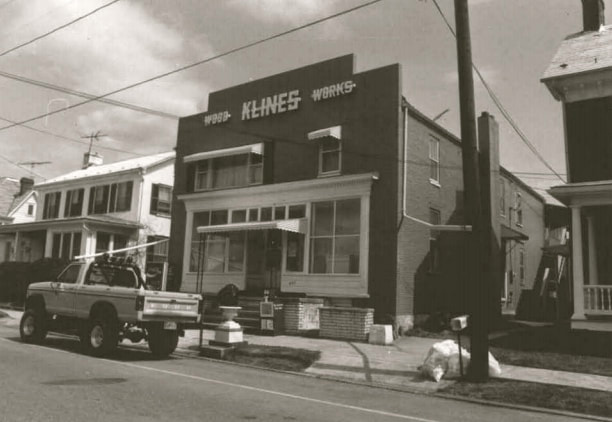
The former George W. Bittle store in 1992. The shooting took place directly under the awning.
During the months before the jury trial of George H. Koogle, merchant George Waters Biddle fully recovered. According to the Baltimore Sun, the gunshot wound to his thigh had nearly proven fatal but the newspaper did not elaborate whether it was from the onset of sepsis or another cause.
Perhaps tellingly, further robberies in Myersville were not reported by the press in the last quarter of that year. This did not mean the little town saw no excitement. On Election Day, 8 November, as President Teddy Roosevelt was reelected, “Some dynamite was exploded [in Myersville] and the shock shattered glass in the Flook, Gaver, Leatherman Bank and in the residence of Mr. George W. Wachtel,” the Hagerstown Daily Mail stated.
A little more than a week later, work was freshly completed on the electric railway between Myersville and Hagerstown. “The railroad runs the full length of the main street of Myersville, the track being laid in the center of the street. The poles and wires are all up and work cars have been running into Myersville from Hagerstown since Tuesday,” reported the Frederick News on 18 November.
This march of progress nearly trampled Myersville resident Martin Wachtel, who made “a narrow escape from being killed by electricity while the wires for the new road were being stretched,” the News noted. A wire fell across the street and Wachtel tried to lead a wagon across it, believing it not live. “When the horses stepped upon the wire, they were violently thrown to the ground. Mr. Wachtel … was also severely shocked. The horses were unhitched from the wagon and assisted to their feet when the one horse accidentally touched the wire a second and third time and was thrown each time. The horses were uninjured, excepting a few burns.”
An albumen carte de visite (CDV) of Anna Martha Bell Tillet wearing mourning for her mother by “Elrod & Son, Opposite Court House, Main Street, Lexington, KY,” probably taken in 1873. Ann Longmore-Etheridge Collection.
She was christened Anna Martha Bell, but she was always known as “Mattie.” The baby girl was born 9 July, 1857, in Erie, Miami County, Indiana to a father with the unusual name Pleasant Lilly Bell (1809-1882). According to his 20 July, 1879, obituary, “Mr. Bell was born in [Vevay,] Switzerland County [Indiana] in 1814, two years before the admission of Indiana to the sisterhood of states. He came to this part of the state [Miami County] when yet a young man and worked on the Wabash & Erie Canal which the state was then constructing. He was a resident of Miami for more than 40 years. His reputation was spotless and he was in high esteem by all who knew him.”
Pleasant was the son of Armiger Lilly Bell (1771-1816) and his wife Sarah Blackford (1779-1848). Armiger Bell was born in Fluvanna, Virginia, 10 January, 1771. He was the third youngest of a dozen children. The Bell family was large, well off, and owned land and slaves. Armiger later sailed down the Ohio River to Kentucky, meeting his future wife Sarah, and married her on 31 March, 1795. The couple settled near Vevey and took up farming in what was then a heavily forested area.
After Armiger’s death on 5 November, 1816, his eldest son James took over the farm, until his mother remarried in 1821 and his new stepfather took over from her son. Her second husband, John White, appears to have been abusive and volatile. Ultimately, he mysteriously vanished while taking a herd of hogs to market. Sarah eventually came to live with her son Pleasant and his family. She died in 1848 and is buried in the Tillett Cemetery.




































 "Your Dying Charlotte"