The eerie and eclectic photography of Caroline Leech
All photos copyright Caroline Leech.
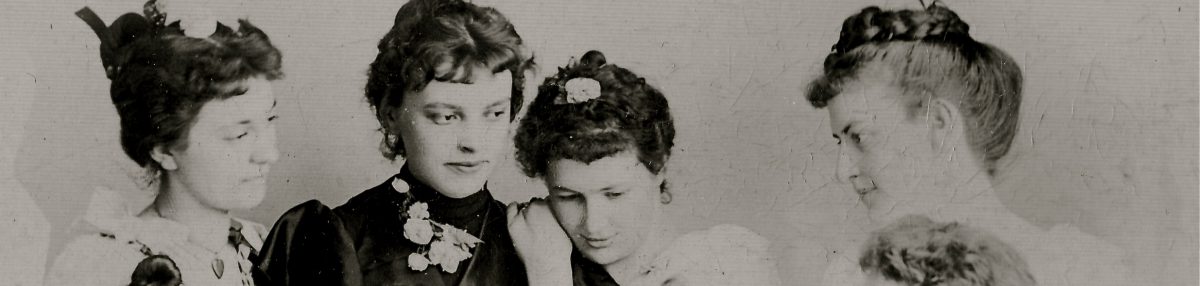
Carolyn, an English woman who lives in Spain, writes of herself: “I am an obsessive Victorian and lover of all things Gothic. As a child I would often rather spend my pocket money in the local antique shop on postcards, photos, stamps or coins than in the toyshop. History just always fascinated me.”
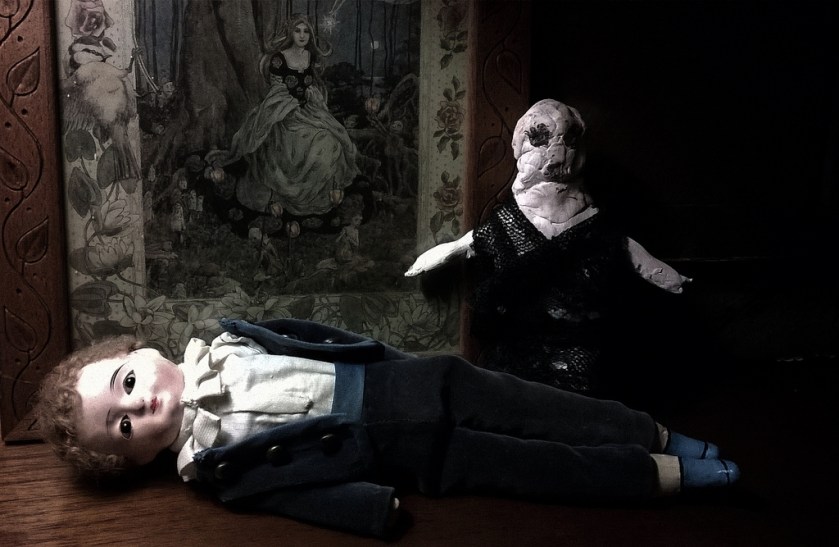
“I then developed an interest in spirits and faeries and fell in love with writers such as my beloved Charles Dickens, Sheridan LeFanu, Emily Dickinson and with the whole world of Victorian spiritualism, mourning, the faery painters of the time and also the darker aspects of Victorian society.”
“I live in a watermill in the middle of a forest, which is always an inspiration to me. I feel I am surrounded by all sorts of spirits.”
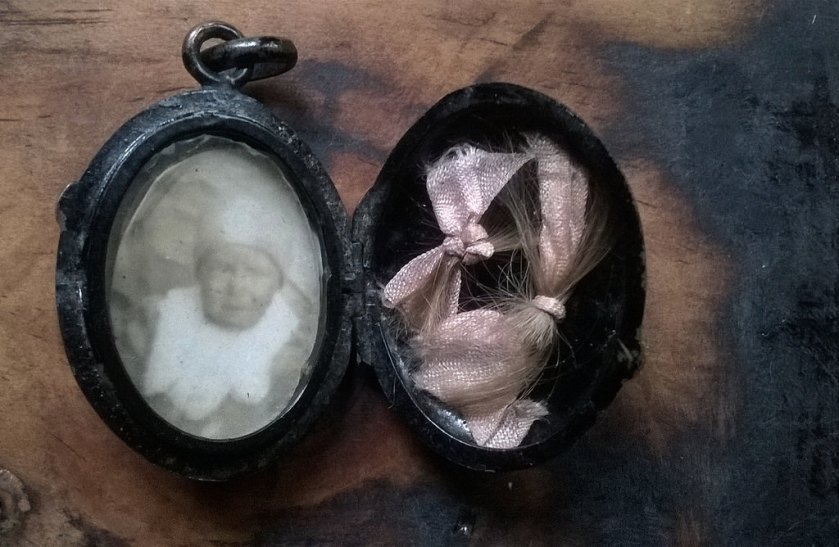
“I have been an antique dealer and visionary artist for years and am also a keen amateur photographer of anything mysterious. My greatest love is of course Victorian photography, these amazing ghosts which pleasantly haunt the pages of my book and the drawers and cabinets of my bedroom.”
Caroline’s book of photos and poetry can be purchased at Amazon. You can also visit her Flickr photostream. Ω
“Because I feel that in the heavens above
The angels, whispering one to another,
Can find among their burning tears of love,
None so devotional as that of ‘Mother,’
Therefore, by that dear name I have long called you,
You who are more than mother unto me.” — Edgar Allan Poe
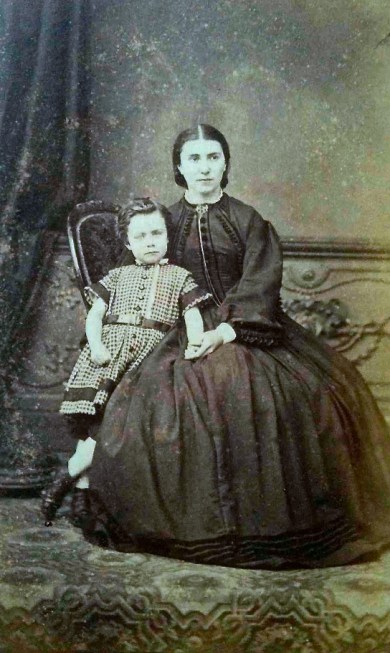
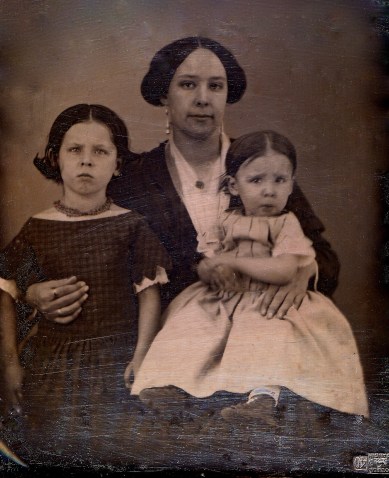
A proud mother and her adorable daughter pose in this 1/6-plate daguerreotype, circa 1850. The mother wears a fashionable “Jennie Lind” collar, made popular by the soprano Jennie Lind, the “Swedish Nightingale,” who toured North America from 1850 to 1852 under the relentless promotion of showman P. T. Barnum. Ann Longmore-Etheridge Collection.This mid-1870s tintype from the Jack and Beverly Wilgus Collection includes a shy “hidden mother” who is revealed with the removal of the decorative paper mat.A nicely dressed English mother and son photographed in about 1862. Her smoothed and center-parted hair, pagoda sleeves, full hoop, and applied decorative trim was at the height of fashion. Her boy’s checkered, belted, one-piece dress was perhaps in shades of red and tan, similar to the fabric used in this earlier example. This albumen carte de visite is from the Caroline Leech Collection, originally photographed by G. J. Tear, Clapham Road, London.A mother, son, and baby in a pram enjoying a sunny day in England during the late 1920s. Scanned film negative from the James Morley Collection.An American mother and two daughters pose for an adorable 1/6th-plate Gaudin daguerreotype, circa 1852. The plate is marked “Double, A. Gaudin, 40,” the hallmark of Antoine Gaudin & Bro., 9 Rue de la Perle, Paris, a French company whose products were widely used by daguerreians throughout America. The older daughter is wearing a “protective” coral necklace. Coral was thought to have special efficacious properties to safeguard children. Ann Longmore-Etheridge Collection.
Ω
A quick note: I will be having surgery on Tuesday, 4 April, and will be taking at least a four- or five-day hiatus to recover. I will return as soon as possible. Promise.
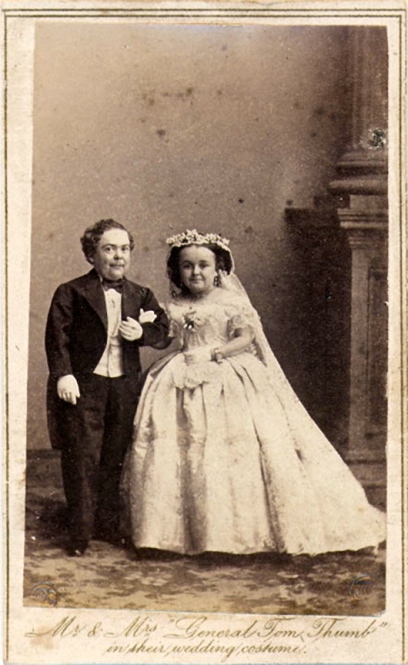
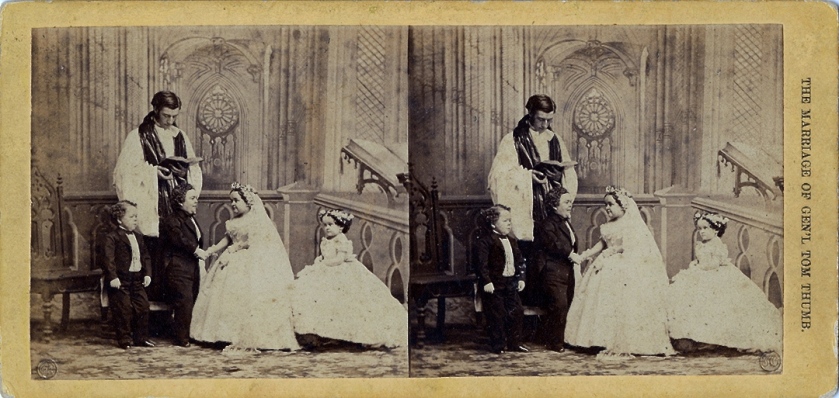
The wedding of Tom Thumb and Lavinia Warren was so popular that children in wedding attire began to reenact the marriage ceremony.
A carte de visite of the Thumb-Warren “Fairy Wedding” published by E. & H. T. Anthony, 1863. Original image by Mathew Brady.
By Beverly Wilgus
The highlight of the 1863 New York City social season was the February 10 “Fairy Wedding” at Grace Episcopal Church of two of P. T. Barnum’s “little people,” Charles Sherwood Stratton and Mercy Lavinia Warren Bump. In the theatrical world, they were known as General Tom Thumb and Lavinia Warren—he stood 2’10”; she, 2’6″. There were 2,000 invited guests and Barnum also sold tickets to the reception after the wedding for $75 each. Although 15,000 ticket requests came in, only 5,000 were available. One newspaper, the Cleveland Daily Leader, noted that after the particulars were announced by Barnum, “then followed such a universal toadyism…all for the sake of begging, buying, or stealing invitations to the wedding.”
In spite of the event’s commercial nature, Tom and Lavinia’s marriage was a true love match. (Barnum, however, thought Lavinia was too tall for Tom and that her smaller sister Minnie would have been a better choice of a bride.) Lavinia had also been romantically pursued by Thumb’s rival performer, George Washington Morrison Nutt, whose stage name was Commodore Nutt, but Lavinia’s heart belonged to the Little General from the start. After their marriage, the couple lived in domestic harmony for twenty years until Tom’s death on July 15, 1883.
A stereoview published by E. & H. T. Anthony of a reenactment of the “Fairy Wedding” in a photographer’s studio. Left to right: Best Man Commodore Nutt; Groom General Tom Thumb; Bride Lavinia Warren; and Bridesmaid Minnie Bump, Lavinia’s sister, who was also known as Minnie Warren. The minister behind them was either Reverend Mr. Wiley, who read the service, or the Reverend Dr. Taylor, who read the benediction, or possibly a costumed stand-in.
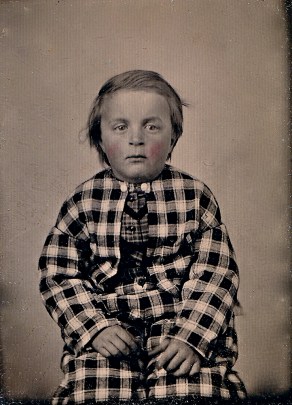
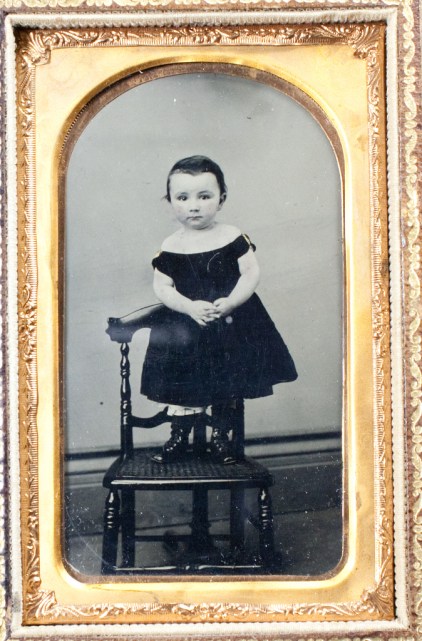
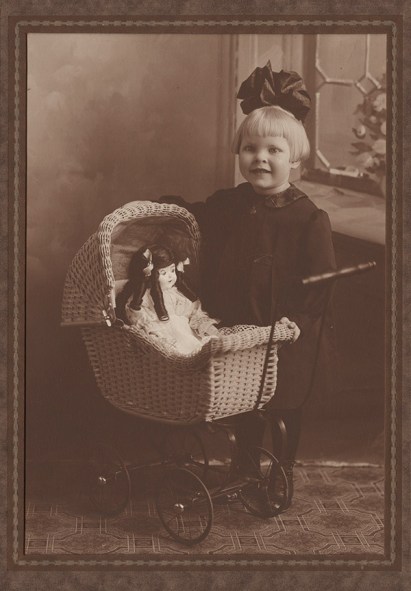
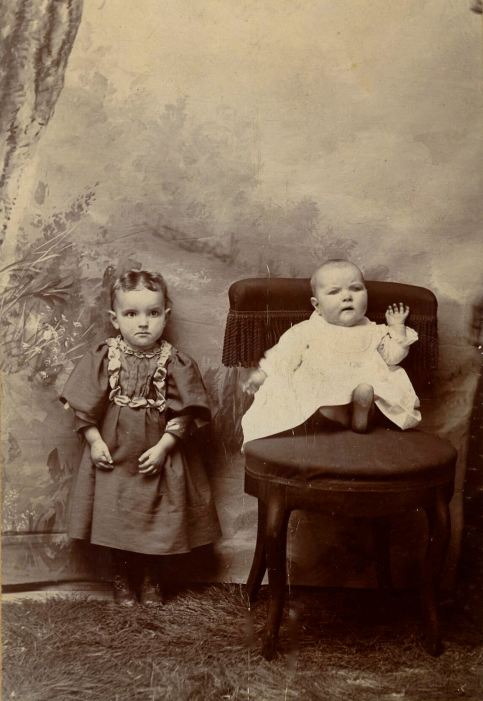
Baby in a barnyard feeding chickens. Glass-plate image, circa 1900. Photo courtesy Price and Zimmer Collection.Boy in checkered suit. Tintype, circa 1870. Ann Longmore-Etheridge Collection.Boy standing on chair. Tintype, circa 1862. Courtesy Price and Zimmer Collection.A doll with a doll. Paper print, circa 1920. Courtesy Jack and Beverly Wilgus Collection.Misses Unimpressed and Fuhgetaboudit. Albumen cabinet card, circa 1875. Ann Longmore-Etheridge Collection.
“Oh! I do like to be beside the seaside! I do like to be beside the sea! I do like to stroll along the Prom, Prom, Prom! Where the brass bands plays tiddely-pom-pom-pom! So just let me be beside the seaside! I’ll be beside myself with glee and there’s lots of girls beside, I should like to be beside, beside the seaside, beside the sea!”
This British ambrotype shows either a mother (right) with three daughters, or four sisters of disparate ages, posed on the exposed ground of a tidal estuary or river. Their fashions date to about 1870. The littlest girl is either carrying her bonnet or a bucket. Ann Longmore-Etheridge Collection.
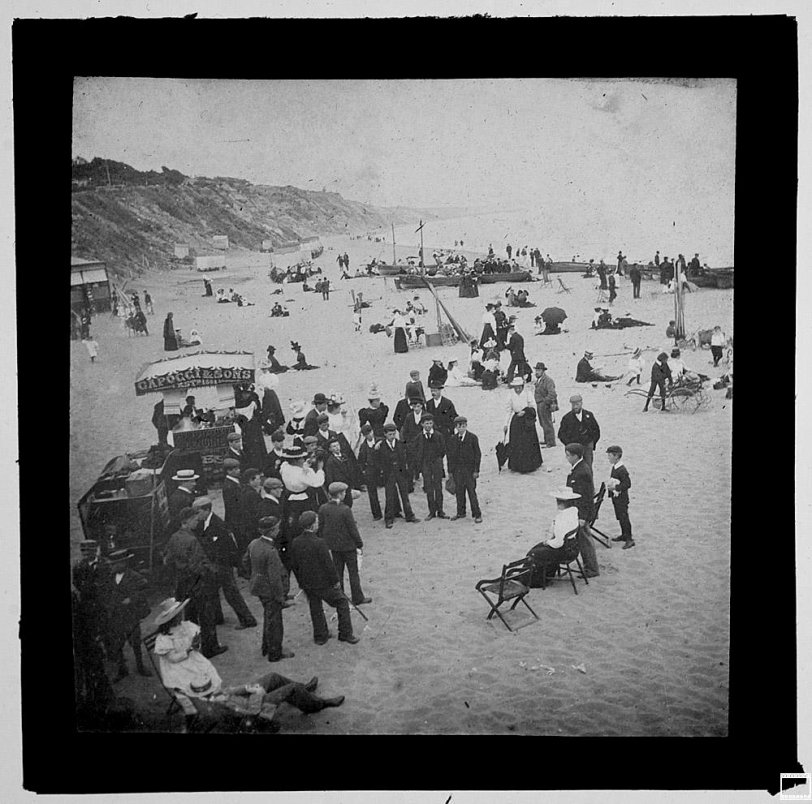
Capocci & Sons, ice cream vendor, on the beach during a sunny, happy day at Bournemouth, Dorset, in the 1890s. The 1891 census enumerated Celestine Capocci, a 51-year-old ice cream maker born in Italy, and her large family living at 5 St. Michael’s Cottages, Holdenhurst, Bournemouth. Glass-plate negative courtesy James Morley (@photosofthepast). The identification of the ice cream vendor was made by EastMarple1, who is a collector and historian at Flickr.
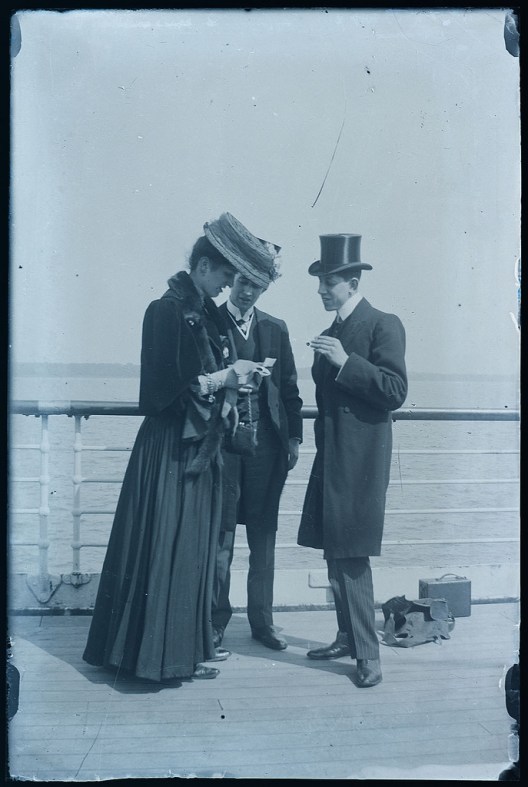
Three elegant young adults on the deck of a ship or a seaside pier, circa 1900. Glass-Plate negative from the collection of James Morley.
On the beach at Trouville, Normandy, France, in September 1926. Paper print from the collection of James Morley.
Although posed in front of a backdrop, this girl was genuinely at the seaside, as Littlehampton, West Sussex, remains a vibrant holiday community to this day. Whilst photographers roamed the beach at Littlehampton and other resort towns, photography studios with their painted seaside scenes provided a second souvenir option. This Carte de Visite, taken circa 1900, is courtesy Caroline Leech.
“The most easily identified and most commonly found British tintype are the seaside portraits where families pose with buckets and spades in the sand or lounge in deck chairs on pebbled beaches with wrought iron piers in the background,” writes the administrator of the site British Tintypes. “The seaside might also be the one place where middle class people could safely and easily have a tintype made—as a fun, spur-of-the-moment amusement in keeping with other beach entertainment.” Tintype, mid-1890s, Ann Longmore-Etheridge Collection.
Ω
Lyrics to “I Do Like to Be Beside the Seaside,” written in 1907 by John A. Glover-Kind.
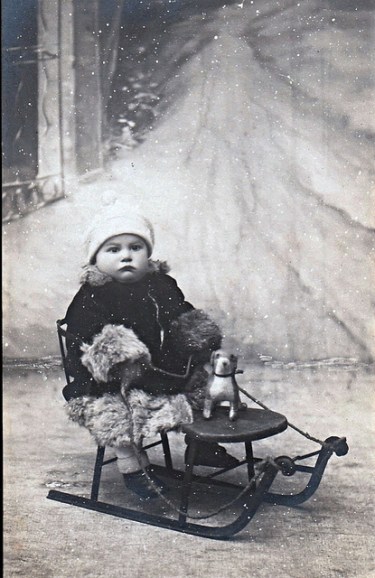
Oh my. After this debacle, let’s hope there was snow outside to sled on.
Austrian unused real photo postcard, circa 1905, stamped “Fotographie L. Strempel, Klosternburg, Stadplaz.”
Okay. Well, at least there is fake snow. And a fake dog.
Phyllis and Barbara Nute on Christmas Day, Winthrop, Maine, circa 1927. Paper print.
This is more like it: Real snow outside and the girls are rocking those gifts from Santa.
Edward Miller on his sled, paper print, circa 1915.
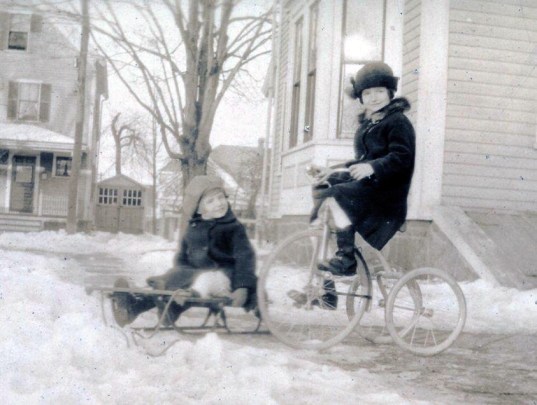
A happy boy on his sled the back garden of what seems to be a row house. A woman stands at the end of the wooden-plank walkway, probably his mother. I hope Edward’s father took him to a local park where there were many high hills to fly down.
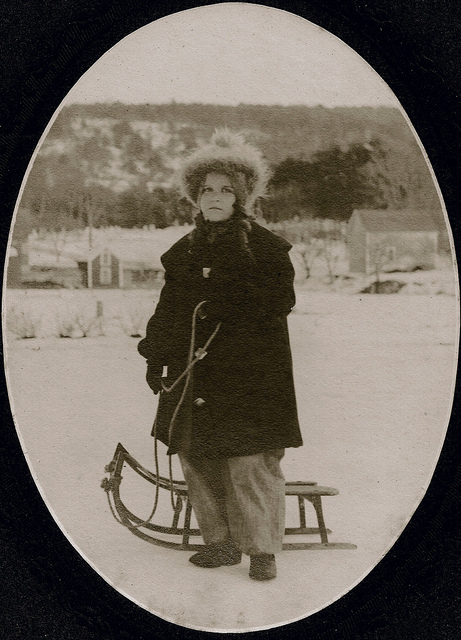
Unmarked albumen print on cardboard, circa 1915.
A wistful girl sleds on a snowy day near the family farm. Everything about this image charms me—from the baggy pants, the bottle curls, and mad hat to the upturned, pointed noise of the sled and the low mountain beyond. I wish I knew more about her, but sadly there is no photographer’s impression or inscription. Ω
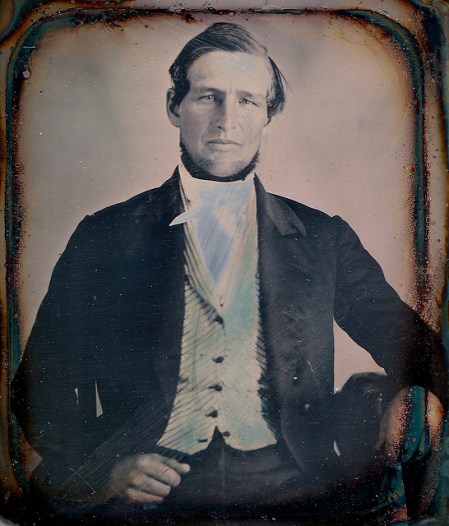
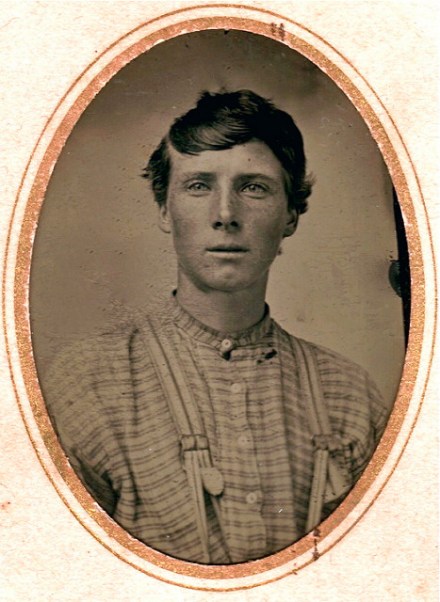
Hoo Boy! 1/6th-plate daguerreotype with tinting and solarization, circa 1846. Ann Longmore-Etheridge Collection.Fresh from the cornfield, tintype, circa 1885. Ann Longmore-Etheridge Collection.Ol’ Blue Eyes, 1/6th-plate, hand-tinted daguerreotype, circa 1852. Ann Longmore-Etheridge Collection.Handsome fellow, 1/6th-plate Weston daguerreotype with solarization, circa 1852. James P. Weston operated a daguerreotype gallery in New York City between 1842 and 1857. The studio functioned out of 132 Chatham Street from 1852 to 1856.
Tintype, circa 1880. Ann Longmore-Etheridge Collection. His hard-soled, lace-up boots are pretty darned adorbs, too.
Big Brother, Little Sister
1/6th-plate daguerreotype, circa 1849. Ann Longmore-Etheridge Collection. The image is shown here in its open case. Nearly all of the earliest forms of photography were presented in wooden cases.
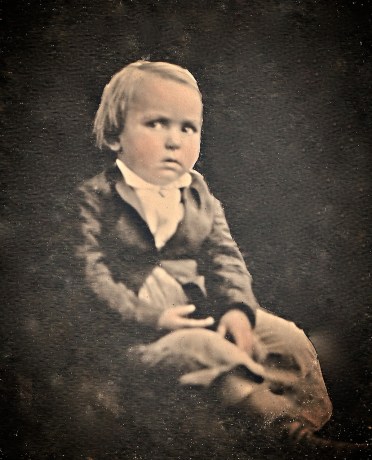
Worried Will
British 1/9th-plate relievo ambrotype, circa 1858. Ann Longmore-Etheridge Collection. In this version of an ambrotype, created in 1854 by a Scottish photographer named Urie, the background surrounding the sitter is scraped away and replaced with one of a number of options, including a solid color, a vignette mat, or a false background. When I purchased this ambrotype there was nothing behind the boy’s image, so I had to create a backdrop.
Daddy’s Darling
1/9th-plate daguerreotype, circa 1850. Ann Longmore-Etheridge Collection. This beautiful little girl, who is literally falling out of her dress, wears a coral necklace (thought to protect children from diseases) but the object in her hand remains a mystery.
The sap of another generation,
fingering through a broken tree
to push fresh branches
towards a further light,
a different identity.
—John Montague, “The Living and The Dead”
Elder and infant, albumen paper print, Ann Longmore-Etheridge Collection.
This wonderful outdoor image, circa 1910, shows a bonneted babe sitting in a wicker pram on an early spring day in the eastern United States. The child’s pudgy hand appears lightly pinched, rather than held, by the arthritic fingers of his or her grandmother—perhaps great-grandmother. The old woman, who was probably born in the 1830s, is magnificent with her weathered face and carefully coiffed, almost ruched white hair in contrast to her elaborate dark clothing. She seems quite elderly, but sturdy and strong. A house, possibly the family home, can be glimpsed through the leafless trees behind her.
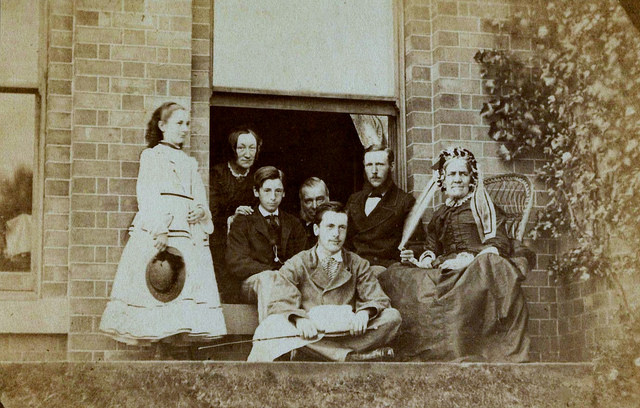
British albumen carte de visite, circa 1866. Ann Longmore-Etheridge Collection.
The next image is of a multigenerational British family posed on a ground-floor window ledge on a pleasant day during the mid-1860s. Grandmother, who is dressed in black-and-white widow’s clothing, sits in wicker chair, whilst Father and Mother lean into the picture from inside the home. Mum’s hand rests possessively on the shoulder of her youngest son, whilst the eldest brother perches on the sill and the middle son sits cross-legged below him. The daughter of the house, a tween in a jaunty summer dress, looks very much a mini-me of her mother.
Family in mourning, British albumen carte de visite, circa 1862. Ann Longmore-Etheridge Collection.
The third image, which is marked “J. McCornick, Photographer, 3 The Bridges, Walsall,” is more somber. One subject is a young girl of about 12 years beside an elderly gentleman who is likely her grandfather. The seated female may be the girl’s mother or her grandmother—it is hard to be sure, although they are clearly related.
The members of this family group are dressed in mourning, but nothing more of the nature of their loss can be supposed, except that the mother or grandmother was not mourning for her husband. The prevailing custom for widows’ bonnets was to include a white inset to frame the face.
Grandfather, whose hand appears to rest protectively on the small of his granddaughter’s back, holds in his other hand some type of folded document or wallet. The message he conveyed with this prop is now inscrutable, but it would have been understood by the carte de visite’s viewers.
The final image is a four-generation portrait, identified on the reverse as “Elizabeth Stokesbury, age 79 years; Clarissa Stokesbury, age 51 years; Extonetta Book, age 29 years; Esther Cook Book, age 3 years.”
The sitters were photographed circa 1902 in Chariton, Lucas County, Iowa. Ann Longmore-Etheridge Collection.
At the far left is Elizabeth Clark (11 April 1824-5 Oct. 1910), born in Fayette County, Ohio, to Welsh native Joshua Clark (1795-29 March 1830) and his wife Mary Blaugher (1795-16 March 1879).
Elizabeth Clark married farmer John S. Stokesbury (7 Sept. 1819-12 May 1867), the son of Robert Stokesbury (1790–1839) and Anna Baughman (1794–1870). In 1850, the Stokesburys farmed in Jefferson, Green County, Iowa; by 1860 they had moved to a new farm in the county of Wayne. The couple had eleven children to assist them: Robert (b. abt. 1842); Angeline (b. abt. 1844); Mary Ann (b. abt. 1846); Joseph (b. abt. 1848); Sarah (b. abt. 1850); Clarissa (12 Sept. 1851-8 March 1935); Harvey (b. abt. 1853); John (b. abt. 1859); Elizabeth Ann (28 June 1861-9 Aug 1946); Clark D. (b. abt. 1863); and Launa (1865-1939).
At age 16, Clarissa, second from left, married a cousin, Jesse Bush Stokesbury (24 Jan. 1843-18 Dec. 1918), the son of James Madison Stokesbury (1813–1869) and Phoebe Painter (1819–1902). By 1870, Clarissa and Jesse had migrated to Chariton, Iowa, where, the family farm was enumerated on the 1870 Census. However, their days on the land were ended by 1880, when Jesse was recorded on the census as a laundry man, and on the 1900 Census he was enumerated as a day laborer. His widowed mother-in-law, Elizabeth Stokesbury, was also in residence, along with her youngest children.
Clarissa and John had the following sons and daughters: Bryant W. (b. abt. 1868); Hillary Edwin (13 April 1870-8 Feb. 1950); Theodosia (b. abt 1872); and Extonetta (b. Dec. 1873), second from right in the photograph, who was known as “Nettie.”
On 24 November, 1898, Nettie married harness maker and saddler John Atwater Book (Sept. 1864-17 April 1924), son of Harlan and Emmaline Book. By 1900, the Books and their first child, Esther Cook (far right—and yes, Cook Book) all lived with Jesse and Clarissa Stokesbury. Nettie and John had two more children: Sarah E. (b. 6 Feb. 1902); and Jesse H. (b. 24 Dec. 1903). Sarah married Loren L. Adams on 12 September, 1935; Jesse married Fae Arza Wicks in June 1929. He died in January 1970 in Seymour, Indiana, and was buried at Chariton Cemetery.
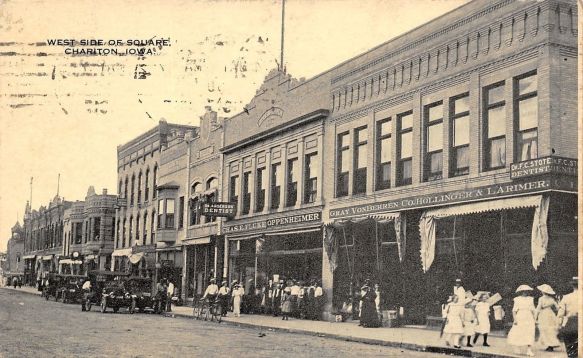
The west side of Chariton’s main square, real photo postcard, circa 1915. Ann Longmore-Etheridge Collection.
Nettie’s brother Edwin Stokesbury, who became a broom maker and married Ollie B. Ritter on 20 February, 1894, had set up house in Chariton by 1900. The couple had four children, but shortly thereafter the marriage failed. Ollie married as her second husband a man named Van Trump and Edwin’s children took their step-father’s surname. By 1920, widowed Clarissa and her son Edwin lived together.
In 1920, Esther Book worked as a bookkeeper in a Chariton store along with sister Sarah. On the 1930 Census, Nettie, Esther, and Sarah were enumerated in one household, with Nettie working as a sales lady in a variety store; Esther worked as a bookkeeper in a bank and Sarah was a tailoress in a dry goods store.
The Des Moines Register of 25 December, 1935, featured a testimonial advertisement by Nettie in which she was quoted, “I like the simplicity of operating the Colonial Furnace and the way it holds fire. The damper enables one to feed the fire so that no smoke, soot, or gas escapes into the rooms. And I like the draft in the feed door, which can be opened to prevent puffing.”
Extonetta Book died on 8 May, 1962, and was buried in Chariton Cemetery. It appears that her daughter Esther never married. She worked for many years as the secretary of the Farmers Mutual Insurance Association and died 25 March, 1965, three years after her mother. Esther is also buried in Chariton Cemetery. Ω

 “I then developed an interest in spirits and faeries and fell in love with writers such as my beloved Charles Dickens, Sheridan LeFanu, Emily Dickinson and with the whole world of Victorian spiritualism, mourning, the faery painters of the time and also the darker aspects of Victorian society.”
 “I live in a watermill in the middle of a forest, which is always an inspiration to me. I feel I am surrounded by all sorts of spirits.”
 “I have been an antique dealer and visionary artist for years and am also a keen amateur photographer of anything mysterious. My greatest love is of course Victorian photography, these amazing ghosts which pleasantly haunt the pages of my book and the drawers and cabinets of my bedroom.”
 Caroline’s book of photos and poetry can be purchased at Amazon. You can also visit her Flickr photostream. Ω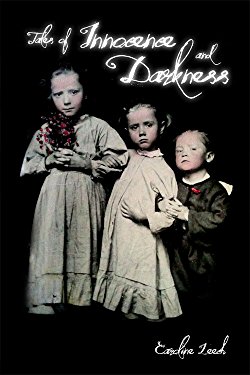















 "Your Dying Charlotte"