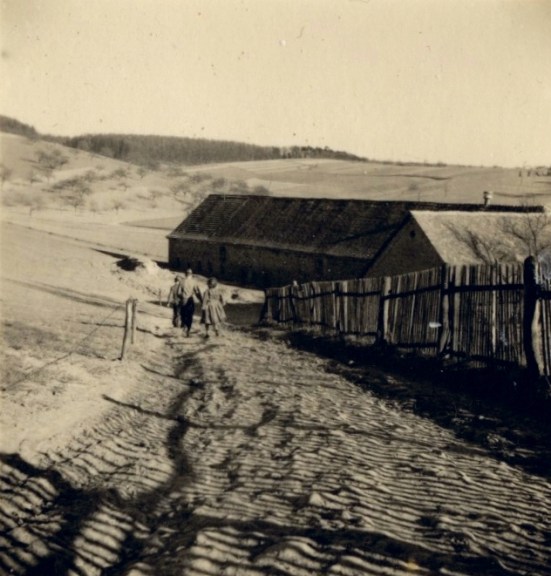
Unknown American hamlet, Real Photo Postcard, circa 1910. Written on the reverse is “To keep.”
“We were happy here
Even in the cold spells
Even with the roads
Like a frozen river
We would keep each other warm
And we were happy here
With the soup on the fire
And the wind in the chimney
And the floors too cold for bare feet…”
Unknown town, real photo postcard, circa 1905.
“And we were happy here
When the Spring broke the ice
And there were limbs to be cleared
And the melting snow
Let the pines spring back up
Toward the sky…”
Unknown Maryland town, real photo postcard, circa 1905.
“But we were happy here
With our simple life
It was our whole life
And we were happy here
Before the news came
That the world was small
And the roar was loud
And not quite so distant after all…”
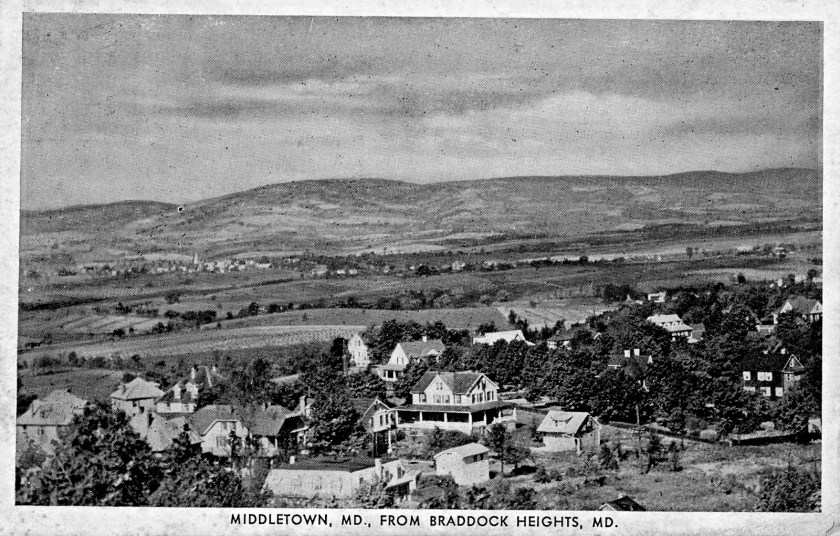
Middletown, Maryland, postcard, circa 1940.
“But we were happy here
When the cries of our babies
Were the only cries
And our bad moods
The only bad moods
Which we coaxed and stroked
Just like our own private fires.”
My mother, Sally Garnand (right), on the farm of her Aunt Edna Newton, King George County, Virginia, circa 1936.
“But we were happy here
Before….” Ω
Words: “Private Fires” by Andreas Vollenweider. Images: Ann Longmore-Etheridge Collection.
There is good evidence that the marriage was kept a secret for some time.
West Patrick Street, Frederick, Maryland, circa 1905. Postcard mailed 11 August, 1909. Ann Longmore-Etheridge Collection.
I live not far from Frederick, Maryland, which is a wonderful little city—a real Maryland gem that is more vital now than at any time in its venerable history. Frederick’s old bones have been lovingly preserved beside modern additions such as a river walk, an antiques row, and a theatre district. In fact, Patrick Street, which this postcard depicts, looks much the same today as it did when this was mailed on 11 August, 1909—just less eerie and weird.
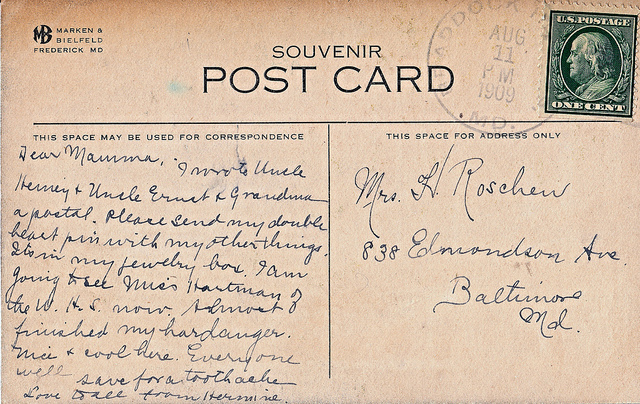
Addressed to Mrs. H. Roschen, 838 Edmundson Avenue, Baltimore, Maryland, and mailed from the summer resort community of Braddock Heights, which was only a reasonable trolly ride away, the message reads: “Dear Mamma, I wrote Uncle Henry & Uncle Ernst & grandma a postal. Please send my double heart pin with my other things. It’s in my jewelry box. I am going to see Miss Hartman of the W.H.S. now. Almost finished my hardanger. Nice & cool here. Everyone well save for a toothache. Love to all from Hermine.”
The reverse of the Roschen postcard.
Hermine Joanna Roschen, who wrote this postcard when she was 19, was born in November 1889. No one yet knew it, but she had been married for the better part of a year.
Her father, Henry Roschen, was from Germany, having come to the United States in 1875. An extant passport application states that he was born in Bremen 23 February, 1858, to Hermann Diedrich Roschen and Adelheid Brockwehl, and became a naturalized U.S. citizen in 1887. On this application, he is described as 5’4″, with brown eyes, a straight nose, a medium mouth, a short chin, dark hair, dark complexion, and a round face.
The 1890 Baltimore City Directory listed 838 Edmondson Avenue as the location of Edward A. Prior and Company, fancy goods and toys wholesaler, and Henry Roschen as its proprietor, so perhaps the family home was above the shop of this establishment. The 2 January, 1897 Baltimore Sun contained a notice from Louis Sinsheimer stating that he had sold his wholesale flour business to Henry Roschen and Frank Boehmer, who would operate it under the name of Boehmer & Roschen. This partnership lasted until January 1907 when Henry Roschen likely died. If not then, Roschen was certainly deceased by the enumeration of the 1910 Census.
“The girls were enticing in all that shimmering cloth, bright tinsel and dainty touches of rouge.”
The “Mamma” of this postcard missive was Roschen’s wife, Louise A. Schroeder, who was born in Maryland in November 1863. She wed Henry Roschen in about 1876. Hermine was the couple’s second child. She had an elder sister named Louisa A. (b. Aug 1888) and younger siblings called Henry Herman (b. 17 June 1892-9 April 1958), Elsa (b. June 1895), Adela (b. Oct. 1897), and Ernest Carl Henry (b. Sept. 1899), the last of whom would spend his life in exotic locations throughout the world.
The Baltimore Sun of 11 February, 1908, offered a glimpse of Hermine at Baltimore’s Lyric Theatre during a masked ball by the Germania Mænnerchor, a German male choral society. “The girls were entrancing, in all that shimmering cloth, bright tinsel and dainty touches of rouge,” salivated the Sun. The men, however, fell short in the newspaper’s eyes, being “as ludicrous and misshapen as they could possibly be while temporarily hiding their masculine grace in masks, flat shoes, and lurid colors.”
The Germania Mænnerchor ball included a tableau, a ballet of small girls, and general revelry. Prizes were given, one of which Hermine, her sister Louisa, and several other young ladies won for a performance titled “School Days.” Later that year, Hermine would experience the last of her own school days when she graduated from Baltimore’s Western High school.
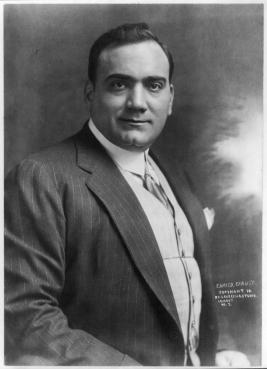
Hermine saw operatic tenor Caruso perform in March 1909.
On 26 January, 1909, Hermine married Irvin Henry Hahn, son of Joseph Henry Ferdinand and Clara M. Hahn. I can ascertain nothing of where or how they met, but there is good evidence that the marriage was kept a secret for some time. For example, the 9 March, 1909 issue of the Sun noted that Miss Hermine Roschen—not Mrs. Irvin Hahn—had been at the Lyric again to hear the Metropolitan Opera Company with the world-renown operatic tenor Enrico Caruso. We already know from her postcard that in August 1909 Hermine was summering in Braddock Heights under her maiden name, and when the 1910 census was taken, Hermine and her siblings lived with Hermine J. Shroeder, their 71-year-old maternal grandmother, who had emigrated from Germany in 1862 with her husband Henry Schroeder, an artist born in Prussia in about 1839.
Whatever caused the delay in announcing their marriage, it was in the open by 5 June, 1917, when Irvin Hahn filled out a World War I draft registration stating that he was born 8 May, 1887, in Baltimore, and was living with his wife and child at 1957 Edmonton Avenue—just down the road from the houses of Hermine’s mother and grandmother. Hahn noted that he worked for his father, a manufacturer of metal goods for the military who led a company that was established in 1898. Irvin was noted to be of medium height and slender, with blue eyes and brown hair.
The Baltimore Sun of 21 October, 1925, ran this delightful article on the return of Dr. Joseph Singewald and Hermine’s brother Ernest from a visit to several tribes of South American headhunters.
In 1920, the Hahns lived in White Street, Baltimore, with their two-year-old son Irvin Henry Ferdinand, born 6 May, 1917, who went by his third name or the nickname “Ferdie.” Their situation was unchanged a decade later, save that the family moved to 708 Reisterstown Road, Pikesville, a Baltimore suburb. Hahn listed his occupation as a manufacturer of metal goods. Finally, the 1940 Census placed all three family members together at the same address.
In 1942, Hahn registered for the WWII draft. Hahn was now the owner of his own business—the Irvin H. Hahn Company of 326 S. Hanover Street, Baltimore, which had been set up in direct rivalry with his father’s. (Incredibly, the company still exists today as a manufacturer of police badges and other insignias.) Hahn was described as 5’8″ with a light complexion, brown hair and brown eyes, and had a scar on his left thumb.
Ferdinand attended Reisterstown’s Franklin High School. This couplet was written about him in the 1933 yearbook: “Fun-loving, quick-tempered, white-haired Ferdie, his classmates’ joy and his teachers’ worry.” (Who else sees Draco Malfoy?) In the school’s 1946 yearbook, Hermine and Irvin were listed as boosters. This is the last trace I have found of her. She died 5 November, 1949.
After Hermine’s death, her husband took a solo journey to what was the Canal Zone, now Panama, in 1951. Two years later, he sailed from the port of New York to spend 3 months in Angola, presumably visiting his brother-in-law Ernest who lived in Loanda with his wife Augusta Fredericka Cranford.
Irvin died in October 1966. His obituary in the Sun reads: “Irvin H. Hahn is Dead at 79. Opened Metal Trimmings Company in 1928. Services for Irvin H. Hahn, retired president of a firm which produces badges and other metal trimming for uniforms, will be held at 11 a.m., Friday, at the Frank H. Newell funeral establishment, Reisterstown Road and Waldron Avenue, Pikesville.
“Mr. Hahn, 79, died Monday night at his home, 708 Reisterstown Road, Pikesville. Hahn was the president of the Irvin H. Hahn Company from 1928 to 1954…. A native of Baltimore, Mr. Hahn attended public schools here and the University of Maryland…. He opened his own firm in 1928…. His company had headquarters at 207 South Sharp Street until 1942, when the building collapsed in a snowstorm. The organization then moved to S. Hanover street. Mr. Hahn relinquished the presidency of his firm, which has 23 employees, to his son I. H. Ferdinand Hahn, in 1954, but remained as an advisor to the enterprise. He also held the posts of vice president and secretary.
“He was a member of the Masons, the Shriners, the Ames Methodist Church, and the 100 Club of Boumi Temple. Survivors include his son; a brother, Edgar F. Hahn, of Catonsville; and two sisters, Miss C. Viola Hahn and Miss Mildred E. Hahn, both of Baltimore.”
Irvin and Hermine’s son Ferdinand never married and had no children. He died in April 1987. I have not been able to ascertain where Ferdinand or his parents are buried. The intrepid Ernest Roschen died in Orange County, California, 2 August 1992, equally childless. Ω
As a postscript, let’s return to the postcard’s message, in which Hermine Roschen mentioned a “Hardanger” that was nearly finished. This was a piece of Hardanger embroidery, or “Hardangersøm,” using white thread on white even-weave cloth, sometimes also known as “whitework” embroidery.
Photo by Velvet-Glove at English Wikipedia.
Hoo Boy! 1/6th-plate daguerreotype with tinting and solarization, circa 1846. Ann Longmore-Etheridge Collection.Fresh from the cornfield, tintype, circa 1885. Ann Longmore-Etheridge Collection.Ol’ Blue Eyes, 1/6th-plate, hand-tinted daguerreotype, circa 1852. Ann Longmore-Etheridge Collection.Handsome fellow, 1/6th-plate Weston daguerreotype with solarization, circa 1852. James P. Weston operated a daguerreotype gallery in New York City between 1842 and 1857. The studio functioned out of 132 Chatham Street from 1852 to 1856.
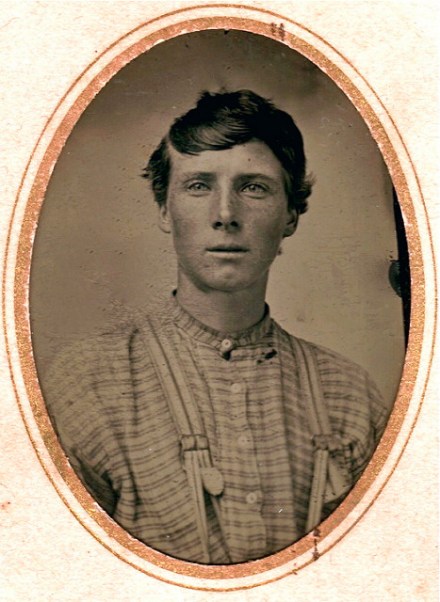
Tintype, circa 1880. Ann Longmore-Etheridge Collection. His hard-soled, lace-up boots are pretty darned adorbs, too.
Big Brother, Little Sister
1/6th-plate daguerreotype, circa 1849. Ann Longmore-Etheridge Collection. The image is shown here in its open case. Nearly all of the earliest forms of photography were presented in wooden cases.
Worried Will
British 1/9th-plate relievo ambrotype, circa 1858. Ann Longmore-Etheridge Collection. In this version of an ambrotype, created in 1854 by a Scottish photographer named Urie, the background surrounding the sitter is scraped away and replaced with one of a number of options, including a solid color, a vignette mat, or a false background. When I purchased this ambrotype there was nothing behind the boy’s image, so I had to create a backdrop.
Daddy’s Darling
1/9th-plate daguerreotype, circa 1850. Ann Longmore-Etheridge Collection. This beautiful little girl, who is literally falling out of her dress, wears a coral necklace (thought to protect children from diseases) but the object in her hand remains a mystery.
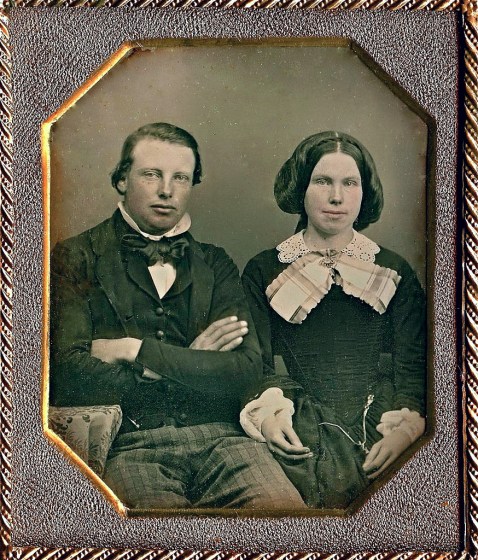
“Almost certainly a wedding portrait, this is a reasonably well-to-do couple, since they are dressed in formal day wear.”
Unknown couple, 6th-plate daguerreotype, circa 1854. Ann Longmore-Etheridge Collection.
This is another of my daguerreotypes, formerly of the Ralph Bova collection, which was published in Joan Severa’s My Likeness Taken. Severa wrote of the image: “Almost certainly a wedding portrait, this is a reasonably well-to-do couple, since they are dressed in formal day wear.
“The wife has done her hair in the bandeau style, in the longer, deeper roll that was one of the choices at mid-decade. Her hairdo is finished with ribbon ends hanging from a bow at the back of the crown. She wears what is probably a black velvet bodice over a black silk shirt. The fine whitework collar is large, and the white undersleeve cuffs are deeply frilled. The unusually wide silk ribbon is an expensive luxury; it flares prettily from the folds under the collar to spread over the bosom. A gold chain for a pencil hangs at the waistline.
“The young man wears a morning suit: a cutaway coat over striped trousers. His black vest matches the coat, and the high, standing collar of his starched shirt is held by a wide, horizontal necktie.”
When I first uploaded this image to my photostream at Flickr, a number of commentors suggested the sitters were siblings rather than man and wife. I agree there is a definite resemblance. Severna felt strongly that this image had the hallmarks of a wedding photograph and I also agree with her assessment. The two positions may be reconciled if the subjects are married cousins—a common occurrence until the second half of the 20th Century. Ω
The daguerreotype may have been taken to mark Pressey’s official coming of age in 1856.
Charles Wilber Pressey, 1/6th-Plate Daguerreotype, 1856. Ann Longmore-Etheridge Collection.
This gorgeous and all-but-pristine daguerreotype portrays Charles Wilber Pressey, most likely at the age of 21. Handsome, jaunty, and possessed of a fetching chapeau, the image may have been taken to reflect Pressey’s official coming of age. He was born in 7 June, 1835, in Sandown, New Hampshire. If my supposition is correct, this image can be dated to the summer of 1856.
The Presseys were New Hampshire natives, having descended from the immigrant John Pressey who arrived in Hampton, New Hampshire, in about 1650. Charles Pressey’s birthplace is in the southeast of Rockingham County, named for Sandown on England’s Isle of Wight. Today’s population is about 6,000. It was smaller in Pressey’s time, although the tranquility and introspection was most likely the same.
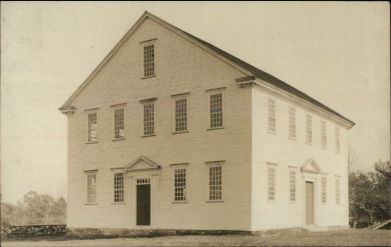
The most prominent structure in Sandown was the Meeting House, built by the first minister of Sandown, the Reverend Josiah Cotton, in 1774, and was a focal point for both civic and religious activities. Today, this simple, sturdy building is preserved on the National Register of Historic Places.
“While the town as a whole has been largely ignored by the outside world, its meetinghouse has gained a marked degree of notoriety. Sandown is credited by many with possessing the finest meetinghouse in New Hampshire—and there are those who would go so far as to say the finest in America,” wrote Richard Holmes in A View from Meeting House Hill. “The praise of outsiders, while always appreciated, is not the chief reason that the townspeople honor this building. To the residents of Sandown, this old building is the encapsulation of their town’s entire history, for within its walls has passed the pageant of the community’s past. For 155 years, the good men and women of Sandown gathered at this building to set their own taxes and to draft their own laws. This building was, to a great extent, the capitol of a small, semi-autonomous republic operating inside New Hampshire.”
Sandown Old Meeting House
Little is known of Charles Pressey’s father, Henry Moulton Pressey, save the barest bones. He was born 7 August, 1806, in Sandown, to Peter Pressey and Bettey Moulton. Peter Pressey died insolvent in October 1823, with debts to a long list of local citizens. Settling the estate included the sale of $280 in real estate to satistfy Peter’s creditors.
On 25 November, 1830, in Freemont, Rockingham County, Henry Pressey married Mary Ingalls (1805-1858), called “Polly.” Their first child was Mary Eliza, born in about 1833 with Charles Wilber following two years after. Another son, Albert A., was born in 1844.
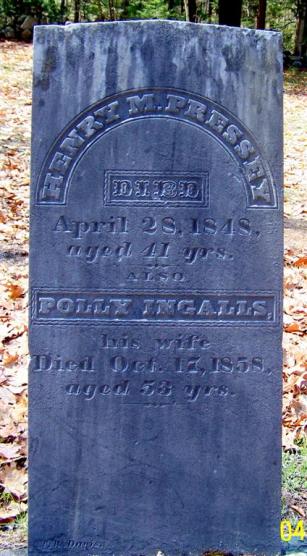
The gravestone of Charles W. Pressey’s parents, Henry and Polly, at Wells Village Cemetery, Sandown, New Hampshire. Photo by D. J. Goldman.
Henry Pressey died 28 April, 1848, at the age of 41, likely of Tuberculosis (TB). Two years later, when the 1850 Census was enumerated, Charles and Albert, along with their mother, dwelt with maternal grandparents Samuel and Betsy Ingalls—both born in 1775 in New Hampshire—on a farm in Sandown. The location in 1850 of Charles’s sister Mary is not known, but neither she nor his mother Polly lived out the decade. Their lives were eaten away by TB, known then as the “White Death” and “Consumption.” Mary died 11 October, 1855, and Polly passed away 17 October, 1858. Sandwiched between those two deaths was 7 June, 1856—Charles’s 21st birthday. It is possible that the daguerreotype in my collection marks this attainment and may have been made as a gift for Polly.
To sit for his picture, Charles likely traveled to Exeter, where John Plumbe, Jr., set up a studio and school in the early 1840s. Barbara Rimkunas wrote in the “Historically Speaking” column of the Exeter News-Letter of 17 September, 2013, “In 1841, advertisements for ‘Mr. Plumbe, Professor of Photography’ began running in the Exeter News-Letter. Mr. Plumbe ‘proposes to instruct a limited number of Ladies and gentlemen in this beautiful and valuable art, who will be furnished with complete sets of the improved patent apparatus, by means of which any one may be enabled to take a likeness in an ordinary room without requiring any peculiar adjustment of the light.’ The technology must have seemed near-miraculous to many people, since Mr. Plumbe had to explain that ‘the process is simple; it requires no acquaintance with chemistry and no knowledge of drawing or painting, for the light engraves itself upon the prepared plate.’…. Exeter’s early photographers—Thomas Boutelle, George Sawyer, the Davis Brothers, and William Hobbs—set up shops all along Water Street.”
Pressey chose as his bride Clementine Wood Sleeper, a cousin and a widow one year older, who brought a young son to the marriage.
The 1860 Census, taken in July, placed Charles Pressey at a Sandown box mill, while his 16-year-old younger brother dwelt with his Ingalls grandparents on their farm. If Charles was living away from his remaining family, he would not be alone for long. His eye had alighted on a pretty cousin who had suffered a tragic blow and Charles was resolved to marry her.
Clementine Wood Sleeper was a young widow one year older. Called “Clemmie” by her family, she was born 3 April, 1834, the daughter of Joseph Gardner and Polly Pressey Wood, a paternal relation of Charles Pressey—and one of those to whom his grandfather Peter had once owed money.
News of Joseph Sleeper’s suicide was carried in multiple newspapers in the eastern United States. This is from the Baltimore Sun, 12 January, 1858. (The Sleepers lived in Sandown, not Landerin.)
In 1855, Clementine married as her first husband Joseph C. Sleeper, son of James and Sally Sleeper of Sandown. The young couple had a child, Edwin Sidney Sleeper, born in Freemont, New Hampshire, 12 November, 1856. Clementine’s husband committed suicide at the Matteson House, a high-class hotel in Chicago, Illinois, on 9 January, 1858. Why he was in that city and what drove him to his desperate act is unknown.
It is likely that Charles and Clementine had known each other all their lives—they were related and their hometown was small. Whether Charles had feelings for Clementine before or during her marriage to Joseph Sleeper is speculation, as is that a man like Charles, who had lost so many of his own family so tragically, might be drawn to comfort a grieving widow, then woo her.
However it came to pass, Clementine Sleeper married Charles Pressey on 28 November, 1860, in the town of Hampstead, which borders Sandown. Charles adopted little Edwin Sleeper as his own. For the rest of Edwin’s life he used the surname Pressey and Charles was always stated as his father, not his stepfather. Many years later, he would be listed in the 1916 Who’s Who in New England as Edwin Sidney Pressey.
“A reference to the roster of the regiment will show that it included many men who were too young to enter the service at the outbreak of hostilities, but who had since become of military age.”
Although a Charles A. Pressey served as sergeant in Company A, Regular Army 19th Infantry, a Charles O. Pressey joined Company I, Indiana 9th Infantry, and a plain Charles Pressey of Company G, 10th Maine Infantry, died during the Battle of Antietam, our Charles Wilber Pressey did not join up during the U.S. Civil War. For a Union man, conscription did not exist until the Draft Act of 1863, but even then single men were conscripted before husbands. Moreover, all drafted men could hire a substitute or pay $300 in lieu of service.
However, Charles’s brother Albert did enlist. On 26 September, 1862, at Concord, the 19-near-old became a private in Company K, 15th New Hampshire Infantry, headed by Colonel John W. Kingman, which mustered for a nine-month stint of service. Charles McGregor, company historian, noted in his Regimental History of the Fifteenth New Hampshire Volunteers, “This was the very darkest period of the war. It was the first regiment of New Hampshire’s quota in response to President Lincoln’s call for 300,000 nine months’ men. A reference to the roster of the regiment will show that it included many men who were too young to enter the service at the outbreak of hostilities, but who had since become of military age…. It is understood that the nine months’ men were raised for a special purpose—as an auxiliary to our struggling armies already in the field, and to enable them to strike the rebellion a staggering and fatal blow.”
Company K went south to Louisiana—probably as foreign a place to Sandown as Albert Pressey could have imagined. The company became part of Sherman’s Division, Department of the Gulf, and participated in the 48-day siege and military assault on Port Hudson in the the summer of 1863, which was the Union’s final engagement in the campaign to recapture the Mississippi.
The Siege of Port Hudson, Louisiana, by J. O. Davidson, Library of Congress.
After Port Hudson surrendered, the men of the 15th New Hampshire “boarded the steamer City of Madison for Cairo, Illinois, thence to Chicago,” wrote McGregor. “From Chicago and through New York, the regiment enjoyed a continuous ovation. Arrived at Concord at about noon of Saturday, the 8th, and was mustered out on the 13th of August.”
A few months later, on 26 November, Albert wed Amelia A. Moore, daughter of John and Alice Moore, in the town of Derry, near Sandown, and would spend the first part of their married lives there. The couple had a farm and a baby daughter, Mary Ann, by 1870. They would have at least five more children, but only three survived infancy—Lyndall E. (1872-1964), William M. (1874-1942), and Bertha M. (b. 1882). Later, Albert Pressey worked as a stableman in Haverhill, Massachusetts, and eventually moved to a Hampstead farm established by his son William. He received a Civil War veteran’s pension and died aged 77 on 9 August, 1920.
“The child is restless at first, but later becomes listless; the features are drawn and shrunken and the face often has the appearance of extreme age.”
In 1867, Charles and Clementine welcomed their first child, a son named Henry Mahlon Pressey, but the boy died aged one year, five months, and 17 days on 15 September, 1868. It was a horrible and heartbreaking twist of fate, and for Charles, it may have painfully echoed the death of the baby’s namesake. Little Henry’s death record states that he perished of Cholera Infantum, an acuteinfectiousenteritis where death comes after severediarrheaand vomiting leads toextremefluidandelectrolytedepletion.
The disease’s progress was described in The Eclectic Practice of Medicine with Especial Reference to the Treatment of Disease, written in 1910 by Dr. Finley Ellingwood: “The diarrhea is at first muco-purulent, soon becoming watery, and amounts to purging. The stools are voided with force, and vary in number from ten to fifty in twenty-four hours, and are alkaline in reaction. Vomiting occurs, and may soon become nearly incessant.
“The pulse is rapid and weak; the temperature taken in the rectum may be found to be as high as 105° to 106° F., while the peripheral temperature may be low. The tongue becomes red and dry; there is intense thirst. The urine is scanty or it may be suppressed. The skin has a mottled appearance from poor capillary circulation; the extremities are usually cold. The child is restless at first, but later becomes listless; the features are drawn and shrunken and the face has often the appearance of extreme age. The eyelids are but partly closed, the mouth is open, and the fontanels are depressed. Not only is prostration present from the beginning, but signs of profound toxemia are are marked. Toward the end of fatal cases the breathing is irregular and the head retracted; the temperature is sub-normal, or there may be hyperpyrexia. Death may occur in twenty-four hours.”
An unidentified mother from Canestota, New York, holding her dead infant, albumen carte de visite, circa 1875. Clementine Pressey may have sat for a similar photograph. Ann Longmore-Etheridge Collection.
Their baby was gone, but the theme of resurgence strongly marked the chapters of Charles Pressey’s life. By the 8 June enumeration of the 1870 Census there was a new son, Charles Park Pressey (b. 25 November, 1869). In 1872, the Presseys—a unit of four again—moved the short distance to Hampstead where their boy, known as Park, would thrive, where they took up farming, and where they would become established as well-respected and noted citizens.
In 1880, the census enumerated Charles and Clementine on their farm with Edwin, aged 23, and Park, aged 10. Also living with them was Clementine’s father Joseph A. Wood, aged 77; her mother Polly, aged 76; and her brother Clarence, who was aged 28 and a commercial miller.
In February 1880, there was a rare glimpse of Clementine Pressey chaperoning the town youth at a meeting of The Ladies’ Sociable where there were “various games, charades, recitations, readings, and singing,” according to A Memorial of the Town of Hampstead, New Hampshire, Vol. II, by Harriette Noyes.
During the years 1880 to 1900, Pressey was elected a member of the Trustees of Hampstead High School and after his election on 31 December, 1884, became a deacon of the Congregational Church. His company, C. W. Pressey & Co.,was a general lumber business and manufactured wooden boxes in the town from about 1872 to 1892. In 1900, he was elected a Rockingham County commissioner.
Charles made an appearance in a June 1890 court case concerning the town of Hampstead’s ability to establish a new cemetery. The New Hampshire Reports, Vol. LXVI’ssummary of Eastman v. Hampstead reveals that a four-acre lot was purchased and the deed delivered to the town. However, when the selectmen went to lay out the new cemetery they found that “across the highway, on land owned by Charles W. Pressey, one of the cemetery committee, was a dwelling-house occupied by George Wyman. Wyman had a contract with Pressey for the purchase of the house and land, and objected to the laying out of the cemetery within 20 rods [110 yards] of it. At this time, Pressey notified the selectmen of Wyman’s objection, and informed them that he could not consent to laying out the cemetery within 20 rods of the dwelling-house.”
Hampstead, New Hampshire, as the Presseys would have known it in about 1910.
The issue was resolved by paying Pressey and Wyman $100 for a release to build the graveyard no closer than ten rods to the house and the laying out progressed with lots no closer than 20 rods. The money was fronted by Selectman Josiah Eastman on behalf of the cemetery committee, but the bad blood this created became evident when the town refused to reimburse Eastman for his expense. The court ruled in Eastman’s favor, writing, “It is noted that Pressey was estopped to withhold his consent to use the land as a cemetery, and therefore the release was without consideration. This objection is not tenable. Wyman had a contract for the purchase of the Pressey land and was the equitable owner. It was Wyman, not Pressey, who objected…. There was no estoppel. The plaintiff is entitled to judgement for $100 and interest from the date of the writ.”
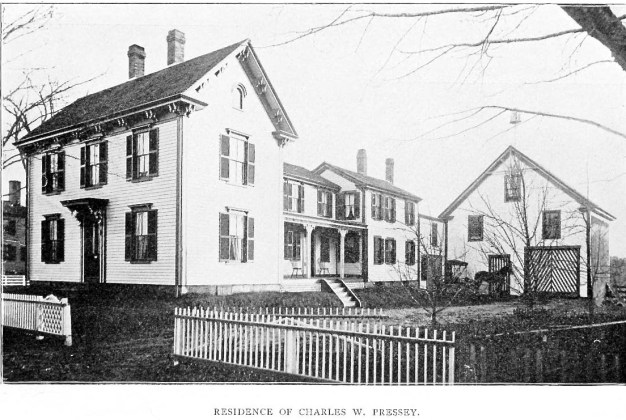
It is possible that the fine photo of the Pressey home was taken by Park, who was fascinated by old houses all his life.
Both Charles and Clementine’s sons were exceedingly well educated—so much so it seems Charles wanted to give them the underpinings for success he’d lost when his own father died.
Park Pressey was schooled in the public and high schools of Hampstead, as well as the Exeter Phillips Academy, a residential school founded in 1781 known for academic excellence and a distinguished faculty. Park also attended Williams College, Williamstown, Massachusetts, from which he graduated in 1893. Later in life, he became the manager of the Boston Branch of the Educational Register Company. He was the author of The Vocational Reader (Beacon Vocational Series) and a regular contributor to Youth’s Companion and St. Nicholas Magazine. Park was also an avid photographer.
This photo of the Pressey home in Hampstead was published in Harriette Noyes’s A Memorial of the Town of Hampstead, New Hampshire, Vol. I.
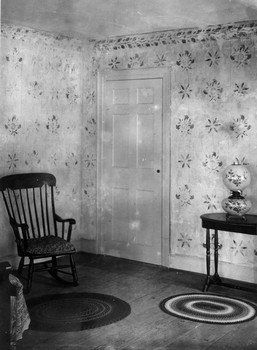
It is probable that the fine photograph of the Pressey home above was taken by Park, who was fascinated with old houses all his life. A local architecture scrapbook compiled by Park between 1896 and 1910 exists in the Historic Society of New England containing “well-illustrated news clippings relating to architectural and historical subjects pertaining to Boston, with some coverage of Andover, Amesbury, Salem, Bedford, Marblehead, Malden, Portsmouth, NH and other communities.”
An interior area of the Pressey’s Hampstead home photographed by Park, from the collection of the Historic Society of New England.
Park also obtained the Halliday Historic Photograph Company Collection, lauded as an “unrivaled” documentary source of old New England homes by The Bulletin of the Society for the Preservation of New England, December 1916. “Sometime after Mr. Halliday’s death in 1904 the collection of negatives came to the possession of Mr. C. Park Pressey, who has still further enlarged it. It would be difficult to overestimate the value of such a collection as this, as an astonishing number of the houses represented have been destroyed and many of these photographs are the best or only record.” The society eventually purchased the collection.
Park married late in life—in 1926 in Belmont, Massachusetts. The 1930 Census enumerated him back in Hampstead, aged 60, with his wife Anne D., aged 39, and daughter Carol Anne (1928-11 Sept. 2011), aged 1. His occupation was given as publisher and photographer.
By the late 1950s, Park devoted himself to preserving old houses and other structures, writing tracts such as Have you seen this Old House? Or Priscilla’s Quest for a Family Roof-Tree, and articles such as “Old New England Canals” in Old Time New England in 1956.
He would die in 1963 in Lynn, Massachusetts.
Park’s daughter Carol married Anthony P. DiPesa (d. 11 Nov. 2007) and had five children. She was buried in Puritan Lawn Memorial Park, Peabody, Massachusetts.
Charles Park Pressey, circa 1900.
Edwin Pressey attended district and Hampstead High schools, graduated from Williams College in 1885, and from Union Theological Seminary, New York, in 1888. He earned a Ph.D. from Illinois Wesleyan University in 1904. He authored the book History, Philosophy and Practical Use of Mental Healing in 1910. (Did his interest spring from a need to understand the suicide of his biological father?) Edwin also lectured on Biblical archeological developments. His chief recreation, he told Who’s Who, was tramping.
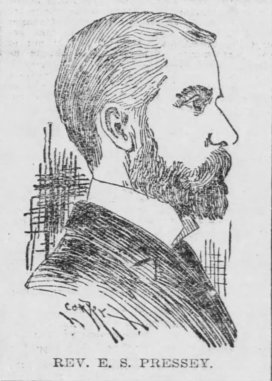
A sketch of Edwin S. Pressey published in the St. Paul Globe.
On 23 August, 1887, Edwin married Orrie Belle, daughter of William C. Little and Julia Harris Haseltine. The bride was a music teacher. The couple had had two children—Sidney Leavitt (b. 1888) and Julia Clementine Pressey (b. 1895).
During his early years in the ministry, Edwin served as pastor of Congregational churches at Brooklyn, New York; Springfield, Vermont; and Glenwood, Illinois. Next, he became pastor of the St. Anthony Park Congregational Church in St. Paul, Minnesota. The 3 March, 1897, St. Paul Globe contained an article on Edwin’s installation, as well as a sketched portrait. “Last night marked an epoch in the history of [the church], which will long be remembered by the members…. The church interior was ablaze with light in honor of the occasion, and was very prettily decorated with festoons of smilax and cut flowers,” the newspaper noted. After the official service was concluded, “the evening was spent in a social way, and Rev. Pressey was given an informal welcome to his new charge.”
The years that followed were crowded with sermons, weddings, christenings, funerals, and conferences. Orrie Pressey was also deeply involved in her husband’s work. The 4 April, 1905, issue of the Minneapolis Journal noted, for example, that when the Congregational Missionary Society next met, “Mrs. Edwin Pressey and Mrs. W. Hays will speak on ‘The Ancient Religions of Japan,’ and ‘Why America is Interested in Japan.’”
“Education was the one major activity to which the country has thus far not systematically applied ingenuity to the solution of its problems.”
As Charles and Clementine had done for Edwin and Park—doubtless recognizing the brilliance of both boys—so Edwin and Orrie did for Sidney and Julia. The children were incredibly gifted. By 1910, Sidney was training to become a psychologist. (Were these the continued ripples of Joseph Sleeper’s long-ago suicide?) His 1918 draft registration stated he was a “mental test expert” in a psychiatric hospital in Boston.
Sidney Pressey was a noted professor of psychology at Ohio State University from 1921 to 1959. A cognitive psychologist, he is credited with inventing in the mid-1920s the first teaching machine, which presented students with multiple-choice questions. Sidney is quoted in a 1932 article in School and Society, “Education was the one major activity to which the country has thus far not systematically applied ingenuity to the solution of its problems;” his teaching machine was an attempt at doing so. After retiring, he continued to publish on the topic of cognitive psychology. He wrote several books, including a influential textbook Psychology and the New Education in 1937. Sidney Pressey died 1 July, 1979.
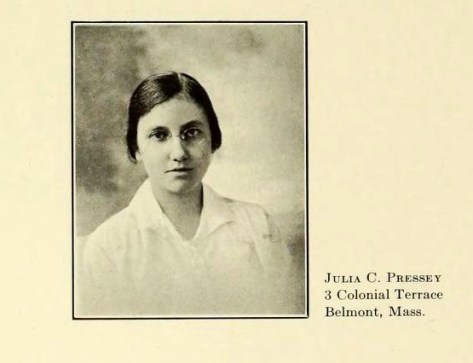
Edwin, Orrie, and Julia Pressey were enumerated in Orange, Massachusetts, in 1910 and in Belmont, Massachusetts in 1920, at which time Edwin served as pastor of the Plymouth Congregational Church. Julia graduated from Smith College, Northampton, Massachussetts, in 1918 then enrolled in the Wisconsin Library School, where she did field work in Harry Houdini’s home town of Appleton in the winter of 1922 and graduated in May of that year. On 14 October, 1924, Kansas’s Emporia Gazette noted, “A demonstration of the use of the catalog will be given by Miss Julia Pressey, head cataloguer at the Kellogg Library.”
Julia Clementine Pressey in 1918 from the Smith College yearbook.
Sometime between 1925 and 1930, Julia received a post as assistant professor of library science at the Atlanta Library School, Atlanta, Georgia. Edwin Pressey had retired and both parents moved with her there. (Later Julia would become a faculty member at Emory University.) Orrie Pressey died sometime between late 1930 and 1940 in Atlanta.
After her mother’s passing, Julia donated a quilt made by Orrie in the late 1800s to the National Museum of American History, which describes it thus: “Crazy-patched square and rectangular blocks were assembled to make Orrie Little’s Parlor Throw. The four corner blocks are made entirely of ribbons. A variety of silks, satins and velvets were used for the other blocks. The lining is a brown-and-black stripe printed fabric. The binding is made of 12 different ¾-inch ribbons, seamed to the lining and whip-stitched to the front. Embroidery is used to embellish the edges of the patches and along the bound edge.”
A crazy quilt made by Orrie Belle Little Pressey. Photo courtesy National Museum of American History.
During the war years and through the end of the decade, Julia was head of the Decimal Classification Section of the U.S. Library of Congress in Washington, D.C. Various University of Illinois alumni newsletters highlight her activities—for example, lecturing to students at a Catholic University evening class on cataloging and classification and serving as a committee member to resolve classification problems at the a national gathering of the Assembly of Librarians of the Americas.
From the end of the Second World War to the close of the 1940s, Edwin Pressey lived with his son Sidney in Columbus, Ohio, near to the university where Sidney taught. Edwin’s passing was noted in this tiny obituary that ran in the 29 November Mansfield, Ohio, News-Journal.
As for Julia, I can find little about her life during the 1950s and 1960s. She never married and died 1 July, 1976, in Pomona, California, at the age of 81.
Clementine Pressey lived long enough to see her husband’s coffin carried from their parlour to his newly dug grave in Lakeview Cemetery.
Back to the beginning now—or at least the end of the beginning.
By 1910, Charles Pressey had largely retired—the census of that year noted he performed odd jobs. His last census appearance was in 1920, when he was enumerated with Clementine in their home on Main Street in Hampstead. Charles died there 26 April, 1927, of pneumonia ten days in duration that began from a cold. He was 92.
Clementine Pressey lived long enough to see her husband’s coffin carried from their parlour to his newly dug grave in Lakeview Cemetery. She would soon join him there—surviving her husband by only three days. Clementine died 29 April, age 93, of a heart attack brought on by cold and bronchitis. She was buried beside him on 1 May.
Just as I finished this article, I located a second photo of Charles Wilber Pressey that dates to about 1903. I freely admit that my eyes filled with tears. He is older, weathered, but recognizably that handsome young man of the summer of ’56. Ω
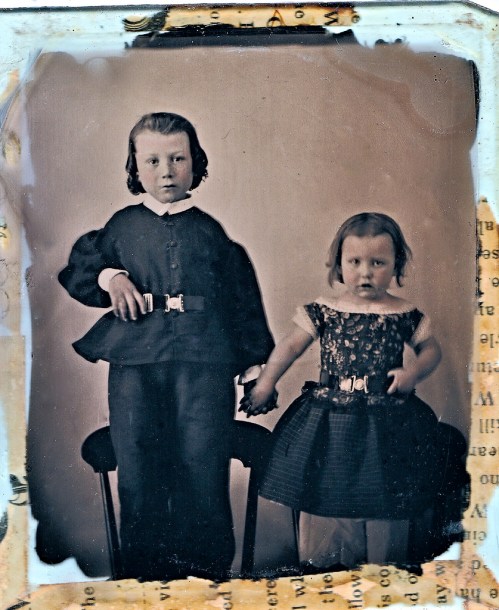
The photographer may have told the children to hold hands and grab the waist belts to keep their arms still during the exposure.
Siblings, 6th-plate ambrotype, circa 1855. Ann Longmore-Etheridge Collection.
This ambrotype is not only endearing, but raises several points of interest: First, both children were stood atop chairs and with that placement came the possibility that either could topple—especially the younger child who looks about age two or three. The belts around the siblings’ waists were not part of their costumes—it is likely they were both strapped to metal stands that photographers used to provide stability for their subjects, as well as to keep young sitters like these from wandering out of the frame. (That this was sometimes necessary is illustrated the adorable image below. How refreshing it is to see a mother cracking up at the antics of her toddler whilst Daddy or a studio assistant tries to keep the child from escaping.) The photographer may also have told the siblings to hold hands and grab the waist belts to keep their arms still during the exposure.
Smiling mother and fleeing toddler, albumen cart de visite, circa 1860. Photograph by Whipple, 96 Washington Street, Boston, Massachussetts. Ann Longmore-Etheridge Collection.
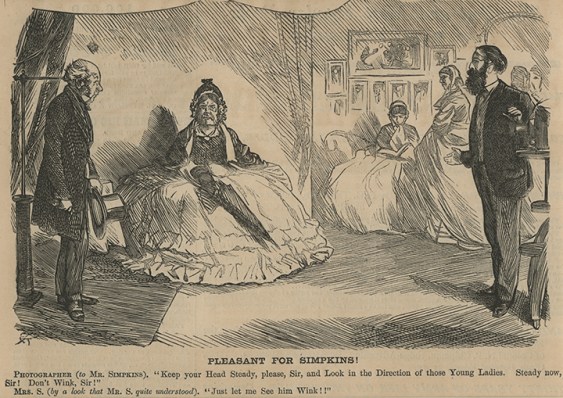
Both children may also have been head clamped, as can be seen in the Victorian cartoon below. Contrary to what duplicitous eBay sellers and 14-year-old goth bloggers might propose, these metal stands were not used to hold up dead bodies. The cartoon below clearly shows how posing stands worked to help keep sitters still.
Secondly, it is unclear whether the child on the right of the ambrotype is a boy or a girl. The center-parted hair argues female, but the rest of the outfit says boy despite the floral top and long cotton bloomers under a buoyant checked skirt.
Also tantalizing are the partial words visible at the edges of the image. At one point, the sticky back of the ambrotype was covered by newspaper. If still intact, this may have yielded a clue about this image’s precise date and location of origin. Ω
The sap of another generation,
fingering through a broken tree
to push fresh branches
towards a further light,
a different identity.
—John Montague, “The Living and The Dead”
Elder and infant, albumen paper print, Ann Longmore-Etheridge Collection.
This wonderful outdoor image, circa 1910, shows a bonneted babe sitting in a wicker pram on an early spring day in the eastern United States. The child’s pudgy hand appears lightly pinched, rather than held, by the arthritic fingers of his or her grandmother—perhaps great-grandmother. The old woman, who was probably born in the 1830s, is magnificent with her weathered face and carefully coiffed, almost ruched white hair in contrast to her elaborate dark clothing. She seems quite elderly, but sturdy and strong. A house, possibly the family home, can be glimpsed through the leafless trees behind her.
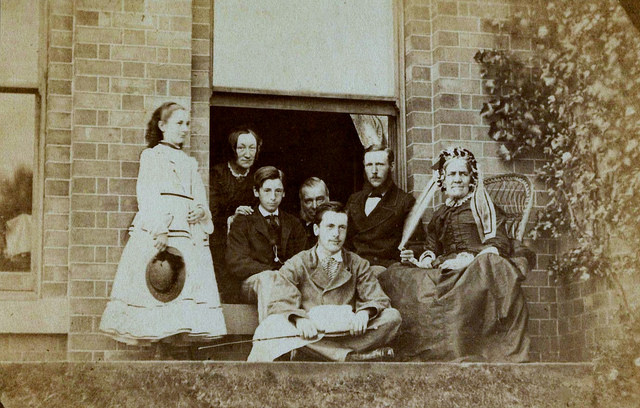
British albumen carte de visite, circa 1866. Ann Longmore-Etheridge Collection.
The next image is of a multigenerational British family posed on a ground-floor window ledge on a pleasant day during the mid-1860s. Grandmother, who is dressed in black-and-white widow’s clothing, sits in wicker chair, whilst Father and Mother lean into the picture from inside the home. Mum’s hand rests possessively on the shoulder of her youngest son, whilst the eldest brother perches on the sill and the middle son sits cross-legged below him. The daughter of the house, a tween in a jaunty summer dress, looks very much a mini-me of her mother.
Family in mourning, British albumen carte de visite, circa 1862. Ann Longmore-Etheridge Collection.
The third image, which is marked “J. McCornick, Photographer, 3 The Bridges, Walsall,” is more somber. One subject is a young girl of about 12 years beside an elderly gentleman who is likely her grandfather. The seated female may be the girl’s mother or her grandmother—it is hard to be sure, although they are clearly related.
The members of this family group are dressed in mourning, but nothing more of the nature of their loss can be supposed, except that the mother or grandmother was not mourning for her husband. The prevailing custom for widows’ bonnets was to include a white inset to frame the face.
Grandfather, whose hand appears to rest protectively on the small of his granddaughter’s back, holds in his other hand some type of folded document or wallet. The message he conveyed with this prop is now inscrutable, but it would have been understood by the carte de visite’s viewers.
The final image is a four-generation portrait, identified on the reverse as “Elizabeth Stokesbury, age 79 years; Clarissa Stokesbury, age 51 years; Extonetta Book, age 29 years; Esther Cook Book, age 3 years.”
The sitters were photographed circa 1902 in Chariton, Lucas County, Iowa. Ann Longmore-Etheridge Collection.
At the far left is Elizabeth Clark (11 April 1824-5 Oct. 1910), born in Fayette County, Ohio, to Welsh native Joshua Clark (1795-29 March 1830) and his wife Mary Blaugher (1795-16 March 1879).
Elizabeth Clark married farmer John S. Stokesbury (7 Sept. 1819-12 May 1867), the son of Robert Stokesbury (1790–1839) and Anna Baughman (1794–1870). In 1850, the Stokesburys farmed in Jefferson, Green County, Iowa; by 1860 they had moved to a new farm in the county of Wayne. The couple had eleven children to assist them: Robert (b. abt. 1842); Angeline (b. abt. 1844); Mary Ann (b. abt. 1846); Joseph (b. abt. 1848); Sarah (b. abt. 1850); Clarissa (12 Sept. 1851-8 March 1935); Harvey (b. abt. 1853); John (b. abt. 1859); Elizabeth Ann (28 June 1861-9 Aug 1946); Clark D. (b. abt. 1863); and Launa (1865-1939).
At age 16, Clarissa, second from left, married a cousin, Jesse Bush Stokesbury (24 Jan. 1843-18 Dec. 1918), the son of James Madison Stokesbury (1813–1869) and Phoebe Painter (1819–1902). By 1870, Clarissa and Jesse had migrated to Chariton, Iowa, where, the family farm was enumerated on the 1870 Census. However, their days on the land were ended by 1880, when Jesse was recorded on the census as a laundry man, and on the 1900 Census he was enumerated as a day laborer. His widowed mother-in-law, Elizabeth Stokesbury, was also in residence, along with her youngest children.
Clarissa and John had the following sons and daughters: Bryant W. (b. abt. 1868); Hillary Edwin (13 April 1870-8 Feb. 1950); Theodosia (b. abt 1872); and Extonetta (b. Dec. 1873), second from right in the photograph, who was known as “Nettie.”
On 24 November, 1898, Nettie married harness maker and saddler John Atwater Book (Sept. 1864-17 April 1924), son of Harlan and Emmaline Book. By 1900, the Books and their first child, Esther Cook (far right—and yes, Cook Book) all lived with Jesse and Clarissa Stokesbury. Nettie and John had two more children: Sarah E. (b. 6 Feb. 1902); and Jesse H. (b. 24 Dec. 1903). Sarah married Loren L. Adams on 12 September, 1935; Jesse married Fae Arza Wicks in June 1929. He died in January 1970 in Seymour, Indiana, and was buried at Chariton Cemetery.
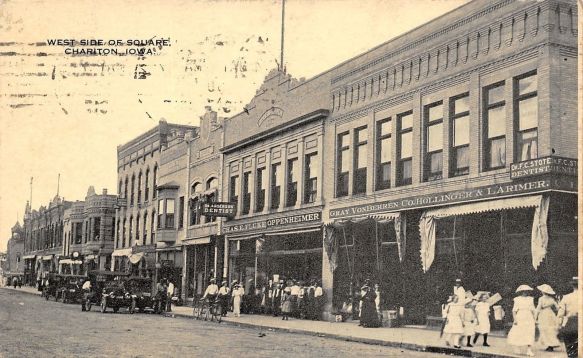
The west side of Chariton’s main square, real photo postcard, circa 1915. Ann Longmore-Etheridge Collection.
Nettie’s brother Edwin Stokesbury, who became a broom maker and married Ollie B. Ritter on 20 February, 1894, had set up house in Chariton by 1900. The couple had four children, but shortly thereafter the marriage failed. Ollie married as her second husband a man named Van Trump and Edwin’s children took their step-father’s surname. By 1920, widowed Clarissa and her son Edwin lived together.
In 1920, Esther Book worked as a bookkeeper in a Chariton store along with sister Sarah. On the 1930 Census, Nettie, Esther, and Sarah were enumerated in one household, with Nettie working as a sales lady in a variety store; Esther worked as a bookkeeper in a bank and Sarah was a tailoress in a dry goods store.
The Des Moines Register of 25 December, 1935, featured a testimonial advertisement by Nettie in which she was quoted, “I like the simplicity of operating the Colonial Furnace and the way it holds fire. The damper enables one to feed the fire so that no smoke, soot, or gas escapes into the rooms. And I like the draft in the feed door, which can be opened to prevent puffing.”
Extonetta Book died on 8 May, 1962, and was buried in Chariton Cemetery. It appears that her daughter Esther never married. She worked for many years as the secretary of the Farmers Mutual Insurance Association and died 25 March, 1965, three years after her mother. Esther is also buried in Chariton Cemetery. Ω
Clearly, I had to win the auction—the wishes of Mr. Guppy, whoever he had been, seemed evident.
An unmarked 1860s albumen carte de visite of an 1850s daguerreotype of an unknown man. Ann Longmore-Etheridge Collection.
In July 2013, I purchased this carte de visite (CDV), which I recognized as an 1860s copy of an earlier daguerreotype. The subject reminded me of the English actor Burn Gorman in his role as Mr. Guppy in the 2005 BBC adaptation of Charles Dickens’ Bleak House. There was no inscription to identify the sitter, so in my Flickr photostream I titled the image “Mr. Guppy” and went on.
In January 2014, I stumbled across the auction of a 1/4-plate daguerreotype that left me gobsmacked. It was Mr. Guppy. The original image.
A conversation with the seller elucidated that the daguerreotype came from a Vermont estate, but there had been no accompanying CDV. The seller was equally surprised at the strange twist of fate.
Clearly, I had to win the auction—the wishes of Mr. Guppy, whoever he had been, seemed evident. I did not fail him; today, the daguerreotype and CDV are united in my care.
The original 1/4th-plate daguerreotype of “Mr. Guppy.” Ann Longmore-Etheridge Collection.
The daguerreotype’s brass mat is stamped “Jaquith, 98 Broadway.” According to Craig’s Daguerreian Registry, this was the gallery of Nathaniel Jaquith, who was active from 1848 to 1857 at that address.
Nathaniel Crosby Jaquith was born 30 April, 1816, in Medford, Middlesex County, Massachusetts, and died 24 June, 1879, in Elizabeth, Union County, New Jersey. He is buried in Green-Wood Cemetery, Brooklyn, New York. Jaquith was the brother-in-law Henry Earle Insley, also a daguerreian photographer, and he was the grandson of Nathan Jaquith, a private in Captain Timothy Walker’s Company, Colonel Greene’s Regiment, during the American Revolution, and the great-grandson of Benjamin Jaquith, who was also a private in that unit. Before taking up the new art of daguerrotyping in 1841, Jaquith operated a shop at 235 Greenwich Street, New York City, where he sold “Cheap and Fashionable Goods.”
An advertisement for Jaquith’s from the 16 August, 1841, New-York Tribune.
When I received the daguerreotype, I found the image packet had old seals, but there were wipe marks on the plate. My supposition is that whoever wanted the daguerreotype duplicated handed it to the copyist, who broke the original seals and removed the metal plate from the packet, as the CDV shows the tarnish halo surrounding the sitter. The copyist may also have cleaned tarnish that had developed on the subject’s face during the two-plus decades since the portrait had been taken. I am likely to be only the second person to break the packet seals in some 140 years.
For an excellent description of the elements of a daguerreotype packet, visit the Library Company of Philadephia’s online exhibit, “Catching a Shadow: Daguerreotypes in Philadelphia 1839-1860.” Ω
At the start of the decade, she lived in a bustling family with every indication of prosperity, as her exuberant mid-1860s teenage fashion shows.
Written on reverse: “Louisa Linebaugh, Myersville, Maryland,” albumen carte de visite, circa 1963. Ann Longmore-Etheridge Collection.
Louisa Caroline Linebaugh was a distant cousin of mine through several of my maternal lines (Dutrow and Summers). She was born 11 September, 1846, in the small rural town of Myersville, Frederick County, Maryland, the daughter of wagonmaker, wheelwright, and farmer Jonathan Linebaugh (1807-1864) and his wife Catharine Shank (1813-1871), whom he married 10 April, 1835. Catharine was the daughter of Jacob Shank (1781-1867) and Catharine Dutrow (1785-1839).
Myersville, Maryland, has been my home for more than 20 years and was also that of my grandfather, Roy Cyrus Garnand, and many generations before him. Until the 21st Century, it was a contentedly rural place—and still remains mostly so, despite the growth of Frederick City and Myersville’s inclusion amongst the bedroom communities of both Washington, D.C., and Baltimore.
An early 20th Century topographical ode says of the town: “I turn away a moment to a landscape lovelier still, Where bloom the fields that circle ’round historic Myersville, And far beyond the village fair the mountains lift again, The blue peaks rising high above the rich and fruitful plain.” (Middletown Valley in Song and Story by Thomas C. Harbaugh, 1910.)
Some of my maternal ancestors were Swiss and Germans who came to Maryland in the 1700s. In 1707, the Swiss explorer Franz-Louis Michel traveled through the area, drew up a map, then went back to Switzerland. Hard on his trail was another Swiss explorer, Christoph von Graffenreid, who also mapped parts of the region. The activities of both these adventurers and their positive descriptions of the fertile land may have directly influenced my Swiss fourth-great-grandfather Georg Gernandt to set sail in late 1737 from Rotterdam to Philadelphia on the ship St. Andrew Galley. After landing on 24 September, Georg took the oath of allegiance and made his way through Pennsylvania to what is now Myersville, knowing that Lord Baltimore had officially thrown open the area for settlement in 1732. Another Swiss fourth-great-grandfather, Johann Jacob Werenfels, was born in Basel 28 January, 1731. He came alone to Philadelphia in 1749 aboard The Crown, which docked in Philadelphia on 30 August, 1749. Werenfels lived for a while in Berks County, Pennsylvania, where he met his bride Hannah Hartman. They later came to Frederick County. Jacob and Hannah Werenfels were the parents of 11 children and are buried in the middle of a wheat field on their farm south of modern-day Wolfsville.
An antique postcard of the Moravian Church in Oley where the Leinbachs worshipped.
The Linebaughs can be traced to Germany, where they generally used the spelling Leinbach. Johannes Leinbach was born in today’s Langenselbold, Isenberg, Hessen—then the princedom of the Count of Isenburg-Birstein—on 9 March, 1674, and is believed to have emigrated to America in 1723. By his death on 27 November, 1747, he was in Oley Township, Berks County, Pennsylvania—the father of at least seven children and a respected member of the Moravian Christian sect with its five guiding principles of simplicity, happiness, unintrusiveness, fellowship, and service. Leinbach’s eldest son, Friedrich Johan, was born July 15, 1703, in Germany, before his family emigrated, and died 6 July, 1784 in Graceham, Frederick County. John Linebaugh, as he became known, was the Linebaughs’ first ancestor in Maryland.
Alice America Linebaugh (1852-1926), circa 1870.
Louisa was one of nine children, all born in Myersville. The others were Sarah Ann (1836-1908), John Henry (1837-1911), Mary Elizabeth (1839-?), Ann Rebecca (1842-1843), Catherine Magdalena (1844-1889), Charlotte Maria (1849-1938), Alice America (1852-1926), and Howard Newton (1856-1900).
The years between 1860 an 1870 altered everything Louisa knew. At the start of the decade, she lived in a bustling family with every indication of prosperity—even in wartime, as her exuberant mid-1860s teenage fashion shows. But shortly after this carte de visite (CDV) was taken, on 26 December, 1864, her father died at the age of 57, and the family in Myersville rapidly dispersed.
The home of the Linebaugh family in Myersville, courtesy of the Frederick County Historical Society.
One of those who left Maryland behind was Louisa’s eldest brother, John Henry. When the Civil War began, the young man was attending Dickenson College in Carlisle, Pennsylvania, in hope of becoming a teacher. He may be the Henry Linebaugh who served in the 7th Maryland Infantry. Or the truth may be that he was a reporter during the war, which was proposed by his descendant Pat Mulso, the executive director of the Freeborn County Historical Museum in Albert Lea, Minnesota.
“The story passed down is that John was a reporter during the war and unpopular in his version of journalism and his death had to be staged to save his life. Whether this is true or not, he did serve in the Civil War and he did leave his native state of Maryland after the war and moved to Ohio where he married my great-grandmother, Margaret Jane Patten. He taught school in Richmond, Ind., and walked home to Liberty, Ohio, on the weekends to be with his family,” wrote Mulso in a 10 April, 2010, article in the Albert Lea Tribune. “After getting established, he built a home in Ellerton, Ohio, located a few miles south of Liberty. He became a justice of the peace, a wagon maker, a funeral director, a steam mill sawmill owner, and operator and owned many farms in the area. He employed several workers and kept a daily journal of the daily events involving his business and life in general. I guess you could say that he was quite an entrepreneur in his time, but he had no success in collecting the debts owed him so my great-grandmother would have to hitch up the buggy and go collect the debts, of course, for a percentage of the money collected as her pay. They raised a large family with many tragedies occurring during the times, but were a very close and hard-working family.”
Back in Myersville, by 1870, only widowed mother Catharine and Louisa remained in the family home. Within a year of the 1870 census’s enumeration, her mother was dead, aged 58. Catharine Shank Linebaugh was buried beside her husband in the cemetery of St. Paul’s Lutheran Church, directly across the street from my present home.
A section of Myersville’s Main Street, in which the Linebaughs lived, taken circa 1910 from the belfry of St. Paul’s Lutheran Church. Louisa would have known the pictured houses well, as they all date from her years as a town resident.
Apparently feeling no personal or financial reason to stay in Myersville, Louisa chose to emigrate to Ohio to join John Henry and his family. Once there, she met and married Henry Benton Getter (1850-1935). Henry was the son of George Getter (1805–1875) and his wife Mary Elizabeth Wertz (1808-1901). Getter was born 9 Oct 1850, in Ellerton, Ohio.
The young couple established a family farm in Jefferson, Ohio, and had the following children: Cora May (1875-1911), Florence Estella, (1877-1951), Ida Kate (1879-1964), Bessie Olive (1881-1958), Herman Cleveland (1884-1955), Carrie Effie (1888-1973), and Carl Victor (1890-1967).
After loading this CDV to my Flickr photostream, I connected with another Linebaugh relation who provided a transcript of a letter by Louisa’s son, Reverend Herman Getter of Emmanuel Lutheran Church, New Philadelphia, Ohio. It reads, in part: “Thru the kind Providence of God these two families became friends and grandfather George Getter married Mary Wertz about the year 1828. To their union were born 13 children—11 boys and two girls. Henry, being the next to the youngest, is my father. He was born on the old Getter homestead 7 miles south-west of Dayton, 4 miles South of National Soldiers home, in the year 1850…. My mother’s father [Jonathan Linebaugh] was a very pious man, having preached in the Church of the Brethren for a number of years. After the death of my mother’s parents [she came] to Ohio and made her home with her brother in Montgomery Co. not far distant from my father’s home. They afterward became acquainted and were married in the year 1874. Seven children were born to them 5 girls and two boys. I being the fifth oldest.
“My father’s people have always been a thrifty agriculture people…. Thru hard labor, they drained the swamps and cleared the forests, and made them to blossom like the rose. Surely God has given to none more noble ancestors, and finer [illegible] parents, than are mine. Happy and grateful am I that they are both living and enjoying the best of health. They reside on the old Getter homestead, having purchased it some years ago.
Louisa Linebaugh Getter in middle age.
“It was near this place where I was born on September 18, 1884. My parents being staunch Lutherans, I was baptized in infancy by the Sainted Rev. Albright who was at that time preaching in Salem’s Lutheran Church in the village of Ellerton. Early in life, I was taught to love the church and her teachings and was a regular attendant at Sunday School and Church Services. Many a time I would rather have gone fishing and swimming than attend church on a hot Summer’s day, but knew better than even suggest going, for Father was very rigid in this respect.”
The flavor of what Louisa’s Ellerton farm life was like can be glimpsed in a letter in the collection of the University of Alabama sent in April 1895 from Ellerton resident Amanda Donatien to her sister Bell Cahill in Dayton. “We will not come over Easter. The horses has [sic] been working hard the last two weeks and besides, I think it your turn to come see me…. I have a lot of work to do right now. I am making soap this week,” Amanda noted. “Bell, I will come as soon as I can and when I do I will bring you some sewing to do. Now you must be ready to do it. Get your thimble ready. If I had any chance to send you some fresh eggs before Easter, I would do so.” Amanda concluded by saying that she must stop writing because her son was waiting to take the pencil to school.
Louisa Linebaugh Getter died 22 April, 1923, age 75 years, seven months, and 11 days, in Ellerton. She was buried 25 April, 1923, at Ellerton Cemetery. On her death certificate, the cause given is hyperthyroidism (Graves Disease), in which the thyroid kicks into overproduction causing weight loss, trembling hands, extreme tachycardia, anxiety, muscle weakness, and—worst of all—insomnia. The sufferers of Graves Disease can die, literally, of exhaustion, or can pass away suddenly from heart failure. How horrible the disease can be is something I understand, for I suffered from it when I was in my mid-twenties. Today there is a cure. In Louisa’s time, there was not.
Twelve years after his mother’s passing, the New Philadelphia Daily Times of 16 August, 1935, carried an item notifying parishioners that Rev. Getter had gone to Dayton to be at the bedside of his critically ill father. After a fortnight, on 29 August, Getter died in Dayton Hospital. Rev. Getter’s father was laid to rest beside his mother in Ellerton. Ω




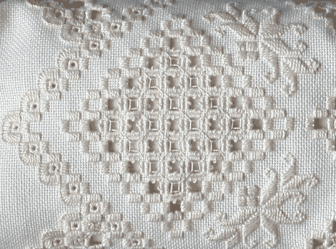 As a postscript, let’s return to the postcard’s message, in which Hermine Roschen mentioned a “Hardanger” that was nearly finished. This was a piece of Hardanger embroidery, or “Hardangersøm,” using white thread on white even-weave cloth, sometimes also known as “whitework” embroidery.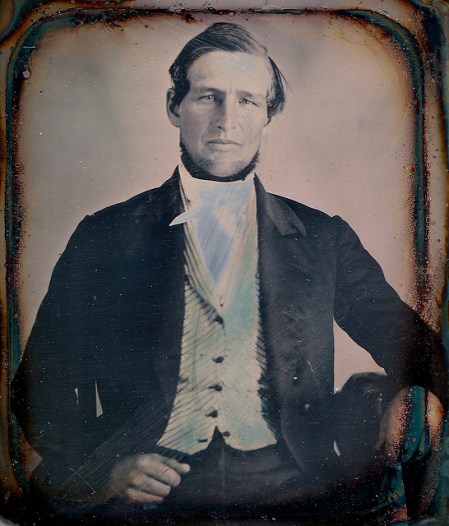















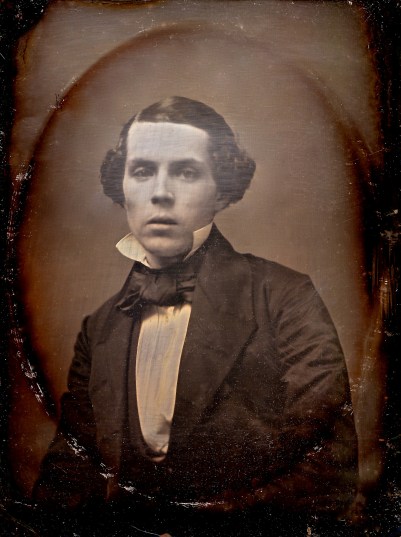


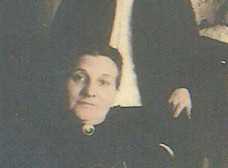
 Louisa Linebaugh Getter died 22 April, 1923, age 75 years, seven months, and 11 days, in Ellerton. She was buried 25 April, 1923, at Ellerton Cemetery. On her death certificate, the cause given is hyperthyroidism (Graves Disease), in which the thyroid kicks into overproduction causing weight loss, trembling hands, extreme tachycardia, anxiety, muscle weakness, and—worst of all—insomnia. The sufferers of Graves Disease can die, literally, of exhaustion, or can pass away suddenly from heart failure. How horrible the disease can be is something I understand, for I suffered from it when I was in my mid-twenties. Today there is a cure. In Louisa’s time, there was not.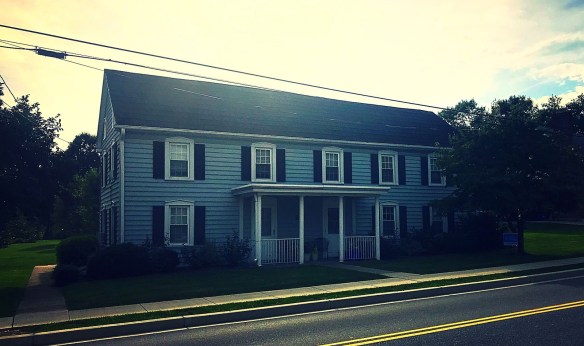
 "Your Dying Charlotte"