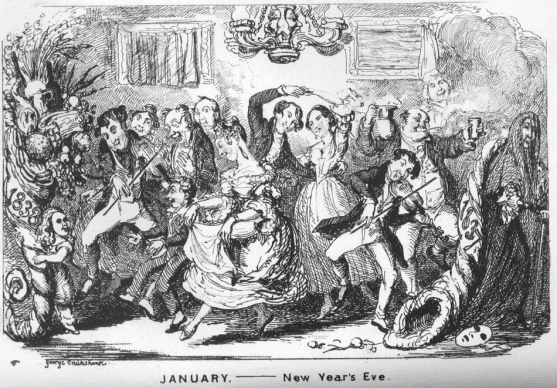


Continue reading “New Year’s Eve: Roaring End, Rowdy Beginning”
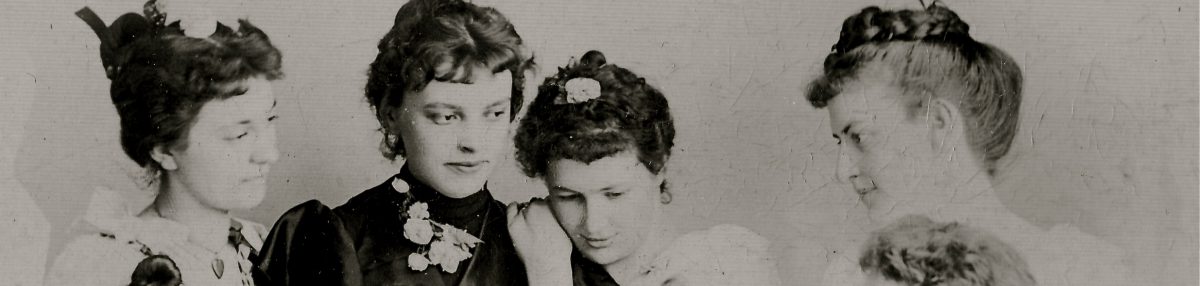
New Year’s Eve was celebrated on 31 December for the first time in 45 B.C. when the Julian calendar came into effect.
Continue reading “New Year’s Eve: Roaring End, Rowdy Beginning”
In about 1849, a mother and child were photographed in a New York town where visionaries struggled to change the world.

A long inscription is penciled inside the case of this daguerreotype: “The picture of Flora and her mother, taken when she was three years old at McGrawville, Cortland Co., NY.

“I’ll think of thee at eventide/ When shines the star of love/ When Earth is garnished like a bride/ and all is joy a-bove/ and when the moon’s pale genial face/ is shed or [sic] land & sea/ and throughs [sic] around her soft light/ t’is then I think of thee. EM
“Flora & I are in the parlor as I write this, talking of the war, etc. etc. Henry …?… is buried Thursday Oct. 30th, ’62.”
The sentimental verse is likely based on “Better Moments,” by poet Nathaniel Parker Willis (1806-1867), printed in 7 July, 1827’s New-York Mirror and Ladies Literary Gazette, Volume IV, as well as and in the New Mirror’s Poems of Passion in 1843. Willis’s poem includes the lines: “I have been out at eventide/ Beneath a moonlit sky of spring/ When Earth was garnished like a bride/ And night had on her silver wing.” It is uncertain whether variants of Willis’s poem existed that included the stanza scriven in the case, or whether the writer “borrowed” a few lines of it for his or her own poetic creation.
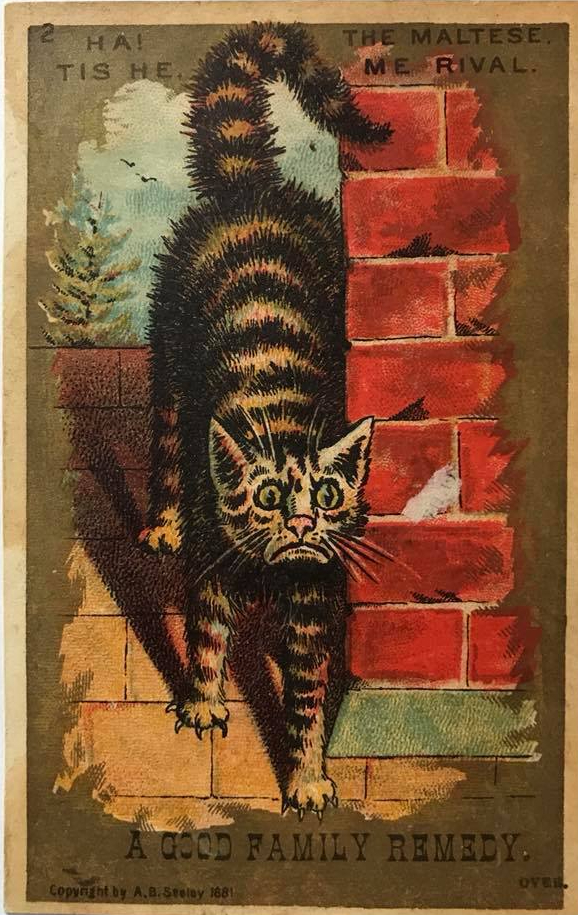
Long before Internet memes, the obsession with yowling, murderous, disdainful, aloof, and weirdly adorable felines produced trade cards that are still collected today.

“Connecticut River at Hartford 18 feet above low water mark. Heavy rain still prevailed, with much thunder.”—Beckwith’s Almanac

Harriet Leonard Hale, scion of an old and venerable New England family, was the third child and only daughter of Russell Hale. Hale was born 22 July, 1799, in Glastonbury, Hartford County, Connecticut, and died 13 April, 1849, in that same place. Harriet’s mother, Harriet Ely, was born 17 April, 1803, in Agawam, Massachusetts, and died 2 September, 1880. Russell was the son of Thomas Hale of Glastonbury (10 June, 1768–12 Feb., 1819) and Lucretia House (1771–24 September, 1835). The Hales descended from Samuel Hale, born 1 July, 1615, at Watton-at-Stone, Hertfordshire, England, who came to Connecticut as a young man, married Mary Smith in about 1642, and died in Glastonbury on 9 November, 1693.
Harriet Hale was born 14 April, 1833, in Glastonbury. Her two older brothers were Robert Ely (1827–1847) and Henry Russell (1830–1876). The 1850 Census of Glastonbury included Harriet Ely Hale as a widow, together with her daughter Harriet and her son Henry, a farmer. It is the only census that Harriet Hale Fox appeared on, as the one compiled a decade previously, when she was seven in 1840, listed the names of household heads only.

At age 18, Harriet wed blond, bearded, and bespectacled Henry Fox, a man twelve years her senior, on 5 October, 1851. He had been born in East Hartford, Hartford County, Connecticut, 19 April, 1821, and was the son of Leonard Fox (1792–1866) and Hannah Nicholson (1795–1894). The Fox family had been in New England since emigrating from London in the 17th century. Members of the clan participated in the Revolutionary War, and Leonard Fox fought in the War of 1812.
Continue reading “Harriet Fox: Drowned at the Wethersfield Ferry”
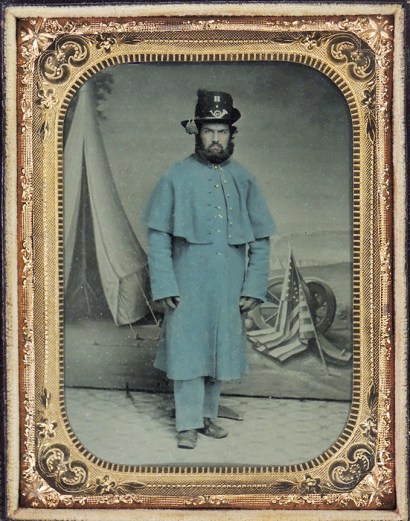
Early images of the Stars and Stripes from the Jack and Beverly Wilgus Collection.
By Beverly Wilgus

All of this historic context, moreover the genetic material of their ancestress, was not valued by her descendants, who found her mourning brooch too disgusting to keep.

In about 1996, while trawling for hair-work brooches on eBay with a tax return smoldering in my pocket, I found a listing with a ridiculously blurry photo of what looked like—just maybe—a Regency-Era mourning brooch. The accompanying item description encapsulated the prevailing 20th-Century attitude toward mourning jewelry. As I recall, it read something very close to “We found this pin that belonged to grandma. It has hair in it! Eww! Get it out of our house!” I obliged for about $40; no other bidders were willing to take the chance with that kind of sales photo. One- by three-quarters-inch in size, this type of small brooch was known as a “lace pin” and used to secure veils, ribbons, pelerines, and other accessories. They were also worn by men as lapel pins.
The 210-hundred-year-old gem that I received was made of 10-karat or higher plain and rose gold with completely intact niello and inset faceted jet cabochons. (Niello is a black metallic alloy of sulfur, copper, silver, and usually lead, used as an inlay on engraved metal.) The brooch was in pristine condition, bearing the inscription “Mary Palmer. Ob. 3 July 1806, aet. 38.” The abbreviation “Ob.” is from the Latin obitus—“a departure,” which has long been a euphemism for death. “Aet.” is from the Latin aetatis—“of age.”
“Live a good life. If there are gods and they are just, then they will not care how devout you have been, but will welcome you based on the virtues you have lived by. If there are gods, but unjust, then you should not want to worship them. If there are no gods, then you will be gone, but will have lived a noble life that will live on in the memories of your loved ones.”―Marcus Aurelius

We see the still, worn body of old lady, prepared for burial by her family and laid out, most likely, upon her own bed.
This photograph may have been both this woman’s first and her last. She was likely a child in the 1790s and a young wife and mother when Jane Austen wrote her literary oeuvre. The story of her life unfolded during the waning of one century and the child years of another. For many, by the time this post-mortem ambrotype was taken, familiar patterns of life had been radically altered by the industrial revolution. The War of 1812 and the Napoleonic Wars had rolled by like awful storms. The British Queen would shortly lose her dearest love and plunge herself into perpetual mourning. America was spilling out across a vast continent and tensions were escalating to the point of eruption between its North and South. War was a dark cloud on the horizon, threatening the young men of her family, but mercifully, she never saw it blot out the sun.

A note tucked inside the case of this 1/6th-plate reads, “Grandmother Whitney—mother of Samuel. Born between 1775 & 1780.” The plate is stamped “Melainotype for Neff’s Pat 19 Feb 56.”
In John Towler’s 1864 opus on what was then state-of-the-art photographic technology, The Silver Sunbeam, he writes, “The melainotype takes its name from the black background upon which it is taken…. Very thin plates of sheet-iron are covered with a protective varnish or Japan, of which one is of a rich black or brown-black color, highly polished, and without flaw, for the reception of the collodion and the collodion picture. Glass in this sort of picture is entirely dispensed with, and so is also the black Japan, the black velvet, and paper. This type is by far the easiest and the quickest to take, and in general the most satisfactory when taken. Melainotype plates of all the variable photographic sizes, and of variable qualities, can be obtained from the photographic warehouses.” Ω


The historical importance of March 1843 daguerreotype was forgotten until now.

A new image of John Quincy Adams, America’s sixth president, will be presented for sale by the auction house Sotheby’s later this year. The March 1843 daguerreotype, which Quincy Adams gifted to a friend, remained in the recipient’s family through the generations although its historical importance was forgotten. The image was made during a sitting with early photographers Southworth & Hawes that yielded at least two daguerreotypes. A copy of the other now resides in the collection of the New York Metropolitan Museum.

There is a third, badly damaged daguerreotype of Quincy Adams held by the Smithsonian’s National Portrait Gallery. Adams disliked it, noting in his diary that he thought it “hideous” because it was “too close to the original.” More than a hundred years later, in 1970, the daguerreotype was bought for 50 cents in an antique shop. After identification, it was eventually donated it to the nation.
Continue reading “Sit Down, John: An Adams Image Rediscovered”
“Being a Grave Gardeners lets them contribute to a place that holds both personal and historic resonance.”

Through the stone gates of Woodlands Cemetery, a tranquil, verdant oasis thrives in the heart of University City. The Victorian necropolis, the last undeveloped parcel of the estate of botanist and plant collector William Hamilton, was preserved and a repurposed as a rural cemetery in 1840 as the city and University of Pennsylvania pushed westward. Today, The Woodlands is flourishing with the aid of creative placemaking and inventive programming.
The Grave Gardeners program is the most recent brainchild of Woodlands’ executive director Jessica Baumert and her staff. The cemetery is home to hundreds of “cradle graves,” tombs with both headstones and footstones connected by two low walls that create a bathtub-like basin. In the 1800s, family members of the deceased filled the French-style “cradles” with living, blooming coverlets of flowers. Cultivating these gardens on weekend outings to sylvan cemetery grounds like The Woodlands was a way of keeping a loved one’s memory alive. As descendants scattered and their memories of connections to Victorian ancestors faded, the gardens died out. The Woodlands’ Adopt-a-Grave program enlists the help of volunteers to revive these now scruffy patches of dirt and grass, one grave at a time.
To read this wonderful article in its entirety, click the link below.
Source: Gardeners Bring Cradle Graves Back From The Dead | Hidden City Philadelphia
Thank you to my dear cousin, Elizabeth Harrison, for calling this to my attention.
Julia was one of thousands of Americans who made for California after gold was discovered in 1848.
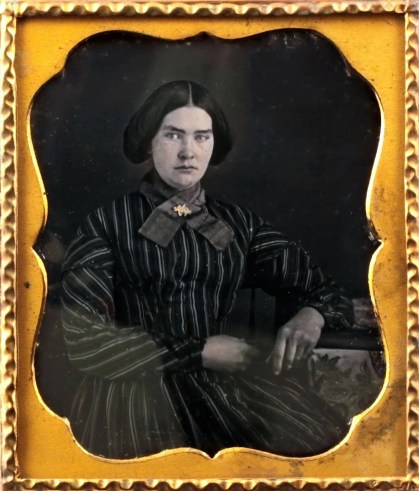
This wonderful 1/6th-plate daguerreotype shows a plump, well-dressed, melancholy woman. An inscription in the case identifies her as “Aunt Julia. mothers [sic] sister that went to Calif. in 1851 or 52.” Unfortunately, the niece or nephew who penned this message to posterity left out Julia’s last name. Lacking it, we will never know Julia’s story, save that this daguerreotype almost certainly marked her departure west, as her fashionable clothing and coiffure can be dated to about 1851.
After the Gold Rush kicked off in January 1848, many thousands hurried west to seek their fortune or to provide goods and services for those allured by gold’s siren song. This mass movement lifted the nonnative population from less than a thousand to 100,000. Filled by newcomers and new wealth, the California Territory was quickly admitted as the U.S. 31st state on 9 September, 1850.
The society that Julia joined was only somewhat more than nascent. One new arrival, Jessie Benton Fremont, who came by sea to San Francisco in 1849, noted her first impressions from the deck of the vessel, “A few low houses, and many tents, such as they were, covered the base of some of the wind-swept treeless hills, over which the June fog rolled its chilling mist.” (A Year of American Travel, published 1878.)
Fremont, the daughter of Missouri Senator Thomas Hart Benton and the wife of military officer and politician John C. Fremont, was used to the finer things. Her account of society in early San Francisco and Monterrey makes for enticing reading. I quote her here at length not necessarily as a member of the social class that Julia represented but as one of the few surviving women’s voices from the Gold Rush era.
Continue reading “For Want of a Surname, Her Lifestory is Lost”
 "Your Dying Charlotte"