“And they shall beat their swords into plowshares, and their spears into pruning hooks: nation shall not lift up sword against nation, neither shall they learn war any more.”
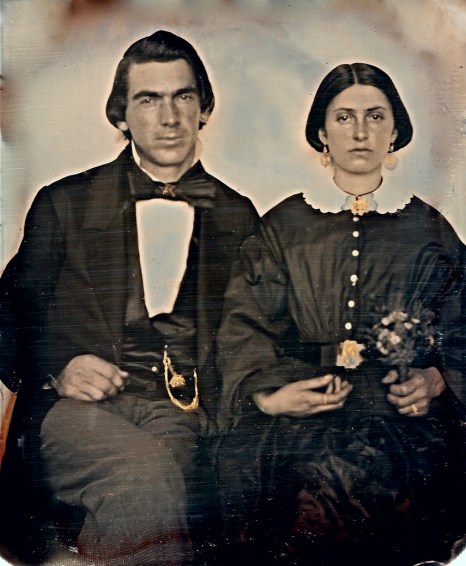
Avis Burr Wooster, 1/4th-plate daguerreotype, circa 1851. Ann Longmore-Etheridge Collection.
The above daguerreotype, which includes a 20th-Century handwritten note indicating it was once held in the collection of the Ossining, New York Historical Society, shows Avis Burr Wooster in about the fifty-fifth year of her life.
Avis was born on 26 May, 1796, in Southbury, New Haven County, Connecticut, in the ember glow of a hot century that had seen Connecticut change from a British colony to a sovereign state inside a new nation. By the time the Revolution exploded, Southbury was already a venerable place, having been established on land bought from the Paugusset tribe in 1659. The area remains much as it was in Avis’s day: rural, agricultural, quiet.
The Burr family’s transplantation to the New World was courtesy of Jehue Burr, born in about 1605, who sailed with Governor Winthrop to Roxbury, Massachusetts, in 1630. Jehue eventually removed to Fairfield, Connecticut, and planted the seeds of a lineage that would include the noted vice president and unfortunate dualist Aaron Burr. Avis’s line was through Jehue’s son Nathaniel (1635-1712) to Avis’s great-great-grandfather Colonel John Burr (1673-1750) to her great-grandfather Captain John Burr (1698-1752) to her grandfather of the same name and rank (1728-1771), who married Eunice Booth (abt. 1728-bef. 1786) circa 1750.
Southbury, Connecticut, from the air. Photo courtesy of the Southbury website.
Avis’s father, William Burr (23 June, 1762-28 Jan., 1841), lost his own father tragically when he was less than ten years old. According to the parish record of Stratfield, on 28 July, 1771, “Capt. John Burr, a farmer, son of…John Burr, was killed by lightning at the old Pequonnock meeting-house…. The congregation was standing in prayer. Parson Rose stopped praying, and after a pause he uttered the following words, ‘Are we all here?’ When the congregation moved out it was found that David Sherman and John Burr were dead. They were both in the prime of life, with families (the very pick of the flock). There was no rod on the steeple at that time.”
A mere five years thereafter, when the Revolution began, teenaged William Burr joined the Connecticut Militia, enlisting on 1 April, 1776. His pension files, included in the tome Revolutionary War Records of Fairfield, Connecticut, indicate that his postings were many and varied, and that he served for a time as a substitute for another man, Andrew Curtiss. One of Burr’s postings was to the “Battery at Black Rock,” or Black Rock Fort in New Haven, later Fort Nathan Hale. The Connecticut Sons of the American Revolution note, “Fort Hale is situated upon an insulated rock, two miles from the end of Long Wharf, New Haven…. The Americans [had] a battery of three guns upon this point, which greatly annoyed the enemy when landing.” Many years later, Aaron Turney of Fairfield attested that in 1779, Burr was 1st sergeant at the battery and second-in-command under Captain Jarvis. Burr appears to have left military service sometime in 1780.
“If my Valentine you won’t be,
I’ll hang myself on your Christmas tree.” —Ernest Hemingway
Postcard valentine, 1910. Ann Longmore-Etheridge Collection.
This tart little valentine was sent from Battle Creek, Michigan, 8 February, 1910, to Mr. Barhite, Bellevue, Michigan, RFD No. 1. The message reads: “Well Mr. Barhite I have not heard from you in a long time and so I don’t know whether you are dead or alive. I hope you are the latter and well write. Edith Mathews.”
Edith’s valentine, reverse.
The addressee was Gordon Lyman Barhite, born 10 June, 1883, in Michigan, son of Everon Barhite (1837-1923) and Delia F. Root (b.1846). Gordon Barhite appeared on the 1900 census of Bellevue as a boarder on the farm of Theodore Davis, probably acting as a farm hand. By 1910, he was in Fredonia, Michigan, working the farm of Frederic Lee.
Barhite’s 1918 World War I draft registration card notes that he was of medium height, medium build, and had blue eyes and brown hair—and if the childhood picture below is any evidence, he may well have grown into a looker. The address to which bitter Edith sent this postcard was that of Gordon’s mother Delia, who was also listed on the draft registration card as his wonderfully misspelled next-of-kin “Deilicia Barhite.”
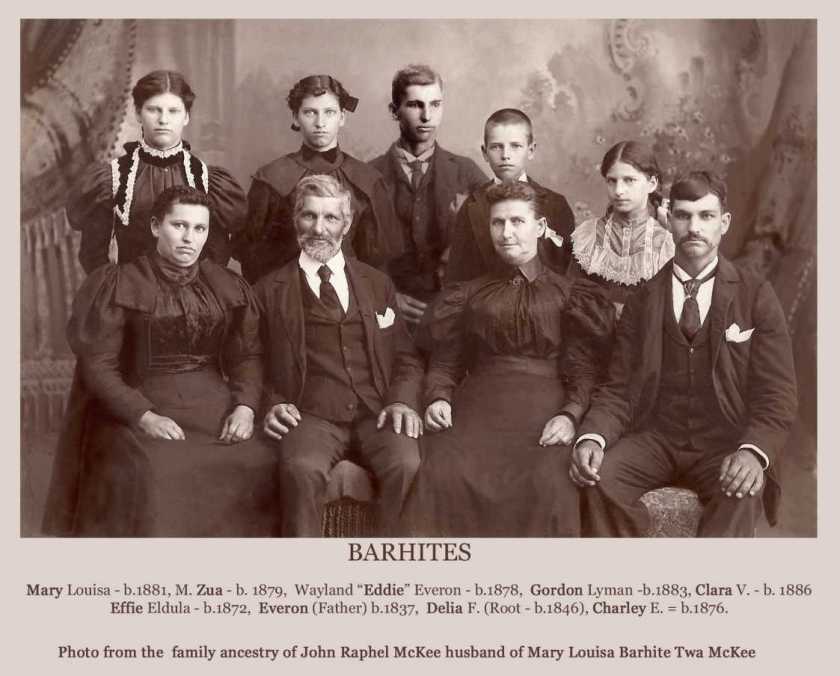
Gordon Barhite, back row, second from right, with his family, circa 1898. The 17 June, 1898 Marshall News ran an item that read, “Master Gordon Barhite gave a birthday party to his young friends Friday night, June 10. The youngsters had a jolly time remaining until a late hour.”
The 1920 census appears to tell the outcome of the valentine’s tale: Gordon Barhite then lived in Convis, Michigan, with his wife Edith (b. 11 June 1888). Also enumerated with Gordon and Edith were three children with the surname Patchett: Loren (1907-1925), Wayne (1910-2001), and Bernadine (b. 1912), as well as mother-in-law Frances Coutz (1847-1920).
Frances’s presence provided a vital clue: twenty years earlier, the 1900 Amboy, Michigan, census detailed the household of farmer Joseph Coutz, Jr. (1843-1911), and his wife Frances E. Oldfield Coutz, as well as their daughter Margery Edith.
On 15 January, 1905, Margery Edith Coutz married Frederick William Patchett, who was born 13 April, 1882, in Salford, Lancashire, England, and came to America in 1879. Before 1919, however, the Patchett marriage ended badly. The 1 May Battle Creek Enquirer announced that Gordon Barhite and Edith Patchett obtained a marriage license—they had actually married the day before—and the later 1930 Census placed Frederick Patchett in Hillsdale as a lodger and a divorced mill worker. He later married Edith Mackey (1889-1972). The appearance of this Edith confused me and before I realized that she was indeed a new individual, I believed for a time that Edith Barhite had returned to her first husband.
A 2 July, 1925, Battle Creek Enquirer article about the death of Loren Patchett.
Edith’s son Loren Patchett, unmarried and working as an electrical lineman, died aged 19 on 29 June, 1925, in Battle Creek, of electrocution caused by the failure to wear protective gloves. “Without the gloves, He climbed a transformer pole on Freemont Street. While in contact with a live wire containing 5,000 volts, he forgot and took hold of another wire which a fellow workman was attempting to sever…. The result was a short circuit which went from hand to hand.” Loren was buried in Riverside Cemetery, Bellevue.
The 1930 census placed Gordon and Edith Barhite in Pennfield. Gordon was a farm laborer and stepdaughter Bernadine worked in a factory. The couple also had a daughter, Helen, born in 1923. Edith acted in a local play put on by the Willing Workers of the Base Line Church in may 1934. In December, 1939, a local newspaper article mentioned that Gordon Barhite and his family were exchanging houses with a Mr. and Mrs. Inman. The Battle Creek Enquirer of 14 March, 1941, noted that “Mr. and Mrs. Gordon Barhite have moved from the Gates apartment house on South Clark to a farm near Climax.” These are the last traces I can find of the family.
Gordon Barhite died in May 1964 and Edith Barhite died 18 June, 1972, in Hillsdale County, Michigan.
Now, the discrepancy: The woman who sent this valentine signed her name Edith Mathews. Was she really Edith Patchett? In 1910, Edith was 22 years old with two young children and an unhappy marriage. Was she already looking to leave Frederick Patchett and was casting about for a new man to provide for her children? If she was, using a false but previously agreed upon surname may have seemed a wise thing to do.
Conversely, Edith Mathews may really have been Edith Mathews. According to the 1911 Battle Creek City Directory, a woman of that name was a boarder at 16 Shepard Street. She was still there in 1912, with fuller details given: Edith G. Mathews was a packer at the Postum Cereal Company. In 1916, she was a machine operator at B.C. Paper Company. After this, she disappeared from 16 Shepard Street.
Was this Valentine from an unhappy woman looking for a way out of a bad marriage or from a single working girl who’d met a handsome farm hand somewhere, somehow? The answer remains unknown, but I shall leave you with this, from my heart to yours: “Love attracts, connects, builds and frees the beauty of humanity. Happy Valentines Day.”—Euginia Herlihy. Ω
“Yet in these ears, till hearing dies,
One set slow bell will seem to toll
The passing of the sweetest soul
That ever look’d with human eyes.”—Alfred Lord Tennyson
Ann Longmore-Etheridge Collection
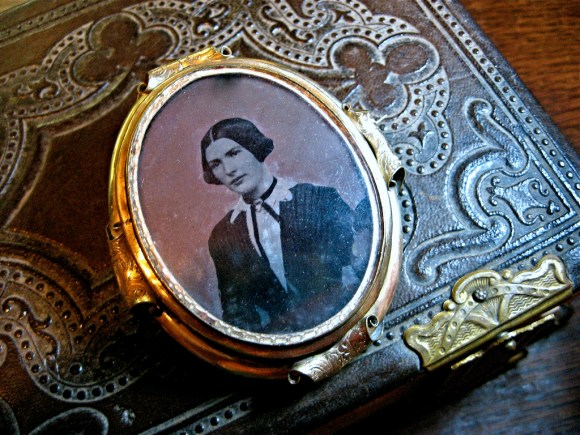
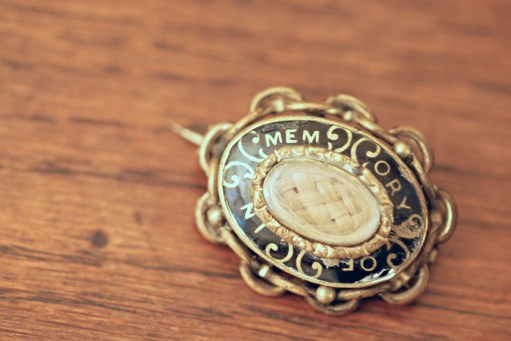
This poignant American brooch, which measures about 1.75 inches tall and dates to the late 1860s, contains a tintype image of a boy of about eight years wearing a wool jacket. Around the inner rim of the viewing compartment is a thin braid of blond hair, presumably that of the child in the photograph.
The brooch has a unique swivel mechanism that I have never seen before. Usually, the brooch body revolves to bring to the front a second viewing compartment (in this case the back side contains only checkered silk). On this brooch, however, it is the pin mechanism that rolls to whichever side will serve as the reverse.
This lovely American woman, who is pictured in fashions of about 1850, once looked out at those who loved her from the black enamel setting of this mourning brooch just as she now studies us, the denizens of an age perhaps unimaginable to her. The daguerreotype is delicately tinted to give her cheeks the rosiness of life and to highlight her gold brooch and earrings.
Ann Longmore-Etheridge Collection.
This large rolled gold brooch contains a ruby ambrotype (an ambrotype made on red glass) of a beautiful English woman whose first name, Emily, is inscribed on the reverse. It dates to about the same year as Beverly Wilgus’s brooch, above. Ω
Image courtesy of the collection of Jack and Beverly Wilgus.
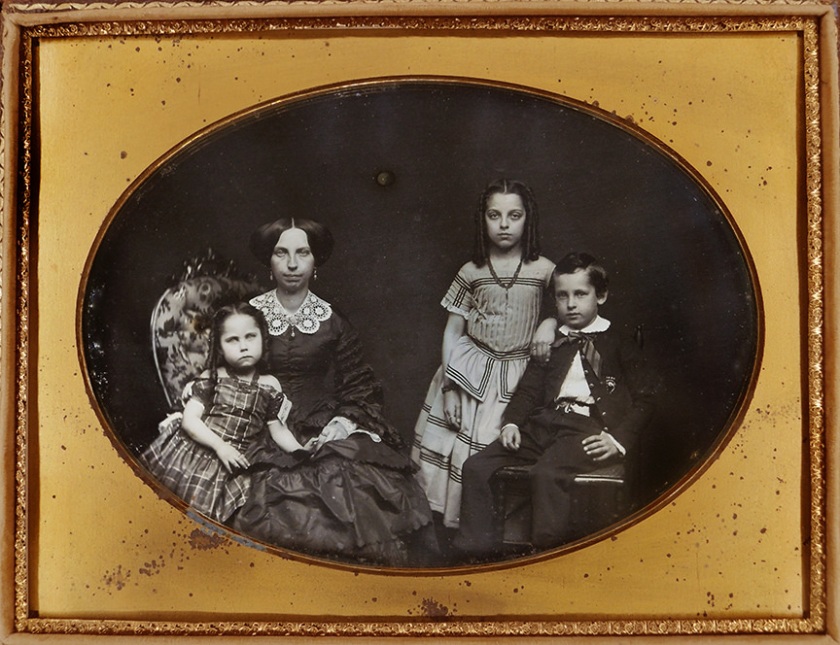
This mid-1850s, whole-plate daguerreotype of a woman and three children is from the collection of Beverly Wilgus, another of the antique photo collectors of Flickr who has graciously allowed me to present her images. Of it, she writes, “[W]e have had the glass replaced by a conservator. It is our only whole plate daguerreotype (6 ½” X 8 ½”), which is the largest size that was in common production…. I have been asked why there is not father with the family. While it is possible that the father is deceased, I like to think that the photograph was a gift for him.”
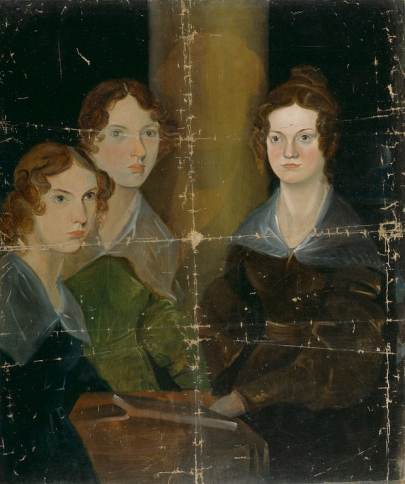
If this image was a gift for Father, it was almost certainly purposefully posed to remind him, or any viewer, of his absence—the blank space in the middle the group screams to be filled. It is reminiscent of the portrait of the Bronte sisters, now known as the “Pillar Portrait,” which hangs in the National Gallery in London.
From left: Anne, Emily, and Charlotte Bronte by their brother Branwell. National Portrait Gallery, London.
Painted in 1834 by the sisters’ talented, ego-driven, and alcohol-fueled brother who was then attempting to become a portrait artist, Branwell Bronte chose to eliminate himself and insert a column instead. It has been argued that he felt the composition was too crowded or that it was done in high dudgeon—we may never know which for sure. Charlotte died in 1855, at about the same time as Beverly’s daguerreotype was taken. After the death of Charlotte’s father in 1861, her husband, the Reverend Arthur Bell Nicholls, cut the painting from its frame, folded it up, and took it with him to his native Ireland, where it languished for many years. During that time, the “ghost” of Branwell began to appear through the paint—part spectral bogeyman, part prodigal son.
Image courtesy of the collection of Jack and Beverly Wilgus.
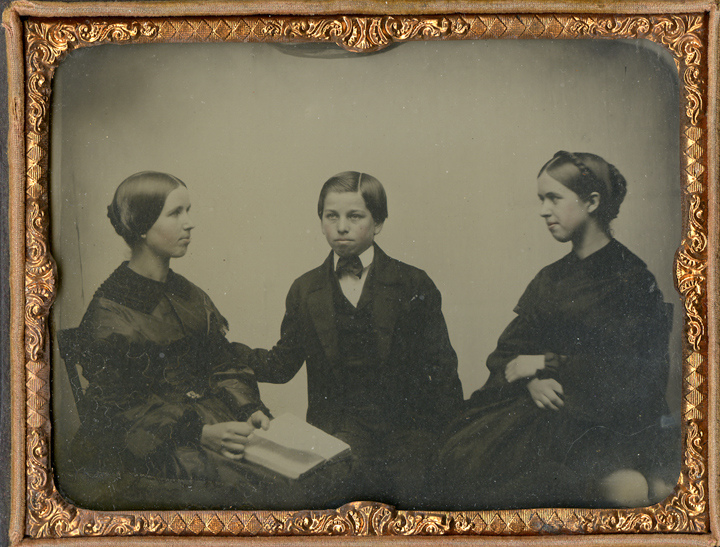
Another of Beverly’s images—this one an ambrotype also taken in the mid-1850s—again makes use of empty space to convey the message of loss. And in this image, it is indisputably death that has struck twice, leaving two pointed shapes like stab wounds between the three young people. A “reader” of this portrait, and it was yet very much a time of encoded meanings in art and photography, would know immediately that the teenage girls wore mourning gowns: the dark, wide lace collars of their dresses leave no doubt that the entirety of their costume is black. Between them is their younger brother, now the man of the family, reassuringly touching his elder sister’s arm. He seems stoic but unprepared for the task.
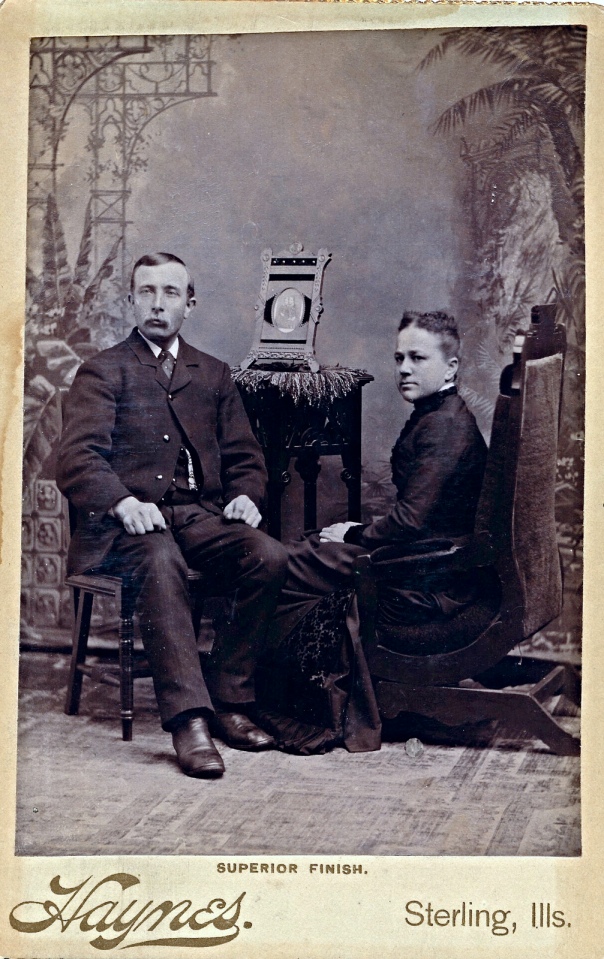
Albumen cabinet Card, circa 1883. Ann Longmore-Etheridge Collection.
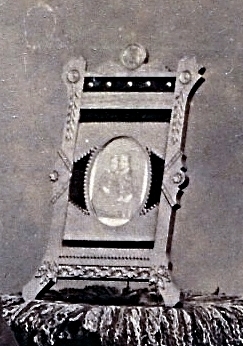
This final image used props to fill the void caused by death. Whilst the husband and wife focused on a point stage left (she almost certainly dressed in mourning), between them sat a plant stand covered by what must have been a colorful, almost childish string doily, upon which an elaborate picture frame was placed. It contains an image a girl and possibly a boy. The message can be taken no other way: “These were our children; now they are no more.” Ω
From the Valley Register, Middletown, Maryland, 2 February, 1917.
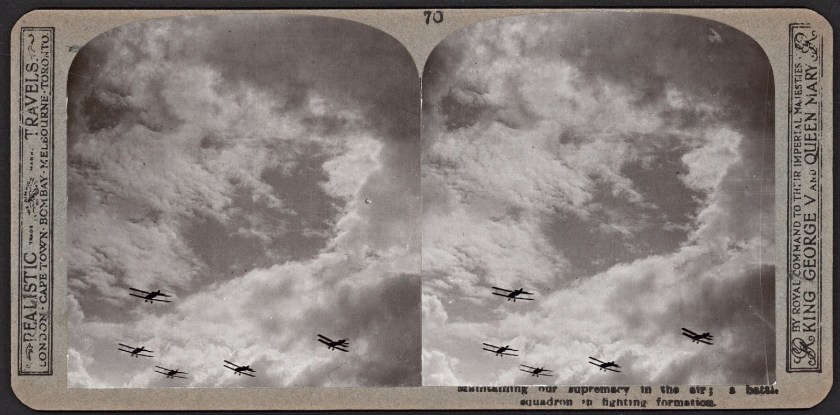
“Maintaining Our Supremacy in the Air,” one-half of No. 70 of the “Great War Through the Stereoview,” published by Realistic Travels Ltd. London, circa 1919. Ann Longmore-Etheridge Collection.
“A very peculiar white cloud, stretching from the northeast clear across the sky to the southwest, in an otherwise perfectly cloudless sky, attracted great attention from shortly before 7 o’clock last night (Thursday), until 7:30. The cloud was pure white and in the centre of the sky appeared to be about 30 feet wide, tapering down at each end to a point. At the southwestern point, a projection hung down.
“The cloud had the appearance of a huge Zeppelin and some described it that way. Nervous persons declared the cloud had a meaning and portended war. Coming as it did, just when the situation with Germany has become serious, plenty of people associated the strange cloud with war.
“The cloud was really a very peculiar and remarkable sight and large groups of people stood gazing at it for some time. The edges of the cloud had the appearance of a solid mass of roiling smoke. One man said it was the Kaiser’s hand reaching out after Uncle Sam.”
Newlyweds, tintype, circa 1871. Ann Longmore-Etheridge Collection.
“I’ve felt for the first time in my life the joyful consciousness that I am truly loved by a truly good man, one that with all my heart I can love and honor… one who loves me for myself alone, and with an unselfish, patient, gentle affection such as I never thought to waken in a human heart… a man in whom I can trust without fear, in whose principles I have perfect faith, in whose large, warm, loving heart my own restless soul can find repose.”—Anna Alcott Pratt, 1859
Newlyweds, 1/6th-plate relievo ambrotype, circa 1858. Ann Longmore-Etheridge Collection.
“[M]y love for you is deathless, it seems to bind me to you with mighty cables that nothing but Omnipotence could break… ”—Sullivan Ballou, letter to wife Sarah, 14 July, 1861.
Newlyweds, English albumen cabinet card by Wakefield, 1 High Street, Ealing, circa 1900. Photo courtesy James Morley.
“To lovers, I devise their imaginary world, with whatever they may need, as the stars of the sky, the red, red roses by the wall, the snow of the hawthorn, the sweet strains of music, and aught else they may desire to figure to each other the lastingness and beauty of their love.”—Williston Fish, A Last Will, 1898
Ω
I am delighted to announce that I have joined the staff writing team at Historical Diaries. Material from Your Dying Charlotte will appear there regularly.
I am also delighted to note that I will be able to bring you material from James Morley, who maintains his vast and wonderful collection on flickr, here, and is the founder of the blogWhat’s That Picture?His twitter handle is @PhotosOfThePast.
“A certain vivid face, looking out at you, with its voice just a breath from speaking, can sometimes stop your heart.”
Albumen carte de visite of an unknown Illinois woman wearing mourning dress and jewelry, photographed by Candace McCormick Reed, circa 1861. Ann Longmore-Etheridge Collection.
This carte de visite (CDV) is both visually stunning as well as a lovely example of mourning jewelry as it was worn in the Victorian era. And no, this woman was not Reptilian. Individuals with blue eyes merely looked like space lizards when pictured by early photographic technologies.
This is what daguerreotypist Albert Sands Southworth told his female customers in an 1854 Lady’s Almanac article titled “Suggestions for Ladies Who Sit for Daguerreotypes”: “Remember that positive red, orange, yellow or green are the same as black, or nearly so; and violet, purple and blue are nearly the same as white; and arrange your costume accordingly.”
The CDV’s subject was probably a widow in a later stage of mourning. Her headgear seems to be a snood made of woven ribbons with fancy bows and by the ears and at the crown as well as black-and-white lace that is perhaps loosely ruched around the lower part of the hairnet. In her monumental bookDressed for the Photographer, Joan Severa writes of a slightly fancier gown of an identical cut, “This well-fitted frock shows the fashionable puffed sleeve at its height in the early sixties…. The dart-fitted, short-waisted bodice and gathered straight lengths of skirt, plus the extreme width of the hoop, are clear evidence of the early date as well. Also seen here are the effects of the new corset in ordinary use: the breasts are full, separated, and well-defined, and the rib cage is tapered firmly to the small waist measurement (the corset being very short below the waist) [where a belt] cinches the garment properly.”
The late Joan Severa: “When my soul is free at last, it will run, flying lithe and barefoot.”
And now I must praise her like I should.
Joan Severa passed away in March 2015, aged 89. Although I never met Joan, I consider her a mentor and will be forever grateful for her research that taught me to date 19th Century photographs by fashions worn within a two-to-four year span, and for her writing that immeasurably enriched my understanding of the Victorian era.
Born 7 August, 1925, in Spring Green, Wisconsin, Joan was long with that state’s historical society, ultimately serving as curator of costume, textiles, and decorative arts. Dressed for the Photographer won the CSA Millia Davenport Award in 1996, and prizes from the Society for the Preservation of New England Antiquities, the Victorian Society in America, Wisconsin Library Association, and the Golden Pen Writing Award from the United States Institute for Theater Technicians. Her followup My Likeness Taken: Daguerreian Portraits in America contains four daguerreotypes now in my collection.
In the introduction to this book, Joan wrote of the photographic traces of lives gone by, “We experience inescapable emotions when viewing these images. A certain vivid face, looking out at you, with its voice just a breath from speaking, can sometimes stop your heart.” When I read these words I was more than convinced Joan and I were kindred spirits. I’m sure that when first glimpsing the beautiful and hauntingly powerful subject of the CDV above, you may have felt the same sudden forceful hearbeats, the in-rush of air pulled sharply through your nose, and knew that when Joan wrote that last quote, she wrote it for you, too.
Leading us yet along a female pathway, the reverse of the above CDV is marked “Mrs. W. A. Reed, Artist, No. 81 1/2 Hampshire Street, Quincy, ILL.”
According to the Illinois Women Artists Project, “Candace McCormick Reed was born in Crab Orchard, Tennessee, on June 17, 1818, and moved to St. Louis as a young girl. She married Warren Reed in 1842 in St. Louis. Leaving Missouri for Quincy, Illinois, the Reeds opened a daguerreotype gallery in 1848 on the southeast corner of the downtown square, now Washington Park. When her husband died ten years later in April of 1858, Candace Reed became the gallery owner and used her acquired expertise as a daguerreotypist, ambrotypist, and photographer to support herself, two young sons, and her mother-in-law.”
Reed opened the Excelsior Gallery at 103 Hampshire Street in Quincy and took as an assistant her sister Celina McCormick. “Typically working under the name Mrs. W. A. Reed or Mrs. Warren Reed, she advertised in the Quincy Whig & Republican (January 4, 1862) promoting her new stock of camera equipment ‘to surpass everything in the line of her art,’” the Women Artist Project noted, and indeed, her career was a garden of unforgettable images.
Candace Reed died in Quincy 7 April, 1900, and despite an 1878 fire in her studio, “Numerous carte de visite portraits, family photographs and photographs of soldiers during the war survive. These photos, along with city street scenes, record events and provide an enhanced view of local 19th Century culture. Her legacy of photographic work adds immensely to community historical perspectives,” the site states. I am glad that my CVD is one of those that can yet cause a breath to draw and a heart to flutter.
Detail of Candace Reed’s photograph showing the black enamel mourning brooch with hair compartment.
In my collection I do not have an truly similar brooch to the one worn by this CDV’s subject—and this is surprising, as mourning jewelry was produced en masse and brooch bodies, ring and stick pin types, and more were commonly advertised for selection by the jewelers of grieving families. I own identical or extremely similar versions of many of the major styles. The closest match from my collection is probably the one below, made to commemorate the death of an English child only a year or so before Candice Reed photographed the blue-eyed widow above. Ω
Pinchbeck and black enamel mourning brooch for Ibbotson W. Posgate, 1859-1860. Ann Longmore-Etheridge Collection.Posgate mourning brooch reverse. “Ibbotson W. Posgate, who Died Feb. 19th 1859, Aged 31/2 Years.”
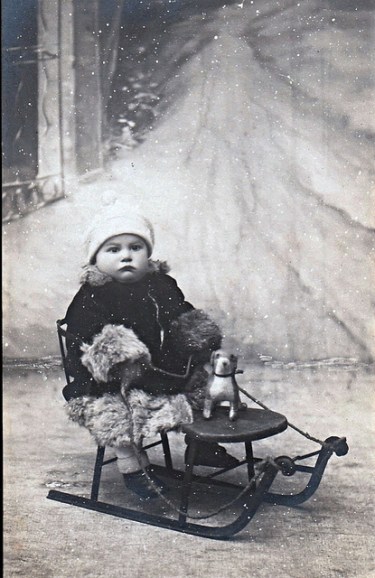
Oh my. After this debacle, let’s hope there was snow outside to sled on.
Austrian unused real photo postcard, circa 1905, stamped “Fotographie L. Strempel, Klosternburg, Stadplaz.”
Okay. Well, at least there is fake snow. And a fake dog.
Phyllis and Barbara Nute on Christmas Day, Winthrop, Maine, circa 1927. Paper print.
This is more like it: Real snow outside and the girls are rocking those gifts from Santa.
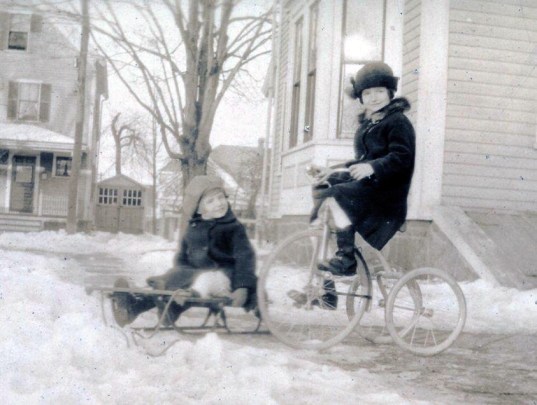
Edward Miller on his sled, paper print, circa 1915.
A happy boy on his sled the back garden of what seems to be a row house. A woman stands at the end of the wooden-plank walkway, probably his mother. I hope Edward’s father took him to a local park where there were many high hills to fly down.
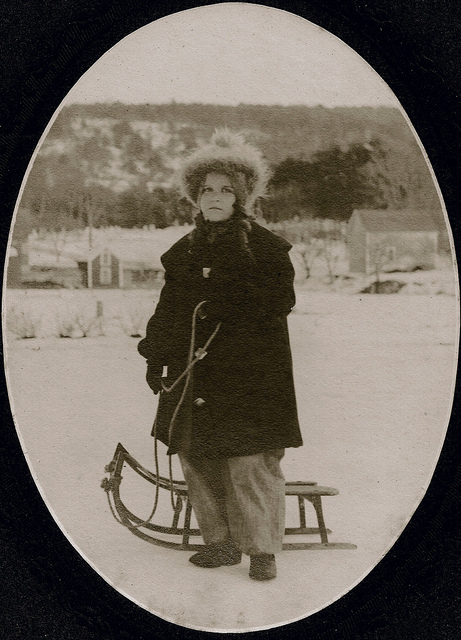
Unmarked albumen print on cardboard, circa 1915.
A wistful girl sleds on a snowy day near the family farm. Everything about this image charms me—from the baggy pants, the bottle curls, and mad hat to the upturned, pointed noise of the sled and the low mountain beyond. I wish I knew more about her, but sadly there is no photographer’s impression or inscription. Ω
“I was standing by my window,
On one cold and cloudy day
When I saw that hearse come rolling
For to carry my mother away
Will the circle be unbroken
By and by, lord, by and by?
There’s a better home a-waiting
In the sky, lord, in the sky?”
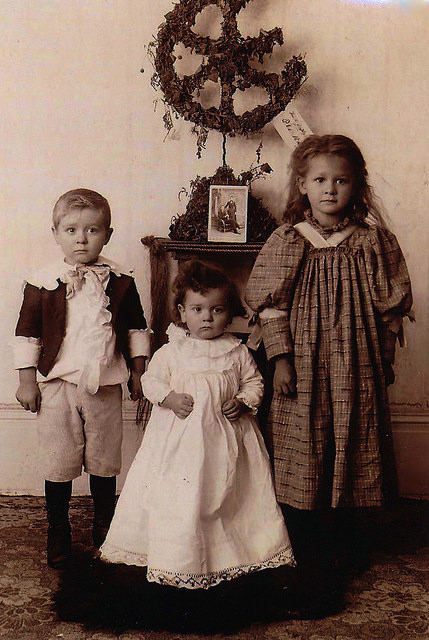
From left: Silas, Milo, and Nellie Fay Helton, a modern copy of a vintage albumen print, circa November 1902. Print: Ann Longmore-Etheridge Collection.
I do not own the original of this photograph, but I purchased this copy from the purported owner, so I reproduce it here with the caveat that the original is not in my collection copyright, but the research is solely my own.
According to the seller, the photo, taken in Monticello, Indiana, bears the inscription “Nellie Fay, Milo, and Silas.” It shows a trio of children stood before a late 1880s or early 1890s cabinet card that almost certainly portrayed their parents. The photograph was propped against a desiccated funeral floral arrangement of a broken wheel, which signified that the family circle was compromised. There was a note attached to the arrangement, but the writing is too small to read.
A search through public records led me to Nellie Fay Helton (b. April, 1891), Milo Charles Helton (b. 24 June, 1895), and Silas Warren Helton (b. June 1893), the children of farmer Charles Milo Helton, born 19 November, 1859, in Whittier, Indiana, and his wife Emma Florence Hart, born November 1867 in Cass County, Indiana. The pair married 20 March, 1887.
Charles’s parents were John Helton (b. 18 Nov., 1825)—also recorded as Hilton—and Susan Vernon (b. 1828). Both originally from Ohio, they married in Indiana 2 March, 1848. Charles, who was the third son and fifth of seven children, grew up on the family farm in the township of Washington.
Charles’s father died at age 40 on 10 June, 1865, but he does not appear to be a Civil War casualty. He was laid to rest in Miller Cemetery, Deacon, Indiana. By the enumeration of the 1870 census, Charles’s brother William had assumed the family patriarchy. The situation remained unchanged in 1880.
Silas W. Hart was 5’10”, blue-eyed, and white-haired. He was of the Protestant faith, could supposedly neither read nor write, and received an annual Civil War pension of $72.
Emma Hart Helton was the daughter of Silas W. Hart and South Carolina-born America Rodabaugh (1838-1880). Silas Hart came into life in Fayette County, Indiana, 6 November, 1836, the son of John Hart and Indiana R. Baldwin (13 June, 1815-18 Dec., 1880).
At age 26, on 16 August, 1862, Hart enlisted as a private in Company G, 73rd Indiana Infantry. “The [regiment] was mustered in at South Bend on 16 August 1862, with Gilbert Hathaway as colonel. Its men came from all over the northern part of the state, with sizable contingents from LaPorte, Valparaiso, Crown Point, Michigan City, Plymouth, Calumet, and Logansport,” wrote W. H. H. Terrell, in the Report of Adjutant General, Indiana, Vols. II and VI. “The regiment went immediately to Kentucky, where its first assignment was to chase Bragg’s forces south into Tennessee. By 20 November the regiment was at Nashville. For several days at the end of December 1862 and the beginning of January 1863 [there] was in heavy fighting at Stone River.
“In April 1863 the 73rd was assigned to Colonel A. D. Streight’s Independent Provisional Brigade, which had the mission of penetrating the enemy’s territory and cutting its communications. Embarking at Nashville, the regiment sailed down the Cumberland and up the Tennessee, landing at Eastport, Mississippi. From 30 April to 2 May they were in heavy engagements at Day’s Gap, Crooked Creek, and Blount’s Farm, all in Alabama. Colonel Hathaway was killed at this last engagement, and five days later Colonel Streight himself surrendered. The enlisted men in the regiment were soon paroled and returned to Nashville while the officers were sent to Confederate prison camps.”
In 1864, the regiment served picket duty along the Tennessee River. “In September they were ordered to Decatur, Alabama, where they held off an attack on 1 October. On 26 October, Hood with 35,000 men besieged Decatur, but was held off. In the winter of 1864-1865 the 73rd moved to Stevenson, Alabama, then to Huntsville, then to guard the Mobile and Charleston Railroad with headquarters at Larkinsville.”
On 1 July, 1865, the regiment was mustered out at Nashville. Silas Hart left the infantry as a full corporal and returned his wife America and his children in Indiana. After America’s death on 4 December, 1880, Silas married twice more. A 2 August, 1911, Richmond Item story about his third and very “winter marriage” to Ellen Donhower is left.
Silas served as post master in Galveston, Indiana, and later was a jeweler in Richmond, Indiana. He ended his days in the National Military Home in Dayton, Ohio. From the admission records of 20 April, 1922, we know that at age 86, Silas was 5’10”, blue-eyed, and white-haired. He was of the Protestant faith, supposedly could neither read nor write, received an annual Civil War pension of $72, and was suffering from severe dementia. His stay at the home was brief: Silas Hart died 24 May, 1922, of chronic cardiac dilation. This is not the last time readers of this article will encounter fatal medical conditions of the heart.
“Mrs. Helton suddenly sank on the shoulders of her husband and expired before she could be gotten out of the vehicle.”
The Helton children’s parents can be seen in this closeup.
The loss of the 1890 Census to a 1921 conflagration prevents a glimpse of the young Helton family in the first years after Charles and Emma wed. (A comprehensive article on the 1890 census and its near total destruction can be read at Prologue.) The enumeration would have shown Charles and Emma’s firstborn children, twins Earl Dick and Pearl, who arrived safely on 21 June, 1888. Next came Flossie Fern, born in January 1890.
(An interesting aside: according to Isaac Blickenstein and Louis G. Keith’s book Multiple Pregnancy: Epidemiology, Gestation, and Perinatal Outcome, “One recently reviewed historical account from a rural German community during the 18th and 19th centuries showed that maternal mortality during the first 42 days postpartum was not significantly different among mothers of twins compared with mothers of singletons. On the other hand, mothers of twins who delivered twins a second time were almost four times more likely to die, compared with mothers of twins who later delivered singletons.” Other more recent studies show multiple gestations associated with a two-fold increase of risk of death.)
Charles and Emma would have seven children in total including Silas, Nellie Fay, Milo, and a final boy, Harold, who arrived in March 1898. The farm on which all were born was six miles southwest of Logansport, rented from E. G. Wilson. Years later, the Logansport Pharos-Tribune would note that Charles Helton was “one of the most successful farmers and well-known residents of the county.” (Backing up this claim, the 12 November, 1891, Logansport Reporter stated that an expensive horse was stolen from Charles.)
Unexpectedly, stunningly, the children lost their mother on 2 November, 1901. The Elwood Daily Record of 11 November describes what happened: “Mrs. Charles Helton, a sister of C. N. Hart of [Kokomo, Indiana], died in a buggy while coming here on a visit from her home near Monticello. She was accompanied by her husband, and when about half way here, and while they were eating a cold lunch, Mrs. Helton suddenly sank on the shoulders of her husband and expired before she could be gotten out of the vehicle. Heart trouble was the cause…. Mr. Helton turned around and returned home with the corpse of his wife.”
Marshall County Independent (Plymouth, Indiana), 15 November, 1901.
The Marshall County Independent reported a slightly different tale: “Her husband, thinking she had fallen asleep, drove several miles not knowing she was dead.”
The eldest children’s shock and horror at the sight of their dead mother in the buggy may have left lasting scars. Conversely, the youngest children, Milo and Harold, probably could not recall the incident, or even their mother, in later years. But no matter how much they remembered, did not care to remember, or could not remember about their mother and her death, the Helton children had inherited from her a genetic propensity toward heart disease, attacks, and failure. As the decades went by, many clan members would die from these medical causes.
On 4 November, Emma Hart Helton was buried, according to her death certificate, in the “IOOF cem,”—presumably the International Order of Odd Fellows Lodge 107 Riverview Cemetery in Monticello, although her grave is unmarked. I think it highly likely that three of the youngest Heltons—Nelly, Milo, and Silas—posed for the photo with their mother’s dried funeral flowers on the first anniversary of her passing in November 1902.
Unlike many widowers with young children, Charles Helton did not remarry and the eldest daughters, Pearl and Flossie, probably took on the mother’s role vacated by Emma’s death. However, Pearl and Flossie did not abandon their education to care for younger siblings. The two girls and brother Earl graduated from Monticello High School in 1908 and Pearl would eventually leave the family farm to study in Chicago.
The White County Court House, Monticello, Indiana, as the Heltons would have known it. Colored postcard, circa 1910.
The Helton family can be found on the 1910 Census of White County, with all surviving members accounted for. On Christmas Eve of that year, Earl married Hazel Vera Eads (1888-1960). Their first child, a boy named after his paternal grandfather, was born in 1911.
Death blighted the family circle once again in 1914. Pearl Helton died in Chicago on 13 January. I cannot locate her death certificate, but it is highly likely she died of a fatal heart condition such as myocardial insufficiency. Her body was returned to her family and she was buried in Monticello, perhaps beside her mother at Riverview. Her grave is also unmarked.
In the Pharos-Tribune of 21 November, 1918, reported that “Charles Helton, with his daughter, Miss Flossie Helton, left Tuesday for Wausaukee, Wisconsin, where they will reside permanently. A son, Milo Helton, is already there and they will be joined at Hammond by another son, Earl Helton, who with his family will also go there to make it his home…. They will live on a large farm which they have purchased near Wausaukee.”
Earl and Hazel did not pull up roots and follow. They would settle in Hammond, Lake County, Indiana, where Earl worked as a crane operator in a car shop and later as a machinist. Earl and Hazel and had six children after Charles Milo: Harry Thomas (b. 1914); Robert James (b. 1917); Joy Mae (b. 1918), George Dick (b. 1922), Gladys Dee (b. 1926) and Richard Earl (b. 1929).
While searching for newspaper articles that mentioned Earl and Hazel, I came across the one at right, from the 28 December, 1935, issue of the Hammond Times, and other issues throughout the 1930s. Hazel Helton was a Spiritualist, as is my own father and are my own paternal grandparents, great-grandparents, and great-great grandparents. I was both christened and married at the Spiritualist Church of Two Worlds in Georgetown, Washington, D.C.
There is much misunderstanding of Spiritualism, but the clearest explanation is that its adherents believe in life after death and that the dead can contact the living in numerous ways. One way is through mediums such as Fred Sundling and Ruth Coyle, mentioned in the article. At the end of every Spiritualist service several mediums take turns giving messages from departed loved ones and spirit guides. If Earl attended the church with Hazel, he may have received regular communications from his long-lost mother and sister Pearl. To hear more from their dear departed, the Heltons may also have visited Camp Chesterfield, Indiana, a Spiritualist summer retreat that opened in 1891 and is still in service today. There, the messages, readings, table-tipping, and séances were a comfort and an assurance that, to quote the famous hymn, the circle would be unbroken, by and by.
At age 71, from acute coronary occlusion, Hazel’s earthly chair was vacated 11 May, 1960. Earl Helton lived on for another four years, dying 30 August, 1964, of coronary myocardial infarction in Crown Point, Indiana. He is buried with his wife at Oak Hill Cemetery, Lake County.
Earl and Hazel Helton. Photo courtesy of Kathleen Faye Helton Lane and Linda Lane Hedges.
Flossie Helton married Malvin Christ Monsen. He was born 2 June, 1890, in Marinette, Wisconsin, to Norwegan immigrants Olaf Monsen and Hansine Anderson. Malvin came to his long-time home in Dunbar, Michigan, as a child and attended the Dunbar School. His 1917 draft registration describes him as short, of a medium complexion, with blue eyes and light-brown hair, and partly bald. (We know from his 1942 draft registration that he was 5’5″ tall, 150 pounds, and was by then completely bald.) He served with the United States Army during World War I from 1917 to 1919. In France, he was shot in the thigh of his left leg and received the Purple Heart.
Malvin and Flossie Monsen from the book “Dunbar Remembered Centennial 1888-1988.”
After the war, Malvin farmed, and in 1922, he became the first rural mail carrier for the area, a position he kept until in 1957. On September 25, 1925, he married Flossie Helton, and by the enumeration of the 1930 Census, the couple had an infant son Wayne (1929-2011), who was known throughout his life as “Swede.” Flossie’s father Charles Helton also lived with them. The old man passed away 30 July, 1934. The Pharos-Tribune of 2 August reported his last journey: “The body of Charles H. Helton, who died at his house In Goodland, Wis., was brought here this morning to the Prevo and Son funeral home, where services were held…. Burial was in Riverview Cemetery.”
Malvin died in Iron Mountain, Dickinson County, Michigan, on 15 November, 1975. Flossie lived for a little more than a year, dying on Christmas Day, 1976, in Kingsford, Michigan. Both are buried in Dunbar Memorial Gardens.
Swede Monsen “graduated from Pembine High School in 1948. After graduation, he proudly served his country in the United States Air Force as a flight engineer including missions in the Berlin Air Lift, Korean War, and Vietnam. After 23 years of service, he and [his wife] Betty moved to Peshtigo [Wisconsin] where he owned and operated Swede’s Standard Station,” recounted his obituary after his death on 20 February, 2011.
Wayne “Swede” Monsen
“Years later, Betty and Wayne moved to Pembine, Wisconsin, and owned Swede’s Place Bar and Restaurant and Swede’s Garage. They relocated to Milwaukee and worked for Doug Rohde Grading Co. for 17 years, finally coming home to his boyhood family farm in Dunbar.”
Swede was buried in Dunbar Memorial Gardens. But this branch of the Heltons live on, with two daughters, seven grandchildren, and six great-grandchildren surviving him.
The informant—Nellie’s daughter Aleatha—did not know the full name of her grandmother, filling in the blank line with “unk. Hart.”
Nellie Fay Helton married Harley Ward Phebus (b. 1891) on 2 May, 1914. The 1920 Census placed the couple and their daughters, two-year-old Agatha and six-month-old Aleatha living in a lodging house in Milwaukee, Wisconsin.
In 1930, the Phebuses had a home in North Arsenal Avenue, Indianapolis. Harley worked as a salesman and Nellie as a waitress in a restaurant. By 1936, he had changed his job career to watchman. Sometime shortly afterward, Phebus returned to an earlier career—auctioneering, eventually joining the company Ace Liquidators, as his obituary (left) detailed. Harley was sometimes referred to in newspaper advertising as “Col. Harley Phebus.” He indeed served in World War I, but I can obtain no more information on his service than his draft registration, which described him as short, with brown hair, blue eyes, and a pale complexion.
Harley Phebus was buried in Crown Hill Cemetery, Indianapolis on 15 January, 1962. Nellie died in a retirement home in Zionsville, Indiana, in May 1972, aged 81, of cerebral arteriosclerosis. She was buried 30 May in Crown Hill Cemetery, Indianapolis.
As I read her death certificate, it saddened me to note that while the informant—Nellie’s daughter Aleatha—knew the name of her grandfather Charles Helton, she did not know the full name of her grandmother, filling in the line with “unk. Hart.” It is speculation whether this spoke of Nellie’s trauma on that long-ago November day when a buggy containing her dead mother arrived at the door.
The registrar reported Milo was missing his right eye and his left index finger at the first joint.
Milo Helton, as previously mentioned, removed to Wausaukee, Wisconsin, by 1918 when his father and Flossie joined him. The year previous, he filled out a Word War I draft registration that stated he was of medium height, a medium build, and had brown eyes and brown hair. It does not appear that he served during the war.
The date of Milo’s marriage remains elusive, but his wife was Maud E. Woosencraft (b. 1900), the daughter of Welsh immigrants. They had four children: Thomas C. (b. 1933), Gwendolyn M. (b. 1934), Dorothy L. (b. 1935), and Donald M. (b. 1938).
In 1942, Milo Helton filled out a World War II draft registration card. At some point between the two wars, he suffered a serious accident. The registrar recorded that Milo was missing his right eye and his left index finger at the first joint. I suspect that this trauma was caused during his employment as an electrician at a lumbar mill in the 1920s. Milo died only a few years after the World War II draft, on 14 March, 1946, and is buried in Dunbar Memorial Gardens, Dunbar, Wisconsin. Maud did not follow until 25 January, 1961, but today she lies beside him.
The headstone of Milo and Maud Helton at Dunbar Memorial Gardens. Photo by Accidental Genealogist.
Silas Helton, the other brother who would not move to Wisconsin in 1918, married Velda Scott Eldridge on 2 June, 1915. (His wife was born in August 1897 to Oregon and Bertha Scott Eldridge.) Their daughter, Pequetti Marge, arrived 11 June, 1917, and Velda was pregnant again when the United States entered into the first World War. Silas was either conscripted or voluntarily joined the fight. According to the U.S. Department of Veterans Affairs, he served from 8 July, 1918, to 8 February, 1919.
Pequetti Helton in 1937. Her resemblance to her father Silas when a child is striking.
Silas returned safely to Monticello, where he met his son Paige Hart Helton, born 9 September, 1918. Silas took up work as slate cutter and later as an insurance salesman.
Wrenchingly, nine-year-old Paige died of Myocardial insufficiency at Methodist Hospital, Indianapolis, 22 August, 1927. He joined his grandmother, aunt, and others of his clan at Riverview Cemetery. Pequetti did not inherit the Heltons’ heart disease. She thrived and grew into an exceptionally beautiful and talented woman. Silas and Velda must have been both relieved and proud.
By 1930, the Heltons were decamped to Crawfordsville, Indiana, where Pequetti attended the town high school, playing the bassoon and marching in a new band uniform of “dark blue, trimmed in gold [with a] Sam Browne belt and Pershing hat,” according to the 1932 yearbook. Shortly thereafter, Pequetti won an MGM screen test and enrolled in the Arthur Jordan Conservatory of Music at Indianapolis’s Butler University. On 19 May, 1940, as she was about to graduate, the “blonde, blue-eyed senior from Lafayette will rule as queen on the annual Butler University Day May celebration…in the formal gardens of the fairview campus,” gushed the Indianapolis Star. The day included folk dancing, a Woman’s League ball, a concert, the play Robin Hood, and a feast.
Pequetti Helton’s engagement announcement.
For the next several years, Pequetti’s life was a round of dramatic performances, social gatherings, and weddings in which she was maid of honor or a bride’s maid. Then on 18 July, 1943, the Star reported her engagement to U.S. Navy Ensign Anthony J. Marra with a large photo of the bride-to-be (right).
After their marriage on 7 August, 1944, the couple lived for a time in San Pedro, California, and later made their home in Indianapolis, where Anthony Marra operated a construction company. They had three sons: Ronan Scott (b. 1947), Anthony J. (b. 1949), and Steven C. Marra (b. 1954).
In 1942, her father Silas registered for the World War II draft from Lafayette, Tippecanoe County, Indiana. He was 5’6″, 145 pounds, with brown hair, blue eyes, and a light complexion. From this time until the late 1960s, I can find nothing to elucidate his life. Silas passed away on Christmas Eve, 1968, of cardiac arrest, in Home Hospital, Lafayette. He was buried on 27 December with his family at Riverview Cemetery in Monticello. Velda, who worked as a clothing seamstress and fitter, died in June 1989 of an acute cerebral hemorrhage and also rests at Riverview.
Pequetti in February 1967, pictured with the famous Dr. Joyce Brothers.
In the 1950s, Pequetti took up charitable work. She was for some time the president or other officer of the Benefe Guild, which undertook good deeds such as raising money for needy families, buying books for hospitals, and making donations causes such as restoring Philadelphia’s Independence Hall. “To raise finds for their work the guild sponsors an annual card party and a style show, and a rummage sale at the Coffee Street Branch of the Center. The membership sews an extensive doll wardrobe during the year for the Dress-a-Doll-at-Christmastime-to-Help-a-Child Project,” reported the Star on 25 October, 1959.
One must wonder, however, whether Pequetti found the life of a mid-century housewife satisfying, no matter how socially prominent she was and how much charitable work she did outside the home. She may have intended to become a Hollywood starlet, a stage actress, or something else entirely. It is tempting from my own 21st Century position to ascribe boredom and frustration to a life lived dressing dolls and holding teas or card parties. I hope she felt fulfilled and never dwelt on chances lost to her.
The Marras were often mentioned in the society pages of Indianapolis newspapers, such as the article (left) on a spectacular open house during the Christmas season of 1968. Another item in the Star discussed the party the Marras threw at their golf and country club after Ronan graduated from Wabash College on 7 June, 1970.
During the 1970s, Pequetti was still frequently in the Society pages. She was a member of the Sunnyside Guild, which sponsored lectures by noted female speakers, and Pequetti was often pictured with them.
Pequetti died of basal cell carcinoma at 3:45 a.m., 10 June, 2001, at St. Vincent Hospital. She was survived by her sons, her husband, and 10 grandchildren. She is buried in Washington Park North Cemetery, Indianapolis.
The youngest Helton, Harold, never married. In 1920, he lived in Zero, Adams County, Nebraska, working as hired hand on a farm. The 1930 census placed Harold in Alameda, California, rooming and working as a vacuum salesman. In 1940, he lived in Pittsburg, Contra Costa County, California, in a boarding house, working as a carpenter. Harold Helton died 5 September, 1967, in Napa, California. Ω
Will the Circle be Unbroken?
Lyrics written in 1907 by Ada R. Habershon with music by Charles H. Gabriel. The song was later rewritten by A. P. Carter and includes the lyrics quoted at the top of this article.
There are loved ones in the glory, Whose dear forms you often miss When you close your earthly story, Will you join them in their bliss?
Will the circle be unbroken By and by, by and by? In a better home awaiting In the sky, in the sky?
In the joyous days of childhood, Oft they told of wondrous love, Pointed to the dying Savior Now they dwell with Him above.
Will the circle be unbroken By and by, by and by? In a better home awaiting In the sky, in the sky?
You remember songs of heaven Which you sang with childish voice, Do you love the hymns they taught you, Or are songs of earth your choice?
Will the circle be unbroken By and by, by and by? In a better home awaiting In the sky, in the sky?
You can picture happy gatherings Round the fireside long ago, And you think of tearful partings, When they left you here below
Will the circle be unbroken By and by, by and by? In a better home awaiting In the sky, in the sky?
One by one their seats were emptied, One by one they went away; Here the circle has been broken Will it be complete one day?











 On 1 July, 1865, the regiment was mustered out at Nashville. Silas Hart left the infantry as a full corporal and returned his wife America and his children in Indiana. After America’s death on 4 December, 1880, Silas married twice more. A 2 August, 1911, Richmond Item story about his third and very “winter marriage” to Ellen Donhower is left.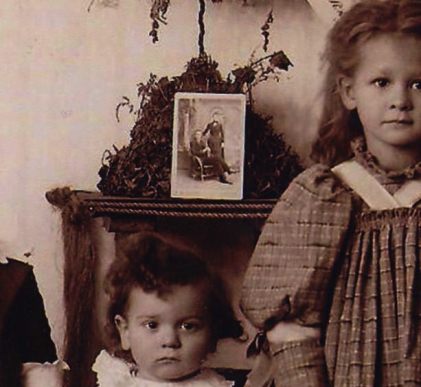


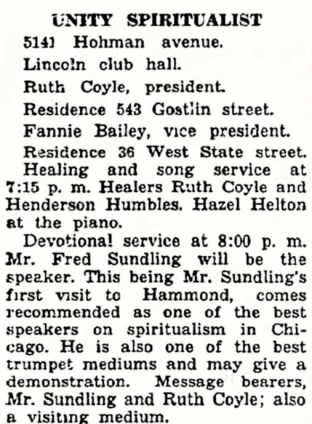 While searching for newspaper articles that mentioned Earl and Hazel, I came across the one at right, from the 28 December, 1935, issue of the Hammond Times, and other issues throughout the 1930s. Hazel Helton was a Spiritualist, as is my own father and are my own paternal grandparents, great-grandparents, and great-great grandparents. I was both christened and married at the Spiritualist Church of Two Worlds in Georgetown, Washington, D.C.


 Nellie Fay Helton married Harley Ward Phebus (b. 1891) on 2 May, 1914. The 1920 Census placed the couple and their daughters, two-year-old Agatha and six-month-old Aleatha living in a lodging house in Milwaukee, Wisconsin.


 The Marras were often mentioned in the society pages of Indianapolis newspapers, such as the article (left) on a spectacular open house during the Christmas season of 1968. Another item in the Star discussed the party the Marras threw at their golf and country club after Ronan graduated from Wabash College on 7 June, 1970.
 "Your Dying Charlotte"