“Boetticher’s drawing, released in 1864, was hardly the perception of prison camps at the time. In it, the players look healthy, even happy. The spectators are just as engaged. Lively conversations are taking place around the makeshift diamond. There are no guards, no guns, no torture, no death.”
“In 1861, when the Civil War broke out, Otto Boetticher left his job as a commercial artist to join the 68th New York Volunteers. Shortly after enlisting, Boetticher, who was born in Germany and came to the U.S around 1850, was captured and sent to a prison camp in Salisbury, North Carolina. He wasn’t there very long. Thanks to a prisoner swap and after only a few months in captivity, he was set free.
“Before leaving, however, Boetticher, did a drawing of a prisoner game of baseball.”
Continue reading at Ken Zurski’s constantly amazing blog, Unremembered. Ω
Some pieces of mourning jewelry offer enough facts to fill volumes. Others are stealthy and secretive, unwilling to share the stories of the dead or their grief-stricken survivors.
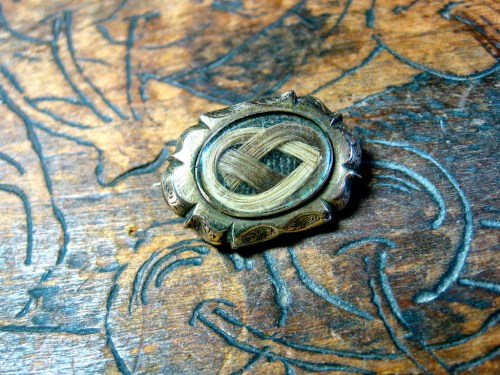
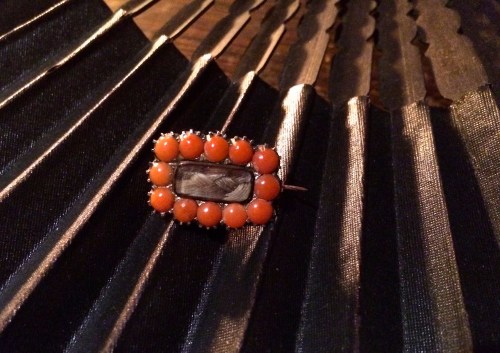
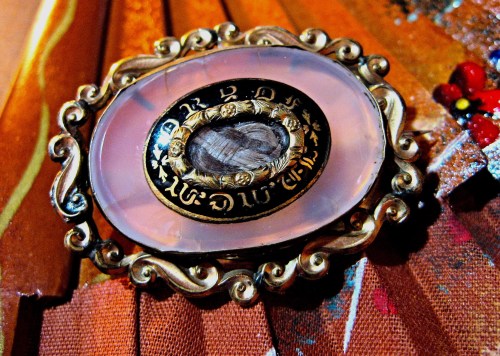
A large and beautifully carved Whitby jet mourning brooch for E.M.H., circa 1860. Purchased in Newbury, England.A tiny mourning or sentimental brooch, circa 1825, featuring the hair of two unknown individuals. What looks like finely woven hair inside some brooches is actually fabric called “checkered silk” inserted by the manufacturer, over which the hair relic was meant to be laid. Here, the contents of the viewing chamber clearly show the hair atop a scrap of this cloth.A Regency-era, gold eye-shaped memorial or sentimental brooch, circa 1800, purchased in Hungerford, England. It is more likely this is a lover’s-eye type brooch and not a mourning piece, although it is impossible to know with certainty. The brooch contains one person’s hair looped into a Celtic knot with similarly colored checkered silk behind it.This mourning brooch, circa 1870-1875, features Prince of Wales hair plumes of two individuals. It is a large brooch, measuring about 3 inches wide. The brooch is pinchbeck, but beautifully done and in immaculate condition. Sadly, there is no inscription. The date I assign is early 1870s, but this is provisional and based on what I can glean from references. It may be later; it may be earlier, but I doubt by more than five years in either direction. Purchased in Hungerford, England.This English mourning or sentimental brooch of coral and Gold, circa 1820, contains what is likely braided locks from two people. While this may be a mourning item, coral was considered a protective substance for children. It may be that this tiny brooch, usually called a lace pin, may contain the hair of two siblings or of a child’s parents, or perhaps a child’s godparents.Agate mourning brooch of pinchbeck, agate, and black enamel, circa 1850. Inside is the interwoven hair of two deceased individuals. The gothic letters that encircle the viewing compartment read “In Memory Of,” a phrase used used throughout the 19th Century on mourning jewelry.
Early images of the Stars and Stripes from the Jack and Beverly Wilgus Collection.
By Beverly Wilgus
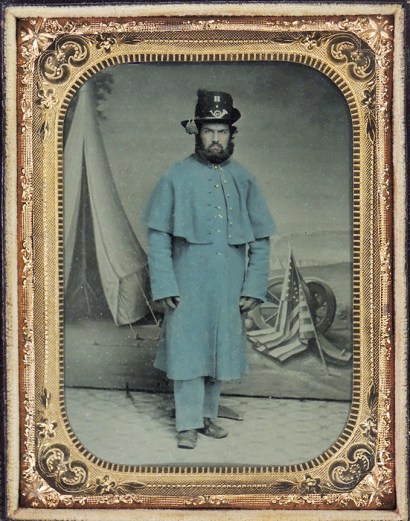
The earliest flag image in our collection is this ambrotype of a young Civil War soldier standing before a painted military backdrop of tents and an American flag. By necessity, it dates from the years of the conflict, between 1861 and 1864. He wears an enlisted man’s trousers, a blue-tinted cape coat, and a regulation enlisted man’s dress Hardee hat bearing the insignia “H” and “81” inside a brass infantry bugle. Five states had an 81st Infantry: Indiana, Illinois, Pennsylvania, Ohio, and New York. This fierce and determined Union soldier joined up from one of them. This albumen stereoview card is from the 1871 “Kitty At Play” series by John P. Soule of Boston.
In Britain in the 1800s, the widow’s grief of Queen Victoria helped spur the creation of mourning jewelry, but in the 1600s, the impetus was the judicial murder of an anointed king.
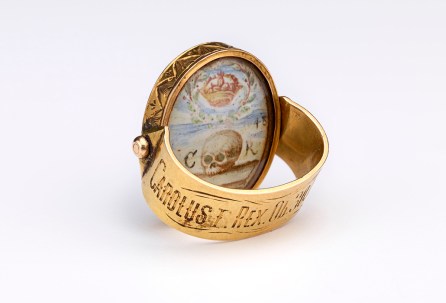
A mid-17th Century gold mourning ring for King Charles I with an enameled portrait covered by cut crystal. National Gallery of Victoria, Melbourne; gift of Mrs Stubbs, 1923.
Charles Stuart, later King Charles I, was born in Fife, Scotland, 19 November, 1600, to King James VI of Scotland, later James I of a unified Britain, and his wife Queen Anne of Denmark. He was a second son, never meant to rule. Yet, Charles had the role of heir foisted on him at the death of his beloved, handsome, and accomplished older brother, Henry, Prince of Wales, who died unexpectedly in 1612.
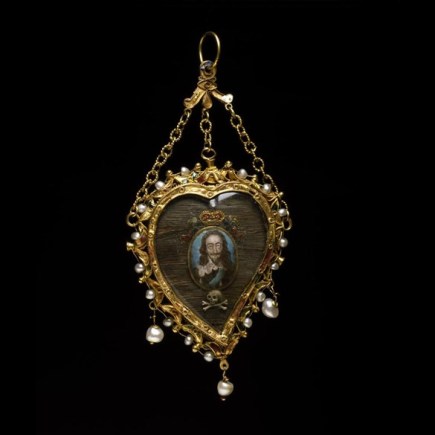
This circa-1700 mourning pendant, sold by the auction house Christie’s in 2016, contains a painted oval portrait of Charles I against a blue ground within black dot decoration, beneath faceted rock crystal. The reverse features a sepia crown and cypher ‘C. R.’ above the date ‘Jan 30 1648/9’ and an image of a skull and crossed bones upon a plinth, under crystal.
Charles was small, sickly, and had a stammer. He was also intellectual, loved and patronized the arts, favored elaborate high Anglican worship in the age of the Puritans, and married a Roman Catholic—the delicate and beautiful Princess Henrietta Maria of France, known as Queen Mary, after whom the U.S. state of Maryland is named. Charles also believed profoundly in the Divine Right of Kings, was willful and stubborn, and refused to make the compromises that could have prevented a civil war, the destruction of the monarchy, and his own death.
As had the life his similarly-natured paternal grandmother, Mary, Queen of Scots, his own earthly days ended in execution by beheading on 30 January, 1649. His final words were “I go from a corruptible to an uncorruptible crown, where no disturbance can be.”
The inscribed band and reverse image of the National Gallery of Victoria ring, showing the initials C. R. (“Charles Rex”) between a skull, with a crown and laurels floating above.A Heart-shaped gold and enamel pendant, circa 1650, containing a miniature of Charles I, an interwoven arrangement of his hair, and a part of the blood-stained linen shirt he wore at his execution. Courtesy National Museums of Scotland.
All of this historic context, moreover the genetic material of their ancestress, was not valued by her descendants, who found her mourning brooch too disgusting to keep.
Memorial brooch for Mary Palmer showing her russet hair with snippets of what might be gold thread that once formed a small design, but which have since become unglued and tarnished. Ann Longmore-Etheridge Collection.
In about 1996, while trawling for hair-work brooches on eBay with a tax return smoldering in my pocket, I found a listing with a ridiculously blurry photo of what looked like—just maybe—a Regency-Era mourning brooch. The accompanying item description encapsulated the prevailing 20th-Century attitude toward mourning jewelry. As I recall, it read something very close to “We found this pin that belonged to grandma. It has hair in it! Eww! Get it out of our house!” I obliged for about $40; no other bidders were willing to take the chance with that kind of sales photo. One- by three-quarters-inch in size, this type of small brooch was known as a “lace pin” and used to secure veils, ribbons, pelerines, and other accessories. They were also worn by men as lapel pins.
The 210-hundred-year-old gem that I received was made of 10-karat or higher plain and rose gold with completely intact niello and inset faceted jet cabochons. (Niello is a black metallic alloy of sulfur, copper, silver, and usually lead, used as an inlay on engraved metal.) The brooch was in pristine condition, bearing the inscription “Mary Palmer. Ob. 3 July 1806, aet. 38.” The abbreviation “Ob.” is from the Latin obitus—“a departure,” which has long been a euphemism for death. “Aet.” is from the Latin aetatis—“of age.”
Victoria’s grief drove into high gear the already strong public market for jewelry to be at worn during all stages of mourning.
A selection of mourning jewelry from the Ann Longmore-Etheridge Collection. The difference is marked between the Regency and early Victorian pieces (far left and center) and the heavy black later Victorian items.
At the close of the 18th century and the early years of the 19th, memorial pieces with hair were generally small, delicate, and graceful. However, the oncoming Victorian era would turn “the entire ritual of mourning into a public display, and the jewelry changed accordingly, becoming larger, heavier, and more obvious,” wrote the curators of the Springfield, Illinois-based Museum of Funeral Customs in Bejeweled Bereavement: Mourning Jewelry—1765-1920.
Victoria in mourning. Courtesy British Museum.
In December 1861, Queen Victoria’s beloved consort, Prince Albert of Saxe-Coburg-Gotha, died of what is thought to have been typhoid fever. Married for twenty-one years, their happy union resulted in the birth of nine children. The forty-two-year-old prince’s demise shattered Victoria. For the rest of her life, the queen wore mourning and required many courtiers who served her and who attended court functions to do the same.
Victoria’s grief drove into high gear the already strong public market for jewelry to be worn during all stages of mourning. For example, in the first nine months, the only acceptable jewelry was made of black glass, dyed pressed animal horn, gutta-percha (a latex plastic derived from tropical evergreens), vulcanite and ebonite (rubber treated with sulfur and heat), bog oak (fossilized peat), or carved from jet (a fossilized wood that washes up on west coast Yorkshire beaches, and was extracted from shale seams, particularly around between Robin Hood’s Bay and Boulby). In later stages of mourning, gold or pinchbeck (a composite metal) and hair-work jewelry commemorating the deceased was worn. Many of these items bore the motto “In Memory Of” and featured heavy black enameling.
“Live a good life. If there are gods and they are just, then they will not care how devout you have been, but will welcome you based on the virtues you have lived by. If there are gods, but unjust, then you should not want to worship them. If there are no gods, then you will be gone, but will have lived a noble life that will live on in the memories of your loved ones.”―Marcus Aurelius
An elderly woman in her final sleep, 1/9th-plate postmortem ambrotype, circa 1860. Ann Longmore-Etheridge Collection.
We see the still, worn body of old lady, prepared for burial by her family and laid out, most likely, upon her own bed.
This photograph may have been both this woman’s first and her last. She was likely a child in the 1790s and a young wife and mother when Jane Austen wrote her literary oeuvre. The story of her life unfolded during the waning of one century and the child years of another. For many, by the time this post-mortem ambrotype was taken, familiar patterns of life had been radically altered by the industrial revolution. The War of 1812 and the Napoleonic Wars had rolled by like awful storms. The British Queen would shortly lose her dearest love and plunge herself into perpetual mourning. America was spilling out across a vast continent and tensions were escalating to the point of eruption between its North and South. War was a dark cloud on the horizon, threatening the young men of her family, but mercifully, she never saw it blot out the sun.
Grandmother Whitney, postmortem cased melainotype, circa 1856-1860.
A note tucked inside the case of this 1/6th-plate reads, “Grandmother Whitney—mother of Samuel. Born between 1775 & 1780.” The plate is stamped “Melainotype for Neff’s Pat 19 Feb 56.”
In John Towler’s 1864 opus on what was then state-of-the-art photographic technology, The Silver Sunbeam, he writes, “The melainotype takes its name from the black background upon which it is taken…. Very thin plates of sheet-iron are covered with a protective varnish or Japan, of which one is of a rich black or brown-black color, highly polished, and without flaw, for the reception of the collodion and the collodion picture. Glass in this sort of picture is entirely dispensed with, and so is also the black Japan, the black velvet, and paper. This type is by far the easiest and the quickest to take, and in general the most satisfactory when taken. Melainotype plates of all the variable photographic sizes, and of variable qualities, can be obtained from the photographic warehouses.” Ω
The historical importance of March 1843 daguerreotype was forgotten until now.
Newly rediscovered daguerreotype of President John Quincy Adams. Photo courtesy Sotheby’s.
A new image of John Quincy Adams, America’s sixth president, will be presented for sale by the auction house Sotheby’s later this year. The March 1843 daguerreotype, which Quincy Adams gifted to a friend, remained in the recipient’s family through the generations although its historical importance was forgotten. The image was made during a sitting with early photographers Southworth & Hawes that yielded at least two daguerreotypes. A copy of the other now resides in the collection of the New York Metropolitan Museum.
This daguerreotype copy of a second, cleaner image from the Southworth & Hawes sitting shows the former president as he actually appeared. Daguerreotypes present a mirror image of the subject; daguerreotype copies present the correct frontal view. Although it may appear so, Adams was not photographed in a private home. This set was used in other daguerreotypes taken by Southworth & Hawes. Image courtesy the Metropolitan Museum.
There is a third, badly damaged daguerreotype of Quincy Adams held by the Smithsonian’s National Portrait Gallery. Adams disliked it, noting in his diary that he thought it “hideous” because it was “too close to the original.” More than a hundred years later, in 1970, the daguerreotype was bought for 50 cents in an antique shop. After identification, it was eventually donated it to the nation.
“Being a Grave Gardeners lets them contribute to a place that holds both personal and historic resonance.”
Photo by Michael Bixler.
Through the stone gates of Woodlands Cemetery, a tranquil, verdant oasis thrives in the heart of University City. The Victorian necropolis, the last undeveloped parcel of the estate of botanist and plant collector William Hamilton, was preserved and a repurposed as a rural cemetery in 1840 as the city and University of Pennsylvania pushed westward. Today, The Woodlands is flourishing with the aid of creative placemaking and inventive programming.
The Grave Gardeners program is the most recent brainchild of Woodlands’ executive director Jessica Baumert and her staff. The cemetery is home to hundreds of “cradle graves,” tombs with both headstones and footstones connected by two low walls that create a bathtub-like basin. In the 1800s, family members of the deceased filled the French-style “cradles” with living, blooming coverlets of flowers. Cultivating these gardens on weekend outings to sylvan cemetery grounds like The Woodlands was a way of keeping a loved one’s memory alive. As descendants scattered and their memories of connections to Victorian ancestors faded, the gardens died out. The Woodlands’ Adopt-a-Grave program enlists the help of volunteers to revive these now scruffy patches of dirt and grass, one grave at a time.
To read this wonderful article in its entirety, click the link below.
Julia was one of thousands of Americans who made for California after gold was discovered in 1848.
1/6th-plate daguerreotype of Aunt Julia. Ann Longmore-Etheridge Collection.
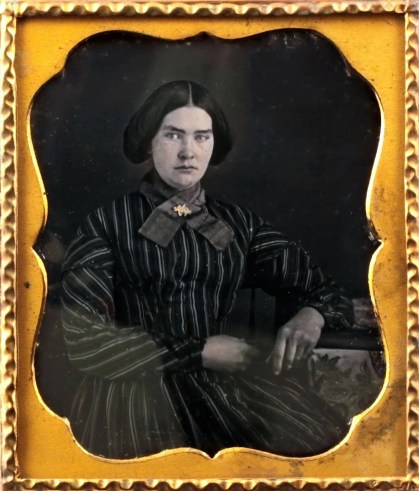
This wonderful 1/6th-plate daguerreotype shows a plump, well-dressed, melancholy woman. An inscription in the case identifies her as “Aunt Julia. mothers [sic] sister that went to Calif. in 1851 or 52.” Unfortunately, the niece or nephew who penned this message to posterity left out Julia’s last name. Lacking it, we will never know Julia’s story, save that this daguerreotype almost certainly marked her departure west, as her fashionable clothing and coiffure can be dated to about 1851.
After the Gold Rush kicked off in January 1848, many thousands hurried west to seek their fortune or to provide goods and services for those allured by gold’s siren song. This mass movement lifted the nonnative population from less than a thousand to 100,000. Filled by newcomers and new wealth, the California Territory was quickly admitted as the U.S. 31st state on 9 September, 1850.
The society that Julia joined was only somewhat more than nascent. One new arrival, Jessie Benton Fremont, who came by sea to San Francisco in 1849, noted her first impressions from the deck of the vessel, “A few low houses, and many tents, such as they were, covered the base of some of the wind-swept treeless hills, over which the June fog rolled its chilling mist.” (A Year of American Travel, published 1878.)
Fremont, the daughter of Missouri Senator Thomas Hart Benton and the wife of military officer and politician John C. Fremont, was used to the finer things. Her account of society in early San Francisco and Monterrey makes for enticing reading. I quote her here at length not necessarily as a member of the social class that Julia represented but as one of the few surviving women’s voices from the Gold Rush era.








 "Your Dying Charlotte"