Death and the Maiden

“Life asked death, ‘Why do people love me but hate you?’ Death responded, ‘Because you are a beautiful lie and I am a painful truth.’”—Author Unknown

18495882091_ea7011bdfe_b
Lavada May Dermott, postmortem albumen print on cardboard, 1904. Ann Longmore-Etheridge Collection.

Lavada May Dermott, seen above laid out in her parents’ home, surrounded by funeral flowers, was born 9 May, 1888, in Goshen, Belmont County, Ohio, to Charles Evans Dermott (1849-1907) and his wife, Sarah Jane Stewart (1853-1936). Sarah was the daughter of Eleazar Evan Stewart (1834-1910) and Honor Brown (1835-1914).

Lavada’s parents married in Goshen 26 January, 1871. They first make an appearance as a family unit on the 1880 Census of that township. Evans Dermott—he went by his middle name—listed his occupation as “huxter.” His father, Irish-born farmer William Dermott (1811-1896) was also a part of the household—his wife, Eliza Kelly (1813-1879), having died the year before.

Evans and Sarah had together four children: William Wilber (1871-1947), Charles E. Dermott (19 June, 1881-23 September, 1944), Lavada, and Lillie F. Dermott (1895-1987). On 20 May, 1900, the eldest son, William, married Grace Stanley King. William spelled the family name as Der Mott and is buried thusly in Forest Rose Cemetery, Lancaster, Ohio. By 1910, the Der Motts lived in Cleveland, Ohio. William became a garment cutter for a clothing company and eventually was the manager of a clothing store. He worked in that position as late as 1940. They had two children: Neil (b. 1902) and William P. (b. 1903).
Continue reading “Death and the Maiden”

The How-To of Hairwork

“Warm the palette by placing it on the hob, or before the fire for a few minutes, and you will soon find that the curl becomes loose and may be lifted off with the edge of a knife.”

35968610886_da44f9c494_o
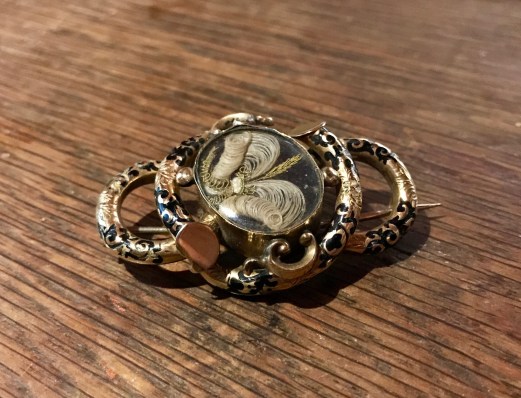
The Edinburgh brooch, circa 1850. The only component missing from this otherwise outstanding example is an inscription. Sadly, no more can be known of the deceased beyond that he or she was gray-haired and elderly, and came from a Scottish family that could afford a high-quality death memento. Ann Longmore-Etheridge Collection.

I purchased this mourning brooch in Edinburgh, Scotland, in 1993. It was the foundation of my collection and, at the time, was actually was my second choice—the first being a smaller, plainer piece with a simply coiled blond lock, probably dating from the 1820s or 1830s. The brooch looked more “human” to me, but the shop owner enticed me toward a different brooch, assuring me it was unusual. It dates from the late 1840s to early 1850s.

The body is 14-karat gold or higher with a tube hinge, C-clasp, and a pin that is longer than the length of the brooch—all evidence that an item that was indeed crafted in the 18th or 19th centuries. The hair memento compartment is set amidst a tempestuous lovers’ knot untamed by the somber black enamel embellishment. Inside the glass-capped compartment is a piece of black cloth on which palette-worked gray hair has been affixed. The design is known as Prince of Wales feathers and is decorated with a pearl band, as well as a stalk of barley and ribbon made from gold wire thread.

The Prince of Wales feathers for the Edinburgh brooch were carefully crafted by a professional hairworker. For an exploration of how it was made, one can turn to no better source than the Collector’s Encyclopedia of Hairwork Jewelry: Identification and Values by C. Jeanenne Bell, which contains a full reprint of Alexanna Speight’s 1877 booklet, A Lock of Hair. The booklet contains instructions for palette work that were aimed at the Victorian lady who aspired to a new and noble handwork. Taking up the hobby, as Bell notes, would not only give her “the satisfaction of working with the hair of her loved ones, but it also assured her that the precious locks would not be substituted for, or augmented with, another’s”—an ignoble deed undertaken by unscrupulous memorial jewelry makers and feared to occur with regularity.

Continue reading “The How-To of Hairwork”

The Wheel in the Sky

Long before the London Eye there was the Earls Court Gigantic Wheel, which gave passengers a bird’s eye view of the capital city and beyond.

34907213543_c5a75c0f06_b
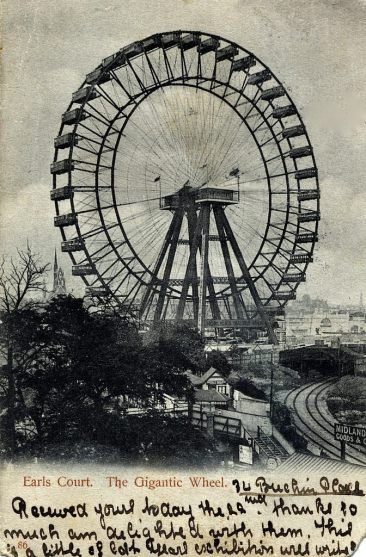
The Earls Court Gigantic Wheel. An advert for Horlicks Malted Milk can be  seen at the structure’s base. Ann Longmore-Etheridge Collection.

This British postcard was mailed to Mr. W. Roberts, 3302 Lindell Avenue, St. Louis, Missouri on 22 January, 1904. The unknown sender posted it from what is today an upscale area of South Kensington, London. The message reads, “34 Brechin Place. Received yours today the 22nd. Thanks so much, am delighted with them. This is a little of Earls Court exhibition. Will write.”

The wheel at Earls Court, London, was built by Maudslay, Sons, and Field, for the Empire of India Exhibition, and opened to the public 17 July, 1895. The project’s engineer was H. Cecil Booth, who recalled, “One morning in 1894, W. B. Bassett, a retired naval officer, one of the managing directors of the firm, entered the drawing office and called out ‘Is there anyone here who can design a great wheel?’ There was dead silence, whereupon I put up my hand and replied, ‘Yes, I can, sir.’ Basset’s answer was ‘Very well, get on with it at once. It is a very urgent matter!’” (Ferris Wheels: An Illustrated History by Norman D. Anderson.)

The design and build process resulted in a 440-ton wheel that reached a height of 220 feet. It had 40 cars, each of which carried up to 40 passengers. On a clear day, from the apex, riders could see out across London and as far as Windsor Castle. At night, the wheel was a sight in itself, with a spotlight affixed to it and the entire structure and passenger cars decorated with incandescent lamps.

Continue reading “The Wheel in the Sky”

Mother Who?

The domestic dervish who authored this letter remains unknown.

15940859284_5b575cb9c3_h
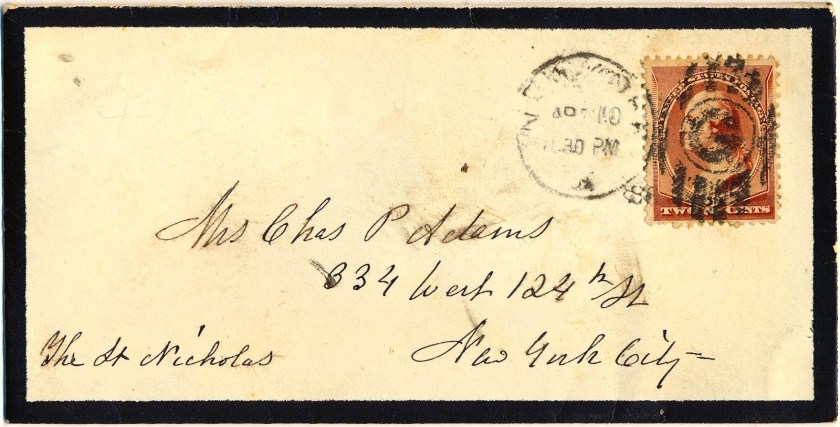
Mourning envelope containing a letter to Mrs. Charles P. Adams, 334 West 124th Street, New York City, postmarked 10 April, 1886. Ann Longmore-Etheridge Collection.

To: Mrs. Chas P Adams
334 West 124th St
New York City
The St Nicholas

The Windermere
April 10th 1886

Just a word Nela dear to tell you what I forgot to say yesterday—that Mrs. Pomeroy has been in town for a week, and is here for her health. So I fear she did not yet get your letter, and also that Grace and Fanny are going next week to Baltimore for a visit, so their house will be closed and any steps toward getting that drawing table must be taken without delay. I am sorry to trouble your mind with my matters, indeed your face full of care haunted me all night—but I can do nothing about the Bates property which others are holding.

And I wish of course to have the rooms as attractive as possible when parties look at them. A letter from Minnie W. to Julie—who is in town for a week—says she must give up her home for a while. I fear she intends renting it, and though hers is as large as mine, with only four bedrooms, it is a formidable rival with its pretty portieres and furniture. She has “lost seven letters since Xmas,” two of them contained checks! John W. is “investigating it.” So her letters to Julie are to be accounted for in that way. Julie is going to see her and has just gone to see “Mad Young Fulton” with the fee for the deposit as her last interview was unsatisfactory being “out of hours”—with the other parties waiting, therefore hurried. She received a letter from Mrs. Boyd this AM, offering her the Junior Department, with an assistant, at $400,” the decided wish of the Bishop and Hersey—“begging her not to disappoint them.” It is pleasant to have such an ultimatum if all else fails, and she need not decide now. But she prefers New York if it is possible to get something here. Don’t speak of these things until she or someone else tells you. You know she does not like to have her plans discovered and disseminated even in the family.

Continue reading “Mother Who?”

The Patriot’s In-Law: Eliza Schuyler Kuypers

18016683635_25ebd08a0b_o
Eliza Schuyler Kuypers, Mrs. Ethan Allen, Unmarked albumen carte de visite (CDV), circa 1864. Ann Longmore-Etheridge Collection.

The subject of this CDV is Eliza Schuyler Kuypers, wife of Ethan Alphonso Allen (8 February, 1818-27 November, 1889). Eliza’s husband was the grandson of the American patriot, farmer, philosopher, deist, and writer Ethan Allen (1737-1789) and his second wife Frances Montressor (1770-1834), through their son Ethan Voltaire Allen (1789-1845) and wife Mary Susanna Johnson (26 Sept., 1797-1 November, 1818).

Eliza, born in 1820, was the great-granddaughter of Elizabeth Schuyler (1771-1801) and her husband Rev. Gerardus Arentz Kuypers of Curacao, Dutch West Indies, who had been born on the island in December 1766 and later came to Hackensack, New Jersey, then to Rhinebeck, New York, to minister to the Dutch community there. Eliza’s grandfather was their son, also named Gerardus Arentz Kuypers (1787-1833), who was educated at Hackensack, and then studied theology under his father. He was licensed to preach in 1787 and served as a collegiate pastor in Paramus, New Jersey. In 1780, he moved to New York City to preach in the Dutch language. In 1791, he earned a Master of Arts degree from the College of New Jersey, as well as a Doctor of Divinity from Rutgers in 1810. It is noted that he suffered from asthma but died of “ossification” of the heart 28 June, 1833.

76a06e67-e29b-4397-9cea-aaff2d76accd
Eliza’s grandfather, Gerardus A. Kuypers, D.D.

Eliza was the daughter of his son, Dr. Samuel S. Kuypers (8 March, 1795-10 January, 1870) and Amelia Ann VanZant (1794-1864). Dr. Kuypers was an alumnus of Rutgers and a member of the Medical Society of the County of New York from 1820 until his death.

In the CDV image above, Eliza is most probably wearing mourning after her mother’s death in the penultimate year of the Civil War. Amelia VanZant Kuyper’s demise was announced in the New York Times of 8 January, 1864, as follows: “On Thursday, Jan. 7…in the 70th year of her age. The relatives and friends of the family are respectfully invited to attend the funeral from her late residence, No. 142 2d-av., on Sunday, Jan. 10, at 3 o’clock p.m. without further invitation.”

Continue reading “The Patriot’s In-Law: Eliza Schuyler Kuypers”

Fashion Fix

“The woolen dress in this portrait has been finished with self puffing to emphasize the waist taper, the shoulder caps, and the sleeve cuffs.”

6837086278_d05b598969_h
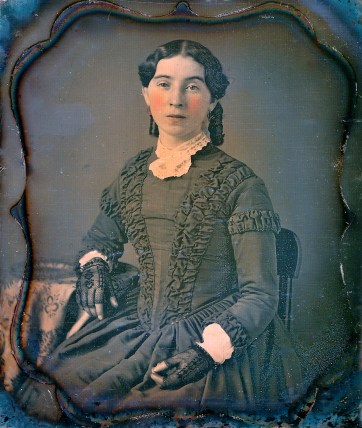
Dennis Waters, who conserved this 1/6th-plate daguerreotype in 1994, helpfully left a note on the reverse that says, “Pemberton & Co, Conn. Very rare plate mark. C. 1850.” Ann Longmore-Etheridge Collection.

This circa-1851 daguerreotype, now in my collection, was published on page 126 of Joan Severa’s seminal work on nineteenth century fashion, My Likeness Taken. Of it she wrote, “The woolen dress in this portrait has been finished with self puffing to emphasize the waist taper, the shoulder caps, and the sleeve cuffs. The fitted and darted bodice has the shorter waist point of the [1850s], and the skirt is taken into the waistline by small knife pleats. It is interesting to speculate on the color of the dress, as it is not black. Cherry red is a possibility, but soft brown is more likely.

“A standing band of whitework, with lappets crossed, is worn at the neck, and fine, close undersleeves extend the somewhat shortened sleeves. The netted mitts cover the fingers to the first finger joint, a new style for the year.

“The hair is done in long curls hanging behind the ears on either side.”

The figure at bottom left of this April 1851 fashion plate wears a similar dress and can help us visualize the full length gown worn by the daguerreotype’s subject. Ω

april

Witness to Disaster

William Parry Rees was a man who died too young, but lived long enough to view an American tragedy.

11312286785_713c6a1291_k
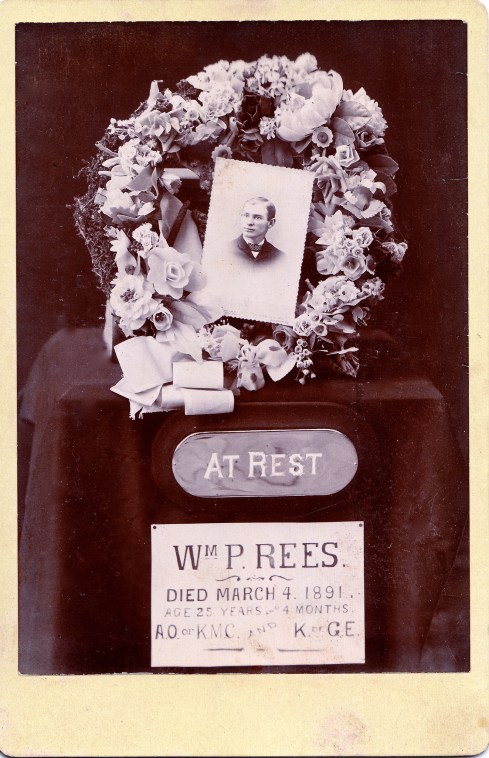
Funeral arrangement for William P. Rees, photographed by Edwards Brothers, 162 and 164 Main Street, Johnstown, Pennsylvania. Ann Longmore-Etheridge Collection.

This wonderful funeral cabinet card includes a photograph of the deceased William P. Rees, as well as the date of his death (4 March, 1891) and his age (“23 years and 4 months”). It also features the interesting inscription “A.O. of K.M.C and K. of G.E.” The first denotes the deceased’s membership in the fraternal society Ancient Order of Knights of the Mystic Chain. The second refers to his membership in the Knights of the Golden Eagle, a fraternal organization founded in Baltimore, Maryland, in 1872. The orders’ original objectives were to help its members find employment and aid them while unemployed. Membership was open to white males over 18, without physical or mental handicaps, who were able to write and to support themselves, were law-abiding of sound moral character, and of the Christian faith. There was a female auxiliary called the Ladies of the Golden Eagle.

A splinter group of the Knights of Pythias, the AO of KMC was founded in Reading, Pennsylvania, in 1870. According to a website about the order, “Though it seems to have been quite popular in PA, it doesn’t seem to have made much headway outside of that state—it is not listed among the top forty fraternal orders in the world almanac of 1896 and probably had no more than 10,000-15,000 members at its peak. Like most small orders, it did not survive the Great Depression of the 1930s.”

Another site about the AO of KMC states that “This group was founded in 1871 in the traditions of King Arthur and the Knights of the Round Table. Amongst the founders were Freemasons and Knights of Pythias. Some of the characteristics of this order can be traced to these two groups. The Knights of the Mystic Chain has three degrees: Knighthood, Mystery and Chivalry…. There was also a separate paramilitary uniform-rank and a degree for women: Naomi or the Daughters of Ruth. In 1889, the order started to work in insurance, however, it never grew larger. At its top, it had around 40,000 members. It disappeared in the first half of the 20th century.”

Continue reading “Witness to Disaster”

A Soldier’s Comfort?

“Many cultures accept the faulty nature of memory. They know even the photograph only gets it halfway right. They believe there is only one way to bring the dead back to life, story.”― Jon Chopan

4938256475_e2c14598a7_b
Unidentified subject, sixth-plate ambrotype. Ann Longmore-Etheridge Collection.

This beautiful young woman was photographed somewhere in the antebellum United States in about 1852—a date I assign for two reasons. First, the fashions she wore, which include a distinctive corset type, ribbon choker, and an open-front bodice—all styles that were enormously popular in the late 1840s and early 1850s. Second, ambrotypes, which are produced by a wet-plate collodion process invented in 1851 by Frederick Scott Archer, became commercially available in 1852, so the image cannot date any earlier.

The subject was surely not more than about 18 years old when photographed and she appears to wear a wedding ring, making it possible that this is a bridal image. At some point, a large curl of her thick brown hair, still as glossy as the day it was cut, was tucked behind the ambrotype packet between slips of newspaper. The text of the newsprint is largely advertising for several companies in northern states, but there is also a mention of the Union occupation of Memphis, Tennessee, which began in June 1862. Together, these facts make it likely the young woman belonged to a northern family.

4938239419_b190f9ba04_b
The ambrotype packet and case contents.

Continue reading “A Soldier’s Comfort?”

Buntings for a Bon Vivant King

“For to him above all was life was good,
Above all he commanded, her abundance full-handed.”—Rudyard Kipling, 1910

s-l1600
Albumen print of the Windsor, Ontario Post Office, in May 1910. Ann Longmore-Etheridge Collection.

In 1910, Dr. William L. Bates of Sioux City, Iowa, took the boat The Florida on a meandering holiday. One of his stops was Windsor, Ontario, Canada. While there, he photographed the Windsor Post Office, located at Ouellette Avenue and Pitt Street. Bates found the public building draped in mourning after the death of British King Edward VII, who had passed away 6 May. A ladder was propped against one side of the building indicating that the mourning swags were in of the process of being raised, so likely this image was captured within a day or so of the king’s demise.

King Edward VII was born Prince Albert Edward, Prince of Wales, second child and eldest son of Queen Victoria and Prince Albert of Saxe-Coburg and Gotha, on the morning of 9 November, 1841. “Our little boy is a wonderfully strong and large child, with very large dark blue eyes, a finely formed but somewhat large nose, and a pretty little mouth,” wrote Victoria to her uncle, Leopold, King of the Belgians, on 29 November. “I hope and pray he may be like his dearest Papa.”

Sadly, “Bertie,” as he was known amongst his family, was little like his erudite, brilliant, moral father or his paragon elder sister, Princess Vicky. Bertie strove to please his parents, who had devised a strict educational program for the heir to the throne, but the boy could never rise to the tonnage of their expectation. Once the grown prince matriculated to Oxford and Cambridge, however, he performed well as a student, giving the lie to his family’s belief that he was somewhat mentally deficient.

Continue reading “Buntings for a Bon Vivant King”

European Daguerreotypes

Europeana.eu offers up 2 million historical photographs that bring the old Europe and its people to life.

dag1
Courtesy Nordiska Museet.

In this daguerreotype an unknown woman sits in a high-backed chair, dressed in a patterned dress with elbow-length sleeves and a wide slanted neckline. The white paper passe-partout is printed with a gold decorative pattern and the stamp “Daguerreotype by J. W. Bergström.” According to Nordiska Museet, Johan Wilhelm Bergström (1812-1881) was born in Kungsholmen to a carpenter’s wife and died quite wealthy, after a decade as a leading daguerreotypist and a career as an inventor.

dag3
Courtesy Victoria and Albert Museum, London.

According to the Victoria and Albert Museum, “This is one of the first daguerreotypes ever taken in the UK. Landscape view of London: Parliament Street from Trafalgar Square. In the foreground to the right is a statue of Charles I mounted on horseback, seen from the back, on a raised stone plinth or column with carved royal arms, surrounded by a palisade of railings and protected by stone bollards. Parliament Street goes to the left, lined with tall buildings of five or more storeys, most of which have awnings over the street. The skyline shows many chimneys and chimney-pots. The pavements have lamps at regular intervals. On the left side of the street is a line of vehicles and drivers. In the distance is the Royal Banqueting House. Note the man in a top hat sitting slumped against the lamp-post in the middle foreground, with four bollards around him.”

Continue reading “European Daguerreotypes”