I own just a few early photographs of African-Americans, for they are scarce and much sought after. I present them with love.
A gelatin silver bromide print of a beautiful African-American woman wearing full mourning. Despite her loss, she was clearly a survivor. Circa 1900.Of this enchanting young Creole woman, I know only that she was from New Orleans, Louisiana, and her name was probably Jois. This was likely a wedding photo. Ambrotype, circa 1855.Mrs. Della Powell, post-mortem albumen print, 1894, photographed by William Carroll, Walnut Ridge, Arkansas. Formerly in the collection of Ben Zigler and now in mine, this rare post-mortem image of an African-American woman, who may have begun her life as a slave, was published in the 2004 book “Mourning Jewelry and Art” by Maureen DeLorme.
“Platitudes for the fallen officer were given in great numbers and the correspondent concluded with a highly personal plea: ‘Poor Joe! May the turf lie lightly on his manly breast.’”
Major Joseph Gilmour, 48th Pennsylvania
“In the spring of 1864, the pages of Schuylkill County’s most important newspaper was filled with information of exciting events from America’s increasingly bloody civil war. But amid the news of battlefield drama also came the sorrowful news of local soldiers cut to pieces during hellish combat in the rolling hills of the Virginia countryside.”
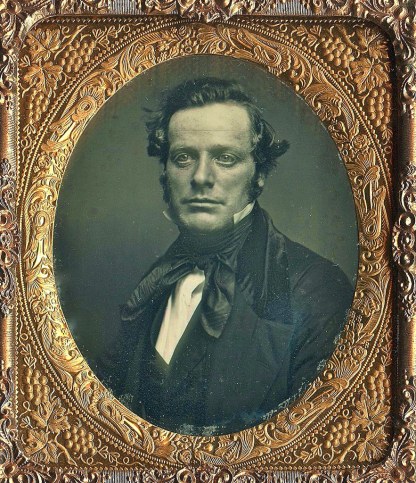
Inside the case of this exquisite 1/6th-plate daguerreotype is written “N. A. Tucker, March 1853.” Ann Longmore-Etheridge Collection.
The opulent mat surrounding this daguerreotype would draw attention from the portrait of a lesser subject, but not the ruggedly handsome, square-jawed, blue-eyed Nathaniel Amory Tucker, then aged 39. Blessed with money and looks, one of his obituaries described him as “an officer and a gentleman of much talent and geniality of wit.” Frère Quevillion, a Catholic priest who knew him well, called Tucker “a rich [man] in every sense.”
Catherine Hay Geyer, mother of Nathaniel Amory Tucker, from an original carte de visite taken not long before her death in 1869.
Tucker was the son of Catherine Hay Geyer (1778-1869), who married merchant Nathaniel Tucker (1775-1857) on 8 July, 1802, in Boston. The Geyers were well-moneyed. Before the Revolution, Catherine’s father—Nathaniel’s grandfather—Friedrich Geyer (1743-1841), had inherited an estate worth £1,000. The family name was originally Von Geyer and the family was “a late immigrant hither, and the tradition was [that] he was of a good German family,” reports English origins of New England families, Second series, Vol. I.
Frederick Geyer married Nathaniel’s grandmother Susanna Ingraham (1750-1796) on 30 April, 1767. In 1778, just before the birth of his daughter Catherine, Geyer—an ardent British royalist—was exiled and his property sequestered.
In the years that followed, the Geyers were based in London. The family had grown to include one son and five daughters, the latter of whom were undoubtedly raised to be prominent ladies of good society. The eldest, Mary Anne (1774-1814), married Andrew (1763-1841), the son of Jonathan Belcher, first Chief Justice of Nova Scotia, on 7 September, 1792. When Catherine’s younger sister Nancy Geyer married Rufus G. Amory on 13 February, 1794, a guest at the wedding was Prince Edward, Duke of Kent, the son of King George III and Queen Charlotte, father of the future Queen Victoria, who was in Boston on his way to Halifax.
My attention was drawn by the unusual name carved into one tombstone: Raisin Pitts, a Confederate private who died 26 September, 1862, now buried in a Yankee town in a Union state, far from home.
The grave of Raisin Pitts, Mount Olivet Cemetery, Frederick, Maryland, photographed by the author on Confederate Memorial Day, 28 April, 2016.
Recently, and quite serendipitously, I visited Mount Olivet Cemetery—the preeminent burial grounds of Frederick County, Maryland. Francis Scott Key, who in 1812 wrote the poem that became the National Anthem, reposes there. Also interred at Mount Olivet are prosperous Victorians and Edwardians, Colonial and Federal-era area residents moved from their original gravesites in small family plots and cemeteries around the county, and Civil War soldiers who fought for the Confederacy but breathed their last as Union captives.
It was Confederate Memorial Day, a solemn remembrance of which I was unaware when a friend and I decided to visit the cemetery. We found Mount Olivet’s Confederate graves bedecked with flags. Reenactors laid wreaths after a small, bagpipe-led parade.
Confederate graves at Mount Olivet. Raisin Pitts is buried in this row.
My attention was drawn by the unusual name carved on one tombstone: Raisin Pitts, a Confederate private who died 26 September, 1862, now buried in a Yankee town in a Union state, far from home. My curiosity propelled by his unusual—and unlikely—name, I decided to search for more about Private Pitts.
A selection of vintage images from my collection featuring sitters whose identities, sadly, are unknown.
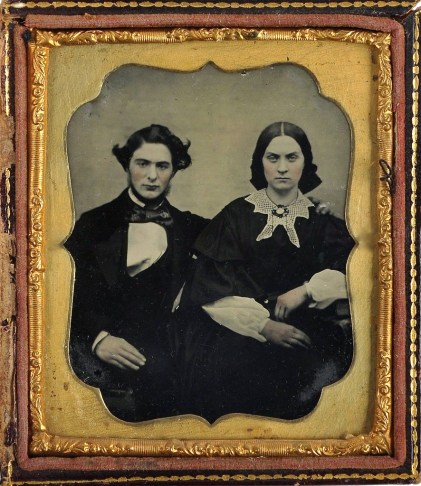
An English matriarch sits resplendent for this tinted 1/6th-plate daguerreotype, circa 1849. It is likely by Beard’s Photographic Institute, London and Liverpool, which was run by Richard Beard (22 December 1801–7 June 1885). Beard enthusiastically protected his business through photographic patents and helped establish professional photography in the United Kingdom. He opened his London and Liverpool studios in 1841. Clouds were frequently painted in as a backdrop by his studio staff.A woman wearing spring fashions uses a finger to mark her place in a book in this 1/6th-plate American daguerreotype, circa 1852. Perhaps she wanted to imply that she had been reading outdoors.I title this American, circa-1858, 1/6th-plate ambrotype “A Man, His Hair, and His Wife.” The husband has a feminine beauty, especially with the delicate tinting of his cheeks. His wife, brooding, intense, and potentially vengeful, may be wearing a large mourning brooch.This early English, 1/4th-plate ambrotype features a Victorian teen who could be a character in a Dickens’ novel. She points to an illustration in a book, but I cannot decipher the title or the meaning of her gesture. The image was taken in about 1852.As photography matured, it became possible to make copies of early, singular photographic images. In the 1890s, this cabinet card was created of a daguerreotype taken in about 1855.
Ω
All images copyright the Ann Longmore-Etheridge Collection.
Whenever the modern world seems unprincipled and bleak, take comfort. It ran amok in the old days, too, as these Victorian news clippings attest.
York, Pennsylvania Gazette, Sunday, 5 December, 1897
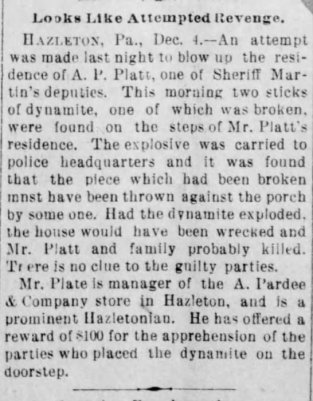
“Looks Like Attempted Revenge”
“Hazelton, Pa., Dec. 4.—An attempt was made last night to blow up the residence of A. P. Platt, one of Sheriff Martin’s deputies. This morning, two sticks of dynamite, one of which was broken, were found on the steps of Mr. Platt’s residence. The explosive was carried to police headquarters and it was found that the piece which had been broken must have been thrown against the porch by someone. Had the dynamite exploded, the house would have been wrecked and Mr. Platt and family probably killed. There is no clue to the guilty parties.
“Mr. Platt is the manager of the A. Pardee & Company store in Hazelton, and is a prominent Hazletonian. He has offered a reward of $100 for the apprehension of the parties who placed the dynamite on the doorstep.”
“Chicago, Oct. 2.—A number of very narrow escapes from death by fire occurred at No. 90 East Chicago avenue early this morning. The building is a two-story frame owned by John Johnson and occupied in the basement by Miss Julia Hogan as a restaurant; first floor as a saloon kept by Roose & Steuberg, and the second floor by John Johnson and family. Officer Moore saw the flames leaping from of the rear of the building, turned in the alarm and then ran to the scene to arouse the inmates. He rushed to Johnson’s rooms and seized two of the children, who were in a back room, and were nearly suffocated. In coming downstairs, he fell and injured his left hand and arm, but the children were not injured. Mrs. Johnson caught up the baby and escaped in her night dress, followed by her sister and husband. In Miss Hogan’s restaurant, in the basement, were sleeping Julia Hogan and Mary Esperson, Helen Larsel and Louise Norin. The last named, the cook, was aroused by the heat and smoke, which came from the kitchen. She called the proprietress, and they tried to gather some valuables, but the flames spread so rapidly that a retreat was necessary. Miss Hogan was compelled to run through the flames, and her arms were severely burned in attempting to save a dress, in the pocket of which was $56. The damage to the building was slight.”
As the Northern Hemisphere explodes with green life, let’s take a look back at rebirth celebrations of yesteryear.
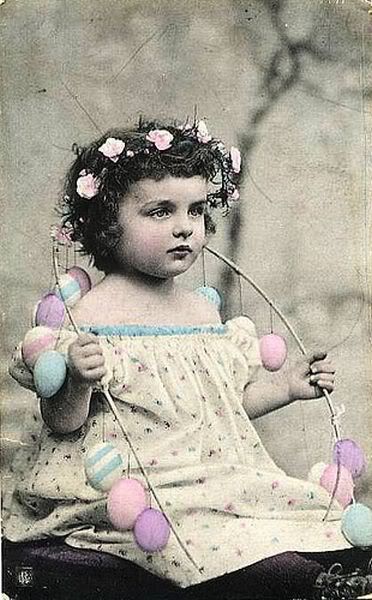
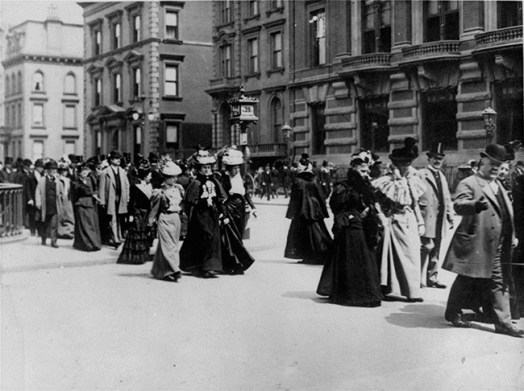
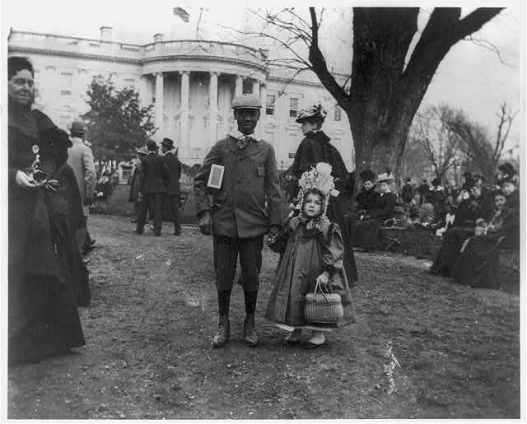
A beautiful early Easter image, probably 1890s.The 1898 5th Avenue Easter Parade, New York City, New York. Courtesy Wikimedia Commons.Children at the 1898 White House Easter Egg Roll. Courtesy Library of Congress.
Last week, a storm brought 10 inches of snow to Western Maryland and turned my mind to snowmen of old.
A woman builds a snowman whilst a man shovels snow. Courtesy National Museum of Wales.
In all probabilty, humans have sculpted snowmen for millenia. In 2007, Bob Eckstein, the author of The History of the Snowman: From the Ice Age to the Flea Market, told NPR that in writing his book, “I wanted to make it clear that snowman-making actually was a form of folk art. Man was making folk art like this for ages, and…maybe it’s one of man’s oldest forms of art…. [T]he further back you go, you find that people were really fascinated with snowmen.”
Eckstein says that building snowmen was “a very popular activity in the Middle Ages…after a snow came down and dumped all these free-art supplies in front of everyone’s house.” The earliest known representation of a snowman dates to that era, drawn in a 1380 A.D. Book of Hours. A century later, in 1494, Michelangelo was commissioned by Piero di Lorenzo de’ Medici, the Gran Maestro of Florence, to practice his art with snow. According to art historian Giorgio Vasari, “de’ Medici had him make in his courtyard a statue of snow, which was very beautiful.” Sadly, no one drew it for posterity.
In 1510, a Florentine apothecary, Lucas Landucci confided in his diary that he had seen “a number of the most beautiful snow-lions, as well as many nude figures…made also by good masters.” Another notable snowmen outbreak occurred just a year later, when folk in Brussels built more than 100 of them “in a public art installation known as the Miracle of 1511,” notes Atlas Obscura. “Their snowmen embodied a dissatisfaction with the political climate, not to mention the six weeks of below-freezing weather. The Belgians rendered their anxieties into tangible, life-like models: a defecating demon, a humiliated king, and womenfolk getting buggered six ways to Sunday. Besides your typical sexually graphic and politically riled caricatures, the Belgian snowmen, Eckstein discovered, were often parodies of folklore figures, such as mermaids, unicorns, and village idiots.”
I own a stereoview card, one half which is seen above, that may portray mourners of President Franklin Pierce. To accompany this image, I am reblogging an excellent look at Pierce’s life and burial place by Gravely Speaking.
A sign outside the gates of the Old North Cemetery announces the burial of the most New Hampshire native son within its fencing. The sign outlines the major accomplishments of Franklin Pierce:
FRANKLIN PIERCE
1804 – 1869
Fourteenth President of the United States
(1853 -1857)
Lies buried in nearby Minot enclosure.
Native son of New Hampshire,
Graduate of Bowdoin College,
Lawyer, effective political leader,
Congressman and U.S. Senator,
Mexican War veteran, courageous
Advocate of States’ rights,
He was popularly known as
“Young Hickory of the Granite Hills.”
While the sign outlines Pierce’s political accomplishments, there is nothing about his personal life. Franklin Pierce was born in Hillsborough, New Hampshire. He married Jane Appleton, the daughter of a Congregational minister. Jane and Franklin were nearly polar opposites. Franklin was outgoing and gregarious. Jane was shy and suffered from depression. Jane was pro-temperance and devoutly religious. Jane was from a family that…
Gentle Readers, your Humble Proprietress is recovering from surgery and so shall share photographic images of antique and vintage buttons in lieu of a lengthy article.
Metal and glass buttons from the Victorian and Edwardian eras.
Of buttons, Collector’s Weekly writes, “As long as human beings have needed to keep their clothing fastened, buttons have been there to do the work.” Buttons may be utilitarian, however, even well into the era of mass production, they were made to be reused on the garments of succeeding generations, resulting in little works of art that please collectors’s eyes today.
A small Victorian carved Mother of Pearl button featuring a steel-cut lizard, probably dating to the mid-1800s.
Many still recall our grandmothers’ button jars or boxes filled with delightful miniature wonders of carved shell, shiny metal augmented with brilliant cut-steel embellishments, luminous glass, light and fancifully shaped celluloid, and bakelite of eye-watering colors. I was born in 1963, my father in 1928, and my father’s mother in 1891. Some of my earliest memories are of Nanny, as I called her, sewing on a black Singer treadle machine richly decorated with Victorian gothic revival red and gold designs. As Nanny pumped the ornate foot panel in a soothing rhythm, I played in a pool of buttons scooped from the sewing machine’s cabinet drawers. I remember, especially, bakelite raspberries, as tart red as the real fruits, and a large navy blue button shaped like a bundle of roses. I have recently obtained a white version, seen below.












 "Your Dying Charlotte"