The Patriot’s In-Law: Eliza Schuyler Kuypers

18016683635_25ebd08a0b_o
Eliza Schuyler Kuypers, Mrs. Ethan Allen, Unmarked albumen carte de visite (CDV), circa 1864. Ann Longmore-Etheridge Collection.

The subject of this CDV is Eliza Schuyler Kuypers, wife of Ethan Alphonso Allen (8 February, 1818-27 November, 1889). Eliza’s husband was the grandson of the American patriot, farmer, philosopher, deist, and writer Ethan Allen (1737-1789) and his second wife Frances Montressor (1770-1834), through their son Ethan Voltaire Allen (1789-1845) and wife Mary Susanna Johnson (26 Sept., 1797-1 November, 1818).

Eliza, born in 1820, was the great-granddaughter of Elizabeth Schuyler (1771-1801) and her husband Rev. Gerardus Arentz Kuypers of Curacao, Dutch West Indies, who had been born on the island in December 1766 and later came to Hackensack, New Jersey, then to Rhinebeck, New York, to minister to the Dutch community there. Eliza’s grandfather was their son, also named Gerardus Arentz Kuypers (1787-1833), who was educated at Hackensack, and then studied theology under his father. He was licensed to preach in 1787 and served as a collegiate pastor in Paramus, New Jersey. In 1780, he moved to New York City to preach in the Dutch language. In 1791, he earned a Master of Arts degree from the College of New Jersey, as well as a Doctor of Divinity from Rutgers in 1810. It is noted that he suffered from asthma but died of “ossification” of the heart 28 June, 1833.

76a06e67-e29b-4397-9cea-aaff2d76accd
Eliza’s grandfather, Gerardus A. Kuypers, D.D.

Eliza was the daughter of his son, Dr. Samuel S. Kuypers (8 March, 1795-10 January, 1870) and Amelia Ann VanZant (1794-1864). Dr. Kuypers was an alumnus of Rutgers and a member of the Medical Society of the County of New York from 1820 until his death.

In the CDV image above, Eliza is most probably wearing mourning after her mother’s death in the penultimate year of the Civil War. Amelia VanZant Kuyper’s demise was announced in the New York Times of 8 January, 1864, as follows: “On Thursday, Jan. 7…in the 70th year of her age. The relatives and friends of the family are respectfully invited to attend the funeral from her late residence, No. 142 2d-av., on Sunday, Jan. 10, at 3 o’clock p.m. without further invitation.”

Continue reading “The Patriot’s In-Law: Eliza Schuyler Kuypers”
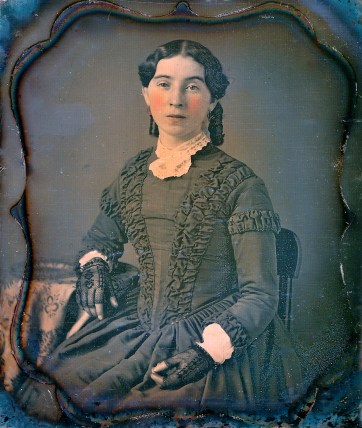
Fashion Fix

“The woolen dress in this portrait has been finished with self puffing to emphasize the waist taper, the shoulder caps, and the sleeve cuffs.”

6837086278_d05b598969_h
Dennis Waters, who conserved this 1/6th-plate daguerreotype in 1994, helpfully left a note on the reverse that says, “Pemberton & Co, Conn. Very rare plate mark. C. 1850.” Ann Longmore-Etheridge Collection.

This circa-1851 daguerreotype, now in my collection, was published on page 126 of Joan Severa’s seminal work on nineteenth century fashion, My Likeness Taken. Of it she wrote, “The woolen dress in this portrait has been finished with self puffing to emphasize the waist taper, the shoulder caps, and the sleeve cuffs. The fitted and darted bodice has the shorter waist point of the [1850s], and the skirt is taken into the waistline by small knife pleats. It is interesting to speculate on the color of the dress, as it is not black. Cherry red is a possibility, but soft brown is more likely.

“A standing band of whitework, with lappets crossed, is worn at the neck, and fine, close undersleeves extend the somewhat shortened sleeves. The netted mitts cover the fingers to the first finger joint, a new style for the year.

“The hair is done in long curls hanging behind the ears on either side.”

The figure at bottom left of this April 1851 fashion plate wears a similar dress and can help us visualize the full length gown worn by the daguerreotype’s subject. Ω

april

European Daguerreotypes

Europeana.eu offers up 2 million historical photographs that bring the old Europe and its people to life.

dag1
Courtesy Nordiska Museet.

In this daguerreotype an unknown woman sits in a high-backed chair, dressed in a patterned dress with elbow-length sleeves and a wide slanted neckline. The white paper passe-partout is printed with a gold decorative pattern and the stamp “Daguerreotype by J. W. Bergström.” According to Nordiska Museet, Johan Wilhelm Bergström (1812-1881) was born in Kungsholmen to a carpenter’s wife and died quite wealthy, after a decade as a leading daguerreotypist and a career as an inventor.

dag3
Courtesy Victoria and Albert Museum, London.

According to the Victoria and Albert Museum, “This is one of the first daguerreotypes ever taken in the UK. Landscape view of London: Parliament Street from Trafalgar Square. In the foreground to the right is a statue of Charles I mounted on horseback, seen from the back, on a raised stone plinth or column with carved royal arms, surrounded by a palisade of railings and protected by stone bollards. Parliament Street goes to the left, lined with tall buildings of five or more storeys, most of which have awnings over the street. The skyline shows many chimneys and chimney-pots. The pavements have lamps at regular intervals. On the left side of the street is a line of vehicles and drivers. In the distance is the Royal Banqueting House. Note the man in a top hat sitting slumped against the lamp-post in the middle foreground, with four bollards around him.”

Continue reading “European Daguerreotypes”

Freddie, My Love

“Oh, Mrs. Crane, he looked so pretty. He looked as if he was asleep and dreaming a very pleasant dream.”

daga1IMG_0004
A partial letter from “Julie” to “Mrs. Crane,” single page with black borders, page one. Ann Longmore-Etheridge Collection.

I have in my collection this incomplete letter from the mid- to late 1800s written by an American woman named Julie who had endured the loss of her fiancé, Freddie. Julie’s letter was for another woman—her elder and probably close family friend, Mrs. Crane.

Julie and Freddie were young, possibly in their teens. Julie was quite literate, but her writing contains numerous errors, phonetic spellings, and a general disuse of commas, full stops, and quotations that is endemic to the era. I have corrected her mistakes and added modern punctuation in the quotes below.

“I sat and looked at him all night,” Julie wrote at the top of the single page, recalling the aftermath of the passing. “So many spoke of his smiling and happy beautiful countenance even in death. He looked too beautiful to bury.” She then hopped backward in time, writing, “He was sensible until two minutes before he died, but whether he realized he was really dying, I know not.”

Next she confides in Mrs. Crane, “About two hours before he died, I sat crying and he looked at me. I said, ‘Freddie darling, how can I give you up?’ He raised his hand and said ‘Oh, Julie, don’t.’”

Don’t? Don’t weep? Don’t imply that he was dying? Don’t tarnish his “good death” with female hysteria? Perhaps Freddie’s command was more prosaic: The dying man needed to move his bowels. “[H]e wanted to get on the chamber [pot] and I asked him if I should tell his mother. He said, ‘Mother is weak.’ I said, ‘Freddie, shall I help you?’ He said, ‘Yes, please,’ so I [assisted] him,” she next wrote. Of all the letter’s painful details, this strikes deepest—a heartbreaking intimacy, demanded by circumstance, between a couple who may never have seen each other unclothed.

Continue reading “Freddie, My Love”

Alice Isn’t Dead: A Cautionary Tale, a Family History

Upon receipt of the carte, I scanned, enlarged, and enhanced the image. Immediately I became aware of motion blur caused by the child’s arms moving during the exposure.

6905559274_525dd552e7_h
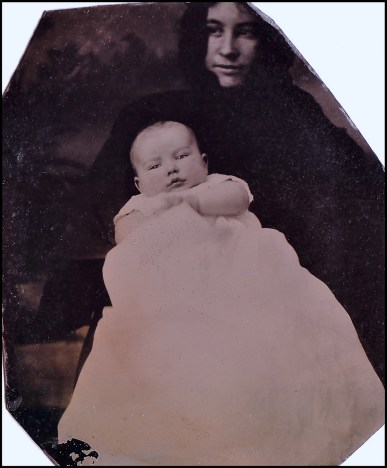
Mary Jane Stayman Culley holding eight-week-old Alice Maud Culley in August 1879. Albumen carte de visite. Ann Longmore-Etheridge Collection.

Within eBay’s vintage and antique photo subcategory, every slightly odd-looking baby is a dead baby. I confess that when I saw the listing for the carte de visite (CDV) above, I thought this was an infant gone, never to grow up, forever to sleep, dressed in angelic white and buried in a tiny coffin so unfairly made-to-fit, her grave topped by a small stone lamb. This was cruel fate; this was a Victorian postmortem. But those who explore the Victorian propensity to mark gut-wrenching loss via photography should take this story as a cautionary tale, not unlike the one I featured last November, “To Be, or Not to Be, a Victorian Postmortem.”

The CDV’s backstamp is that of “John Davies, Portrait & Landscape photographer, BelleVue High Street, Weston-super-Mare. Formerly with the late T. R. Williams, London, Photographer to the Queen and Royal Family.” There is also a handwritten inscription: “Alice Maud Culley, 8 weeks old, Aug. 1879.”

Upon receipt of the carte, I scanned, enlarged, and enhanced the image. Immediately, I was aware of motion blur caused by the child’s arms moving during the exposure. Alice Maud Culley wasn’t dead. I could then plow into the public records because of the fortuitous identification upon the reverse.

Continue reading “Alice Isn’t Dead: A Cautionary Tale, a Family History”

Tales of Innocence and Darkness

The eerie and eclectic photography of Caroline Leech

19077302489_dcf11bbe45_b
All photos copyright Caroline Leech.

Carolyn, an English woman who lives in Spain, writes of herself: “I am an obsessive Victorian and lover of all things Gothic. As a child I would often rather spend my pocket money in the local antique shop on postcards, photos, stamps or coins than in the toyshop. History just always fascinated me.”

31912891283_65cf2621f8_b“I then developed an interest in spirits and faeries and fell in love with writers such as my beloved Charles Dickens, Sheridan LeFanu, Emily Dickinson and with the whole world of Victorian spiritualism, mourning, the faery painters of the time and also the darker aspects of Victorian society.”

32681174485_02339b8c1e_k“I live in a watermill in the middle of a forest, which is always an inspiration to me. I feel I am surrounded by all sorts of spirits.”

30342997980_f63fb34691_k“I have been an antique dealer and visionary artist for years and am also a keen amateur photographer of anything mysterious. My greatest love is of course Victorian photography, these amazing ghosts which pleasantly haunt the pages of my book and the drawers and cabinets of my bedroom.”
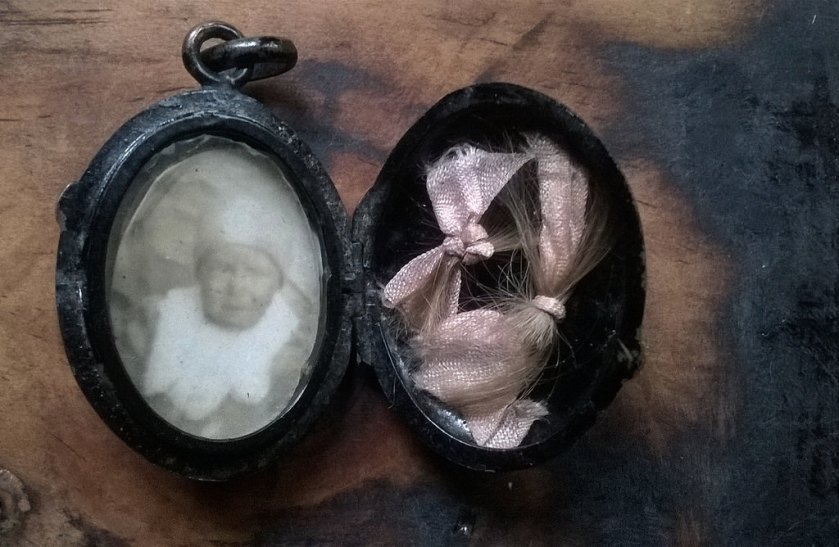
25955709410_3133c5fda8_bCaroline’s book of photos and poetry can be purchased at Amazon. You can also visit her Flickr photostream. Ω
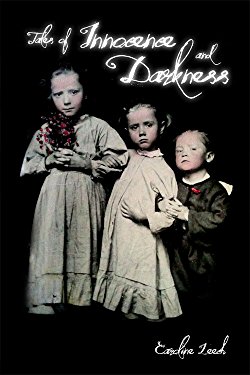
61zy1g15BbL._UX250_

Photo-Multigraphs: The Mirror and the Camera

“It was the purpose of the author to describe a number of novel and curious effects that can be obtained by the aid of the camera, together with some instructive and interesting photographic experiments.”—F. R. Fraprie, 1922

5._MultiMnCab2
A photo-multigraph cabinet card by A. M. Lease of Lancaster, Pennsylvania, circa 1895.

By Beverly Wilgus

In 1893, H. P. Ranger was granted Patent No. 505,127 for a “Mirror For Use In Photography.” This was a device comprised of two adjustable mirrors set at an angle. When a subject was placed in front of it, his or her image was reflected in each mirror and that reflection was again reflected, resulting in five or more figures—the number of figures determined by the angle of the mirrors.

1._MirrorPatent

The above schema is from an article published in Scientific American in the 1890s that was included in the 1896 book Photographic Amusements by Frank R. Fraprie and Walter E. Woodbury. My husband and I own a copy of the 1931 edition that still contains the original illustrations.

2._mirror_top

Also from the book is the illustration above: “Diagram Showing The Method Of Production Of Five Views of One Subject By Multiphotography.”

Continue reading “Photo-Multigraphs: The Mirror and the Camera”

Mommy and Me

“Because I feel that in the heavens above
The angels, whispering one to another,
Can find among their burning tears of love,
None so devotional as that of ‘Mother,’
Therefore, by that dear name I have long called you,
You who are more than mother unto me.” — Edgar Allan Poe

8673431850_5ae172a421_h
A proud mother and her adorable daughter pose in this 1/6-plate daguerreotype, circa 1850. The mother wears a fashionable “Jennie Lind” collar, made popular by the soprano Jennie Lind, the “Swedish Nightingale,” who toured North America from 1850 to 1852 under the relentless promotion of showman P. T. Barnum. Ann Longmore-Etheridge Collection.
8754664382_17b1ed2681_o
This mid-1870s tintype from the Jack and Beverly Wilgus Collection includes a shy “hidden mother” who is revealed with the removal of the decorative paper mat.
5265855274_ecf823dfb1_b
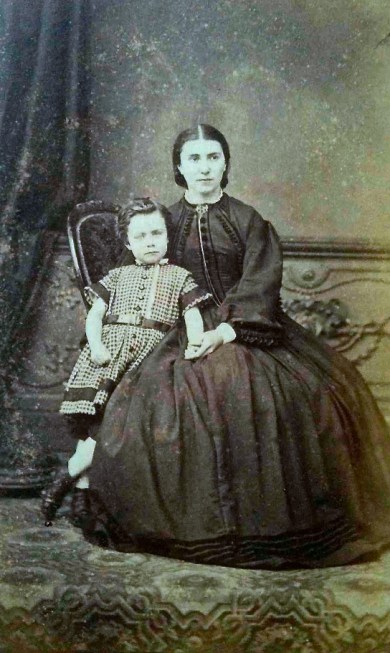
A nicely dressed English mother and son photographed in about 1862. Her smoothed and center-parted hair, pagoda sleeves, full hoop, and applied decorative trim was at the height of fashion. Her boy’s checkered, belted, one-piece dress was perhaps in shades of red and tan, similar to the fabric used in this earlier example. This albumen carte de visite is from the Caroline Leech Collection, originally photographed by G. J. Tear, Clapham Road, London.
11131720303_bcd7c86041_b
A mother, son, and baby in a pram enjoying a sunny day in England during the late 1920s. Scanned film negative from the James Morley Collection.
9860148255_605fce91a3_h
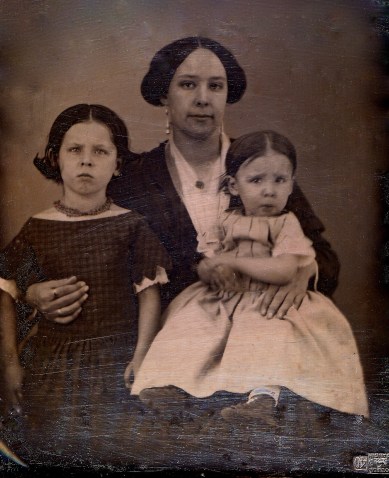
An American mother and two daughters pose for an adorable 1/6th-plate Gaudin daguerreotype, circa 1852. The plate is marked “Double, A. Gaudin, 40,” the hallmark of Antoine Gaudin & Bro., 9 Rue de la Perle, Paris, a French company whose products were widely used by daguerreians throughout America. The older daughter is wearing a “protective” coral necklace. Coral was thought to have special efficacious properties to safeguard children. Ann Longmore-Etheridge Collection.

Ω


A quick note: I will be having surgery on Tuesday, 4 April, and will be taking at least a four- or five-day hiatus to recover. I will return as soon as possible. Promise.

Men of Mystery

A selection of unidentified daguerreotype and ambrotype portraits.

5679251533_186706854b_o
A very early daguerreotype of a personable young man that dates to about 1843. Courtesy Price and Zimmer Collection.
5693420331_498234a042_b
The rugged and remarkable older gentleman who sat for this ambrotype in about 1852 probably first opened his eyes to the world in the 1780s or 1790s. Courtesy Price and Zimmer Collection.
20477909888_2eb9174f52_o
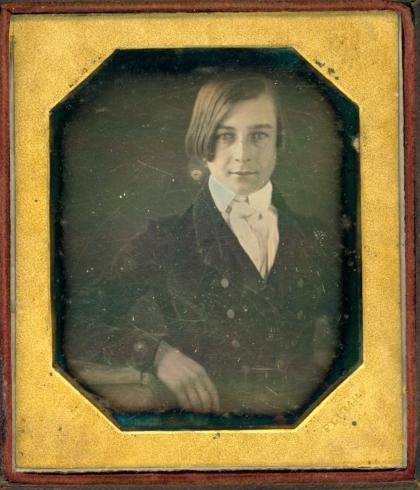
A painterly 1/6th-plate daguerreotype of a breathtaking young man. His fashions date this portrait to about 1850. Ann Longmore-Etheridge Collection.
2465492782_412c6d8937_o
An unusual profile daguerreotype taken in about 1850. Courtesy Jack and Beverly Wilgus Collection.
15387966094_29d327bfee_k
A 1/4th-plate ambrotype of an unknown man intently focused on a point in the distance. Taken circa 1860. From the James Morley Collection.
5417551681_21bebe0d15_b
A man and his dog, whose front paws were held to keep them from moving during the long exposure. This 1/6th-plate ambrotype, probably from the late 1850s, is courtesy of the Caroline Leech Collection.

Ω

The Lillibridges: From Prairie Grass to Cream

Although there had been settlers in the area since the 1830s, the Lillibridges were part of an immense rush of newcomers to the Iowa territory during the 1850s.

ambro_0002
Adeline Young Lillibridge holding her infant son, Clair. Tintype, 1876. Ann Longmore-Etheridge Collection.

Today, the prairies of Iowa are all but gone—their restoration the scheme of environmentalists and concerned volunteers. But when these great grass seas last existed, it was the grandparents of the baby above, Clair Miles Lillibridge, who arrived to radically reshape them.

Clair’s father Leverett Lillibridge, born 25 June, 1851, was the son of John Lillibridge (b. 1816) and Mary Rexford (b. 1815), who married in Lebanon, Madison County, New York, 25 May, 1836, and had seven children, of which Leverett was the fourth. The family went west to what became the town of Manchester, Delaware County, Iowa, almost a decade before Leverett’s birth in 1851. The namesake of John and Mary’s son was his maternal grandfather, early settler Leverett Rexford, who in 1841, according to The History of Delware County, Iowa and Its People, “built a log cabin near the Bailey home, which was later inhabited by John Lillibridge.”

Although there had been settlers in the area since the 1830s, the Lillibridges were part of an immense rush of newcomers to the territory during the 1850s. “Families camped at the Mississippi, waiting their turn for ferryboats to the other side. In only a few years these settlers would turn the forests and prairies into plowed fields,” notes Iowa Public Television. “Farmers arriving from the many different regions of the United States brought their special agriculture with them. Those from New England and New York carried the seeds for plum, apple and pear trees. Kentuckians brought their knowledge of improved seed and livestock breeding. From Pennsylvania and Ohio fine flocks of sheep came to graze in the dry pastures of southern Iowa.”

One harrowing story of the early years of Manchester took place when Leverett Lillibridge was two. “Jane and Eliza Scott, whose home was near Delhi…in the spring of 1853, attempted to ford Spring Branch, a mile above Bailey’s, but the water was so high that their horse and wagon were swept [away] and the horse was drowned. The current carried one of the girls safely to shore, but the other was drawn into the eddy but was finally rescued by her sister, who succeeded in reaching her with a pole and drawing her to shore. One of the girls reached Bailey’s cabin, but was so exhausted she could not for some time explain the situation. As soon as she made herself understood, Mrs. Bailey left her and hastened to the locality where the other girl was expected to be found. On her way she met John Lillibridge and they together carried the insensible girl from where they found her to Mr. Lillibridge’s horse and placing the limp body on the animal’s back, she was conveyed to the Bailey home, where both the unfortunate girls were given every attention.”

Continue reading “The Lillibridges: From Prairie Grass to Cream”