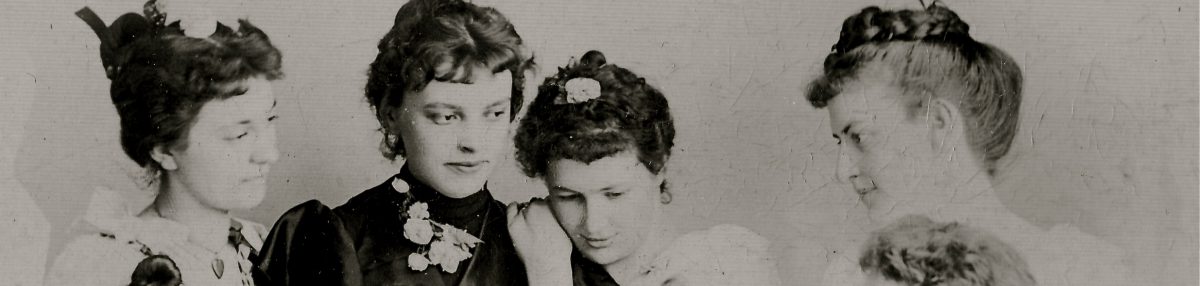
Death and the Maiden

“Life asked death, ‘Why do people love me but hate you?’ Death responded, ‘Because you are a beautiful lie and I am a painful truth.’”—Author Unknown

18495882091_ea7011bdfe_b
Lavada May Dermott, postmortem albumen print on cardboard, 1904. Ann Longmore-Etheridge Collection.

Lavada May Dermott, seen above laid out in her parents’ home, surrounded by funeral flowers, was born 9 May, 1888, in Goshen, Belmont County, Ohio, to Charles Evans Dermott (1849-1907) and his wife, Sarah Jane Stewart (1853-1936). Sarah was the daughter of Eleazar Evan Stewart (1834-1910) and Honor Brown (1835-1914).

Lavada’s parents married in Goshen 26 January, 1871. They first make an appearance as a family unit on the 1880 Census of that township. Evans Dermott—he went by his middle name—listed his occupation as “huxter.” His father, Irish-born farmer William Dermott (1811-1896) was also a part of the household—his wife, Eliza Kelly (1813-1879), having died the year before.

Evans and Sarah had together four children: William Wilber (1871-1947), Charles E. Dermott (19 June, 1881-23 September, 1944), Lavada, and Lillie F. Dermott (1895-1987). On 20 May, 1900, the eldest son, William, married Grace Stanley King. William spelled the family name as Der Mott and is buried thusly in Forest Rose Cemetery, Lancaster, Ohio. By 1910, the Der Motts lived in Cleveland, Ohio. William became a garment cutter for a clothing company and eventually was the manager of a clothing store. He worked in that position as late as 1940. They had two children: Neil (b. 1902) and William P. (b. 1903).

Continue reading “Death and the Maiden”

The Patriot’s In-Law: Eliza Schuyler Kuypers

18016683635_25ebd08a0b_o
Eliza Schuyler Kuypers, Mrs. Ethan Allen, Unmarked albumen carte de visite (CDV), circa 1864. Ann Longmore-Etheridge Collection.

The subject of this CDV is Eliza Schuyler Kuypers, wife of Ethan Alphonso Allen (8 February, 1818-27 November, 1889). Eliza’s husband was the grandson of the American patriot, farmer, philosopher, deist, and writer Ethan Allen (1737-1789) and his second wife Frances Montressor (1770-1834), through their son Ethan Voltaire Allen (1789-1845) and wife Mary Susanna Johnson (26 Sept., 1797-1 November, 1818).

Eliza, born in 1820, was the great-granddaughter of Elizabeth Schuyler (1771-1801) and her husband Rev. Gerardus Arentz Kuypers of Curacao, Dutch West Indies, who had been born on the island in December 1766 and later came to Hackensack, New Jersey, then to Rhinebeck, New York, to minister to the Dutch community there. Eliza’s grandfather was their son, also named Gerardus Arentz Kuypers (1787-1833), who was educated at Hackensack, and then studied theology under his father. He was licensed to preach in 1787 and served as a collegiate pastor in Paramus, New Jersey. In 1780, he moved to New York City to preach in the Dutch language. In 1791, he earned a Master of Arts degree from the College of New Jersey, as well as a Doctor of Divinity from Rutgers in 1810. It is noted that he suffered from asthma but died of “ossification” of the heart 28 June, 1833.

76a06e67-e29b-4397-9cea-aaff2d76accd
Eliza’s grandfather, Gerardus A. Kuypers, D.D.

Eliza was the daughter of his son, Dr. Samuel S. Kuypers (8 March, 1795-10 January, 1870) and Amelia Ann VanZant (1794-1864). Dr. Kuypers was an alumnus of Rutgers and a member of the Medical Society of the County of New York from 1820 until his death.

In the CDV image above, Eliza is most probably wearing mourning after her mother’s death in the penultimate year of the Civil War. Amelia VanZant Kuyper’s demise was announced in the New York Times of 8 January, 1864, as follows: “On Thursday, Jan. 7…in the 70th year of her age. The relatives and friends of the family are respectfully invited to attend the funeral from her late residence, No. 142 2d-av., on Sunday, Jan. 10, at 3 o’clock p.m. without further invitation.”

Continue reading “The Patriot’s In-Law: Eliza Schuyler Kuypers”

Witness to Disaster

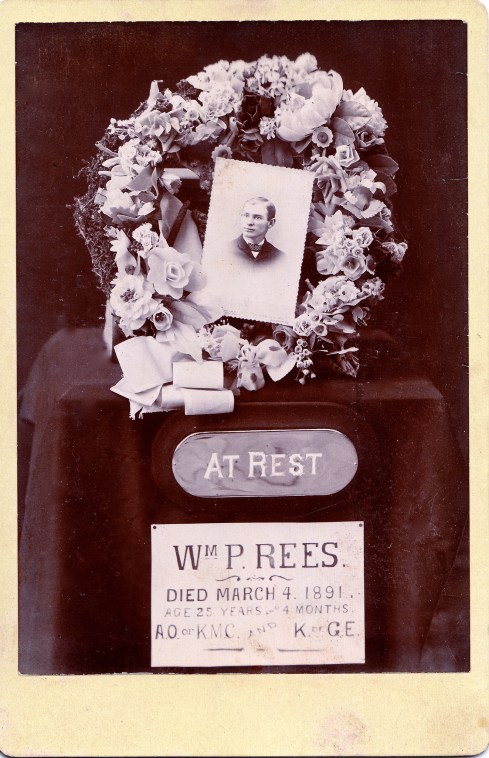
William Parry Rees was a man who died too young, but lived long enough to view an American tragedy.

11312286785_713c6a1291_k
Funeral arrangement for William P. Rees, photographed by Edwards Brothers, 162 and 164 Main Street, Johnstown, Pennsylvania. Ann Longmore-Etheridge Collection.

This wonderful funeral cabinet card includes a photograph of the deceased William P. Rees, as well as the date of his death (4 March, 1891) and his age (“23 years and 4 months”). It also features the interesting inscription “A.O. of K.M.C and K. of G.E.” The first denotes the deceased’s membership in the fraternal society Ancient Order of Knights of the Mystic Chain. The second refers to his membership in the Knights of the Golden Eagle, a fraternal organization founded in Baltimore, Maryland, in 1872. The orders’ original objectives were to help its members find employment and aid them while unemployed. Membership was open to white males over 18, without physical or mental handicaps, who were able to write and to support themselves, were law-abiding of sound moral character, and of the Christian faith. There was a female auxiliary called the Ladies of the Golden Eagle.

A splinter group of the Knights of Pythias, the AO of KMC was founded in Reading, Pennsylvania, in 1870. According to a website about the order, “Though it seems to have been quite popular in PA, it doesn’t seem to have made much headway outside of that state—it is not listed among the top forty fraternal orders in the world almanac of 1896 and probably had no more than 10,000-15,000 members at its peak. Like most small orders, it did not survive the Great Depression of the 1930s.”

Another site about the AO of KMC states that “This group was founded in 1871 in the traditions of King Arthur and the Knights of the Round Table. Amongst the founders were Freemasons and Knights of Pythias. Some of the characteristics of this order can be traced to these two groups. The Knights of the Mystic Chain has three degrees: Knighthood, Mystery and Chivalry…. There was also a separate paramilitary uniform-rank and a degree for women: Naomi or the Daughters of Ruth. In 1889, the order started to work in insurance, however, it never grew larger. At its top, it had around 40,000 members. It disappeared in the first half of the 20th century.”

Continue reading “Witness to Disaster”

A Soldier’s Comfort?

“Many cultures accept the faulty nature of memory. They know even the photograph only gets it halfway right. They believe there is only one way to bring the dead back to life, story.”― Jon Chopan

4938256475_e2c14598a7_b
Unidentified subject, sixth-plate ambrotype. Ann Longmore-Etheridge Collection.

This beautiful young woman was photographed somewhere in the antebellum United States in about 1852—a date I assign for two reasons. First, the fashions she wore, which include a distinctive corset type, ribbon choker, and an open-front bodice—all styles that were enormously popular in the late 1840s and early 1850s. Second, ambrotypes, which are produced by a wet-plate collodion process invented in 1851 by Frederick Scott Archer, became commercially available in 1852, so the image cannot date any earlier.

The subject was surely not more than about 18 years old when photographed and she appears to wear a wedding ring, making it possible that this is a bridal image. At some point, a large curl of her thick brown hair, still as glossy as the day it was cut, was tucked behind the ambrotype packet between slips of newspaper. The text of the newsprint is largely advertising for several companies in northern states, but there is also a mention of the Union occupation of Memphis, Tennessee, which began in June 1862. Together, these facts make it likely the young woman belonged to a northern family.

4938239419_b190f9ba04_b
The ambrotype packet and case contents.

Continue reading “A Soldier’s Comfort?”

Elmer D. Marshall, Man of Business

“We used to be fascinated watching the owner, the late Elmer Marshall, sitting at his desk in the window.”—Nashua Telegraph, 1961

daga1IMG
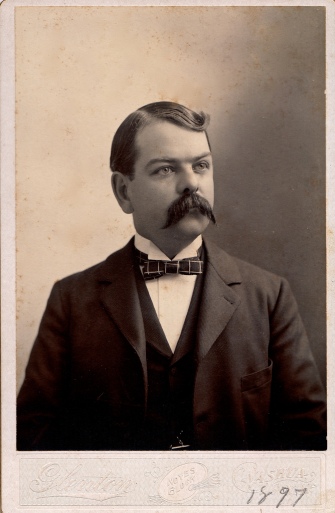
An albumen cabinet card of the still-boyish grocery purveyor Elmer D. Marshall in 1897. Ann Longmore-Etheridge Collection.

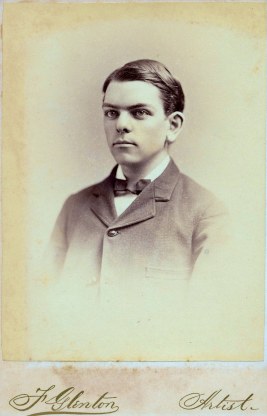
Due to a wonderful synchronicity, I own two cabinet card portraits of Elmer Daniel Marshall, late-Victorian and Edwardian man of business. I was contacted by a photo seller who found the image above on Elmer’s Find A Grave memorial after I had placed it there. He offered me a younger image of Marshall, below, which I purchased to keep them together.

15351275761_f28882c121_h
Elmer D. Marshall photographed in about 1882. Ann Longmore-Etheridge Collection.

Elmer was born 3 July, 1862, in Nashua, New Hampshire, the son of Daniel Robinson Marshall, born 18 March, 1821, in Windham, New Hampshire, and his wife Roxanna R. Morse, of Wilton, New Hampshire, born 25 January, 1824. She was the daughter of Ephrem Morse and Lois Hackett, both of Wilton.

His paternal grandparents were Samson Marshall (3 April, 1786-28 May, 1845), a watchman, and his wife Margaret Davidson (1794-9 Feb., 1877); his great-grandfather was Nathaniel, son of Richard and Ruth Marshall, who married Hannah Marsh in 1788. She was born at Nottingham West, New Hampshire, 22 July, 1757.

Daniel Marshall, who was then a butcher, and Roxanna Morse married before 1850. It appears the couple’s firstborn was a boy named Charles, who died before the 1850 census was taken. In that year, the couple was enumerated with a five-month-old daughter, Harriet L., who died before the next census in 1860. In that year, the Marshalls lived with Daniel’s mother Margaret and a daughter, Carrie G. (b. December 1858), who died only a few months later in August. Today, in Nashua’s Woodlawn Cemetery, where several generations of Marshalls are interred, there is a row of three tiny stones—the only trace of Elmer’s lost siblings.

Continue reading “Elmer D. Marshall, Man of Business”

On This Day for Mothers

“Mothers, I believe, intoxicate us. We idolize them and take them for granted. We hate them and blame them and exalt them more thoroughly than anyone else in our lives. We sift through the evidence of their love, reassure ourselves of their affection and its biological genesis. We can steal and lie and leave and they will love us.”—Megan Mayhew Bergman

4715860088_170bbac360_o
From left, my grandmother, Lillian Marie Fox; my great-grandmother, Rebecca Murdock Fox; and my great aunt, Rebecca Fox, posed for this tintype in about 1901. Ann Longmore-Etheridge Collection.
11178332634_3e9d60169a_o
This tintype’s sitters were a beautiful turn-of-the-century mother and daughter who appear to be African-American. Courtesy Jack and Beverley Wilgus Collection.
5099229059_1a590a3bd5_o
An American mother sat outside with her children for this ambrotype taken on a clear day in about 1880. Ann Longmore-Etheridge Collection.
3360043331_837fa3d3cd_o
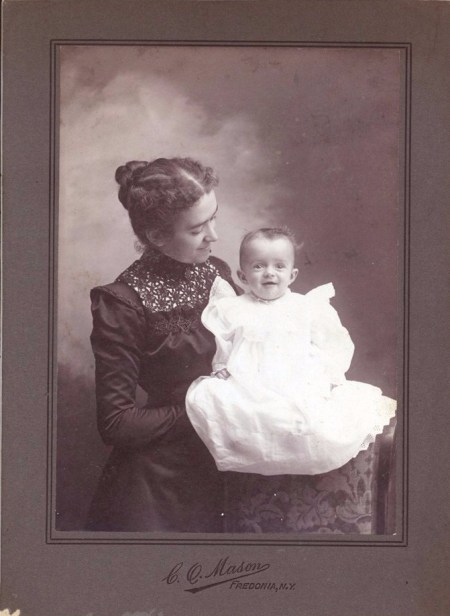
An adoring, late-Victorian mother and delighted child were the subjects of this albumen print on cardboard. Photo Courtesy Price and Zimmer Collection.
15981569687_60f65482d1_k
An unknown lady tenderly holds her baby in this circa-1875 carte de visite by Hills & Saunders, Oxford, England. Courtesy James Morley Collection.

Ω


I wish all mothers a happy day of love and peace. For all you have done and will do, you are saluted.

A Quaker Legacy

“I lament the loss of honest Richard Hough. Such men must needs be wanted where selfishness and forgetfulness of God’s mercies so much abound.”—William Penn, 1705

29742821045_e25c29b00d_h-1

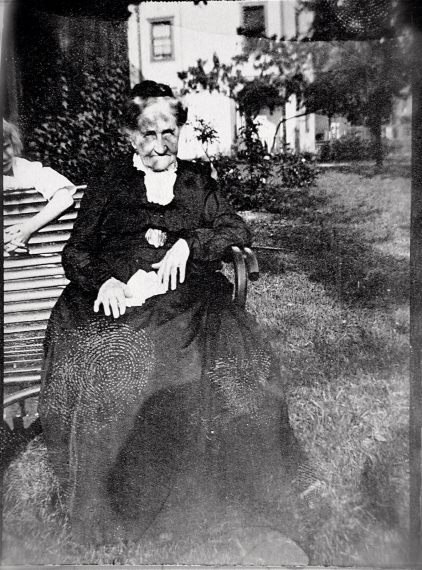
The subject of this black-and-white version of an albumen paper print is my great-great-grandmother, Rebecca Barbara Hough Murdock (25 Nov., 1828-26 Nov., 1917), widow of Thomas McKea Murdock (28 June, 1827-17 April, 1891), seated on a bench outside the Fox family home at 5737 Pierce Street, Pittsburgh, Pennsylvania, in 1916. Her daughter, my great-grandmother Rebecca Elizabeth Murdock (29 Sept., 1863-14 April, 1918) married John Thomas Fox (31 March, 1860-11 Jan., 1928). Together they had ten children, the youngest of whom—Helen Kathleen Fox (4 Oct., 1906-28 June, 1983)—can be seen at left. (The fingerprints of my ancestors are also clearly visible.)

Rebecca Hough’s parents were John Thompson Hough (1801-6 Nov., 1869), a cabinet maker in Pittsburgh, and Mary Ann McBride (b. 1804, New Jersey). Rebecca was a direct descendant of the early Quaker Richard Hough (1650-25 March, 1705), a trusted friend and advisor of William Penn. Penn asked Hough to accompany him to Penn’s new land in America to assist in governing the nascent commonwealth.

quakers-very-still
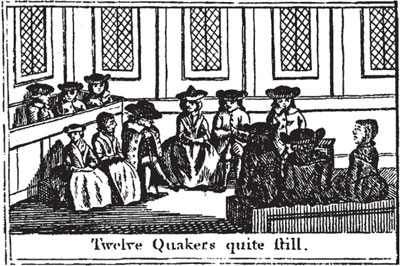
Quakers seek religious truth through inner knowing and place emphasis on a direct connection to God.

Continue reading “A Quaker Legacy”

A Mother’s Mortality, A Woman’s Glory

The posing of mother and child may also deliberately highlight the loss of her long and well-cared for hair.

23273872339_7eb55fa4cb_o (1)
Photo courtesy Jack and Beverly Wilgus Collection.

This stunning tintype, circa 1875, of an American mother and infant, is owned by collector and Your Dying Charlotte contributor Beverly Wilgus, who notes, “This little tintype is not as much a ‘hidden mother’ as a mother who chose to put the emphasis on the baby. I do wonder about her very short hair. One explanation could be that she has been very ill, maybe after a difficult birth, and her hair was cut short for comfort.”

It is possible that the woman pictured suffered from puerperal sepsis (called childbed fever) in the aftermath of delivery, which had been combatted, in part, by hair cropping. If true, this mother surely thought the tintype image celebratory—even triumphant: She had survived; her magnificent reward was the healthy infant draped over her shoulder, offered visually to posterity.

The sitter was lucky—a scarce survivor of a bitter scourge. “Childbed fever killed at the cruelest moments. It was described as a ‘desecration,’ an aspect of the natural world that felt almost deliberately evil. What caused it? Some thought ‘a failure of uterine discharge;’ others, a little later, called it ‘milk metastasis,’ noting that the internal organs of the women who died seemed covered in milk. Eventually, it was accepted that the fluid was not milk at all. It was pus,” wrote Druin Burch in a Live Science article, “When Childbirth Was Natural, and Deadly.” When obstetricians and midwives talked of “delivering women,” he explained, they meant delivering them from the deadly perils of childbirth.

Continue reading “A Mother’s Mortality, A Woman’s Glory”

Photo-Multigraphs: The Mirror and the Camera

“It was the purpose of the author to describe a number of novel and curious effects that can be obtained by the aid of the camera, together with some instructive and interesting photographic experiments.”—F. R. Fraprie, 1922

5._MultiMnCab2
A photo-multigraph cabinet card by A. M. Lease of Lancaster, Pennsylvania, circa 1895.

By Beverly Wilgus

In 1893, H. P. Ranger was granted Patent No. 505,127 for a “Mirror For Use In Photography.” This was a device comprised of two adjustable mirrors set at an angle. When a subject was placed in front of it, his or her image was reflected in each mirror and that reflection was again reflected, resulting in five or more figures—the number of figures determined by the angle of the mirrors.

1._MirrorPatent

The above schema is from an article published in Scientific American in the 1890s that was included in the 1896 book Photographic Amusements by Frank R. Fraprie and Walter E. Woodbury. My husband and I own a copy of the 1931 edition that still contains the original illustrations.

2._mirror_top

Also from the book is the illustration above: “Diagram Showing The Method Of Production Of Five Views of One Subject By Multiphotography.”

Continue reading “Photo-Multigraphs: The Mirror and the Camera”

Mommy and Me

“Because I feel that in the heavens above
The angels, whispering one to another,
Can find among their burning tears of love,
None so devotional as that of ‘Mother,’
Therefore, by that dear name I have long called you,
You who are more than mother unto me.” — Edgar Allan Poe

8673431850_5ae172a421_h
A proud mother and her adorable daughter pose in this 1/6-plate daguerreotype, circa 1850. The mother wears a fashionable “Jennie Lind” collar, made popular by the soprano Jennie Lind, the “Swedish Nightingale,” who toured North America from 1850 to 1852 under the relentless promotion of showman P. T. Barnum. Ann Longmore-Etheridge Collection.
8754664382_17b1ed2681_o
This mid-1870s tintype from the Jack and Beverly Wilgus Collection includes a shy “hidden mother” who is revealed with the removal of the decorative paper mat.
5265855274_ecf823dfb1_b
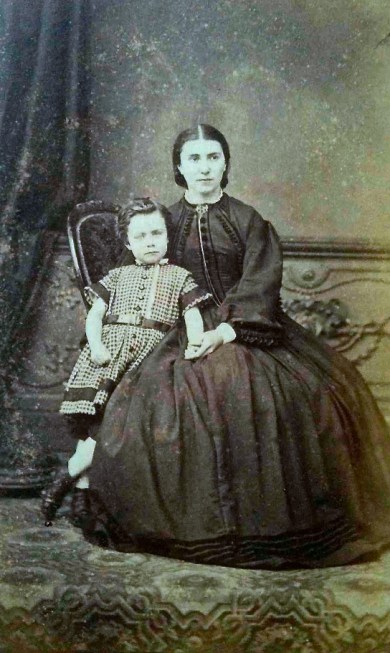
A nicely dressed English mother and son photographed in about 1862. Her smoothed and center-parted hair, pagoda sleeves, full hoop, and applied decorative trim was at the height of fashion. Her boy’s checkered, belted, one-piece dress was perhaps in shades of red and tan, similar to the fabric used in this earlier example. This albumen carte de visite is from the Caroline Leech Collection, originally photographed by G. J. Tear, Clapham Road, London.
11131720303_bcd7c86041_b
A mother, son, and baby in a pram enjoying a sunny day in England during the late 1920s. Scanned film negative from the James Morley Collection.
9860148255_605fce91a3_h
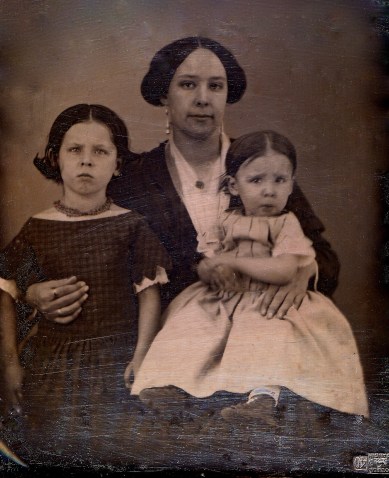
An American mother and two daughters pose for an adorable 1/6th-plate Gaudin daguerreotype, circa 1852. The plate is marked “Double, A. Gaudin, 40,” the hallmark of Antoine Gaudin & Bro., 9 Rue de la Perle, Paris, a French company whose products were widely used by daguerreians throughout America. The older daughter is wearing a “protective” coral necklace. Coral was thought to have special efficacious properties to safeguard children. Ann Longmore-Etheridge Collection.

Ω


A quick note: I will be having surgery on Tuesday, 4 April, and will be taking at least a four- or five-day hiatus to recover. I will return as soon as possible. Promise.