A Widower’s Search for Solace

“Some of my best friends have told me that I need not expect to be happy anymore unless I would marry again and have advised me to do so.”

page1
Letter from Joseph Brown to Emeline Hoffman, page one. Ann Longmore-Etheridge Collection.

Myersville, July 10th, 1852

Dear Emeline,

I hope you will not think hard of me for thus approaching you so unexpectedly, as my mind has bin [sic] for some time a good deal taken up with you in regard to coming to see you in order to have some private conversations with you, not knowing at all whether my company would be agreeable or not, but take this plan of ascertaining something about the state of your mind.

Dear Emma, you are well acquainted with me and know all about my situation. You know that I have bin unfortunate in the loss of a very dear and kind companion, one in who my whole soul delighted to honor and respect. But she has gone I trust from a world of trouble and sorrow to one of happiness and joy, and I can have no more comfort nor consolation from her anymore, only with a firm hope and expectation of meeting her again in those blissful regions where parting shall be no more. I can do no more than to respect her memory, which I will ever do.

We read in the Bible that it is not good for man to be alone. I have realized that to be a very true saying indeed. I was once as happy as any person could be in the enjoyment in the company of my much-lamented Mary, but how different my case. With all I have I have no enjoyment & some of my best friends have told me that I need not expect to be happy anymore unless I would marry again and have advised me to do so, although I do not wish to do so for some time yet. But I have come to the conclusion to do so providing I can suit myself. I now feel like a lost sheep, lonely and without anyone to cheer me or comfort me, and if it was not for the comforts and the consolations of religion, I would often times have to despair in sorrow. But thanks be to God that he still comforts and consoles me. I find that I can never be happy again in this world without fixing my affection on one again in who I am satisfied will be a kind companion to me, and dear Emeline, you appear to the only one I can have any idea of going to see at the present and of fixing my affection upon.

Continue reading “A Widower’s Search for Solace”

In Honor of Juneteenth, Three Images from My Collection

I own just a few early photographs of African-Americans, for they are scarce and much sought after. I present them with love.

18472494001_5f2b547cf6_o
A gelatin silver bromide print of a beautiful African-American woman wearing full mourning. Despite her loss, she was clearly a survivor. Circa 1900.
daga1IMG
Of this enchanting young Creole woman, I know only that she was from New Orleans, Louisiana, and her name was probably Jois. This was likely a wedding photo. Ambrotype, circa 1855.
21506079371_ed5484c3f4_h
Mrs. Della Powell, post-mortem albumen print, 1894, photographed by William Carroll, Walnut Ridge, Arkansas. Formerly in the collection of Ben Zigler and now in mine, this rare post-mortem image of an African-American woman, who may have begun her life as a slave, was published in the 2004 book “Mourning Jewelry and Art” by Maureen DeLorme.

Ω

Preternaturally Lovely: Britain’s Queen Alexandra of Denmark

4908949356_80b166bd20_o.jpg
Albumen carte de visite (CDV) of future Queen Alexandra when Princess of Wales, taken at Sandringham in 1863. This image was marketed by the London Stereoscopic & Photographic Company, 54 Cheapside and 110 Regent Street. There is also a sticker on CDV’s reverse: “Juvenile Book Depot and Passport Agency, C. Goodman, bookseller and stationer, 407 Strand.” Ann Longmore-Etheridge Collection.
33715445136_0a713ae6a6_o
Princess Alexandra Caroline Marie Charlotte Louise Julia of Denmark as a young woman, circa 1860. She was born 1 December, 1844, in the Yellow Palace in Copenhagen, the daughter of Prince Christian of Schleswig-Holstein-Sonderburg-Glücksburg (later King Christian IX of Denmark) and Princess Louise of Hesse-Kassel. Her upbringing was not extravagant and she remained close to her parents and siblings, even after marrying Albert Edward, Prince of Wales, eldest son of Queen Victoria and Prince Albert, and taking up her new life in Great Britain. Library of Congress.
174206-1306235169
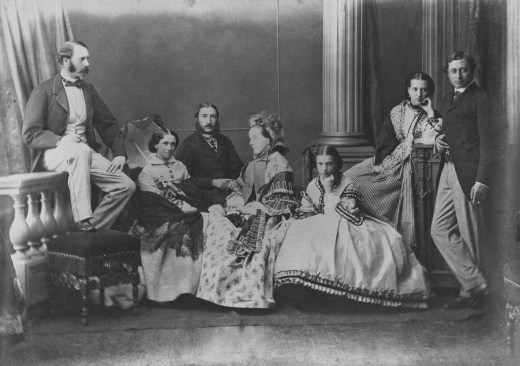
September 1862: A group photograph to mark the engagement between the Prince of Wales and Princess Alexandra. Included are members of the Princess’s family including Prince Christian of Denmark, later King Christian IX; Princess Louise, later Queen of Denmark; Leopold, Duke of Brabant; Marie Henriette, Duchess of Brabant; and Princess Dagmar of Denmark. According to an 1879 issue of the magazine Harpers Bazaar, “A younger generation are fond of recalling the April morning when the young Princess of Wales reached England. The boat touched the shore, and the multitude crowding the quay saw a mere slip of a girl nervously clinging to the railing on the deck, and looking with a pale, pretty face at the new country, her dress plain almost to shabbiness, and her bonnet of so old-fashioned a make that a London milliner was hurriedly telegraphed to for a more lilting head-gear for the future queen’s entry into London. A wave of applause and cheers went up as the Prince of Wales embraced his betrothed and conducted her to the shores of her new home. The same day she was driven through London in great state, and a lady near enough socially to be good authority has told us of her pretty, girlish timidity when the crowd stared at her, with cheers and wild demonstrations of delight.” Courtesy Royal Collection.

Continue reading “Preternaturally Lovely: Britain’s Queen Alexandra of Denmark”

“With Great Sorrow I Address You”

“Platitudes for the fallen officer were given in great numbers and the correspondent concluded with a highly personal plea: ‘Poor Joe! May the turf lie lightly on his manly breast.’”

48-pa-gilmour-joseph-major-e1524491399469
Major Joseph Gilmour, 48th Pennsylvania

“In the spring of 1864, the pages of Schuylkill County’s most important newspaper was filled with information of exciting events from America’s increasingly bloody civil war. But amid the news of battlefield drama also came the sorrowful news of local soldiers cut to pieces during hellish combat in the rolling hills of the Virginia countryside.”

Read more via Wynning History’s “With great sorrow I address you” – A heartbreaking letter to the father of a fallen Civil War soldier. Ω

Who Was Private Raisin Pitts?

My attention was drawn by the unusual name carved into one tombstone: Raisin Pitts, a Confederate private who died 26 September, 1862, now buried in a Yankee town in a Union state, far from home.

41764816831_cbdac16a00_h
The grave of Raisin Pitts, Mount Olivet Cemetery, Frederick, Maryland, photographed by the author on Confederate Memorial Day, 28 April, 2016.

Recently, and quite serendipitously, I visited Mount Olivet Cemetery—the preeminent burial grounds of Frederick County, Maryland. Francis Scott Key, who in 1812 wrote the poem that became the National Anthem, reposes there. Also interred at Mount Olivet are prosperous Victorians and Edwardians, Colonial and Federal-era area residents moved from their original gravesites in small family plots and cemeteries around the county, and Civil War soldiers who fought for the Confederacy but breathed their last as Union captives.

It was Confederate Memorial Day, a solemn remembrance of which I was unaware when a friend and I decided to visit the cemetery. We found Mount Olivet’s Confederate graves bedecked with flags. Reenactors laid wreaths after a small, bagpipe-led parade.

41723455812_e1ad1245be_k
Confederate graves at Mount Olivet. Raisin Pitts is buried in this row.

My attention was drawn by the unusual name carved on one tombstone: Raisin Pitts, a Confederate private who died 26 September, 1862, now buried in a Yankee town in a Union state, far from home. My curiosity propelled by his unusual—and unlikely—name, I decided to search for more about Private Pitts.

Continue reading “Who Was Private Raisin Pitts?”

Those I Know Not

A selection of vintage images from my collection featuring sitters whose identities, sadly, are unknown.

daga1IMG_0001
An English matriarch sits resplendent for this tinted 1/6th-plate daguerreotype, circa 1849. It is likely by Beard’s Photographic Institute, London and Liverpool, which was run by Richard Beard (22 December 1801–7 June 1885). Beard enthusiastically protected his business through photographic patents and helped establish professional photography in the United Kingdom. He opened his London and Liverpool studios in 1841. Clouds were frequently painted in as a backdrop by his studio staff.
5286168656_589529ce66_b
A woman wearing spring fashions uses a finger to mark her place in a book in this 1/6th-plate American daguerreotype, circa 1852. Perhaps she wanted to imply that she had been reading outdoors.
16396212482_ce58d82edc_b
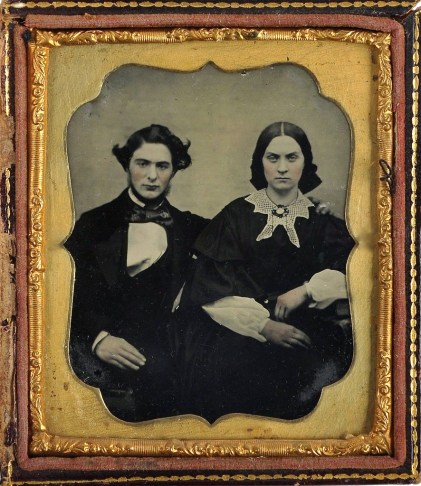
I title this American, circa-1858, 1/6th-plate ambrotype “A Man, His Hair, and His Wife.” The husband has a feminine beauty, especially with the delicate tinting of his cheeks. His wife, brooding, intense, and potentially vengeful, may be wearing a large mourning brooch.
14417061311_8e6b8ea017_b
This early English, 1/4th-plate ambrotype features a Victorian teen who could be a character in a Dickens’ novel. She points to an illustration in a book, but I cannot decipher the title or the meaning of her gesture. The image was taken in about 1852.
8284768353_331bc57271_k
As photography matured, it became possible to make copies of early, singular photographic images. In the 1890s, this cabinet card was created of a daguerreotype taken in about 1855.

Ω


All images copyright the Ann Longmore-Etheridge Collection.

Mayhem, Mishaps, Murders, and Misdeeds

Whenever the modern world seems unprincipled and bleak, take comfort. It ran amok in the old days, too, as these Victorian news clippings attest.

img-15
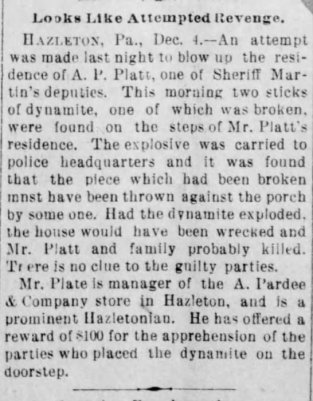
York, Pennsylvania Gazette, Sunday, 5 December, 1897

“Looks Like Attempted Revenge”

“Hazelton, Pa., Dec. 4.—An attempt was made last night to blow up the residence of A. P. Platt, one of Sheriff Martin’s deputies. This morning, two sticks of dynamite, one of which was broken, were found on the steps of Mr. Platt’s residence. The explosive was carried to police headquarters and it was found that the piece which had been broken must have been thrown against the porch by someone. Had the dynamite exploded, the house would have been wrecked and Mr. Platt and family probably killed. There is no clue to the guilty parties.

“Mr. Platt is the manager of the A. Pardee & Company store in Hazelton, and is a prominent Hazletonian. He has offered a reward of $100 for the apprehension of the parties who placed the dynamite on the doorstep.”

victorian+ornaments+image+graphicsfairy2

img-16
Ottawa, Kansas Daily Republic, Monday, 4 October, 1886

“A Narrow Escape”

“Chicago, Oct. 2.—A number of very narrow escapes from death by fire occurred at No. 90 East Chicago avenue early this morning. The building is a two-story frame owned by John Johnson and occupied in the basement by Miss Julia Hogan as a restaurant; first floor as a saloon kept by Roose & Steuberg, and the second floor by John Johnson and family. Officer Moore saw the flames leaping from of the rear of the building, turned in the alarm and then ran to the scene to arouse the inmates. He rushed to Johnson’s rooms and seized two of the children, who were in a back room, and were nearly suffocated. In coming downstairs, he fell and injured his left hand and arm, but the children were not injured. Mrs. Johnson caught up the baby and escaped in her night dress, followed by her sister and husband. In Miss Hogan’s restaurant, in the basement, were sleeping Julia Hogan and Mary Esperson, Helen Larsel and Louise Norin. The last named, the cook, was aroused by the heat and smoke, which came from the kitchen. She called the proprietress, and they tried to gather some valuables, but the flames spread so rapidly that a retreat was necessary. Miss Hogan was compelled to run through the flames, and her arms were severely burned in attempting to save a dress, in the pocket of which was $56. The damage to the building was slight.”

victorian+ornaments+image+graphicsfairy2

Continue reading “Mayhem, Mishaps, Murders, and Misdeeds”

Easters Ago

As the Northern Hemisphere explodes with green life, let’s take a look back at rebirth celebrations of yesteryear.

bfbeb62789c5e88cae8e29f0528efdc1
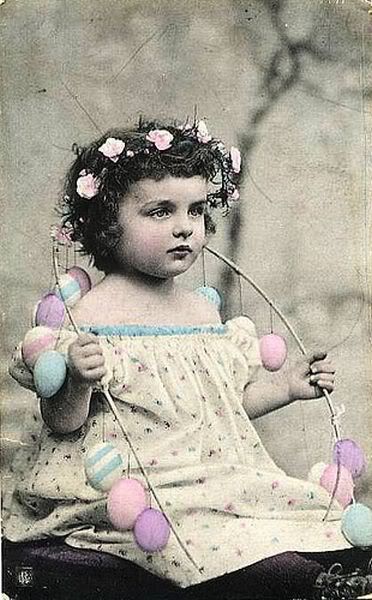
A beautiful early Easter image, probably 1890s.
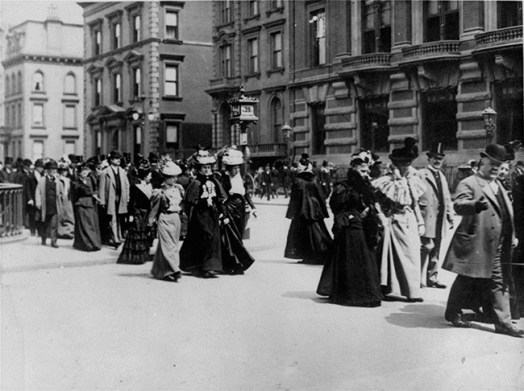
Easter_parade_Fifth_Avenue_1890
The 1898 5th Avenue Easter Parade, New York City, New York. Courtesy Wikimedia Commons.
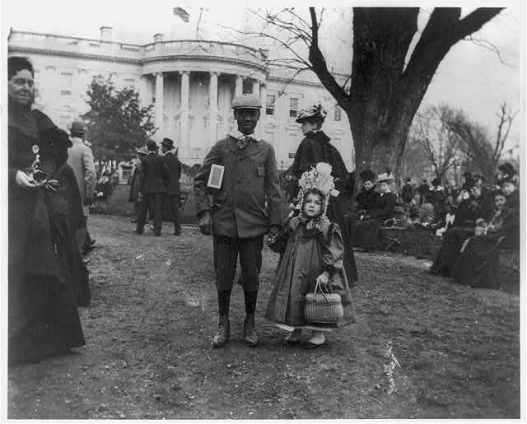
3a46622r
Children at the 1898 White House Easter Egg Roll. Courtesy Library of Congress.

Continue reading “Easters Ago”

The First Photographed Frostie

Last week, a storm brought 10 inches of snow to Western Maryland and turned my mind to snowmen of old.

DXIlkTUW0AA4wV8
A woman builds a snowman whilst a man shovels snow. Courtesy National Museum of Wales.

In all probabilty, humans have sculpted snowmen for millenia. In 2007, Bob Eckstein, the author of The History of the Snowman: From the Ice Age to the Flea Market, told NPR that in writing his book, “I wanted to make it clear that snowman-making actually was a form of folk art. Man was making folk art like this for ages, and…maybe it’s one of man’s oldest forms of art…. [T]he further back you go, you find that people were really fascinated with snowmen.”

Eckstein says that building snowmen was “a very popular activity in the Middle Ages…after a snow came down and dumped all these free-art supplies in front of everyone’s house.” The earliest known representation of a snowman dates to that era, drawn in a 1380 A.D. Book of Hours. A century later, in 1494, Michelangelo was commissioned by Piero di Lorenzo de’ Medici, the Gran Maestro of Florence, to practice his art with snow. According to art historian Giorgio Vasari, “de’ Medici had him make in his courtyard a statue of snow, which was very beautiful.” Sadly, no one drew it for posterity.

In 1510, a Florentine apothecary, Lucas Landucci confided in his diary that he had seen “a number of the most beautiful snow-lions, as well as many nude figures…made also by good masters.” Another notable snowmen outbreak occurred just a year later, when folk in Brussels built more than 100 of them “in a public art installation known as the Miracle of 1511,” notes Atlas Obscura. “Their snowmen embodied a dissatisfaction with the political climate, not to mention the six weeks of below-freezing weather. The Belgians rendered their anxieties into tangible, life-like models: a defecating demon, a humiliated king, and womenfolk getting buggered six ways to Sunday. Besides your typical sexually graphic and politically riled caricatures, the Belgian snowmen, Eckstein discovered, were often parodies of folklore figures, such as mermaids, unicorns, and village idiots.”

Continue reading “The First Photographed Frostie”

“Young Hickory of the Granite Hills”

16311267651_d6f1fca0e4_o
Ann Longmore-Etheridge Collection

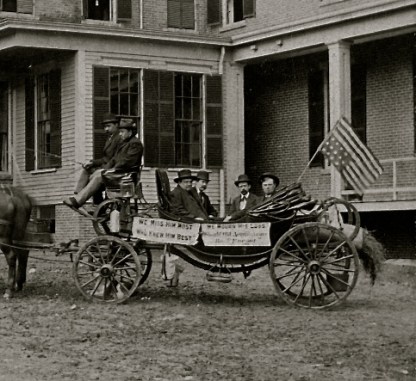
I own a stereoview card, one half which is seen above, that may portray mourners of President Franklin Pierce. To accompany this image, I am reblogging an excellent look at Pierce’s life and burial place by Gravely Speaking.

gravelyspeaking's avatarGravely Speaking

A sign outside the gates of the Old North Cemetery announces the burial of the most New Hampshire native son within its fencing.  The sign outlines the major accomplishments of Franklin Pierce:

FRANKLIN PIERCE

1804 – 1869

Fourteenth President of the United States

(1853 -1857)

Lies buried in nearby Minot enclosure.

Native son of New Hampshire,

Graduate of Bowdoin College,

Lawyer, effective political leader,

Congressman and U.S. Senator,

Mexican War veteran, courageous

Advocate of States’ rights,

He was popularly known as

“Young Hickory of the Granite Hills.”

While the sign outlines Pierce’s political accomplishments, there is nothing about his personal life.  Franklin Pierce was born in Hillsborough, New Hampshire.  He married Jane Appleton, the daughter of a Congregational minister.  Jane and Franklin were nearly polar opposites.  Franklin was outgoing and gregarious.  Jane was shy and suffered from depression.  Jane was pro-temperance and devoutly religious.  Jane was from a family that…

View original post 396 more words