



Ω
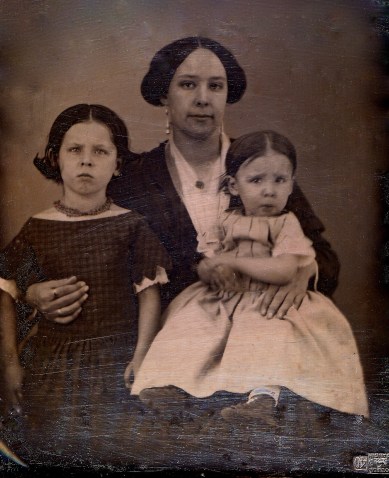
I wish all mothers a happy day of love and peace. For all you have done and will do, you are saluted.
“Mothers, I believe, intoxicate us. We idolize them and take them for granted. We hate them and blame them and exalt them more thoroughly than anyone else in our lives. We sift through the evidence of their love, reassure ourselves of their affection and its biological genesis. We can steal and lie and leave and they will love us.”—Megan Mayhew Bergman
Ω
I wish all mothers a happy day of love and peace. For all you have done and will do, you are saluted.
“I bought this for 6d. at a Rummage Sale at Ealing Broadway Methodist Church. It was thrown out by Mrs J. W. Allcock.”—Thomas Inwood, 1939
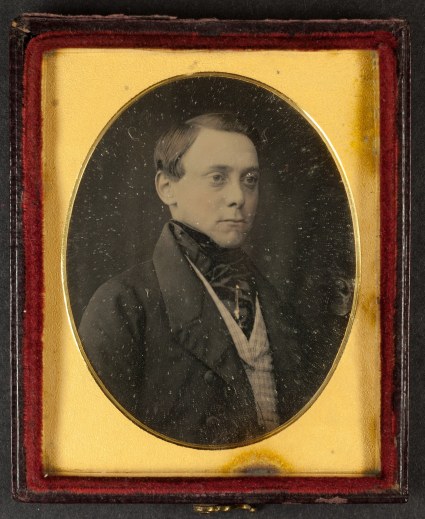
The first photographic image of a human being was captured in 1839, when at about 8 a.m. one fine Spring day, photographic pioneer Louis-Jacques-Mandé Daguerre sat up his camera in the window of the Diorama in Boulevard du Temple, Paris, 3rd arrondissement, for an exposure that lasted up to 12 minutes. Although the street was crowded with both persons and horse-drawn traffic, none of them remained still long enough to register save for one man on a corner to whom a bootblack attended. We will never know who he was, but this 19th Century Frenchman holds a special place in mankind’s history.

In the 21st Century, we possess both still and moving images of our family and friends, but in the 1830s faces of loved ones could be preserved only by personal memory, sculpture, portraits, caricatures, or silhouettes. The vast majority of people were born and died leaving no visual legacy. This quote from Henry Fitz, Sr., captures the enthusiasm that resulted from the release of the daguerreotype process by the French government as a gift to the world 19 August, 1839: “Here is a similitude of heavenly origin! Of a wonderful power! A supernatural (so far as man’s agency is concerned,) agent! An effect produced by the light of heaven; absolutely creating man’s perfect image and identity [emphasis mine].” (The Layman’s Legacy, Volume II, 1840.)
Here is a full and excellent article on how Victorian women cared for their hair by historian Mimi Matthews. Thrills and pomade await, gentle readers! Speed!
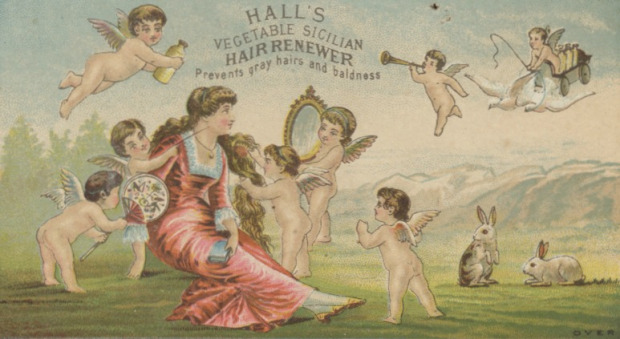 Hall’s Vegetable Sicilian Hair Renewer, 19th Century Advertisement.
Since biblical times, a woman’s hair has been known as her crowning glory. This was never more true than in the Victorian era – a span of years during which thick, glossy hair was one of the primary measures of a lady’s beauty. But how did our 19th century female forebears maintain long, luxurious hair without the aid of special shampoos, crème rinses, and styling treatments? And how did they deal with hair-related complaints such as an oily scalp, dry, brittle tresses, or premature greyness?
View original post 1,582 more words
Upon receipt of the carte, I scanned, enlarged, and enhanced the image. Immediately I became aware of motion blur caused by the child’s arms moving during the exposure.

Within eBay’s vintage and antique photo subcategory, every slightly odd-looking baby is a dead baby. I confess that when I saw the listing for the carte de visite (CDV) above, I thought this was an infant gone, never to grow up, forever to sleep, dressed in angelic white and buried in a tiny coffin so unfairly made-to-fit, her grave topped by a small stone lamb. This was cruel fate; this was a Victorian postmortem. But those who explore the Victorian propensity to mark gut-wrenching loss via photography should take this story as a cautionary tale, not unlike the one I featured last November, “To Be, or Not to Be, a Victorian Postmortem.”
The CDV’s backstamp is that of “John Davies, Portrait & Landscape photographer, BelleVue High Street, Weston-super-Mare. Formerly with the late T. R. Williams, London, Photographer to the Queen and Royal Family.” There is also a handwritten inscription: “Alice Maud Culley, 8 weeks old, Aug. 1879.”
Upon receipt of the carte, I scanned, enlarged, and enhanced the image. Immediately, I was aware of motion blur caused by the child’s arms moving during the exposure. Alice Maud Culley wasn’t dead. I could then plow into the public records because of the fortuitous identification upon the reverse.
Continue reading “Alice Isn’t Dead: A Cautionary Tale, a Family History”
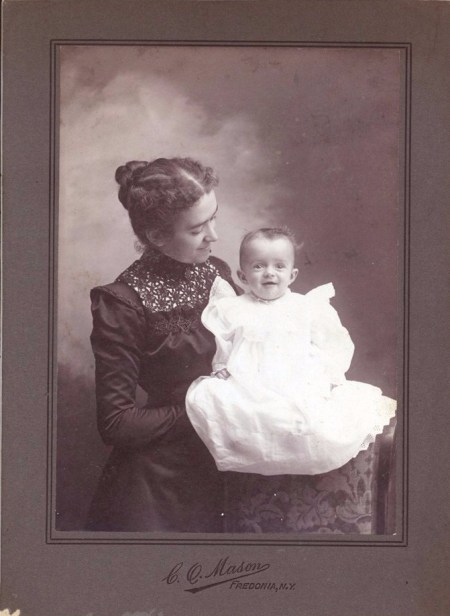
The posing of mother and child may also deliberately highlight the loss of her long and well-cared for hair.

This stunning tintype, circa 1875, of an American mother and infant, is owned by collector and Your Dying Charlotte contributor Beverly Wilgus, who notes, “This little tintype is not as much a ‘hidden mother’ as a mother who chose to put the emphasis on the baby. I do wonder about her very short hair. One explanation could be that she has been very ill, maybe after a difficult birth, and her hair was cut short for comfort.”
It is possible that the woman pictured suffered from puerperal sepsis (called childbed fever) in the aftermath of delivery, which had been combatted, in part, by hair cropping. If true, this mother surely thought the tintype image celebratory—even triumphant: She had survived; her magnificent reward was the healthy infant draped over her shoulder, offered visually to posterity.
The sitter was lucky—a scarce survivor of a bitter scourge. “Childbed fever killed at the cruelest moments. It was described as a ‘desecration,’ an aspect of the natural world that felt almost deliberately evil. What caused it? Some thought ‘a failure of uterine discharge;’ others, a little later, called it ‘milk metastasis,’ noting that the internal organs of the women who died seemed covered in milk. Eventually, it was accepted that the fluid was not milk at all. It was pus,” wrote Druin Burch in a Live Science article, “When Childbirth Was Natural, and Deadly.” When obstetricians and midwives talked of “delivering women,” he explained, they meant delivering them from the deadly perils of childbirth.
The eerie and eclectic photography of Caroline Leech

Carolyn, an English woman who lives in Spain, writes of herself: “I am an obsessive Victorian and lover of all things Gothic. As a child I would often rather spend my pocket money in the local antique shop on postcards, photos, stamps or coins than in the toyshop. History just always fascinated me.”
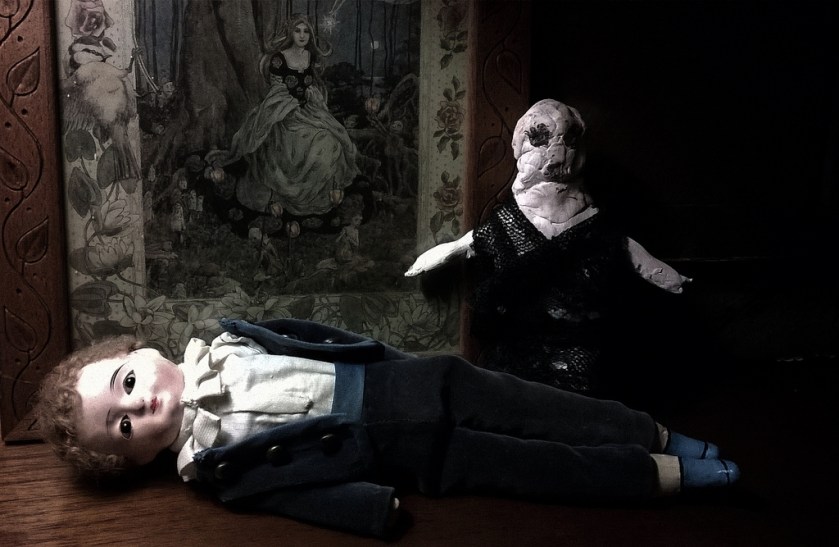 “I then developed an interest in spirits and faeries and fell in love with writers such as my beloved Charles Dickens, Sheridan LeFanu, Emily Dickinson and with the whole world of Victorian spiritualism, mourning, the faery painters of the time and also the darker aspects of Victorian society.”
 “I live in a watermill in the middle of a forest, which is always an inspiration to me. I feel I am surrounded by all sorts of spirits.”
 “I have been an antique dealer and visionary artist for years and am also a keen amateur photographer of anything mysterious. My greatest love is of course Victorian photography, these amazing ghosts which pleasantly haunt the pages of my book and the drawers and cabinets of my bedroom.”
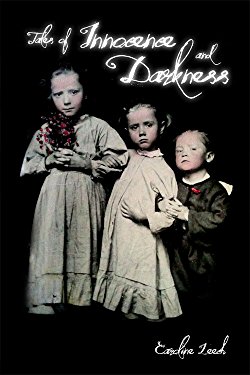
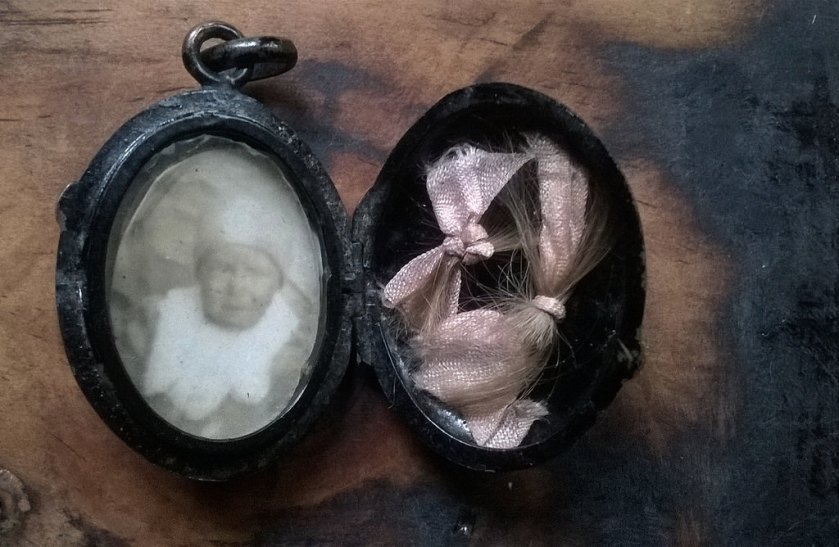 Caroline’s book of photos and poetry can be purchased at Amazon. You can also visit her Flickr photostream. Ω
“It was the purpose of the author to describe a number of novel and curious effects that can be obtained by the aid of the camera, together with some instructive and interesting photographic experiments.”—F. R. Fraprie, 1922

By Beverly Wilgus
In 1893, H. P. Ranger was granted Patent No. 505,127 for a “Mirror For Use In Photography.” This was a device comprised of two adjustable mirrors set at an angle. When a subject was placed in front of it, his or her image was reflected in each mirror and that reflection was again reflected, resulting in five or more figures—the number of figures determined by the angle of the mirrors.

The above schema is from an article published in Scientific American in the 1890s that was included in the 1896 book Photographic Amusements by Frank R. Fraprie and Walter E. Woodbury. My husband and I own a copy of the 1931 edition that still contains the original illustrations.

Also from the book is the illustration above: “Diagram Showing The Method Of Production Of Five Views of One Subject By Multiphotography.”
Continue reading “Photo-Multigraphs: The Mirror and the Camera”
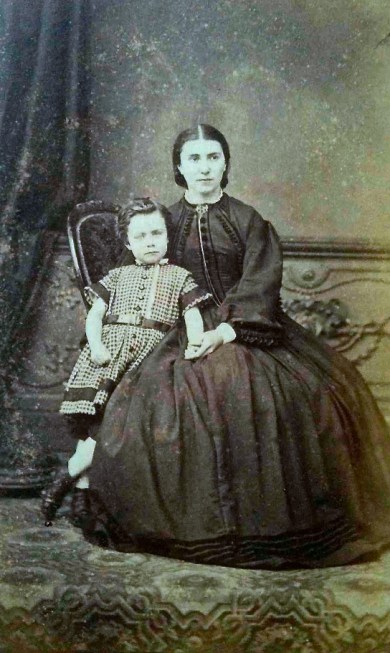
“Because I feel that in the heavens above
The angels, whispering one to another,
Can find among their burning tears of love,
None so devotional as that of ‘Mother,’
Therefore, by that dear name I have long called you,
You who are more than mother unto me.” — Edgar Allan Poe



Ω
A quick note: I will be having surgery on Tuesday, 4 April, and will be taking at least a four- or five-day hiatus to recover. I will return as soon as possible. Promise.
How Instantaneous Views changed photography and let us travel to a fixed point in time.
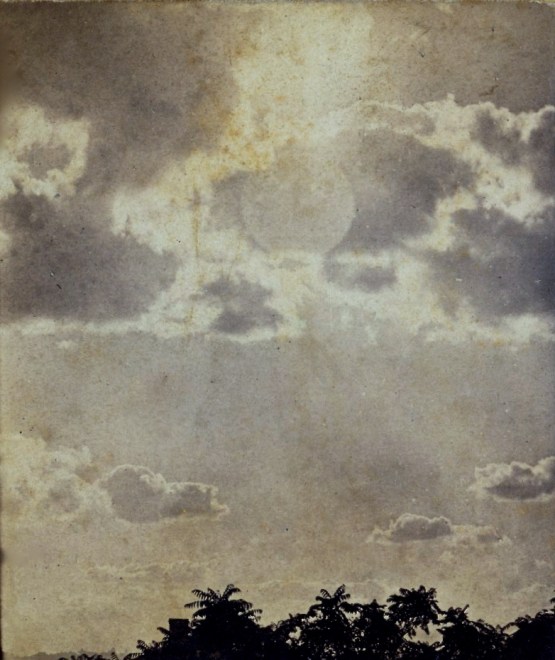
This is genuine time travel: You are looking at a sky in a southern clime taken on the early afternoon of 12 July, 1865. A handwritten paper glued to the reverse provides the exact date. When this fraction of a day was preserved, the Civil War was over but for a few months; this part of the sky was again above the United States, not the Confederacy.
There was a house amongst the trees—its triangular roof and chimney visible mid-left. The sky was bright blue and the clouds were gentle fluffs that, nonetheless, hinted rain. By them the great hot orb of the sun was obscured enough to safely see and photograph. The revolutionary iodized collodion process used by the photographer allowed images to be taken in as little as a few seconds, depending on the light, and this picture probably would have required the briefest of exposures.
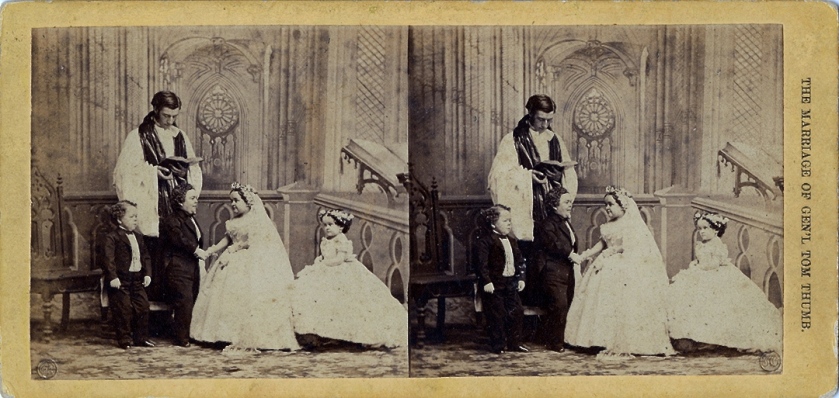
The wedding of Tom Thumb and Lavinia Warren was so popular that children in wedding attire began to reenact the marriage ceremony.
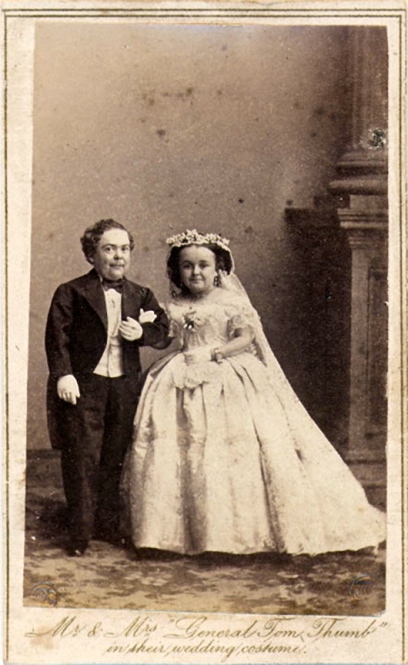
By Beverly Wilgus
The highlight of the 1863 New York City social season was the February 10 “Fairy Wedding” at Grace Episcopal Church of two of P. T. Barnum’s “little people,” Charles Sherwood Stratton and Mercy Lavinia Warren Bump. In the theatrical world, they were known as General Tom Thumb and Lavinia Warren—he stood 2’10”; she, 2’6″. There were 2,000 invited guests and Barnum also sold tickets to the reception after the wedding for $75 each. Although 15,000 ticket requests came in, only 5,000 were available. One newspaper, the Cleveland Daily Leader, noted that after the particulars were announced by Barnum, “then followed such a universal toadyism…all for the sake of begging, buying, or stealing invitations to the wedding.”
In spite of the event’s commercial nature, Tom and Lavinia’s marriage was a true love match. (Barnum, however, thought Lavinia was too tall for Tom and that her smaller sister Minnie would have been a better choice of a bride.) Lavinia had also been romantically pursued by Thumb’s rival performer, George Washington Morrison Nutt, whose stage name was Commodore Nutt, but Lavinia’s heart belonged to the Little General from the start. After their marriage, the couple lived in domestic harmony for twenty years until Tom’s death on July 15, 1883.

 "Your Dying Charlotte"