

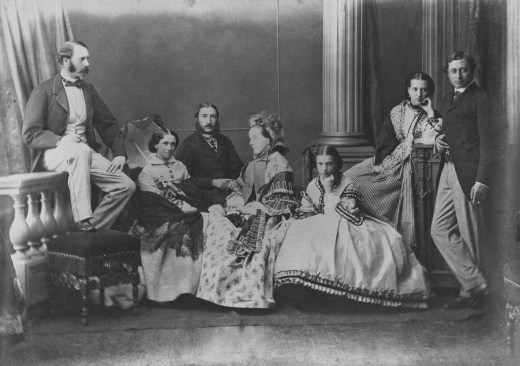
Continue reading “Preternaturally Lovely: Britain’s Queen Alexandra of Denmark”
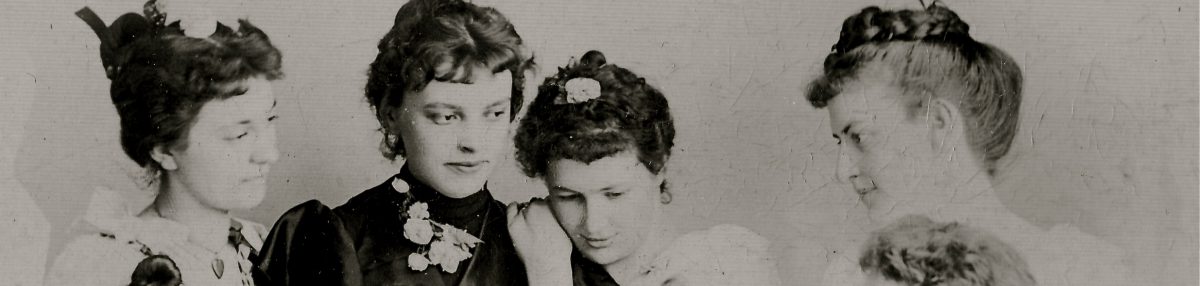
Continue reading “Preternaturally Lovely: Britain’s Queen Alexandra of Denmark”
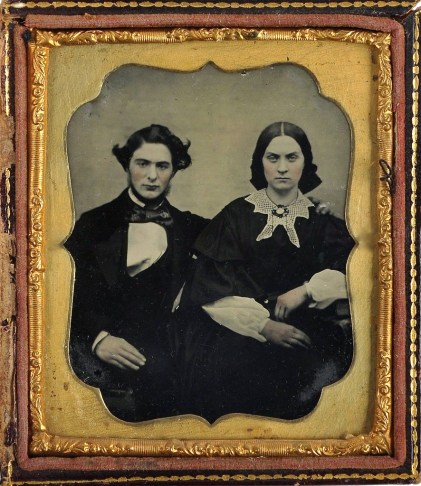
A selection of vintage images from my collection featuring sitters whose identities, sadly, are unknown.




Ω
All images copyright the Ann Longmore-Etheridge Collection.
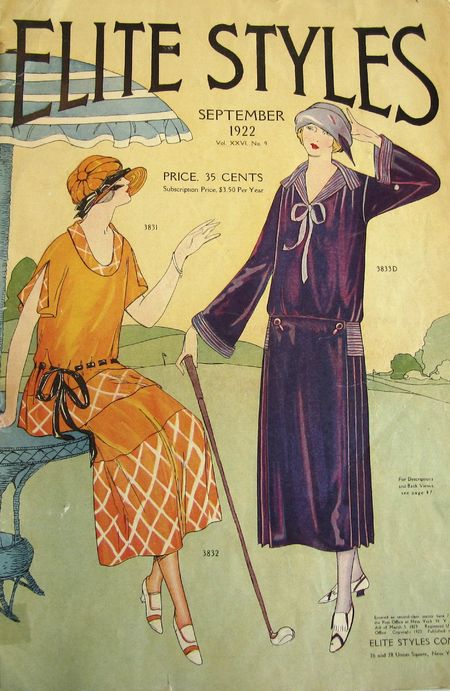
Vintage Patterns Wikia has released a catalog of more than 83,000 vintage sewing patterns. Costuming enthusiasts can use the reference numbers to search for extant patterns on sites like eBay.


“Her husband was the only one in the room, and he was asleep.”—Louisville Courier-Journal

The earthly remains of Iola M. Haley Newell are buried in Somerset City Cemetery, Somerset, Kentucky, within the casket seen above. It was almost certainly white, with a crackled paint finish and colored velvet covering the pallbearers′ handles. The rest of the gently sunlit parlor held rich photographic detail. The fireplace was surrounded by colorful Victorian art nouveau tiles. On the wall, above the harp-shaped floral tribute, a paper or cardboard image of a blooming plant proclaimed, “The Year of Flowers.” Reflected in the mirror, along with two female mourners, were more images also possibly culled from “The Year of Flowers.” Behind the black-clad ladies was the staircase to the home’s upper floor.
It is a wistfully beautiful image: A bright-colored room, burgeoning with flowers in recognition of a beloved daughter, sister, friend, and bride of little more than a year, dead before age 30. The most likely causes of Iola’s demise should have been pregnancy complications or childbirth. However, there is no record of a child born alive or dead—and if the latter, we would expect to see the stillborn infant in the casket, beside its mother.
It is also clear from the photo that Iola was not the victim of a wasting disease, rather of something that cut her down in otherwise acceptable health. Her husband, Dr. John B. Newell, survived Iola narrowly, dying a year-and-a-half later. Newell worked in a field of medicine—dentistry—whose practitioners could be easily exposed to Tuberculosis and other contagious diseases. Another possible cause for one, or both, of the couple’s deaths was typhoid. An epidemic occurred in Pulaski County in 1920, and since the disease can be waterborne, contaminated waterways may have existed in the area in the decade before, when the couple was yet alive.
Continue reading ““Everybody Loved Her”: The Mysterious Death of Iola Haley Newell”
A visit to the Renwick Gallery of the Smithsonian American Art Museum, Washington, D.C., to view the fiendishly intriguing Nutshell Studies of Unexplained Death.

Frances Glessner Lee (1878–1962), regarded as the “mother” of forensic science, was also the first female U.S. police captain, although the title was honorary. In 1936, Glessner Lee came by a sizable inheritance—her father was cofounder of the International Harvester Company—and she used it to help build a Department of Legal Medicine at Harvard Medical School. It was during the decade afterward that Glessner Lee crafted many of the 20 known Nutshell murder dioramas.
Corine May Botz wrote in The Nutshell Murders of Unexplained Deaths that “[Lee] took a special interest in training police officers because, as the first to arrive on the scene of a crime, they had to recognize and preserve evidence critical to solving the case. At the time, most police officers inadvertently botched cases by touching, moving, or failing to identify evidence. Lee was also extremely interested in better integrating the work of, and communication among medical experts, police officers, forensic investigators and prosecutors.”
In the Nutshell Study above, farmer Eben Wallace was found hanged in his barn. His wife told police, “When things did not suit Eben he would go out into the barn, stand on a bucket, put a noose around his neck, and threaten suicide. I always talked him out of it. On this afternoon, he made the usual threats, but this time I did not follow him to the barn right away. When I did, I found him hanging there with his feet through a wooden crate.”
“When old Francis died in 1913, Dad sent him off in a hearse pulled by four black horses followed by mutes carrying ostrich feather wands and a procession of friends and family in the deepest mourning possible.”—Barbara Nadel

New Year’s Eve was celebrated on 31 December for the first time in 45 B.C. when the Julian calendar came into effect.
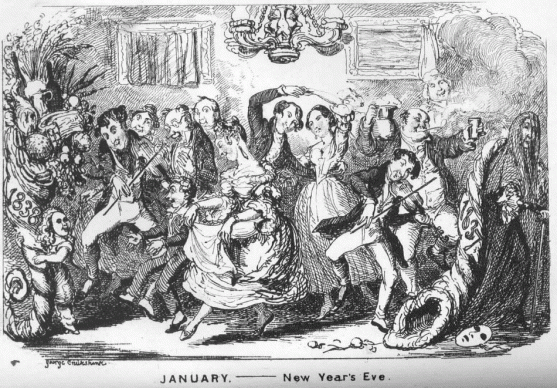


Continue reading “New Year’s Eve: Roaring End, Rowdy Beginning”
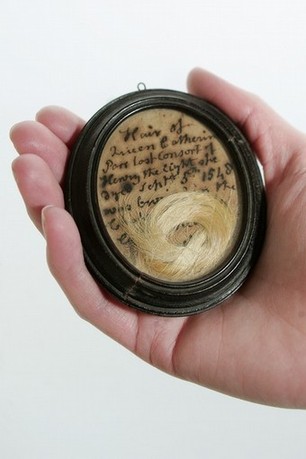
In the aftermath of Katherine Parr’s passing, Lady Elizabeth Tyrwhitt, one of her closest friends, recalled, “Two days afore the death of the Queen, at my coming to her in the morning, she asked me where I had been so long, and said unto me, she did fear such things in herself, that she was sure she could not live. Whereunto I answered, as I thought, that I saw no likelihood of death in her. She then having my Lord Admiral by the hand, and divers others standing by, spake these words, partly, as I took it, [in delirium], ‘My Lady Tyrwhitt, I am not well handled, for those that be about me careth not for me, but standeth laughing at my grief, and the more good I will to them, the less good they will to me.’”
“Connecticut River at Hartford 18 feet above low water mark. Heavy rain still prevailed, with much thunder.”—Beckwith’s Almanac

Harriet Leonard Hale, scion of an old and venerable New England family, was the third child and only daughter of Russell Hale. Hale was born 22 July, 1799, in Glastonbury, Hartford County, Connecticut, and died 13 April, 1849, in that same place. Harriet’s mother, Harriet Ely, was born 17 April, 1803, in Agawam, Massachusetts, and died 2 September, 1880. Russell was the son of Thomas Hale of Glastonbury (10 June, 1768–12 Feb., 1819) and Lucretia House (1771–24 September, 1835). The Hales descended from Samuel Hale, born 1 July, 1615, at Watton-at-Stone, Hertfordshire, England, who came to Connecticut as a young man, married Mary Smith in about 1642, and died in Glastonbury on 9 November, 1693.
Harriet Hale was born 14 April, 1833, in Glastonbury. Her two older brothers were Robert Ely (1827–1847) and Henry Russell (1830–1876). The 1850 Census of Glastonbury included Harriet Ely Hale as a widow, together with her daughter Harriet and her son Henry, a farmer. It is the only census that Harriet Hale Fox appeared on, as the one compiled a decade previously, when she was seven in 1840, listed the names of household heads only.

At age 18, Harriet wed blond, bearded, and bespectacled Henry Fox, a man twelve years her senior, on 5 October, 1851. He had been born in East Hartford, Hartford County, Connecticut, 19 April, 1821, and was the son of Leonard Fox (1792–1866) and Hannah Nicholson (1795–1894). The Fox family had been in New England since emigrating from London in the 17th century. Members of the clan participated in the Revolutionary War, and Leonard Fox fought in the War of 1812.
Continue reading “Harriet Fox: Drowned at the Wethersfield Ferry”
“Live a good life. If there are gods and they are just, then they will not care how devout you have been, but will welcome you based on the virtues you have lived by. If there are gods, but unjust, then you should not want to worship them. If there are no gods, then you will be gone, but will have lived a noble life that will live on in the memories of your loved ones.”―Marcus Aurelius

We see the still, worn body of old lady, prepared for burial by her family and laid out, most likely, upon her own bed.
This photograph may have been both this woman’s first and her last. She was likely a child in the 1790s and a young wife and mother when Jane Austen wrote her literary oeuvre. The story of her life unfolded during the waning of one century and the child years of another. For many, by the time this post-mortem ambrotype was taken, familiar patterns of life had been radically altered by the industrial revolution. The War of 1812 and the Napoleonic Wars had rolled by like awful storms. The British Queen would shortly lose her dearest love and plunge herself into perpetual mourning. America was spilling out across a vast continent and tensions were escalating to the point of eruption between its North and South. War was a dark cloud on the horizon, threatening the young men of her family, but mercifully, she never saw it blot out the sun.

A note tucked inside the case of this 1/6th-plate reads, “Grandmother Whitney—mother of Samuel. Born between 1775 & 1780.” The plate is stamped “Melainotype for Neff’s Pat 19 Feb 56.”
In John Towler’s 1864 opus on what was then state-of-the-art photographic technology, The Silver Sunbeam, he writes, “The melainotype takes its name from the black background upon which it is taken…. Very thin plates of sheet-iron are covered with a protective varnish or Japan, of which one is of a rich black or brown-black color, highly polished, and without flaw, for the reception of the collodion and the collodion picture. Glass in this sort of picture is entirely dispensed with, and so is also the black Japan, the black velvet, and paper. This type is by far the easiest and the quickest to take, and in general the most satisfactory when taken. Melainotype plates of all the variable photographic sizes, and of variable qualities, can be obtained from the photographic warehouses.” Ω


 "Your Dying Charlotte"