Freddie, My Love

“Oh, Mrs. Crane, he looked so pretty. He looked as if he was asleep and dreaming a very pleasant dream.”

daga1IMG_0004
A partial letter from “Julie” to “Mrs. Crane,” single page with black borders, page one. Ann Longmore-Etheridge Collection.

I have in my collection this incomplete letter from the mid- to late 1800s written by an American woman named Julie who had endured the loss of her fiancé, Freddie. Julie’s letter was for another woman—her elder and probably close family friend, Mrs. Crane.

Julie and Freddie were young, possibly in their teens. Julie was quite literate, but her writing contains numerous errors, phonetic spellings, and a general disuse of commas, full stops, and quotations that is endemic to the era. I have corrected her mistakes and added modern punctuation in the quotes below.

“I sat and looked at him all night,” Julie wrote at the top of the single page, recalling the aftermath of the passing. “So many spoke of his smiling and happy beautiful countenance even in death. He looked too beautiful to bury.” She then hopped backward in time, writing, “He was sensible until two minutes before he died, but whether he realized he was really dying, I know not.”

Next she confides in Mrs. Crane, “About two hours before he died, I sat crying and he looked at me. I said, ‘Freddie darling, how can I give you up?’ He raised his hand and said ‘Oh, Julie, don’t.’”

Don’t? Don’t weep? Don’t imply that he was dying? Don’t tarnish his “good death” with female hysteria? Perhaps Freddie’s command was more prosaic: The dying man needed to move his bowels. “[H]e wanted to get on the chamber [pot] and I asked him if I should tell his mother. He said, ‘Mother is weak.’ I said, ‘Freddie, shall I help you?’ He said, ‘Yes, please,’ so I [assisted] him,” she next wrote. Of all the letter’s painful details, this strikes deepest—a heartbreaking intimacy, demanded by circumstance, between a couple who may never have seen each other unclothed.
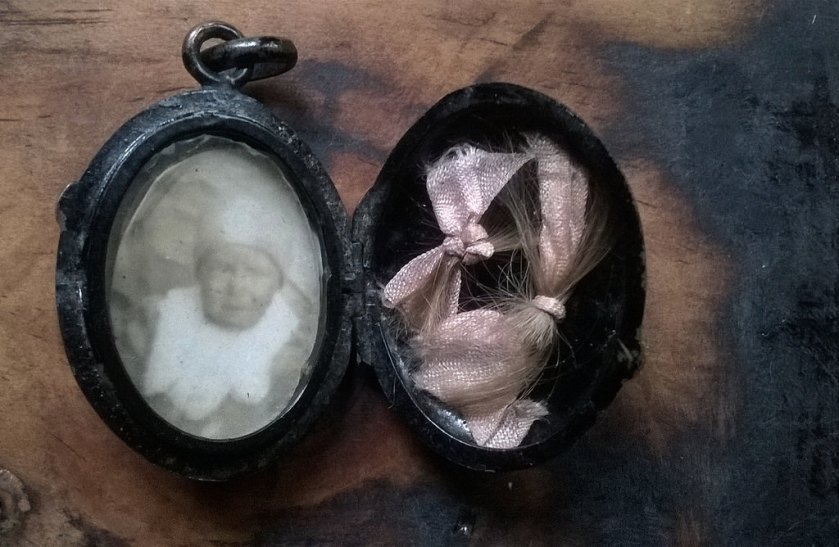
Continue reading “Freddie, My Love”

Elmer D. Marshall, Man of Business

“We used to be fascinated watching the owner, the late Elmer Marshall, sitting at his desk in the window.”—Nashua Telegraph, 1961

daga1IMG
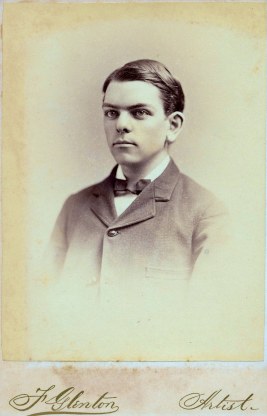
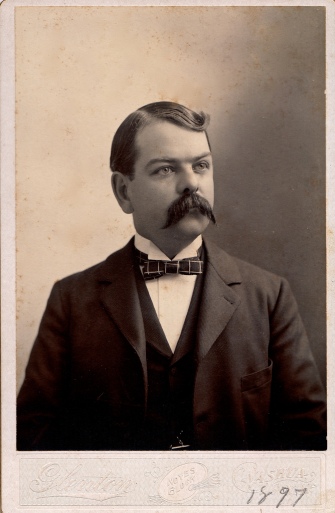
An albumen cabinet card of the still-boyish grocery purveyor Elmer D. Marshall in 1897. Ann Longmore-Etheridge Collection.

Due to a wonderful synchronicity, I own two cabinet card portraits of Elmer Daniel Marshall, late-Victorian and Edwardian man of business. I was contacted by a photo seller who found the image above on Elmer’s Find A Grave memorial after I had placed it there. He offered me a younger image of Marshall, below, which I purchased to keep them together.

15351275761_f28882c121_h
Elmer D. Marshall photographed in about 1882. Ann Longmore-Etheridge Collection.

Elmer was born 3 July, 1862, in Nashua, New Hampshire, the son of Daniel Robinson Marshall, born 18 March, 1821, in Windham, New Hampshire, and his wife Roxanna R. Morse, of Wilton, New Hampshire, born 25 January, 1824. She was the daughter of Ephrem Morse and Lois Hackett, both of Wilton.

His paternal grandparents were Samson Marshall (3 April, 1786-28 May, 1845), a watchman, and his wife Margaret Davidson (1794-9 Feb., 1877); his great-grandfather was Nathaniel, son of Richard and Ruth Marshall, who married Hannah Marsh in 1788. She was born at Nottingham West, New Hampshire, 22 July, 1757.

Daniel Marshall, who was then a butcher, and Roxanna Morse married before 1850. It appears the couple’s firstborn was a boy named Charles, who died before the 1850 census was taken. In that year, the couple was enumerated with a five-month-old daughter, Harriet L., who died before the next census in 1860. In that year, the Marshalls lived with Daniel’s mother Margaret and a daughter, Carrie G. (b. December 1858), who died only a few months later in August. Today, in Nashua’s Woodlawn Cemetery, where several generations of Marshalls are interred, there is a row of three tiny stones—the only trace of Elmer’s lost siblings.

Continue reading “Elmer D. Marshall, Man of Business”

On This Day for Mothers

“Mothers, I believe, intoxicate us. We idolize them and take them for granted. We hate them and blame them and exalt them more thoroughly than anyone else in our lives. We sift through the evidence of their love, reassure ourselves of their affection and its biological genesis. We can steal and lie and leave and they will love us.”—Megan Mayhew Bergman

4715860088_170bbac360_o
From left, my grandmother, Lillian Marie Fox; my great-grandmother, Rebecca Murdock Fox; and my great aunt, Rebecca Fox, posed for this tintype in about 1901. Ann Longmore-Etheridge Collection.
11178332634_3e9d60169a_o
This tintype’s sitters were a beautiful turn-of-the-century mother and daughter who appear to be African-American. Courtesy Jack and Beverley Wilgus Collection.
5099229059_1a590a3bd5_o
An American mother sat outside with her children for this ambrotype taken on a clear day in about 1880. Ann Longmore-Etheridge Collection.
3360043331_837fa3d3cd_o
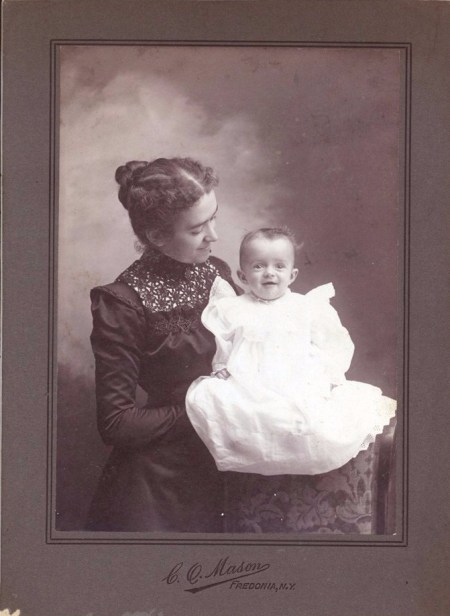
An adoring, late-Victorian mother and delighted child were the subjects of this albumen print on cardboard. Photo Courtesy Price and Zimmer Collection.
15981569687_60f65482d1_k
An unknown lady tenderly holds her baby in this circa-1875 carte de visite by Hills & Saunders, Oxford, England. Courtesy James Morley Collection.

Ω


I wish all mothers a happy day of love and peace. For all you have done and will do, you are saluted.

A Quaker Legacy

“I lament the loss of honest Richard Hough. Such men must needs be wanted where selfishness and forgetfulness of God’s mercies so much abound.”—William Penn, 1705

29742821045_e25c29b00d_h-1

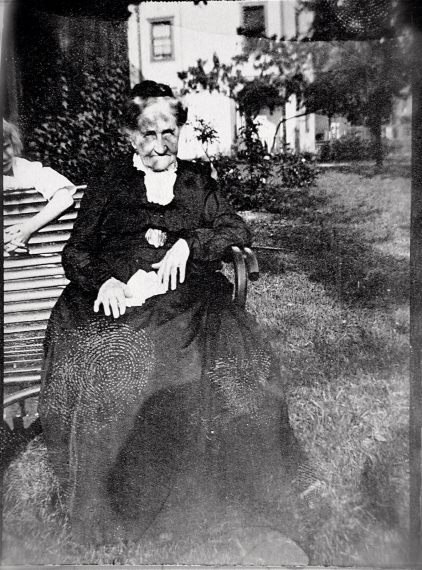
The subject of this black-and-white version of an albumen paper print is my great-great-grandmother, Rebecca Barbara Hough Murdock (25 Nov., 1828-26 Nov., 1917), widow of Thomas McKea Murdock (28 June, 1827-17 April, 1891), seated on a bench outside the Fox family home at 5737 Pierce Street, Pittsburgh, Pennsylvania, in 1916. Her daughter, my great-grandmother Rebecca Elizabeth Murdock (29 Sept., 1863-14 April, 1918) married John Thomas Fox (31 March, 1860-11 Jan., 1928). Together they had ten children, the youngest of whom—Helen Kathleen Fox (4 Oct., 1906-28 June, 1983)—can be seen at left. (The fingerprints of my ancestors are also clearly visible.)

Rebecca Hough’s parents were John Thompson Hough (1801-6 Nov., 1869), a cabinet maker in Pittsburgh, and Mary Ann McBride (b. 1804, New Jersey). Rebecca was a direct descendant of the early Quaker Richard Hough (1650-25 March, 1705), a trusted friend and advisor of William Penn. Penn asked Hough to accompany him to Penn’s new land in America to assist in governing the nascent commonwealth.

quakers-very-still
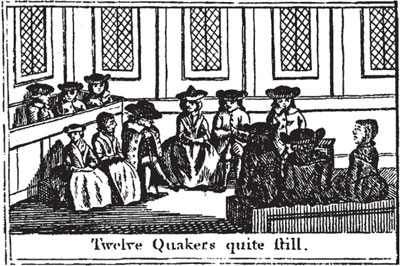
Quakers seek religious truth through inner knowing and place emphasis on a direct connection to God.

Continue reading “A Quaker Legacy”

This is Why We Can’t Have Nice Things

“I bought this for 6d. at a Rummage Sale at Ealing Broadway Methodist Church. It was thrown out by Mrs J. W. Allcock.”—Thomas Inwood, 1939

25615080614_14c01b2e7b_k
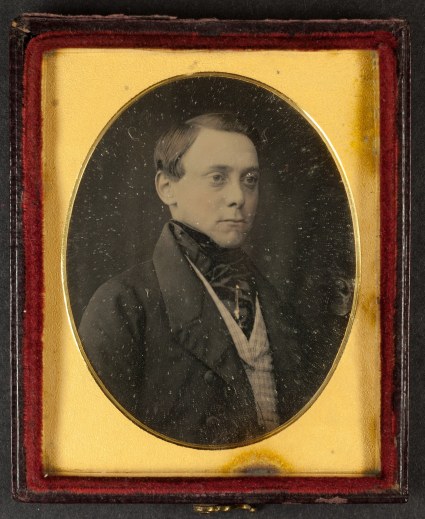
An English 1/9th-plate daguerreotype of an unidentified teenager, possibly a member of the Allcock family, taken in the mid-1840s. Image courtesy James Morley Collection.

The first photographic image of a human being was captured in 1839, when at about 8 a.m. one fine Spring day, photographic pioneer Louis-Jacques-Mandé Daguerre sat up his camera in the window of the Diorama in Boulevard du Temple, Paris, 3rd arrondissement, for an exposure that lasted up to 12 minutes. Although the street was crowded with both persons and horse-drawn traffic, none of them remained still long enough to register save for one man on a corner to whom a bootblack attended. We will never know who he was, but this 19th Century Frenchman holds a special place in mankind’s history.

1280px-Boulevard_du_Temple_by_Daguerre_(unmirrored)
This is the unmirrored version of the Daguerre’s 1839 daguerreotype, correctly reflecting the photographer’s view of the Boulevarde du Temple. The man having his boots blackened is at lower right. This precious sliver of the past was destroyed during cleaning in 1974.

In the 21st Century, we possess both still and moving images of our family and friends, but in the 1830s faces of loved ones could be preserved only by personal memory, sculpture, portraits, caricatures, or silhouettes. The vast majority of people were born and died leaving no visual legacy. This quote from Henry Fitz, Sr., captures the enthusiasm that resulted from the release of the daguerreotype process by the French government as a gift to the world 19 August, 1839: “Here is a similitude of heavenly origin! Of a wonderful power! A supernatural (so far as man’s agency is concerned,) agent! An effect produced by the light of heaven; absolutely creating man’s perfect image and identity [emphasis mine].” (The Layman’s Legacy, Volume II, 1840.)

Continue reading “This is Why We Can’t Have Nice Things”

A Victorian Lady’s Guide to Hair Care

Here is a full and excellent article on how Victorian women cared for their hair by historian Mimi Matthews. Thrills and pomade await, gentle readers! Speed!

Mimi Matthews's avatarMimi Matthews

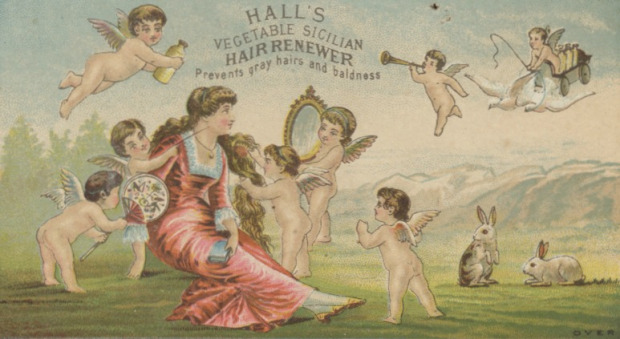
Hall's Vegetable Sicilian Hair Renewer, 19th Century Advertisement. Hall’s Vegetable Sicilian Hair Renewer, 19th Century Advertisement.

Since biblical times, a woman’s hair has been known as her crowning glory.  This was never more true than in the Victorian era – a span of years during which thick, glossy hair was one of the primary measures of a lady’s beauty.  But how did our 19th century female forebears maintain long, luxurious hair without the aid of special shampoos, crème rinses, and styling treatments?  And how did they deal with hair-related complaints such as an oily scalp, dry, brittle tresses, or premature greyness?

View original post 1,582 more words

Alice Isn’t Dead: A Cautionary Tale, a Family History

Upon receipt of the carte, I scanned, enlarged, and enhanced the image. Immediately I became aware of motion blur caused by the child’s arms moving during the exposure.

6905559274_525dd552e7_h
Mary Jane Stayman Culley holding eight-week-old Alice Maud Culley in August 1879. Albumen carte de visite. Ann Longmore-Etheridge Collection.

Within eBay’s vintage and antique photo subcategory, every slightly odd-looking baby is a dead baby. I confess that when I saw the listing for the carte de visite (CDV) above, I thought this was an infant gone, never to grow up, forever to sleep, dressed in angelic white and buried in a tiny coffin so unfairly made-to-fit, her grave topped by a small stone lamb. This was cruel fate; this was a Victorian postmortem. But those who explore the Victorian propensity to mark gut-wrenching loss via photography should take this story as a cautionary tale, not unlike the one I featured last November, “To Be, or Not to Be, a Victorian Postmortem.”

The CDV’s backstamp is that of “John Davies, Portrait & Landscape photographer, BelleVue High Street, Weston-super-Mare. Formerly with the late T. R. Williams, London, Photographer to the Queen and Royal Family.” There is also a handwritten inscription: “Alice Maud Culley, 8 weeks old, Aug. 1879.”

Upon receipt of the carte, I scanned, enlarged, and enhanced the image. Immediately, I was aware of motion blur caused by the child’s arms moving during the exposure. Alice Maud Culley wasn’t dead. I could then plow into the public records because of the fortuitous identification upon the reverse.

Continue reading “Alice Isn’t Dead: A Cautionary Tale, a Family History”

A Mother’s Mortality, A Woman’s Glory

The posing of mother and child may also deliberately highlight the loss of her long and well-cared for hair.

23273872339_7eb55fa4cb_o (1)
Photo courtesy Jack and Beverly Wilgus Collection.

This stunning tintype, circa 1875, of an American mother and infant, is owned by collector and Your Dying Charlotte contributor Beverly Wilgus, who notes, “This little tintype is not as much a ‘hidden mother’ as a mother who chose to put the emphasis on the baby. I do wonder about her very short hair. One explanation could be that she has been very ill, maybe after a difficult birth, and her hair was cut short for comfort.”

It is possible that the woman pictured suffered from puerperal sepsis (called childbed fever) in the aftermath of delivery, which had been combatted, in part, by hair cropping. If true, this mother surely thought the tintype image celebratory—even triumphant: She had survived; her magnificent reward was the healthy infant draped over her shoulder, offered visually to posterity.

The sitter was lucky—a scarce survivor of a bitter scourge. “Childbed fever killed at the cruelest moments. It was described as a ‘desecration,’ an aspect of the natural world that felt almost deliberately evil. What caused it? Some thought ‘a failure of uterine discharge;’ others, a little later, called it ‘milk metastasis,’ noting that the internal organs of the women who died seemed covered in milk. Eventually, it was accepted that the fluid was not milk at all. It was pus,” wrote Druin Burch in a Live Science article, “When Childbirth Was Natural, and Deadly.” When obstetricians and midwives talked of “delivering women,” he explained, they meant delivering them from the deadly perils of childbirth.

Continue reading “A Mother’s Mortality, A Woman’s Glory”

Tales of Innocence and Darkness

The eerie and eclectic photography of Caroline Leech

19077302489_dcf11bbe45_b
All photos copyright Caroline Leech.

Carolyn, an English woman who lives in Spain, writes of herself: “I am an obsessive Victorian and lover of all things Gothic. As a child I would often rather spend my pocket money in the local antique shop on postcards, photos, stamps or coins than in the toyshop. History just always fascinated me.”

31912891283_65cf2621f8_b“I then developed an interest in spirits and faeries and fell in love with writers such as my beloved Charles Dickens, Sheridan LeFanu, Emily Dickinson and with the whole world of Victorian spiritualism, mourning, the faery painters of the time and also the darker aspects of Victorian society.”

32681174485_02339b8c1e_k“I live in a watermill in the middle of a forest, which is always an inspiration to me. I feel I am surrounded by all sorts of spirits.”

30342997980_f63fb34691_k“I have been an antique dealer and visionary artist for years and am also a keen amateur photographer of anything mysterious. My greatest love is of course Victorian photography, these amazing ghosts which pleasantly haunt the pages of my book and the drawers and cabinets of my bedroom.”
25955709410_3133c5fda8_bCaroline’s book of photos and poetry can be purchased at Amazon. You can also visit her Flickr photostream. Ω
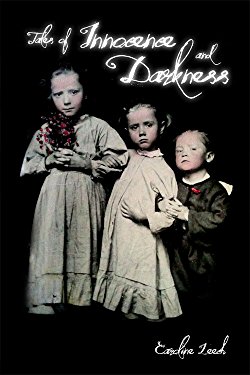
61zy1g15BbL._UX250_

Photo-Multigraphs: The Mirror and the Camera

“It was the purpose of the author to describe a number of novel and curious effects that can be obtained by the aid of the camera, together with some instructive and interesting photographic experiments.”—F. R. Fraprie, 1922

5._MultiMnCab2
A photo-multigraph cabinet card by A. M. Lease of Lancaster, Pennsylvania, circa 1895.

By Beverly Wilgus

In 1893, H. P. Ranger was granted Patent No. 505,127 for a “Mirror For Use In Photography.” This was a device comprised of two adjustable mirrors set at an angle. When a subject was placed in front of it, his or her image was reflected in each mirror and that reflection was again reflected, resulting in five or more figures—the number of figures determined by the angle of the mirrors.

1._MirrorPatent

The above schema is from an article published in Scientific American in the 1890s that was included in the 1896 book Photographic Amusements by Frank R. Fraprie and Walter E. Woodbury. My husband and I own a copy of the 1931 edition that still contains the original illustrations.

2._mirror_top

Also from the book is the illustration above: “Diagram Showing The Method Of Production Of Five Views of One Subject By Multiphotography.”

Continue reading “Photo-Multigraphs: The Mirror and the Camera”