





Ω
Ω
“She sleeps in peace, dear sister sleeps—
Art thou forever gone?
No, we will see thee soon again,
Where parting is unknown”— In Memory of Mary Frey by Her Sister CMB

This angelic child, pictured at the start of what should have been a long life, was Edyth Embery, born 5 March, 1909, in Frankford, Philadelphia County, Pennsylvania. She was the daughter of Dr. Francis Patrick Embery (1867-1939), a Philadelphia otorhinolaryngologist, and his wife Miriam Fairbairn Wilson (1875-1948), whom he wed in early 1899. (The 12 February Philadelphia Inquirer described Miriam as wearing “heavy corded white silk, trimmed with chiffon and lace and carried bride roses. The flower girl, maid of honor, and bridesmaids wore white organdie and carried white carnations.”)
Francis Embery, known as Frank, was born at Foxchase, Philadelphia County, to William Henry Embery (1840-1914). Frank’s father was, by 1872, head of the Assay Laboratory of the United States Mint. Previously, he’d served as a sergeant in Co. A, 1st New Jersey Cavalry, during the Civil War. Frank’s mother was Annie Elizabeth Manning (1841-1921), who was of Irish descent.
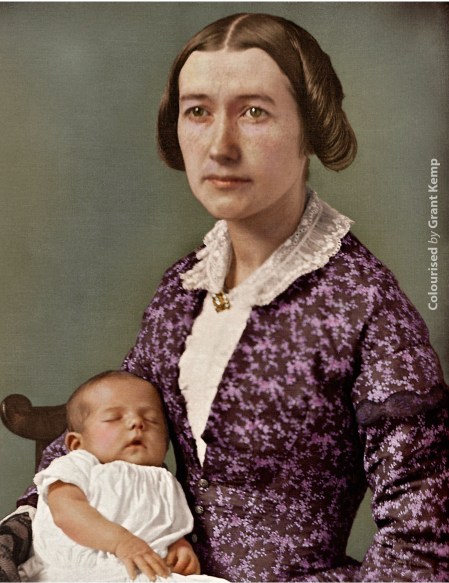
Recently, I was honored that Grant Kemp, of restoringyourpast.co.uk and a truly remarkable artist, chose two of my daguerreotypes to colorize. The results were utterly revitalizing, as can be seen from the comparison below.


Grant says of himself, “Trained as a Graphic Designer, I have a Bachelor of Arts Honours Degree in Graphic Design. During my long graphics and print career, I have used design, image software and scanners from every leading supplier including the highest resolution drum scanners. I bring all of my industry experience to the Restoring Your Past service. Graphic design, image scanning, newspaper/magazine production, web, litho, and digital printing experience means I can offer a graphics service that’s based on having dealt with just about every sort of image destined for any type of output.”
Enjoy these samples of his work and if you have old family photographs to restore or colorize, a better digital artist than Kemp is unlikely to be found.

Continue reading “Resaturated with Life: Historical Photos Colorized by Grant Kemp”
New Year’s Eve was celebrated on 31 December for the first time in 45 B.C. when the Julian calendar came into effect.


Continue reading “New Year’s Eve: Roaring End, Rowdy Beginning”
Early images of the Stars and Stripes from the Jack and Beverly Wilgus Collection.
By Beverly Wilgus
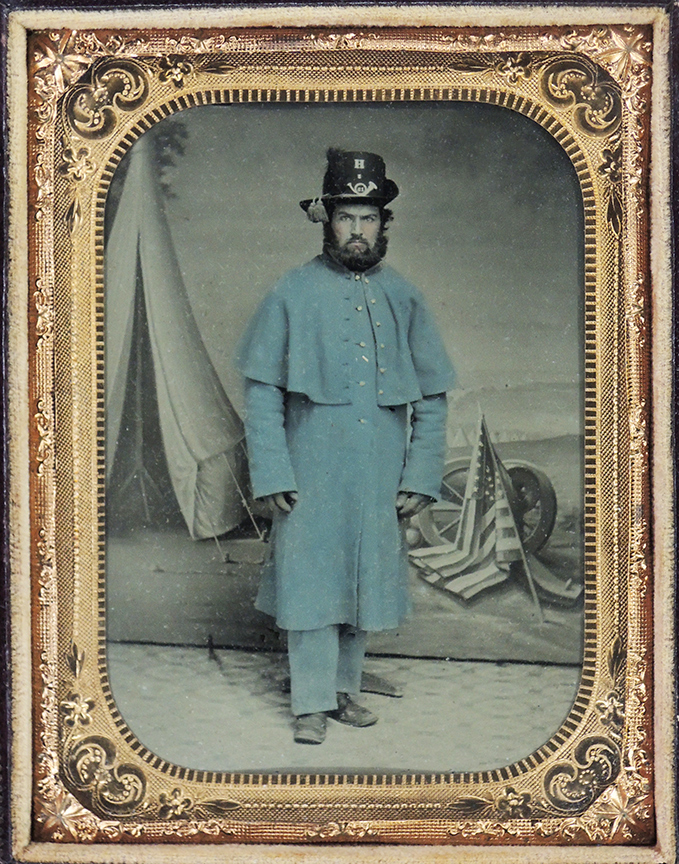

“It was the purpose of the author to describe a number of novel and curious effects that can be obtained by the aid of the camera, together with some instructive and interesting photographic experiments.”—F. R. Fraprie, 1922
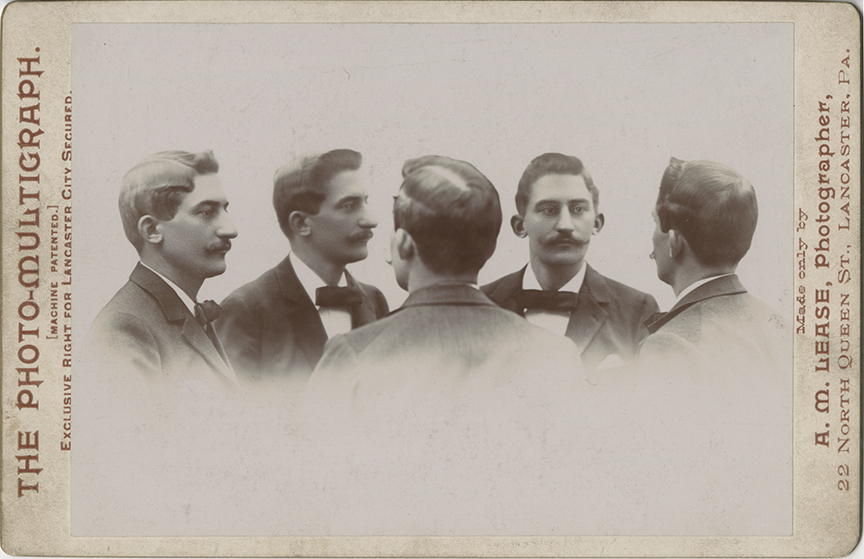
By Beverly Wilgus
In 1893, H. P. Ranger was granted Patent No. 505,127 for a “Mirror For Use In Photography.” This was a device comprised of two adjustable mirrors set at an angle. When a subject was placed in front of it, his or her image was reflected in each mirror and that reflection was again reflected, resulting in five or more figures—the number of figures determined by the angle of the mirrors.

The above schema is from an article published in Scientific American in the 1890s that was included in the 1896 book Photographic Amusements by Frank R. Fraprie and Walter E. Woodbury. My husband and I own a copy of the 1931 edition that still contains the original illustrations.
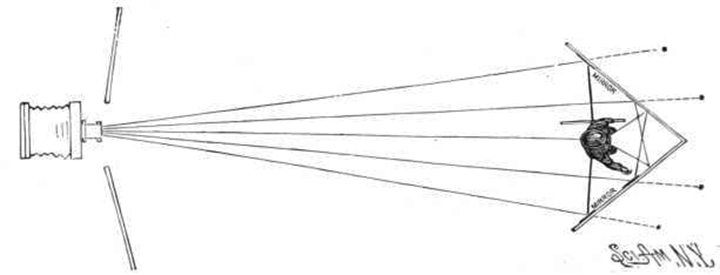
Also from the book is the illustration above: “Diagram Showing The Method Of Production Of Five Views of One Subject By Multiphotography.”
Continue reading “Photo-Multigraphs: The Mirror and the Camera”
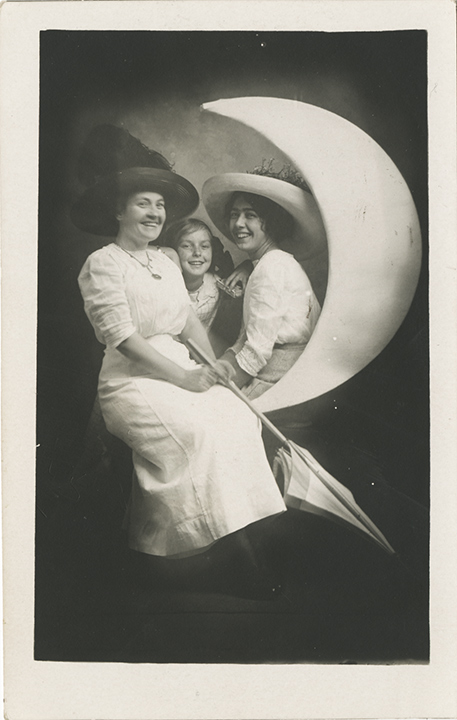
A selection of paper-moon real photo postcards from the collection of Jack and Beverly Wilgus. All date from the second decade of the 20th Century.


Ω
All of Jack and Beverly’s paper moon images can be seen here.
Do you have a vintage image or artifact that might educate and entertain? If so, I would be delighted to hear from you.
“Thank you dear for the nice letter you sent us and all the kisses. Hope you are a good boy. Did you throw Herbert out of bed Sunday morning?”
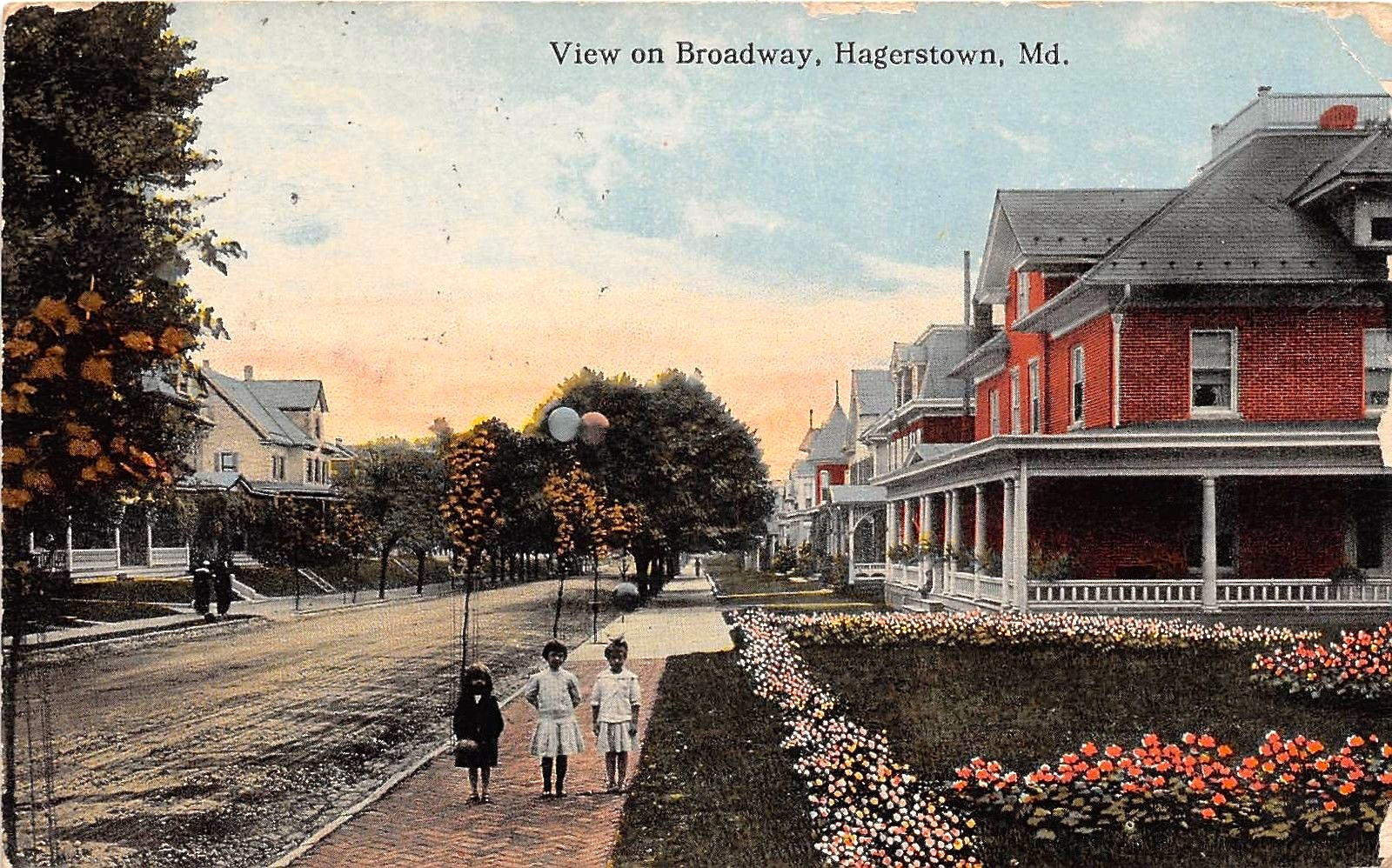
Today’s postcards convey “Wish you were here!” almost exclusively, but in the first decades of the 20th Century this method regularly moved information to friends and family who resided even just a few miles away. The short messages often read much like modern email, and when in combination with the photos on the front, can seem like old-school versions of modern Facebook posts.
On 4 March, 1914, this cheerful, beautifully colored postcard of Hagerstown, Maryland’s Broadway (above) was sent to Mrs. C. L. Pennison, Newton, Massachusetts, care of Peckitts on Sugar Hill. The message reads, “Dear Catherine, I was pleased to get your card on Monday while at home. But surprised to hear you are in the White Mountains. I hope you will soon recover your health up there. We were in the midst of a blizzard Monday but are enjoying pleasant weather now. I am well and enjoy my work. Yours, B.”

This postcard of the Washington Street Bridge, Monticello, Indiana, was addressed to Miss Ruthie Brown of Modesto, Illinois, and mailed 4 July, 1913. The reverse reads, “Dear Ruth: This is where I am spending the day. This morning our car struck a buggy just as we were going up the hill beyond this bridge. I hope you are having a lovely vacation. Would like to hear from you very much. Grace Mc. 1 Danville, Ind.”

Beverly Wilgus, the owner of this example, writes, “This postcard was mailed by a grandfather to his granddaughter in November, 1912. The caption ‘Tommy’s first and Turkey’s last picture” [has an] unpleasant edge. The image is embossed and gives the figures a slight 3D effect. It was sent to Dorothy Flower in North Uxbridge, Massachusetts, by Grandpa Midley.”
The message reads, “Dear Dorothy: How would you like to have your picture taken this way? I suppose you would rather have some of the turkey to eat. Hope you will have some for your Thanksgiving dinner. Am going to try to get to No. Uxbridge to see you soon.”

Margaret Ripley was a nurse in France during World War I. The above is one of a series of postcards she sent to her sister back in Surrey, England. “Had 2 nice days here unfortunately Louvre & all museums shut but seen as much as possible. Off to Dunkirk tomorrow to typhoid hospital—so glad to feel we may at last get real work in connection with war. Have enjoyed our week’s holiday very much & were hoping to stay on here a few more days. Love to E & children. Hope they are well again. Mar.”

Although the photographic image is from a decade previous, this postcard’s stamp was cancelled 24 December, 1922. Addressed to Mr. S. Schmall, 4549 Calumet St., Chicago, Illinois, the delightful message reads: “Thank you dear for the nice letter you sent us and all the kisses. Hope you are a good boy. Did you throw Herbert out of bed Sunday morning? Love to you & all. Aunt Alice.”
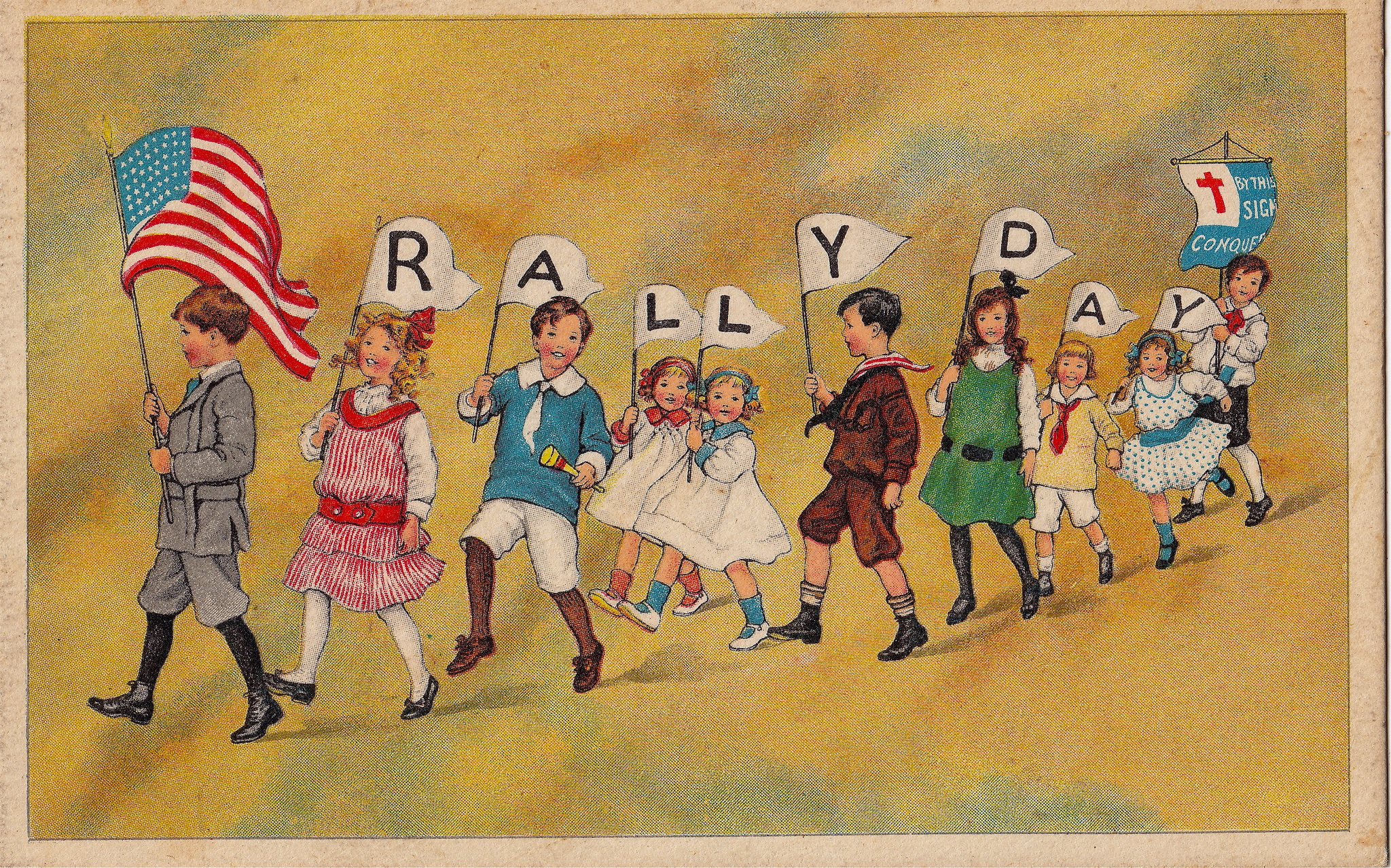
Postmarked 30 October, 1917, this postcard was sent by the United Brethren Sunday School of Myersville, Maryland, to Helen Keller and family. “U B ready for the U.B. Rally. We need you on Rally Day. Remember the date: Nov. 11th. Do not disappoint us. Help us make this our best Rally Day.” (If there was a smiling emoticon after “Do not disappoint us,” I would feel less creeped out.)
According to Holidays, Festivals, and Celebrations of the World Dictionary, “In liturgical Protestant churches, Rally Day marks the beginning of the church calendar year. It typically occurs at the end of September or the beginning of October. Although not all Protestant churches observe this day, the customs associated with it include giving Bibles to children, promoting children from one Sunday school grade to the next, welcoming new members into the church, and making a formal presentation of church goals for the coming year.”
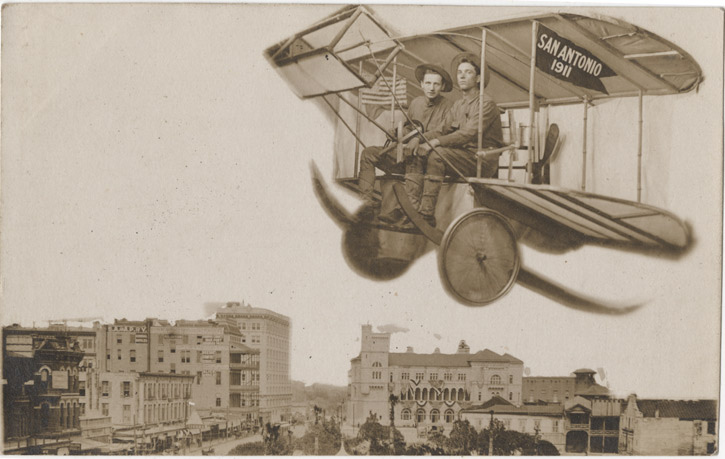
Beverly Wilgus writes, “This multiple-print, real photo postcard shows two soldiers in a studio prop biplane flying over a real San Antonio streetscape. A banner reading ‘San Antonio 1911’ flies from the wing. Even though the plane is obviously phony, the two airmen appear to be real pilots since the message on the back reads, ‘Our first lesson what do you think of it? Geo.’”
I’m thinking Photoshop, version 1.911. Ω
“If my Valentine you won’t be,
I’ll hang myself on your Christmas tree.” —Ernest Hemingway

This tart little valentine was sent from Battle Creek, Michigan, 8 February, 1910, to Mr. Barhite, Bellevue, Michigan, RFD No. 1. The message reads: “Well Mr. Barhite I have not heard from you in a long time and so I don’t know whether you are dead or alive. I hope you are the latter and well write. Edith Mathews.”

The addressee was Gordon Lyman Barhite, born 10 June, 1883, in Michigan, son of Everon Barhite (1837-1923) and Delia F. Root (b.1846). Gordon Barhite appeared on the 1900 census of Bellevue as a boarder on the farm of Theodore Davis, probably acting as a farm hand. By 1910, he was in Fredonia, Michigan, working the farm of Frederic Lee.
Barhite’s 1918 World War I draft registration card notes that he was of medium height, medium build, and had blue eyes and brown hair—and if the childhood picture below is any evidence, he may well have grown into a looker. The address to which bitter Edith sent this postcard was that of Gordon’s mother Delia, who was also listed on the draft registration card as his wonderfully misspelled next-of-kin “Deilicia Barhite.”

The 1920 census appears to tell the outcome of the valentine’s tale: Gordon Barhite then lived in Convis, Michigan, with his wife Edith (b. 11 June 1888). Also enumerated with Gordon and Edith were three children with the surname Patchett: Loren (1907-1925), Wayne (1910-2001), and Bernadine (b. 1912), as well as mother-in-law Frances Coutz (1847-1920).
Frances’s presence provided a vital clue: twenty years earlier, the 1900 Amboy, Michigan, census detailed the household of farmer Joseph Coutz, Jr. (1843-1911), and his wife Frances E. Oldfield Coutz, as well as their daughter Margery Edith.
On 15 January, 1905, Margery Edith Coutz married Frederick William Patchett, who was born 13 April, 1882, in Salford, Lancashire, England, and came to America in 1879. Before 1919, however, the Patchett marriage ended badly. The 1 May Battle Creek Enquirer announced that Gordon Barhite and Edith Patchett obtained a marriage license—they had actually married the day before—and the later 1930 Census placed Frederick Patchett in Hillsdale as a lodger and a divorced mill worker. He later married Edith Mackey (1889-1972). The appearance of this Edith confused me and before I realized that she was indeed a new individual, I believed for a time that Edith Barhite had returned to her first husband.

Edith’s son Loren Patchett, unmarried and working as an electrical lineman, died aged 19 on 29 June, 1925, in Battle Creek, of electrocution caused by the failure to wear protective gloves. “Without the gloves, He climbed a transformer pole on Freemont Street. While in contact with a live wire containing 5,000 volts, he forgot and took hold of another wire which a fellow workman was attempting to sever…. The result was a short circuit which went from hand to hand.” Loren was buried in Riverside Cemetery, Bellevue.
The 1930 census placed Gordon and Edith Barhite in Pennfield. Gordon was a farm laborer and stepdaughter Bernadine worked in a factory. The couple also had a daughter, Helen, born in 1923. Edith acted in a local play put on by the Willing Workers of the Base Line Church in may 1934. In December, 1939, a local newspaper article mentioned that Gordon Barhite and his family were exchanging houses with a Mr. and Mrs. Inman. The Battle Creek Enquirer of 14 March, 1941, noted that “Mr. and Mrs. Gordon Barhite have moved from the Gates apartment house on South Clark to a farm near Climax.” These are the last traces I can find of the family.
Gordon Barhite died in May 1964 and Edith Barhite died 18 June, 1972, in Hillsdale County, Michigan.
Now, the discrepancy: The woman who sent this valentine signed her name Edith Mathews. Was she really Edith Patchett? In 1910, Edith was 22 years old with two young children and an unhappy marriage. Was she already looking to leave Frederick Patchett and was casting about for a new man to provide for her children? If she was, using a false but previously agreed upon surname may have seemed a wise thing to do.
Conversely, Edith Mathews may really have been Edith Mathews. According to the 1911 Battle Creek City Directory, a woman of that name was a boarder at 16 Shepard Street. She was still there in 1912, with fuller details given: Edith G. Mathews was a packer at the Postum Cereal Company. In 1916, she was a machine operator at B.C. Paper Company. After this, she disappeared from 16 Shepard Street.
Was this Valentine from an unhappy woman looking for a way out of a bad marriage or from a single working girl who’d met a handsome farm hand somewhere, somehow? The answer remains unknown, but I shall leave you with this, from my heart to yours: “Love attracts, connects, builds and frees the beauty of humanity. Happy Valentines Day.”—Euginia Herlihy. Ω
Even the fake kind, or the missing altogether….

Oh my. After this debacle, let’s hope there was snow outside to sled on.

Okay. Well, at least there is fake snow. And a fake dog.

This is more like it: Real snow outside and the girls are rocking those gifts from Santa.
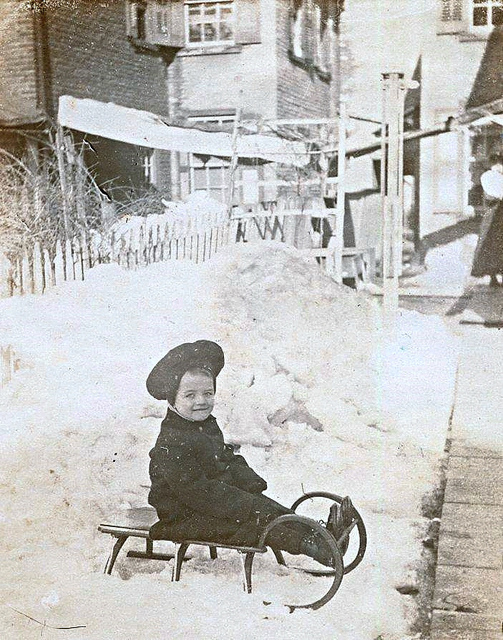
A happy boy on his sled the back garden of what seems to be a row house. A woman stands at the end of the wooden-plank walkway, probably his mother. I hope Edward’s father took him to a local park where there were many high hills to fly down.

A wistful girl sleds on a snowy day near the family farm. Everything about this image charms me—from the baggy pants, the bottle curls, and mad hat to the upturned, pointed noise of the sled and the low mountain beyond. I wish I knew more about her, but sadly there is no photographer’s impression or inscription. Ω
All images: Ann Longmore-Etheridge Collection.
 "Your Dying Charlotte"