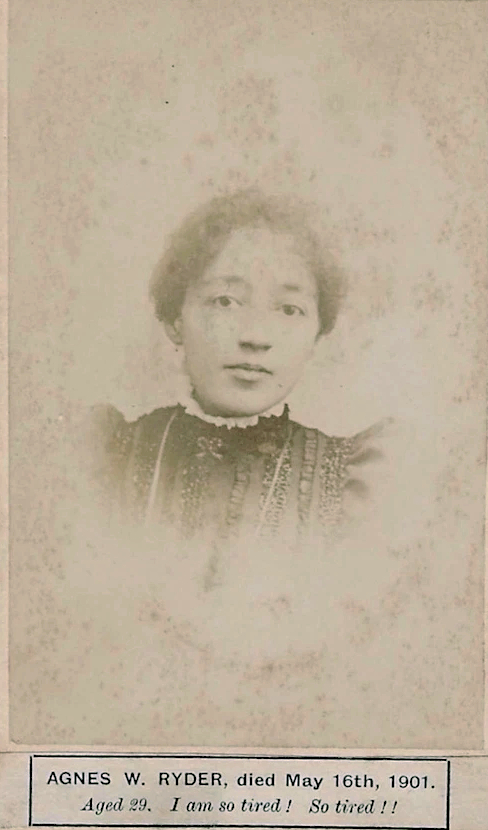
Carte de visite from the Ann Longmore-Etheridge Collection.
Agnes Warner Rider, pictured above, died on 16 May, 1901, at the age of 29. Presumably, her final words, as printed on this albumen carte de visite, were “I’m so tired. So tired!”
Agnes was born 18 January, 1872, in Southwark, London, to Charles Ryder (1846-1907), a printshop manager, and his wife Hannah Bramley (1847-1919), who both hailed from Loughborough, Leicestershire. Agnes, along with her other siblings, was baptised on 19 January, 1874, at Saint George the Martyr, Queen Square, Camden. At that time, her family lived at 10 Dunford Road, Holloway, London, in a small terraced home that still stands today.
The 1891 Census reveals that Agnes was the eldest surviving child in a family that included siblings Archie Hammond, Dudley Charles, Gertrude, Isabel, Henry Granville, Grace Hannah, and John Basil. Baptismal records indicate there was also a sister called Martha, born in 1878, one named Elizabeth Helen, born in 1868, and another called Marguerite, born in 1870. These three girls do not appear to have outlived childhood.
When the 1901 Census was taken, Agnes had but little time to live. She is listed as the eldest of a group of six children still in the home, along with Archie, Dudley, Henry, Grace, and John. One worked as a milliner, one as a dressmaker, and one as a merchant’s assistant. Archie had already married and become a young widower.
This census also reveals this clue as to why pretty, brown-eyed Agnes had not married or held a job: “Curvature of the spine since birth” was scribbled at the far right of the enumeration page.
In the Victorian era, spinal curvatures, like scoliosis and kyphosis, were prevalent. There were misconceptions about the causes of scoliosis, sometimes linking it to moral failings or perceived societal problems rather than solely medical conditions. Victorian attitudes toward spinal deformities reflected the broader societal views on disability, ranging from pity and fear to marginalization. Those with such conditions might be seen as “others” and face challenges in social and economic participation.
Illustrations from a 1916 publication on treatments for scoliosis. Wikimedia Commons.
Treatment options for spinal curvature were varied and often experimental. Doctors utilized braces and modified corsets for correction. Traction and immobilization techniques were employed to reduce the curve, sometimes with limited success and potential complications, like paralysis.
In the mid-19th century, surgeons began exploring surgical options like percutaneous myotomies (muscle and tendon cutting) and later, spinal fusions to address deformities. However, these procedures carried significant risks, including infections and recurrence. Some practitioners advocated for gymnastic exercises to strengthen back muscles and treat deformities, believing it was more effective than solely relying on braces.
While spine curvature was not often fatal, it depends on severity and type. In severe cases, it can lead to respiratory complications, cardiovascular issues, nerve damage, reduced mobility, and significant pain. Some or all of these could lend weight to Agnes’s departing words, “I’m so tired….”
Agnes Warner Ryder was buried on 22 May, 1901, at Highgate Cemetery, Camden. Her grave, Square 19, Grave 33932, remains unmarked.
This fine 1/6th-plate daguerreotype is of Caroline Hulda Felt, born 24 April, 1830, in Stow, Middlesex County, Massachusetts, United States. The portrait was probably taken on her eighteenth birthday in 1848.
Caroline, whose freckles and adolescent acne are visible, is wearing a gown well-suited for a willowy teenager: a gentle fan-fold bodice leads to a V-waist that creates the silhouette of a long, slender torso and sloping shoulders. Her bell-shaped skirt is gathered at the natural waist and is supported by multiple corded petticoats. By 1848, high necklines were the fashion for daywear, and Caroline’s appears edged with crocheted lace, as do her tight undersleeves. Whilst the material of her gown (probably silk) is patternless, the dress features attractive sleeve caps that echo the point of her bodice and are decorated prettily with buttons, embroidery, and fringe.
Caroline’s hair is twisted into a series of braids visible at the sides of her face and coiled around the back of her head. She also has two long, tight sausage curls dangling to touch her shoulders. The only jewelry Caroline wears is a plain band on the middle finger of her left hand. (Remember, daguerreotypes are reverse images.)
Caroline was the daughter of John Felt and his wife Huldah. According to The Felt Genealogy: A Record of the Descendants of George Felt of Casco Bay, John Felt was “born in Packersfield, Sept. 22 1798; died in Jaffrey, N. H., May 23, 1887. He married in Stow, Mass., March 29, 1825, Huldah Hobart Conant, daughter of John and Maria (Houghton) Conant. She was born in Stow, Oct. 3, 1803, and died in Jaffrey, May 27, 1867. Mr. Felt removed to Jaffrey in April, 1825, then after two years to Stow, but in 1831 he removed back to Jaffrey, where the remainder of his life was passed. He was a farmer, a prominent citizen, and filled nearly every office in his town, and was for five successive years a Representative in the State Legislature, and for many years a justice of the peace; a man in whose ability and integrity the public had full confidence.”
The Felt Genealogy goes on to note that “In October, 1860, he fell from a tree while gathering apples and received injuries that left him enfeebled and crippled for life, and for twenty-seven years, though shut out from the active duties of life, bore his sufferings with exemplary patience and cheerfulness, and never lost his interest in the affairs of the outside world. In politics, he was a whig and afterwards a Republican.”
The Felts first child, a daughter, was born 13 June, 1826, and died the following day. After this tragedy, however, the couple was blessed with a number of surviving children—among them John Conant, born in 1827, who became a dentist, a member of the Masonic Order, a justice of the peace, and a selectman in the town of Orange. Sarah Maria was born in 1828; Caroline arrived in 1830; Martha Ward was born in 1836, married Marett Evicth, a manufacturer of wooden mantels and other items, and lived in Philadelphia, Pennsylvania; and William Henry Harrison, who was born in 1841, but died young, in 1860, aged 19.
On 18 April, 1850, just a few days before her twentieth birthday, Caroline married Julius Cutter of Jaffrey, New Hampshire. They had likely known each other since childhood. Julius was born on November 28, 1824, to farmer Benjamin Cutter and Grata Cutter (nee Hunt). In the History of the Town of Jaffrey, New Hampshire, published in 1881, the author, William B. Cutter, thanks “Benjamin Cutter, Esq., a venerable citizen, now over 88 years of age, who has furnished much that is valuable from actual knowledge, being born and having always lived in town.”
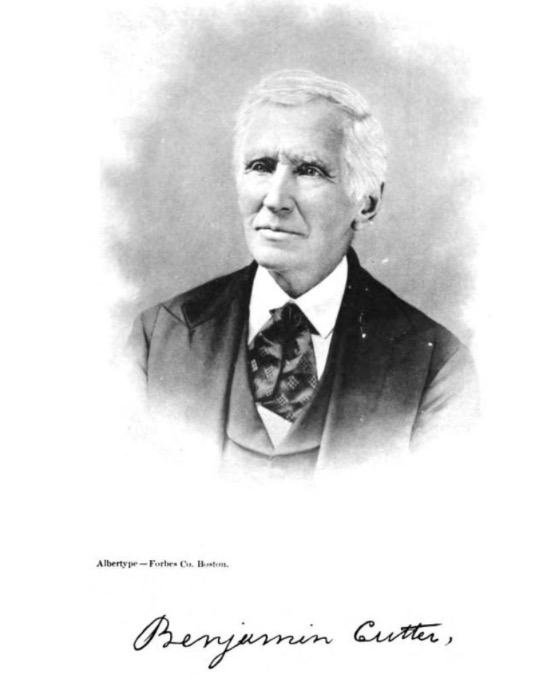
Caroline’s father-in-law, Benjamin Cutter.
The text notes that “Benjamin Cutter has pursued the manufacture of leather in Jaffrey: first, in the original establishment erected by his father, and afterward, the building now occupied by his son Julius for the same purpose. He has been a prominent leading man in town affairs; for many years town-clerk, justice of the piece, and is now (1880) president of Manadnock National Bank, East Jaffrey. For several years he has been engaged in antiquarian research, and has a more extensive knowledge of the history of his native town than any other man living.”
One of Benjamin’s children, and Julius’s elder sister, was Sarah Augusta Cutter, who became wife of Dr. William Johnson Campbell, died at age 26, and of whom, it was noted, “[She] left manuscripts, poetically written, that have never been published. She possessed a ‘philosophic mind, and though she wrote poetry it was with a philosophic expression.'”
Another sister, Adaliza (1823-1852), married medical man Dr. Gurley A. Phelps. She also wrote poetry, but her work saw post-mortem publication in a 300-page volume compiled by her friends. Her husband said of her that “[S]he burst forth in a poet’s song—a simple expression of what she lived, she felt,” and who wrote “…not to be admired, but to be loved.” With both sisters dabbling in poetry, one wonders whether Caroline composed verses, too.
Julius and Caroline had two daughters: Emma Maria Cutter Mitchell (b. 7 June, 1853) and Alice E. Cutter (b. 1857).
At the time of Julius’s marriage to Caroline, he headed a leather tannery; by the following December, the Fitchburg Sentinel reported he had a boiler (presumably for the tannery) made by a Fitchburg fabricator. He was later was assessed for taxes in 1862 as a maker of buggy harnesses. At some point soon thereafter, Julius became a farmer who was iterated on the 1880 Census living with Caroline, his father, his eldest daughter, and his niece.
Main Street, Jaffrey, New Hampshire, circa 1905.The town was settled in 1758, incorporated in 1773 by Governor John Wentworth, and named for George Jaffrey, a member of a wealthy Portsmouth family. The Meetinghouse (below) was built in 1775.(Colorized postcard, “View from Cutter’s Hotel, Jaffrey, N.H.,” circa 1905.)
Julius died of pneumonia on 2 May, 1890, with his brother-in-law Dr. Gurley signing the death certificate. The executor of his Will was his daughter Emma, who attested she was “received of the estate of Julius Cutter one dollar and other valuable considerations, being my share in full of his estate,” and his wife Caroline, who attested to the same.
Widowed, Caroline lived for some time in Cambridge, Middlesex County, Massachusetts, with her younger daughter until Alice’s death in 1916. Caroline passed away 18 January, 1921, aged 90, in Cambridge. Her daughter Emma died of “senile dementia” and arteriosclerosis at an institution called Beverly Heights in Wilton, New Hampshire, on 3 October, 1937, at age 84.
Caroline’s simple obituary in the 19 January, 1921 edition of the Boston Globe.“CUTTER—In Cambridge, Jan. 18 at the home of her daughter Mrs. John Mitchell, Caroline H. Cutter, widow of Julius Cutter Esq. of Jaffrey, N.H., in her 91st year. Funeral in Jaffrey, Thursday, Jan. 20.
Caroline and her daughters were laid to rest in Cutter’s Cemetery, Jaffrey. An article about this place was written by Robert Stephanson in 2011 and published on JaffreyHistory.org. In it, Stephanson writes that the burying ground “…lies at the edge of the Jaffrey Center village on Harkness Road quite close to Route 124. In days past this section of Jaffrey could just as well be named ‘Cutterville’ because of the preponderance of Cutters, Cutter homesteads and Cutter businesses within earshot…. The cemetery was laid out …in 1836 in accordance with the wishes of John Cutter… [1765-1835] who lived beside the site chosen. His house, the largest in the village, still stands. At the start and for nearly a century the cemetery was for the Cutter family alone.”
Unfortunately, I have not been able to fill out Caroline’s life more fully. If more information is found, I will update this post.
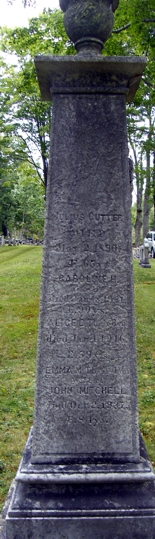
Julius and Caroline Cutter’s tombstone in Cutter Cemetery, Jeffrey, New Hampshire.
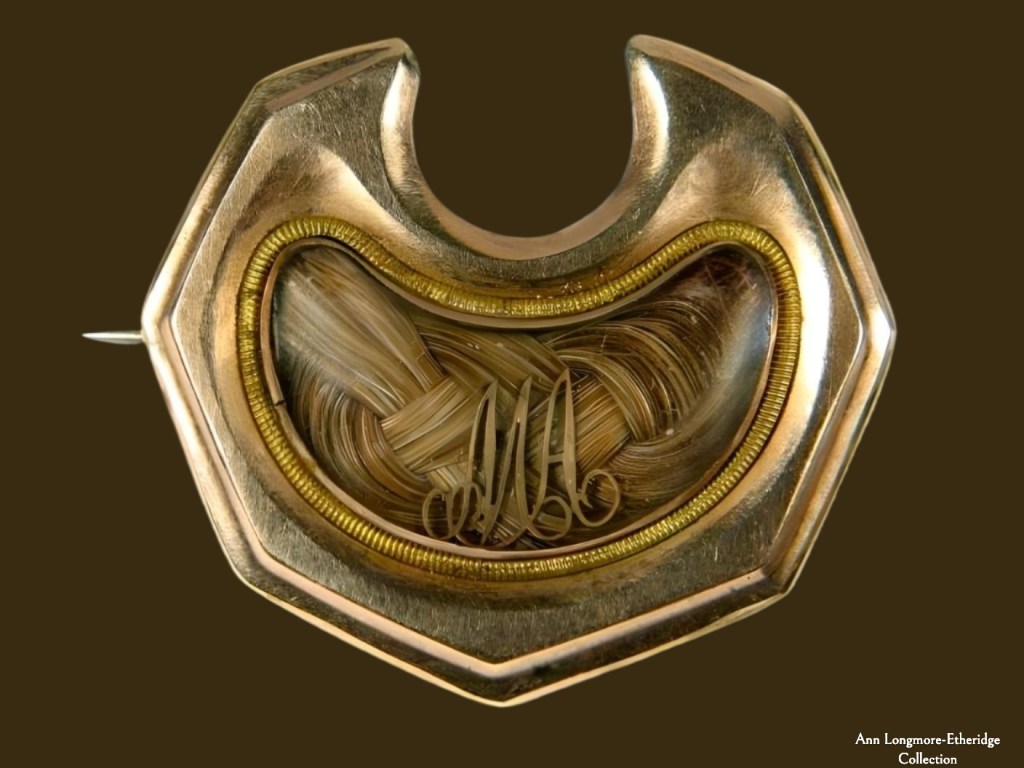
“The Monthly Magazine or the British Register, Part one for 1809,” references the 14 December, 1808, death commemorated by this brooch: “At Stodday Lodge, near Lancashire, Mrs. Arthington, relict of Thomas A. esq. of Leeds, 52.”
The Arthingtons were Quakers, and Mary’s interment at the Friends Burying Ground “at the Moor Side near Lancaster” was arranged by the Friends. A request exists from one George Barrow to Robert Dean, “Grave-Maker,” sent two days after Mary’s death, ordering Dean to “make a Grave on or before next Third Day…and therein lay the Body of Mary Arthington of Lancaster…aged about 51 years.”
According to Quarkeriana, Vol. I, April 1894, Moorside, also known as Golgotha, was “about a mile from Lancaster…in which there have been over 100 interments…. Tradition says that formerly there were many stones removed by the desire of the Yearly Meetings Committee that once visited the meeting. One, a large, heavy stone chest, still remains, which is said to have been too large to move.” If Mary Arthington had a gravestone at the burying ground, sadly, it is long gone.
Below this entry, Robert Dean attests, “The Body above mentioned was buried twentieth day of Twelfth Month, 1808.”
The reverse of the brooch, engraved with, “Mary Arthington, died at Stodday Lodge dec 14th, 1808”. Ann Longmore-Etheridge Collection
Mary was born 28 May, 1757, the daughter of Robert and Jane Lawson, who were deceased by the date of Mary’s second union. When she married Thomas Arthington, a “common brewer,” in York on 14 July, 1785, she was known as Mary Whalley, the widow of Joseph, “late of Lancaster in the county of Lancaster, merchant.”
Mary married Joseph Whalley on 9 May, 1781, at the Quaker meeting house in Yealand Conyers, Lancashire. He was the son of Joshua Whalley, who was present at the marriage, and Bridget, his wife, who was already dead. Both Robert and Jane Lawson were also present, placing their own deaths (and Joshua Whalley’s) between June 1781 and June 1785.
A Quaker wedding, circa 1790.
Thomas Arthington was the son of Robert and Phoebe Arthington, born at Armley, Leeds Parish, Yorkshire, 5 December, 1743. His father had also been a common brewer, and like Mary, both Thomas’s parents were dead by 1785.
The Quaker document, while formulaic, is still so detailed that the wedding of the 28-year-old Mary and 42-year-old Thomas can almost be envisioned: “The said Thomas Arthington and Mary Whalley appeared in publick assembly [at the] Meeting House at Wray in the said county of Lancaster. And the said Thomas Arthington, taking the said Mary Whalley by the hand, did openly and solemnly declare as followeth, “Friends, in the fear of the Lord and before this assembly, I take this my friend, Mary Whalley, to be my wife, promising through divine assistance to be unto her a loving and faithfull husband, until it shall please the Lorde to separate us by death.” Mary then repeated the same to Thomas, whilst holding his hand.
The house where Mary Arthington died, Stodday Lodge, is a secluded dwelling set in wooded gardens near the old village of Stodday, four miles south of the city of Lancaster. Today, Stodday Lodge is a Grade II listed building known as Lunecliffe Hall. British Listed Buildings describes it as a “small country house, now house and office. Late C18 and early C19, with later additions. Sandstone ashlar, with ashlar dressings. Slate roof…entrance hall has Venetian-style panelled and glazed screens to rear and left, with fluted pilasters, moulded architraves with fluted keystones, and 2-light stained glass windows.” (The entire report on the house is here: www.britishlistedbuildings.co.uk/en-383029-lunecliffe-hal… )
On September 10, 1862, a detachment of Confederate cavalry rode into Middletown, Frederick County, Maryland, led by their captain—a town native son—to search out an American flag. It was there as reported, suspended from the porch of a Main Street home and floating prettily in the breeze. Incensed, looking to fight, and not knowing the battle horrors that the next days would bring, some dozen of the cavalrymen dismounted and rushed up the steps to tear Old Glory down. But a proud seventeen-year-old stepped outside to confront them.
For her patriotism during that tumultuous week, teenager Nancy H. Crouse, known to her loved ones as Nannie, was hailed for a time as “Middletown’s Maid” or, later, “Middletown’s Barbara Fritchie.” But now her story molders in obscurity, even in her childhood hometown.
Her father, George William Crouse (1804-1892), came from Waynesboro, Franklin County, Pennsylvania—the son of Hessian immigrant Johann Phillip Krauss and his wife Anna Marie Eberhardt; Nannie’s mother, Catherine Ellen Smith (1814-1862), was a native of Leesburg, Virginia. George Crouse was a saddler and harness maker—the trade he pursued his whole life according to censuses, as did his own father and his eldest son.
George and Catherine were early members of the Church of the Latter Day Saints. Mormon missionaries Jedediah M. Grant, Erastus Snow, William Bosley, and John F. Wakefield came to Maryland in 1837. Snow and Bosley recruited new members in Washington County, where they organized a Mormon branch. Snow preached in Greencastle, Pennsylvania, and was reported to have baptized more than a dozen new Saints in Leitersburg, just south of the Pennsylvania line. It is likely that George Crouse was one of either of these groups of converts.
The Latter Day Saints, following their prophet Joseph Smith, settled in the mostly abandoned town of Commerce, Illinois, in 1839, renaming it Nauvoo and building a community of as many as 20,000. The Crouses, who were then parents to George V., born in 1834; Mary Ellen, born in 1835; Phoebe Ann, born in 1838; and Catherine J., born in 1840, were in Nauvoo at the birth of daughter Laura in May 1841. The family was listed in the Nauvoo Stake Ward Census of 1842, bought property there in April, and Catherine was accepted as a member of the Female Relief Society of Nauvoo on 28 September. On 9 March, 1844, George Crouse, who was by then a Mormon elder, fronted a petition to lengthen a street in the town.
Reversed and cropped image of a daguerreotype of Nauvoo, Illinois, in 1846. This is the only known photograph of Nauvoo during the time it was the settlement of the Church of Jesus Christ of Latter Day Saints. The original temple is on the hill. CourtesyDigital Image Collection, Western Illinois University.
Just a few months later, on 27 June, the Prophet Joseph Smith and his brother were murdered by a mob while imprisoned in Carthage, Illinois. Even before their deaths, a leadership void opened and schisms cleaved. Crouse was excommunicated on 15 September, 1844, for “unchristian conduct.” (It is likely this happened because he wasn’t among the clique who’d grasped power, rather than for any offense he committed.) Catherine was heavily pregnant so the Crouses remained in Nauvoo for Nannie’s birth on 16 December. After Catherine and the baby could safely travel, the Crouses went east to Pittsburgh—part of the way by steamboat, as daughter Laura Crouse Cook recalled—where the family remained for several years.
The couple’s next child, Martha Rebecca, was born 27 July, 1846, either in Pittsburg or her father’s hometown of Waynesboro, just over the Maryland line. The 1850 census reveals the family were in Middletown, and George Crouse would ply his trade there with the help of his namesake son until around 1880. There are several sources that say Crouse was a baker and confectioner, and these side professions may also be valid, but the evidence does not appear on official documents such as the censuses, where occupations are noted.
Nannie and her little siblings (Rebecca; Charles Melvin, born in 1853; and Frances Ida born in 1856) knew no other home than Middletown, nestled in the green valley surrounded by a checkerboard of agricultural fields and pastures; its streets, if not literally bustling, saw much commerce and many travelers. Nannie would have grown there, played there, been schooled there; however, as there is some evidence that George Crouse continued to identify as a Mormon, whether the family partook in Middletown’s hearty Christian religious life is unknown.
Nannie’s older sister Laura, who later lived in Frederick and who spoke to the Frederick News in April 1922, aged 81, did not mention the family’s Nauvoo experience in her childhood recollections, which could be telling. The faith that other members of the Crouse family embraced may be best evinced by their burials in Middletown’s Lutheran Church cemetery.
Middletown from Isaac Bond’s Map of Frederick County, 1858. The Crouses’ home is at left, marked “saddler,” directly across from the church that would become a commandeered Union hospital after the battles of South Mountain and Antietam. Courtesy Library of Congress.
The Middletown Valley was of overwhelming Union sympathy. In January 1861, Myersville held a large pro-Union gathering at which speeches were made and resolutions passed. In February, Middletown held its own, and the Crouses were no doubt in the crowd of up to 3,000 people. After speechifying and adopting antisecessionist resolves, a 102-foot liberty pole was raised while the Boliver Band played a patriotic tune.
“On the whole, it was a day long to be remembered by those present, every one of whom seemed to partake of the general feeling of patriotism, clearly demonstrated that the citizens of our lovely valley, …with few exceptions, are loyal and devoted friends of the Union AS IT IS,” the 1 March, 1861, issue of the Middletown Valley Register proclaimed.
By all accounts, Nannie’s father was a warm Union man. Seeing the streets of Middletown congested with carriages, horses, and wagons, while men, women, and children wore their Sunday best, George Crouse must have felt the North’s cause was manifestly just and that any battles would be waged down South; their own small town was safe from harm.
⌘︎⌘︎⌘︎
Nannie Crouse’s story (and that of Mary Quantrell, detailed below) stands on more solid ground than that of Barbara Hauer Fritchie, who gained international fame through an ode by poet John Greenleaf Whittier. Whittier portrayed the nonagenarian Frederick denizen as defiantly shaking a Union flag at the troops of Confederate General J. E. B. Stuart from her second-floor window as they marched through the city in the lead-up to the battles of South Mountain and Antietam. When confronted and told to throw down her banner, the poem gives her tart, chin-lifted reply: “‘Shoot, if you must, this old gray head, But spare your country’s flag!’ [She said.]”
Barbara Fritchie stands down Gen. J. E. B. Stuart. Source: Woman’s Work in the Civil War: A Record of Heroism, Patriotism, and Patience, 1867.
Whether Fritchie took on the Confederacy from the upper floor of her modest Patrick Street home was debated from the poem’s first printing in the October 1863 issue of The Atlantic Monthly. Fritchie was notably elderly (she was born in 1766, making her 95 in September 1862) and was mostly confined to her bed.
However, according to Julia Maria Hanshew Abbott (1839-1923), Fritchie’s great-niece, who was quoted in the essay “The Historical Basis of Whittier’s Barbara Frietchie” by George O. Seilheimer in 1884’s Battles and Leaders of the Civil War, Vol. II, “[Gen. Stonewall] Jackson and his men had been in Frederick and had left a short time before… Mother said I should go and see aunt and tell her not to be frightened… When I reached aunt’s place she knew as much as I did about matters, and cousin Harriet was with her. They were on the front porch and aunt was leaning on the cane she always carried. When the troops marched along, aunt waved her hand, and cheer after cheer went up from the men. Some even ran into the yard. ‘God bless you, old lady.’ ‘Let me take you by the hand.’ ‘May you live long, you dear old soul!’ cried one after another….”
At this point, cousin Harriet decided to retrieve for Fritchie a flag that was hidden in the family Bible. “Then [Fritchie] waved the flag to the men and they cheered her as they went by,” Abbott attested. She would eventually inherit the small, silk, 34-starred flag and show it proudly.
Barbara Hauer Fritchie. Courtesy Historical Society of Frederick County.
The genuine flag-waver in Frederick City was Mary Ann Sands Quantrell (1825-1879). She also lived on Patrick Street, reportedly only a block or so away from Fritchie.
This account of that day was supplied by Quantrell’s son-in-law, Joseph Walker, in early 1885 to a special correspondent of the Baltimore American, and carried by newspapers around the country as far afield as the Santa Barbara (CA) Daily Press.
“Mrs. Mary A. Quantrell was at that time a woman of [38], black-haired, and though she did become my mother-in-law afterward, I must say that she was very pretty. Her husband was then at work as a compositor on the National Intelligencer, in [Washington, D.C.], and Mrs. Quantrell was living in Frederick with her children,'” reported the Indianapolis Journal.
Mary’s kin, the Sands, were a well-connected and well-thought-of pro-Union family. “Mrs. Quantrell was for several years a teacher in Frederick and was a lady of unusual accomplishments. She was a frequent contributor to the press, the York (Pa.) Evening Herald, having printed many of her poems and other literary efforts… [Her] brother, George W. Sands, was a member of the Maryland legislature, and a United States collector of internal revenue by appointment of President Lincoln,” the News reporter noted.
Mary’s father-in-law was Capt. Thomas Quantrell (1785-1862) of the War of 1812’s “Homespun Volunteers,” and a native of Hagerstown, whose son Archibald Ritchey Quantrell (1816–1883) was her spouse. Captain Quantrell was an avid Unionist, despite being a slaveholder. Another near branch of the Captain’s family spawned William Clarke Quantrell (1837–1865) of Quantrell’s Raiders, a notorious Confederate guerilla unit.
“On the day that Jackson and his army passed through Frederick, [Mary] and her little daughter, Virgie Quantrell… were standing at the gate. They had several small Union flags, which they brought there to wave as the Confederates marched by. Mrs. Quantrell was enthusiastically loyal, and she, womanlike, simply took advantage of the occasion to show her devotion to the Union.
“They stood within a few feet of the line of march. Virgie was waving a very small flag, such as children play with on patriotic days. Many of the rebel soldiers had called out, ‘Throw down that flag!’ but the little girl kept waving it. Suddenly, a lieutenant drew his sword and cut the staff in two, the flag falling to the ground. The little girl then took another small flag and waved it, and this in turn was cut from her hand.
“Then Mrs. Quantrell displayed a larger flag and waved it in a conspicuous manner. This she continued to do until Stonewall Jackson and his men had all marched past her house. She was not molested in the least. In fact, many of the officers and men treated her with marked courtesy. Some of the officers raised their hats and said: ‘To you, madam; not to your flag.'”
Walker also told the reporter that “the Quantrell family are now in possession of three letters from [poet John Greenleaf] Whittier acknowledging his mistake and the injustice that had been done the real heroine, or rather the two heroines, as it would seem that the little Virgie was as much entitled to a niche in the temple of fame as her patriotic mother.”
Virginia May Quantrell was born in March 1862, making her about six months old in that September, so Walker was wrong: Virgie was not the child waving her flag beside her mother that day. The honor must fall on Julie Milton Quantrell, born in 1859, who would have been aged three, and therefore capable of standing.
According to her son-in-law, Whittier’s admission that he was misinformed about the identity of Frederick’s flag-waver combined with the claim that it was too late to change the famous poem seemed a personal slight to Mary Quantrell. “She was proud and ambitious, just the sort of woman who yearned for the glory of posthumous fame,” he opined.
In February 1869, Mary wrote to the Washington Star, laying out her story: Whilst she stood on her porch, a subordinate officer shouted a slander against the flag. “It was too much. My little daughter, who had been enjoying her flag secretly, at this moment came to the door, and taking it from her hand, I held it firmly in my own, but not a word was spoken. Soon, a splendid carriage, accompanied by elegantly mounted officers, approached. As they came near the house they caught a glimpse of my flag and exclaimed ‘See! See! The flag! The Stars and Stripes!'”
When the carriage—presumably Gen. Robert E. Lee’s—halted, a fearful friend told Mary to run away, but she refused. When an adjutant approached and demanded the flag, she also refused, telling him, “I think it worthy of a better cause.”
“Come down South and we will show you whole negro brigades equipped for the service of the United States,” he told her.
“I’m informed on that topic,” Mary retorted.
After this, the officer drew a sword and snapped the flag’s staff close to Mary’s hand, causing a loud report, then picked up her fallen flag and tore it to bits. “I pronounced it the act of a coward. Among the young ladies present was Miss Mary Hopewood, daughter of a well-known Union citizen of Frederick. Seeing my flag cut down, she drew a concealed flaglet from her sleeve… In an instant the second flag was cut down by the same man,” Mary wrote. An older officer then appeared, reproved the adjutant loudly, and dragged him away.
The article concluded by noting that it was through error “Mary Quantrell lost her everlasting fame, which was bestowed upon a bedridden old lady who never lived to appreciate fully the important place her name was destined to take.”
⌘︎⌘︎⌘︎
Early on the same day that Mary Quantrell cooly faced the ire of Lee’s adjutant, Nannie Crouse hung her flag from the porch of her family’s Main Street home. Not all of Middletown’s citizens were Union supporters. The Crouse’s nearby neighbor, hotel manager Samuel D. Riddlemoser (1811-1864) was “a man of Southern proclivities… and he frequently taunted Miss Crouse, telling her that her ‘rag’ would come down,” reported the Middletown Valley Register of 28 February, 1908.
Riddlemoser was a distinctly unlikeable fellow. Nannie’s brother Charles told the Cincinnati Commercial Tribune of 10 November, 1901, that Riddlemoser “openly and daily taunted his sister whenever he saw her, particularly when she would fling to the breeze… her big flag. Lee was marching northward, fresh from the victory at Chancellorsville. Rumors of all kinds were current as to our fate if the rebels invaded Maryland, and for this reason alone, we did not lay violent hands on our loud-talking neighbor,” whom the Crouses believed was a spy in communication with the scouts of Stonewall Jackson.
Charles himself encountered the general on the road when returning from a grist mill with a friend. Jackson was polite, Charles said. “He asked me several questions concerning Middletown and the roads thereabouts… On leaving us, he asked if there were any Yankees about. ‘You’ll find plenty of them if you go far enough,’ I replied boldly, though with considerable trepidation for the consequence.” Jackson merely smiled and rode away.
“The next day, a detachment of cavalry galloped into town, no doubt at the instigation of our neighbor, to secure the offending flag, which was floating as big as life in the wind,” Charles stated. He told the Tribune that the 30-strong detachment was “Louisiana Tigers,” as 9th Louisiana Infantrymen were known; however, the Middletown Valley Register, as cited in the Frederick News‘s 11 December, 1901 article, reported that these were “Virginia soldiers under the command of Captain Edward Motter [(1832-1893)], youngest son of… John S. Motter [(1800-1883)], who formerly resided at [Fountaindale Farm], east of town.”
The Motters were tavern keepers (their tavern still stands at the intersection of the Old National Pike and Hollow Road), farmers, and slaveholders—they owned six human beings in 1840, three in 1850, and four again in 1860, according to U.S. Federal Census Slave Schedules. Edward Motter attended the University of Maryland and earned a doctorate in medicine. He had a practice in Easton, Kansas, in 1854, where he intervened in an election dispute that turned violent; then he was back in Maryland in 1857, marrying Mary Amelia Brengle of Frederick. The couple made a home in Marion, Virginia, where Motter took up his practice once more.
Motter chose to fight for the Confederacy (his military records are lost); however, in a classic example of how the war split border-state families, his brother William Motter (1844-1915) was a Union sergeant in Company A, 65th Illinois Infantry. Edward Motter lost his 24-year-old wife in February 1863, and after the war, he drifted west with the Confederate diaspora, dying in Pulaski County, Arkansas, in 1893.
Main Street, Middletown, looking east toward Braddock Heights and Frederick, circa the mid-1880s. This photo was presumably taken from the steeple of today’s Zion Lutheran Church. The Crouses’ saddlery and home were across the street.
An unnamed Middletown citizen, who stood somewhere nearby when Motter and his men arrived at the Crouse home, later wrote down what he recalled of the incident. Charles Crouse possessed a copy of this account and quoted from it during his interview with the Tribune. The witness remembered the detachment galloping down Main Street and past the waving flag. Someone called, “Halt!” and the soldiers dismounted and rushed up the porch steps when next occurred “the bravest and most thrilling dramatic scene” he ever witnessed.
The unknown witness told his tale with the language of a bodice ripper. “A beautiful young lady, superbly formed, stepped from the doorway of her father’s house and demanded of the rebels what they wanted there. ‘That dammed Yankee rag!’ said a big ruffian trooper, pointing derisively to ‘Old Glory” and moving toward the door as though he would enter the house and tear it from its staff. Anticipating the rebel’s intention and taunting him with disloyalty to his country, Miss Crouse sprang past the man, ran up the [interior] stairway, hauled down the flag, and draping it about her form, returned to the porch, looking the very impersonation of the Goddess of Liberty.'”
The Confederate again demanded the flag but she looked upon him with disdain. Reportedly (and terrifyingly), he drew his revolver and pointed it at her head. Her little brother Charles, who was behind her, said he watched while cowering against an interior wall as other soldiers urged their companion to kill his sister.
The witness and Charles both recalled they heard Nannie say in a strong, firm voice, “You may shoot me, but never will I willingly give up my country’s flag into the hands of traitors.”
At this point, a more rational soldier told Nannie reassuringly, “They dare not hurt you or touch the flag while you have it round you, but please save the trouble and give it to [Captain Motter].”
Charles recalled, “Finally, seeing odds were against her and to hold out longer was in vain, she handed the beloved flag over to the captain, who left the house, tied the flag about his horses’ neck, and departed.” The squad rode back over Braddock Mountain to the Old White House, a tavern run by John Hagan, whose name by which the building is now known.
They were raising glasses to their victory when apprehended by Captain Charles H. Russell (1827-1895), who was known as the “Fighting Parson,” formerly a minister in Williamsport. Russell commanded a company of the 1st Maryland Cavalry. He and his men “came out a mountain road a short distance below Hagan’s… and captured every man except Motter, who, being acquainted with the country, slipped out a back door and escaped to the mountain,” reported the Frederick News.
John Hagen’s circa-1790 tavern on Braddock Mountain, photographed in 1914. It was formerly called the Old White House. Today, the plaster has been removed, the stone walls revealed, and a porch added. During the war years, both Union and Confederate supporters frequented Hagan’s establishment, where whiskey was swilled, chickens fought, and brawls were expected.
According to Laura Crouse Cook’s interview with the Frederick News, Russell brought the captured Confederates back to the Crouse home, presumably to return the flag. The family kindly fed the prisoners and Mrs. Crouse gave Capt. Russell another Union banner that the family owned.
Nannie’s act, news of which quickly raced around Middletown, likely emboldened other young women. When Stonewall Jackson himself rode through the town soon thereafter, Henry Kyd Douglas (1838-1903) of the Confederate Second Corps, Army of Northern Virginia, who served on Jackson’s staff and later wrote of his war experience in I Rode with Stonewall, noted, “Two very pretty girls with ribbons of red, white, and blue in their hair and small Union flags in their hands ran out to the curbstone, and laughingly waved their colors defiantly in the face of the General. He bowed and lifted his cap with a quiet smile and said to his staff, ‘We evidently have no friends in this town.'”
⌘︎⌘︎⌘︎
Middletown Valley Register, 3 October 1862.
In late September, Catherine Crouse experienced the first signs of an unidentified illness that would kill her. She lived her final days in a town traumatized by blood-drenched battles and overburdened with wounded troops from both sides. The church across from the Crouse home was crammed with injured soldiers brought over the mountain by a stream of army ambulances. As she sickened and took to her bed, Catherine heard the cries of those shot, maimed, and dying; the clomping horses’ hooves and thuds of boots; the shouted orders of doctors and surgeons; and the anxious voices of Middletown’s women who were actively caring for the invalids. Catherine passed away on 30 September.
A contemporary sketch of the Lutheran Church in Middletown with wounded arriving after the battle of South Mountain.
It was through this continuing altered reality that Catherine’s casket was borne from the family home by George Crouse and male friends of the family, then the pallbearers and mourners took the slow walk to the cemetery where Catherine was laid to rest.
In 1854, Nannie’s brother George married and began a family with Malinda Lorentz (1837-1890), a daughter of one of Middletown’s shoemaking and tailoring multigenerational mercantiles. He joined Co. G, 7th Maryland Infantry as a drummer on 14 August, mustering a little more than a month before his mother died. It may have been in the army that he met John Henry Bennett (1841-1920), son of Frederick City’s Lewis Henry Bennett (1818-1898) and Mary Ann Margaret Suman (1821-1873). Bennett mustered into the 7th’s Co. E. on 31 August. Both men mustered out on 31 May, 1865, from Washington, D.C., and it is tempting to think they traveled home together.
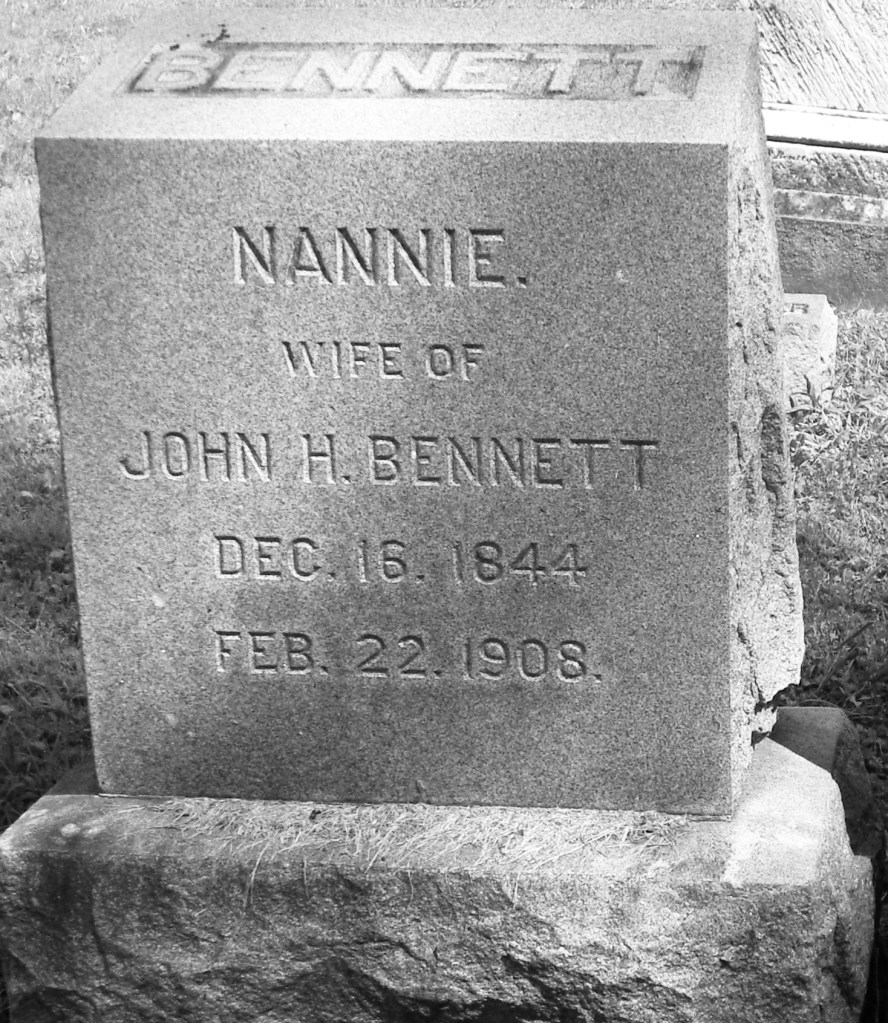
However it was that the Crouses and Bennetts first met, Nannie married John Henry on 9 September, 1863, in Frederick. They would take up homemaking at 24 West South Street and John Henry would make a living as a wheelwright. The marriage produced seven children: Carrie Elner (1864-1905), Henry Luther (1868-1950), Robert Alton (1870-1950), Annie May (1872-1935), Jessie (1875-1951), Lewis William (1878-1949), and Norma (1881-1937).
When her brother Charles spoke to the Tribune in 1901, he supplied the newspaper with the only known image of his sister. The cabinet card photo, taken in the mid to late 1890s, shows Nannie in her fifties and proves that the description of her fresh beauty in September 1862 was not hyperbole.
Nannie Crouse Bennett
By 1906, Nannie was ill with liver cancer, which caused her death on 22 February, 1908, aged 63. After a service held in the family home on West South Street, the coffin was carried away by six of her nephews acting as pallbearers. She was buried in Mount Olivet Cemetery.
At the time of Nannie’s death, the Valley Register and Frederick News included the tale of that September day as part of her obituary and also printed a poem by author and native son Thomas Chalmers Harbaugh.
“Middletown remembers yet How the tide of war was stayed, And the years will not forget Nancy Crouse, the Valley Maid.”
Albumen Cabinet Card of Abigail Hitchcock in widow’s weeds, circa 1872. Written on reverse: “Aunt Abby Hanks Hitchcock. Gubelman, 77 &79 Montgomery St., Jersey City.” Ann Longmore-Etheridge Collection.
Abigail Irena Hanks was born on 10 November, 1816, in Mansfield, Tolland County, Connecticut. She was the daughter of Rodney Hanks (1782–1846), a Mansfield, Connecticut, manufacturer of silk machinery, woolen goods, cannon swabs, and other machinery, and Olive Freeman (1783–1816). The extended Hanks clan were large-scale makers of silk, a business that had begun with the family importing English mulberry trees to Connecticut for the nurture of silkworms.
Abigail’s renowned uncle, Benjamin Hanks, cannon, bell, and clockmaker.
The Hanks family was also associated with the Meneely (Watervliet) foundry, which closed the mid-20th Century after more than a hundred years providing bells for various carillons and chimes throughout the Western hemisphere. The bell foundry was established 1826 in Gibbonsville, New York, on the west bank of the Hudson River, a few miles north of Albany, by Andrew Meneely, a former apprentice in the foundry of Benjamin Hanks (1755-1824), Abigail’s uncle, who is generally credited with being the first bronze cannon and church bell maker in the United States. Hanks is believed to have worked at a foundry connected with patriot Paul Revere and was a drummer during the Revolutionary War.
When it was Koogle’s chance to defend himself, he told the judge and state’s attorney that he had not committed the shooting nor any of the burglaries.
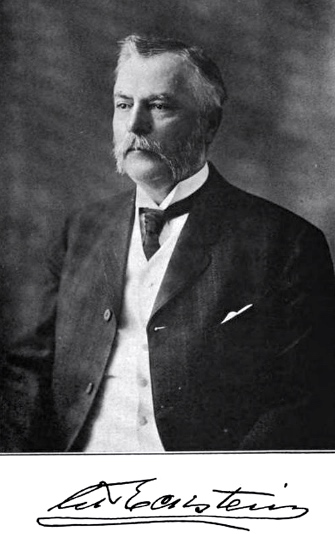
Amazingly—almost miraculously—on 8 August, just four days after the shooting, George Waters Bittle was able to give testimony to Justice of the Peace Christian H. Eckstein whilst propped up in a chair in the bedroom of his Main Street home. Also present during the testimony was State’s Attorney for Frederick County Arthur D. Willard (1872-1959), the counsels for the defense, the accused, Captain Jacob Koogle, Dr. Ralph Browning, Rev. Otto E. Bregenzer (abt. 1877-1920) of St. Paul’s Lutheran Church, and Mrs. Bittle, the former Mary Elizabeth Routzahn (1865-1936.)
Bittle told Willard and Eckstein that on the night of the attempted burglary, “He had seen the burglar around his place early in the evening [and] though he recognized his walk,” the Frederick News noted. “The party wore a dark slouch hat, dark coat, and trousers. He did not see the face of the man at the door sufficiently well to say it was George Koogle, but he could say from what he had seen of Koogle earlier in the evening and what he could say of the man at the door he thought it was George Koogle, although he was sorry to say so.” The dolorous look Bittle may have given Captain Koogle as he spoke can well be imagined.
Justice of the Peace Christian H. Eckstein heard Bittle’s testimony.
Bittle, like his fellow citizens, probably saw Koogle as somewhat of a superhero. For example, the merchant would surely have heard this wartime anecdote from Myersville veteran Daniel Mowen, Koogle’s brother-in-law, who included it in a series of articles he wrote for the newspaper, The Globe: “At the assault of Petersburg, on the 17th of June, 1864, and while the Seventh [Maryland Regiment] was in line, Jacob Koogle, first sergeant of company, saw a shell bounding toward them. He called to the men to ‘look out!’ Watching its course, he attempted to step out of its way when it lodged against his breast. Its force being about spent, he threw it off with his arm without injury to himself and, as it didn’t explode, it injured no one else.” This was before the affair of stealing of the Confederate colors and returning with the secessionist banner and a uniform full of bullet holes. Those twin events could make anyone wonder whether Koogle was divinely blessed.
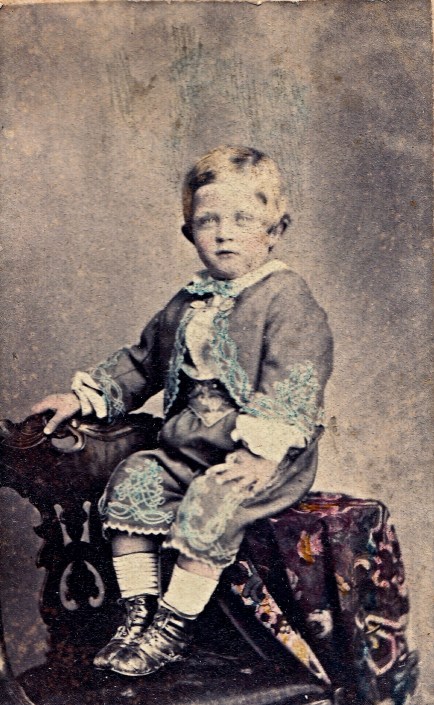
Handpainted carte de visite of “Little Willie, Uncle George and Aunt Emma’s son,” likely taken between 1860-1863. Many Mid-Maryland children of this generation witnessed the war and carried these memories well into the 20th Century. Ann Longmore-Etheridge Collection.
When James Hard died on 12 March, 1953, in Rochester, New York, the final firsthand battle memories from U.S. Civil War were forever lost. Hard was the last verified soldier on either side of the conflict who actively fought—in his case, as a teenaged infantryman in the 37th New York Volunteer Infantry Regiment—at First Bull Run, Antietam, Chancellorsville, and Fredericksburg.
There were others still alive, however, such as John Caleb Leatherman, who were children and teens during the war years. In Maryland’s Frederick and Washington Counties, and just across the Potomac in West Virginia’s Shepherdstown, these elders possessed indelible memories of South Mountain, Antietam, or Monocacy lain down through civilian, juvenile lenses.
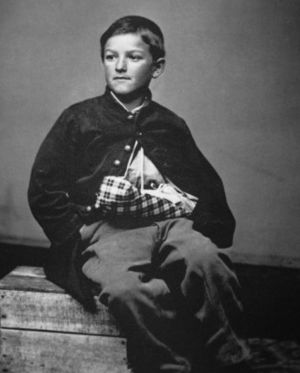
Twelve-year-old Edward Black (1853–1872) had his hand and arm shattered by an exploding shell whilst serving as a Union drummer boy. Courtesy Library of Congress.
One example was Jacob E. Eavey. On 15 August, 1948, he died in the Guildford Nursing Home in Boonsboro at age 97 after a professional life spent running a grocery shop at 29 North Main Street, Keedysville. Eavey was the son of Samuel Eavey (1828-1911) and Catherine Ecker (1828-1868) and was born in Porterstown on 21 October, 1850. He would marry Clementine Eugenia Keedy (1850-1929) and father five daughters and one son.
Like John Leatherman, Eavey kept vivid memories of 16 September, 1862. Whilst John spent the 16th in Middletown, helping his mother nurse wounded soldiers from the previous day’s fighting, 12-year-old Jacob spent it “sitting on a fence beside the road, watching the soldiers striding down South Mountain” on their way to meet their individual destinies at the Battle of Antietam, reported the Hagerstown Daily Herald of 16 August, 1948. When fighting kicked off at Sharpsburg on the 17th, Eavey stood near his parent’s smokehouse in Porterstown, just to the east of Sharpsburg, as a Rebel shell tore through and wrecked the building but spared his life.
“Young John sat fascinated all day, watching the trajectories of shells above the trees of the mountain, followed by the little puffs of smoke that marked their targets.”
John C. Leatherman (1852-1952) and his first wife Susan Rebecca Grossnickle Leatherman (1852-1909).
Just short of his 97th birthday, in May 1950, John Caleb Leatherman spoke to reporter Betty Sullivan from the Hagerstown Daily Mail about his life and boyhood memories of the Union blue and Confederate grey armies’ descent on Frederick County, Maryland. The interview he gave is a boon for historians, as firsthand accounts from the Jackson and Catoctin districts—including Myersville, Wolfsville, Ellerton, Harmony, Jerusalem, Pleasant Walk, Highland, and Church Hill—are almost nonexistent. I recounted two of these pertaining to George Blessing, “Hero of Highland,” in a previous article, and Leatherman’s secondhand testimony was also integral to that reportage, as the Leathermans and Blessings knew each other well.
John Leatherman was born 15 December, 1852, in Harmony (also known for a time as Beallsville)—a nascent town that never fully took root. Today, it is a series of farms and old buildings set along Harmony Road. John was the son of farmer George Leatherman (1827-1907) and his wife, Rebecca Elizabeth Johnson (1827-1908), who married 16 December, 1847. The 1860 Census records that George Leatherman’s farm was worth more than $8,500 and his personal estate more than $4,000—some $360,000 in today’s dollars. At that time, the family had six children, the oldest of whom, Mary (b. 1848) was enumerated as deaf and mute.
John’s father, Elder George Leatherman.
Although he was listed in several Union draft registers of the Jackson District, it’s likely that Leatherman, who was in his 30s during the war, would have opposed serving. He was a devoted member of the Brethren, a pacifist German Baptist sect also known as the Dunkards, was elected to the clergy of the Grossnickle Meeting House in 1865, and would become a church elder in 1880. In an earlier article about Robert Ridgley, the longhaired still-breaker of Myersville, I wrote that Ridgley wanted to be buried near Leatherman, of whom he said, “I feel that I owe practically all from a spiritual standpoint to this Grand Good Man.”
My attention was drawn by the unusual name carved into one tombstone: Raisin Pitts, a Confederate private who died 26 September, 1862, now buried in a Yankee town in a Union state, far from home.
The grave of Raisin Pitts, Mount Olivet Cemetery, Frederick, Maryland, photographed by the author on Confederate Memorial Day, 28 April, 2016.
Recently, and quite serendipitously, I visited Mount Olivet Cemetery—the preeminent burial grounds of Frederick County, Maryland. Francis Scott Key, who in 1812 wrote the poem that became the National Anthem, reposes there. Also interred at Mount Olivet are prosperous Victorians and Edwardians, Colonial and Federal-era area residents moved from their original gravesites in small family plots and cemeteries around the county, and Civil War soldiers who fought for the Confederacy but breathed their last as Union captives.
It was Confederate Memorial Day, a solemn remembrance of which I was unaware when a friend and I decided to visit the cemetery. We found Mount Olivet’s Confederate graves bedecked with flags. Reenactors laid wreaths after a small, bagpipe-led parade.
Confederate graves at Mount Olivet. Raisin Pitts is buried in this row.
My attention was drawn by the unusual name carved on one tombstone: Raisin Pitts, a Confederate private who died 26 September, 1862, now buried in a Yankee town in a Union state, far from home. My curiosity propelled by his unusual—and unlikely—name, I decided to search for more about Private Pitts.
Whenever the modern world seems unprincipled and bleak, take comfort. It ran amok in the old days, too, as these Victorian news clippings attest.
York, Pennsylvania Gazette, Sunday, 5 December, 1897
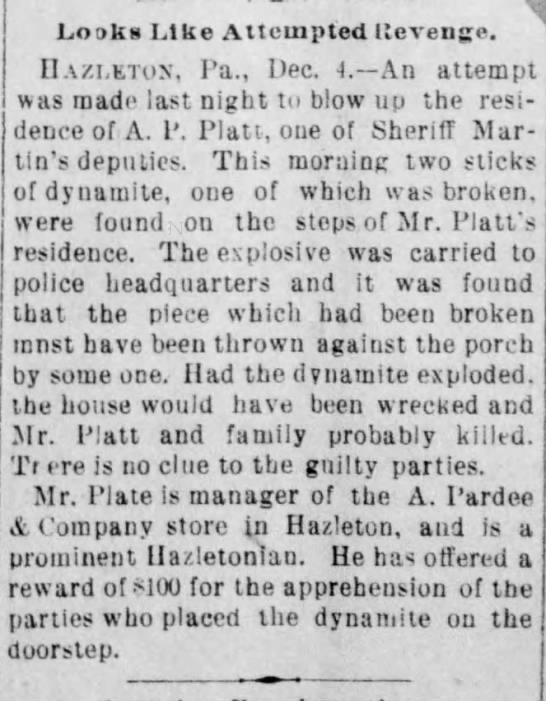
“Looks Like Attempted Revenge”
“Hazelton, Pa., Dec. 4.—An attempt was made last night to blow up the residence of A. P. Platt, one of Sheriff Martin’s deputies. This morning, two sticks of dynamite, one of which was broken, were found on the steps of Mr. Platt’s residence. The explosive was carried to police headquarters and it was found that the piece which had been broken must have been thrown against the porch by someone. Had the dynamite exploded, the house would have been wrecked and Mr. Platt and family probably killed. There is no clue to the guilty parties.
“Mr. Platt is the manager of the A. Pardee & Company store in Hazelton, and is a prominent Hazletonian. He has offered a reward of $100 for the apprehension of the parties who placed the dynamite on the doorstep.”
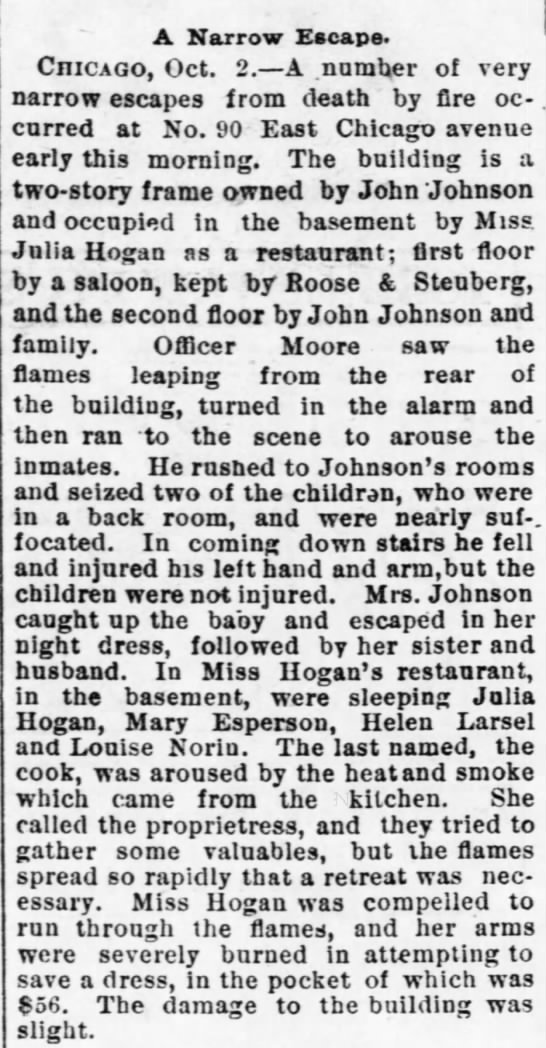
“Chicago, Oct. 2.—A number of very narrow escapes from death by fire occurred at No. 90 East Chicago avenue early this morning. The building is a two-story frame owned by John Johnson and occupied in the basement by Miss Julia Hogan as a restaurant; first floor as a saloon kept by Roose & Steuberg, and the second floor by John Johnson and family. Officer Moore saw the flames leaping from of the rear of the building, turned in the alarm and then ran to the scene to arouse the inmates. He rushed to Johnson’s rooms and seized two of the children, who were in a back room, and were nearly suffocated. In coming downstairs, he fell and injured his left hand and arm, but the children were not injured. Mrs. Johnson caught up the baby and escaped in her night dress, followed by her sister and husband. In Miss Hogan’s restaurant, in the basement, were sleeping Julia Hogan and Mary Esperson, Helen Larsel and Louise Norin. The last named, the cook, was aroused by the heat and smoke, which came from the kitchen. She called the proprietress, and they tried to gather some valuables, but the flames spread so rapidly that a retreat was necessary. Miss Hogan was compelled to run through the flames, and her arms were severely burned in attempting to save a dress, in the pocket of which was $56. The damage to the building was slight.”













 "Your Dying Charlotte"