Fashion Fix

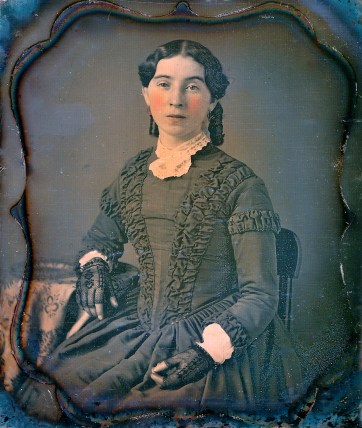
“The woolen dress in this portrait has been finished with self puffing to emphasize the waist taper, the shoulder caps, and the sleeve cuffs.”

6837086278_d05b598969_h
Dennis Waters, who conserved this 1/6th-plate daguerreotype in 1994, helpfully left a note on the reverse that says, “Pemberton & Co, Conn. Very rare plate mark. C. 1850.” Ann Longmore-Etheridge Collection.

This circa-1851 daguerreotype, now in my collection, was published on page 126 of Joan Severa’s seminal work on nineteenth century fashion, My Likeness Taken. Of it she wrote, “The woolen dress in this portrait has been finished with self puffing to emphasize the waist taper, the shoulder caps, and the sleeve cuffs. The fitted and darted bodice has the shorter waist point of the [1850s], and the skirt is taken into the waistline by small knife pleats. It is interesting to speculate on the color of the dress, as it is not black. Cherry red is a possibility, but soft brown is more likely.

“A standing band of whitework, with lappets crossed, is worn at the neck, and fine, close undersleeves extend the somewhat shortened sleeves. The netted mitts cover the fingers to the first finger joint, a new style for the year.

“The hair is done in long curls hanging behind the ears on either side.”

The figure at bottom left of this April 1851 fashion plate wears a similar dress and can help us visualize the full length gown worn by the daguerreotype’s subject. Ω

april

European Daguerreotypes

Europeana.eu offers up 2 million historical photographs that bring the old Europe and its people to life.

dag1
Courtesy Nordiska Museet.

In this daguerreotype an unknown woman sits in a high-backed chair, dressed in a patterned dress with elbow-length sleeves and a wide slanted neckline. The white paper passe-partout is printed with a gold decorative pattern and the stamp “Daguerreotype by J. W. Bergström.” According to Nordiska Museet, Johan Wilhelm Bergström (1812-1881) was born in Kungsholmen to a carpenter’s wife and died quite wealthy, after a decade as a leading daguerreotypist and a career as an inventor.

dag3
Courtesy Victoria and Albert Museum, London.

According to the Victoria and Albert Museum, “This is one of the first daguerreotypes ever taken in the UK. Landscape view of London: Parliament Street from Trafalgar Square. In the foreground to the right is a statue of Charles I mounted on horseback, seen from the back, on a raised stone plinth or column with carved royal arms, surrounded by a palisade of railings and protected by stone bollards. Parliament Street goes to the left, lined with tall buildings of five or more storeys, most of which have awnings over the street. The skyline shows many chimneys and chimney-pots. The pavements have lamps at regular intervals. On the left side of the street is a line of vehicles and drivers. In the distance is the Royal Banqueting House. Note the man in a top hat sitting slumped against the lamp-post in the middle foreground, with four bollards around him.”

Continue reading “European Daguerreotypes”

On This Day for Mothers

“Mothers, I believe, intoxicate us. We idolize them and take them for granted. We hate them and blame them and exalt them more thoroughly than anyone else in our lives. We sift through the evidence of their love, reassure ourselves of their affection and its biological genesis. We can steal and lie and leave and they will love us.”—Megan Mayhew Bergman

4715860088_170bbac360_o
From left, my grandmother, Lillian Marie Fox; my great-grandmother, Rebecca Murdock Fox; and my great aunt, Rebecca Fox, posed for this tintype in about 1901. Ann Longmore-Etheridge Collection.
11178332634_3e9d60169a_o
This tintype’s sitters were a beautiful turn-of-the-century mother and daughter who appear to be African-American. Courtesy Jack and Beverley Wilgus Collection.
5099229059_1a590a3bd5_o
An American mother sat outside with her children for this ambrotype taken on a clear day in about 1880. Ann Longmore-Etheridge Collection.
3360043331_837fa3d3cd_o
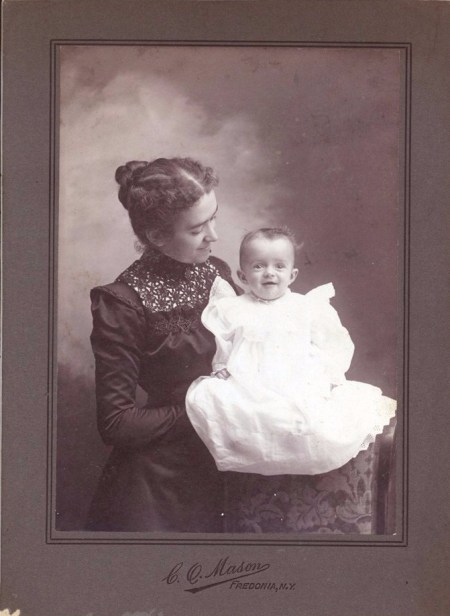
An adoring, late-Victorian mother and delighted child were the subjects of this albumen print on cardboard. Photo Courtesy Price and Zimmer Collection.
15981569687_60f65482d1_k
An unknown lady tenderly holds her baby in this circa-1875 carte de visite by Hills & Saunders, Oxford, England. Courtesy James Morley Collection.

Ω


I wish all mothers a happy day of love and peace. For all you have done and will do, you are saluted.

A Victorian Lady’s Guide to Hair Care

Here is a full and excellent article on how Victorian women cared for their hair by historian Mimi Matthews. Thrills and pomade await, gentle readers! Speed!

Mimi Matthews's avatarMimi Matthews

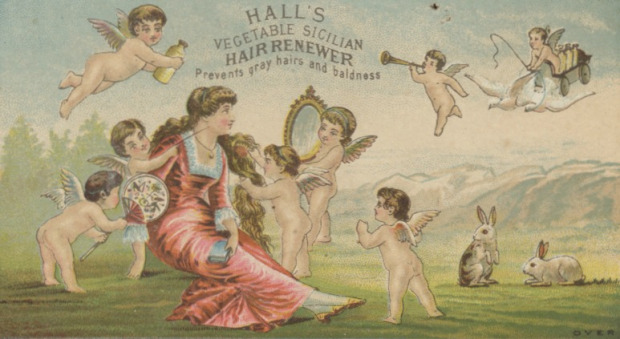
Hall's Vegetable Sicilian Hair Renewer, 19th Century Advertisement. Hall’s Vegetable Sicilian Hair Renewer, 19th Century Advertisement.

Since biblical times, a woman’s hair has been known as her crowning glory.  This was never more true than in the Victorian era – a span of years during which thick, glossy hair was one of the primary measures of a lady’s beauty.  But how did our 19th century female forebears maintain long, luxurious hair without the aid of special shampoos, crème rinses, and styling treatments?  And how did they deal with hair-related complaints such as an oily scalp, dry, brittle tresses, or premature greyness?

View original post 1,582 more words

Alice Isn’t Dead: A Cautionary Tale, a Family History

Upon receipt of the carte, I scanned, enlarged, and enhanced the image. Immediately I became aware of motion blur caused by the child’s arms moving during the exposure.

6905559274_525dd552e7_h
Mary Jane Stayman Culley holding eight-week-old Alice Maud Culley in August 1879. Albumen carte de visite. Ann Longmore-Etheridge Collection.

Within eBay’s vintage and antique photo subcategory, every slightly odd-looking baby is a dead baby. I confess that when I saw the listing for the carte de visite (CDV) above, I thought this was an infant gone, never to grow up, forever to sleep, dressed in angelic white and buried in a tiny coffin so unfairly made-to-fit, her grave topped by a small stone lamb. This was cruel fate; this was a Victorian postmortem. But those who explore the Victorian propensity to mark gut-wrenching loss via photography should take this story as a cautionary tale, not unlike the one I featured last November, “To Be, or Not to Be, a Victorian Postmortem.”

The CDV’s backstamp is that of “John Davies, Portrait & Landscape photographer, BelleVue High Street, Weston-super-Mare. Formerly with the late T. R. Williams, London, Photographer to the Queen and Royal Family.” There is also a handwritten inscription: “Alice Maud Culley, 8 weeks old, Aug. 1879.”

Upon receipt of the carte, I scanned, enlarged, and enhanced the image. Immediately, I was aware of motion blur caused by the child’s arms moving during the exposure. Alice Maud Culley wasn’t dead. I could then plow into the public records because of the fortuitous identification upon the reverse.

Continue reading “Alice Isn’t Dead: A Cautionary Tale, a Family History”

Photo-Multigraphs: The Mirror and the Camera

“It was the purpose of the author to describe a number of novel and curious effects that can be obtained by the aid of the camera, together with some instructive and interesting photographic experiments.”—F. R. Fraprie, 1922

5._MultiMnCab2
A photo-multigraph cabinet card by A. M. Lease of Lancaster, Pennsylvania, circa 1895.

By Beverly Wilgus

In 1893, H. P. Ranger was granted Patent No. 505,127 for a “Mirror For Use In Photography.” This was a device comprised of two adjustable mirrors set at an angle. When a subject was placed in front of it, his or her image was reflected in each mirror and that reflection was again reflected, resulting in five or more figures—the number of figures determined by the angle of the mirrors.

1._MirrorPatent

The above schema is from an article published in Scientific American in the 1890s that was included in the 1896 book Photographic Amusements by Frank R. Fraprie and Walter E. Woodbury. My husband and I own a copy of the 1931 edition that still contains the original illustrations.

2._mirror_top

Also from the book is the illustration above: “Diagram Showing The Method Of Production Of Five Views of One Subject By Multiphotography.”

Continue reading “Photo-Multigraphs: The Mirror and the Camera”

Mommy and Me

“Because I feel that in the heavens above
The angels, whispering one to another,
Can find among their burning tears of love,
None so devotional as that of ‘Mother,’
Therefore, by that dear name I have long called you,
You who are more than mother unto me.” — Edgar Allan Poe

8673431850_5ae172a421_h
A proud mother and her adorable daughter pose in this 1/6-plate daguerreotype, circa 1850. The mother wears a fashionable “Jennie Lind” collar, made popular by the soprano Jennie Lind, the “Swedish Nightingale,” who toured North America from 1850 to 1852 under the relentless promotion of showman P. T. Barnum. Ann Longmore-Etheridge Collection.
8754664382_17b1ed2681_o
This mid-1870s tintype from the Jack and Beverly Wilgus Collection includes a shy “hidden mother” who is revealed with the removal of the decorative paper mat.
5265855274_ecf823dfb1_b
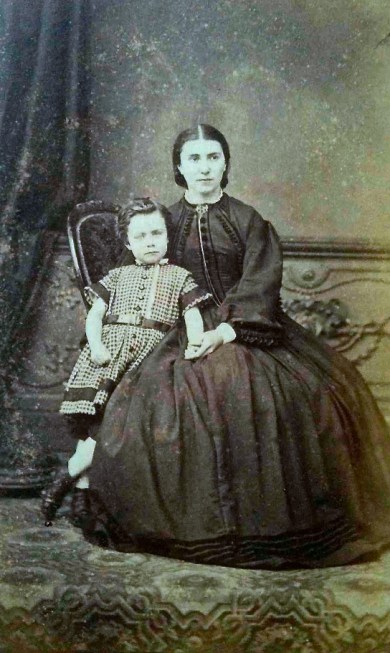
A nicely dressed English mother and son photographed in about 1862. Her smoothed and center-parted hair, pagoda sleeves, full hoop, and applied decorative trim was at the height of fashion. Her boy’s checkered, belted, one-piece dress was perhaps in shades of red and tan, similar to the fabric used in this earlier example. This albumen carte de visite is from the Caroline Leech Collection, originally photographed by G. J. Tear, Clapham Road, London.
11131720303_bcd7c86041_b
A mother, son, and baby in a pram enjoying a sunny day in England during the late 1920s. Scanned film negative from the James Morley Collection.
9860148255_605fce91a3_h
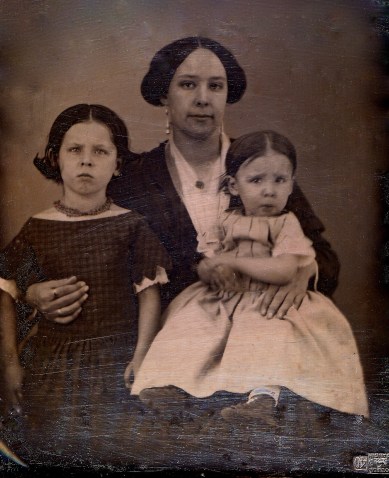
An American mother and two daughters pose for an adorable 1/6th-plate Gaudin daguerreotype, circa 1852. The plate is marked “Double, A. Gaudin, 40,” the hallmark of Antoine Gaudin & Bro., 9 Rue de la Perle, Paris, a French company whose products were widely used by daguerreians throughout America. The older daughter is wearing a “protective” coral necklace. Coral was thought to have special efficacious properties to safeguard children. Ann Longmore-Etheridge Collection.

Ω


A quick note: I will be having surgery on Tuesday, 4 April, and will be taking at least a four- or five-day hiatus to recover. I will return as soon as possible. Promise.

Men of Mystery

A selection of unidentified daguerreotype and ambrotype portraits.

5679251533_186706854b_o
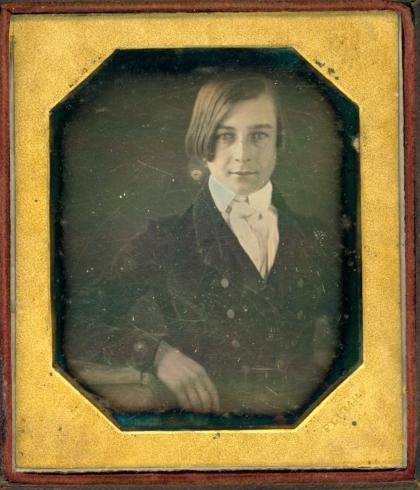
A very early daguerreotype of a personable young man that dates to about 1843. Courtesy Price and Zimmer Collection.
5693420331_498234a042_b
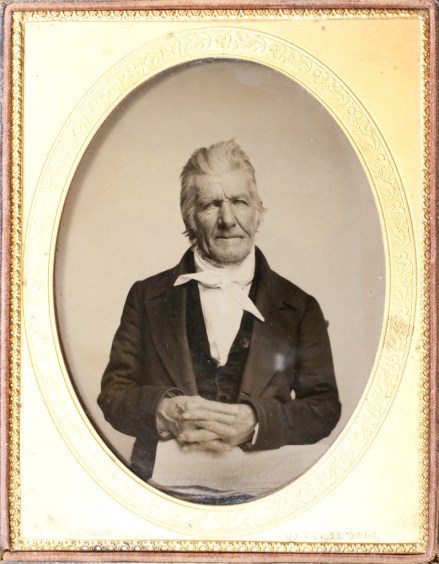
The rugged and remarkable older gentleman who sat for this ambrotype in about 1852 probably first opened his eyes to the world in the 1780s or 1790s. Courtesy Price and Zimmer Collection.
20477909888_2eb9174f52_o
A painterly 1/6th-plate daguerreotype of a breathtaking young man. His fashions date this portrait to about 1850. Ann Longmore-Etheridge Collection.
2465492782_412c6d8937_o
An unusual profile daguerreotype taken in about 1850. Courtesy Jack and Beverly Wilgus Collection.
15387966094_29d327bfee_k
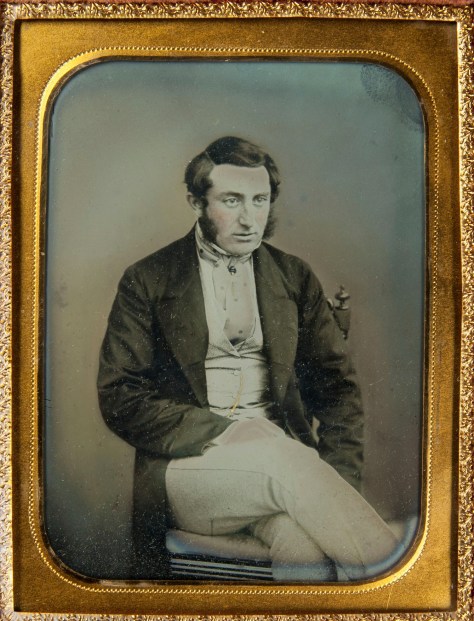
A 1/4th-plate ambrotype of an unknown man intently focused on a point in the distance. Taken circa 1860. From the James Morley Collection.
5417551681_21bebe0d15_b
A man and his dog, whose front paws were held to keep them from moving during the long exposure. This 1/6th-plate ambrotype, probably from the late 1850s, is courtesy of the Caroline Leech Collection.

Ω

On Top of the Moon

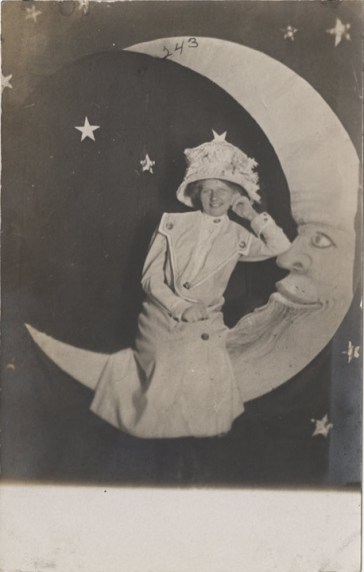
A selection of paper-moon real photo postcards from the collection of Jack and Beverly Wilgus. All date from the second decade of the 20th Century.

16183808464_ddf61b6376_o
A mother and her daughters sit happily on a plain, but elegant, sliver of moon.
8090640566_c408d7f515_o
Beverly writes, “I like the smile and relaxed air of this young man who holds the nose of the man in the moon. I wonder why the paint on the nose of the man in the moon is not worn off, since so many of my cards show the sitter holding the nose.”
30095131171_e86240e15c_o
A delightfully saucy real photo postcard by the Electric Post Gallery, Fort Worth, Texas.
7810793704_4dd1a2f3cb_o
A flirty moon tries to chat up a pretty gal.
9624076205_0c9bb25c98_o
A fashionable young lady poses on a friendly moon surrounded by stars and a sky-skimming biplane.

Ω


All of Jack and Beverly’s paper moon images can be seen here

Do you have a vintage image or artifact that might educate and entertain? If so, I would be delighted to hear from you.


Adorable Moppets 2.0

The second of an occasional series.

8651290067_5863e2dfe5_b
Baby in a barnyard feeding chickens. Glass-plate image, circa 1900. Photo courtesy Price and Zimmer Collection.
5480285698_b5b958c74b_b
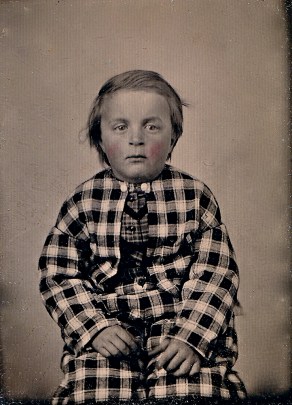
Boy in checkered suit. Tintype, circa 1870. Ann Longmore-Etheridge Collection.
5702974559_f288904e44_b
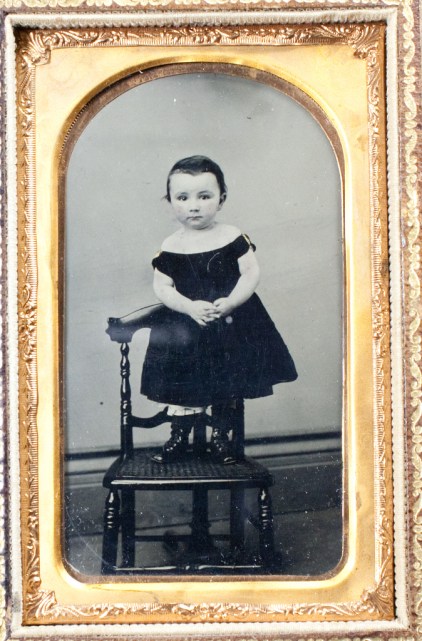
Boy standing on chair. Tintype, circa 1862. Courtesy Price and Zimmer Collection.
23249091575_575a7853fc_b
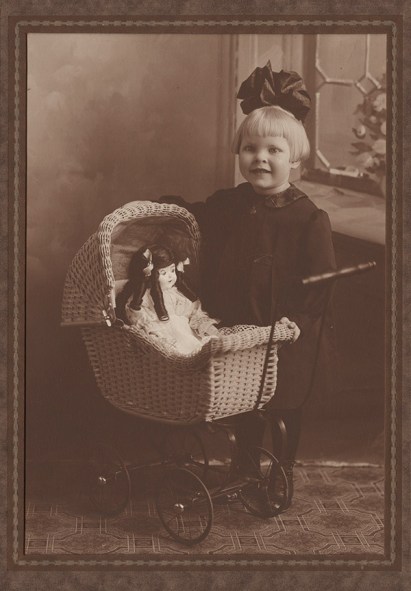
A doll with a doll. Paper print, circa 1920. Courtesy Jack and Beverly Wilgus Collection.
21441206573_d97c13299b_h
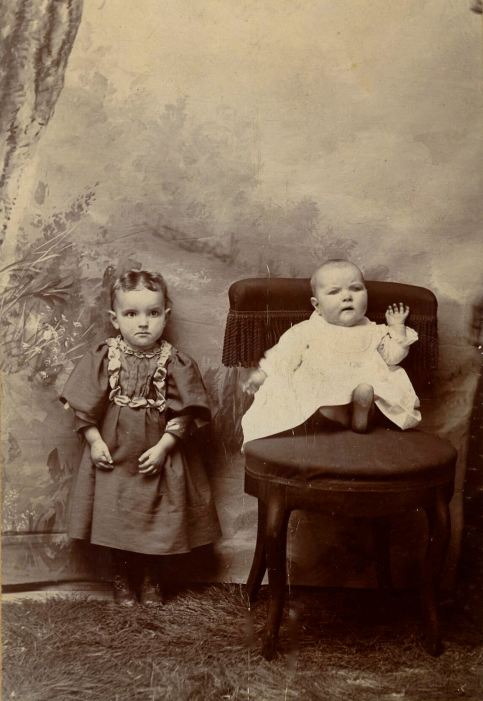
Misses Unimpressed and Fuhgetaboudit. Albumen cabinet card, circa 1875. Ann Longmore-Etheridge Collection.

Ω