This is genuine time travel: You are looking at a sky in a southern clime taken on the early afternoon of 12 July, 1865. A handwritten paper glued to the reverse provides the exact date. When this fraction of a day was preserved, the Civil War was over but for a few months; this part of the sky was again above the United States, not the Confederacy.
There was a house amongst the trees—its triangular roof and chimney visible mid-left. The sky was bright blue and the clouds were gentle fluffs that, nonetheless, hinted rain. By them the great hot orb of the sun was obscured enough to safely see and photograph. The revolutionary iodized collodion process used by the photographer allowed images to be taken in as little as a few seconds, depending on the light, and this picture probably would have required the briefest of exposures.
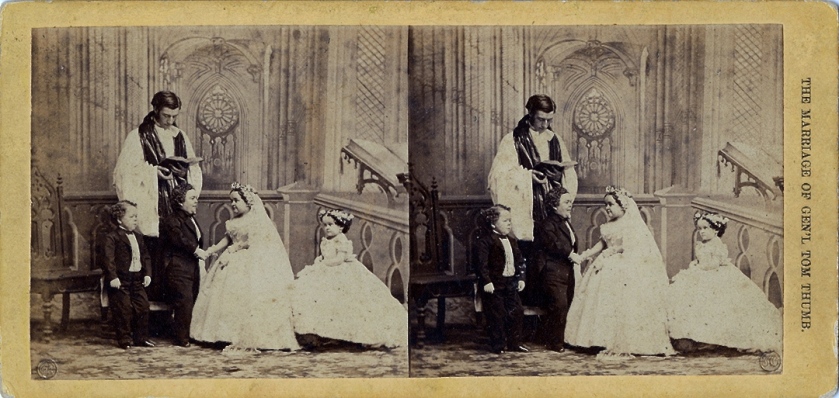
The wedding of Tom Thumb and Lavinia Warren was so popular that children in wedding attire began to reenact the marriage ceremony.
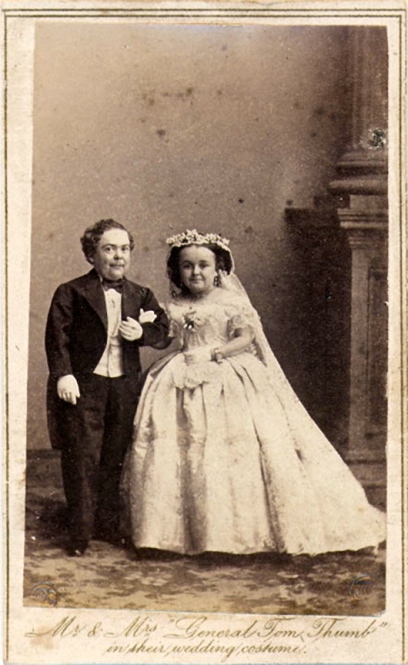
A carte de visite of the Thumb-Warren “Fairy Wedding” published by E. & H. T. Anthony, 1863. Original image by Mathew Brady.
By Beverly Wilgus
The highlight of the 1863 New York City social season was the February 10 “Fairy Wedding” at Grace Episcopal Church of two of P. T. Barnum’s “little people,” Charles Sherwood Stratton and Mercy Lavinia Warren Bump. In the theatrical world, they were known as General Tom Thumb and Lavinia Warren—he stood 2’10”; she, 2’6″. There were 2,000 invited guests and Barnum also sold tickets to the reception after the wedding for $75 each. Although 15,000 ticket requests came in, only 5,000 were available. One newspaper, the Cleveland Daily Leader, noted that after the particulars were announced by Barnum, “then followed such a universal toadyism…all for the sake of begging, buying, or stealing invitations to the wedding.”
In spite of the event’s commercial nature, Tom and Lavinia’s marriage was a true love match. (Barnum, however, thought Lavinia was too tall for Tom and that her smaller sister Minnie would have been a better choice of a bride.) Lavinia had also been romantically pursued by Thumb’s rival performer, George Washington Morrison Nutt, whose stage name was Commodore Nutt, but Lavinia’s heart belonged to the Little General from the start. After their marriage, the couple lived in domestic harmony for twenty years until Tom’s death on July 15, 1883.
A stereoview published by E. & H. T. Anthony of a reenactment of the “Fairy Wedding” in a photographer’s studio. Left to right: Best Man Commodore Nutt; Groom General Tom Thumb; Bride Lavinia Warren; and Bridesmaid Minnie Bump, Lavinia’s sister, who was also known as Minnie Warren. The minister behind them was either Reverend Mr. Wiley, who read the service, or the Reverend Dr. Taylor, who read the benediction, or possibly a costumed stand-in.
A selection of unidentified daguerreotype and ambrotype portraits.
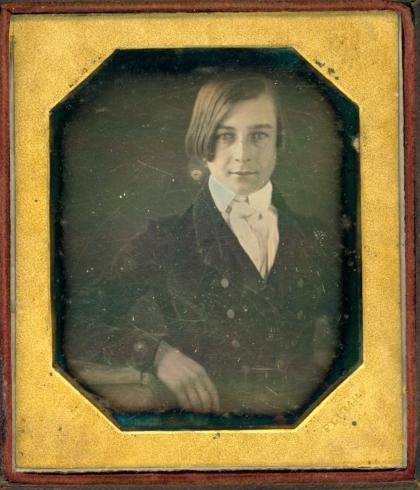
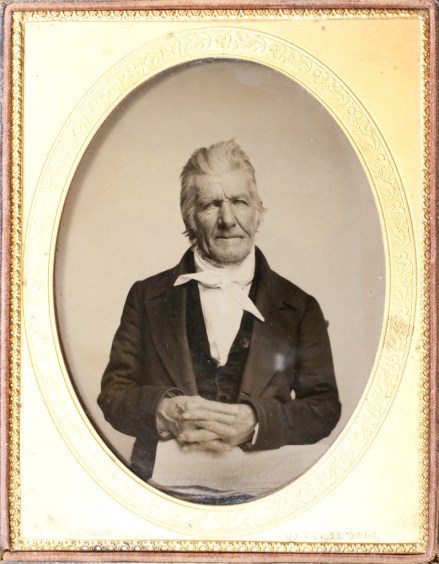
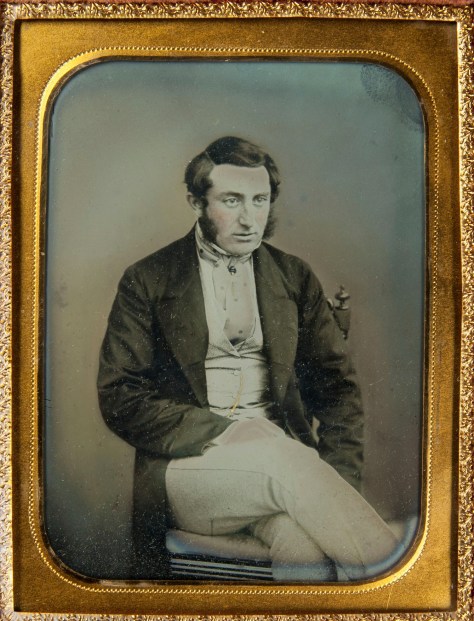
A very early daguerreotype of a personable young man that dates to about 1843. Courtesy Price and Zimmer Collection.The rugged and remarkable older gentleman who sat for this ambrotype in about 1852 probably first opened his eyes to the world in the 1780s or 1790s. Courtesy Price and Zimmer Collection.A painterly 1/6th-plate daguerreotype of a breathtaking young man. His fashions date this portrait to about 1850. Ann Longmore-Etheridge Collection.An unusual profile daguerreotype taken in about 1850. Courtesy Jack and Beverly Wilgus Collection.A 1/4th-plate ambrotype of an unknown man intently focused on a point in the distance. Taken circa 1860. From the James Morley Collection.A man and his dog, whose front paws were held to keep them from moving during the long exposure. This 1/6th-plate ambrotype, probably from the late 1850s, is courtesy of the Caroline Leech Collection.
“You shall come to your grave in ripe old age, like a sheaf gathered up in its season.”
Albumen cabinet card of funeral flowers, a coffin plaque, and a cabinet card portrait of Abial Thomas. Ann Longmore-Etheridge Collection.
On 26 March, 1900, the Alfred Sun of Allegheny County, New York, included this obituary: “Abial Thomas, son of Rowland and Prudence Thomas, was born Sept. 22, 1825, and died Mar. 2, 1900, aged 74 years, 5 months, and 10 days. He was married Sept. 25, 1845, to Mary Crandall, being one of three brothers who married three sisters. In 1848, his wife and infant child died. Mr. Thomas was married again Dec. 1, 1840, to [Ascenath] Jane Stillman. Seven children resulted from this union. Prudence, now Mrs. McHenry, who resides at Alfred Station; Rowland of Hornellsville; Mary, Mrs. Congdon of Hornellsville; Nancy, deceased; Frank of Hornellsville; Lucy, deceased; and Charlotte, Mrs. Melville Green of Hornellsville. Two brothers and one sister also survive, viz., Rowland Thomas of Alfred; Silas Thomas of Milton, Wis.; and Mrs. Alma Green of Silver Lake. Mr. Thomas was taken a little over a week before his death with acute pneumonia, and little hope of his recovery was entertained from the first. The funeral services were held at the 2nd Alfred Church, conducted by the pastor. Text, Acts 26:8. The funeral was well attended, a good many old neighbors and relatives of the deceased being present.”
Abial Thomas was a lifetime native of Alfred—an unusual locality in that there is a Village of Alfred within the borders of the eponymous town that is the site of Alfred State College, Alfred University, and the New York State College of Ceramics. Abial spent his days as a farmer and later a carpenter, never appearing in the newspapers and leaving few records; he registered for the Civil War draft, for example, but already in his late 30s, Abial did not serve.
The above detail of the cabinet card allows us to see Abial as he was late in life, as well as his coffin plaque. According to Ancestors at Rest, “In North America…the popularity of the practice of removing the plates from the coffin before burial increased. Often the coffin plates were never attached to the coffin but displayed on a stand or table next to it…. This practice started in the early 1840s and was particularly popular in the North Eastern United States, Maine, Massachusetts, Vermont, New Hampshire, New York, Connecticut, and Rhode Island…. This practice peaked in the late 19th century (1880-1899) and by the 1920s this practice had all but stopped.”
Albumen cabinet card of a floral scythe and wheat sheaf. Ann Longmore-Etheridge Collection.
After the funeral, the coffin plaques might become parts of hanging wall shrines to the deceased, which were often replete with wax-dipped linen flowers, skeletonized leaves, dyed and shaped feathers, shells, locks of hair, photographs, and other sentimental items.
The wheat sheaf amongst Abial’s funeral flowers is also worthy of note. Unseen at modern funerals, during the 19th Century the wheat sheaf was a recognized symbol of the biblical verse Job 5:26: “You shall come to your grave in ripe old age, like a sheaf gathered up in its season.” This is beautifully illustrated in the cabinet card above, which includes both elements of the verse from Job. The wheat sheaf was regularly given in tribute to the elderly.
“Her life was marked for honesty of dealings and purity of character.”
The Sabbath Recorder of 17 April, 1890, provides us a concise biography of Abial’s second wife, Ascenath Jane, who had died a decade before him. She was “born in Newport, Herkimer Co., N.Y., Oct. 10, 1818, and died at her home in Alfred, after an illness of about five weeks of heart disease, March 29, 1890, in the 72nd year of her age. Mrs. Thomas was a daughter of Ezra Stillman, long known and well remembered. Four sons and one daughter only are now left of his family. Under the ministry of Elder John Green she was baptized and united with the Seventh-Day Baptist Church of Newport, of which she remained a member until it disbanded, and she never removed her membership. Her life was marked for honesty of dealings and purity of character. In 1849, she was married to Abial Thomas, by whom she had seven children. She was held in honorable esteem by all who knew her, and casting all her cares on Jesus, she died, as she had lived, a Christian.”
Final resting place of Abial, Mary Crandall, and Ascenath Jane Stillman Thomas at Alfred Rural Cemetery, Alfred, New York. Photo by Chuck Metcalfe.Abial Thomas circa 1890.
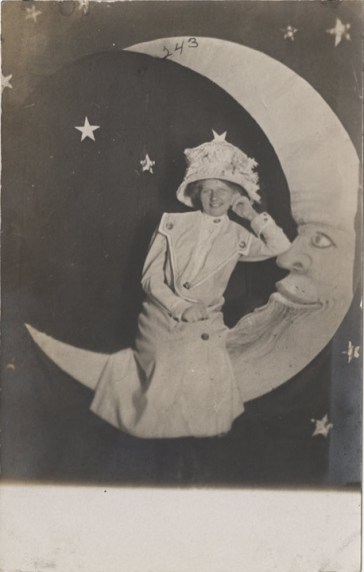
A selection of paper-moon real photo postcards from the collection of Jack and Beverly Wilgus. All date from the second decade of the 20th Century.
A mother and her daughters sit happily on a plain, but elegant, sliver of moon.Beverly writes, “I like the smile and relaxed air of this young man who holds the nose of the man in the moon. I wonder why the paint on the nose of the man in the moon is not worn off, since so many of my cards show the sitter holding the nose.”A delightfully saucy real photo postcard by the Electric Post Gallery, Fort Worth, Texas.A flirty moon tries to chat up a pretty gal.A fashionable young lady poses on a friendly moon surrounded by stars and a sky-skimming biplane.
Ω
All of Jack and Beverly’s paper moon images can be seen here.
Do you have a vintage image or artifact that might educate and entertain? If so, I would be delighted to hear from you.
Although there had been settlers in the area since the 1830s, the Lillibridges were part of an immense rush of newcomers to the Iowa territory during the 1850s.
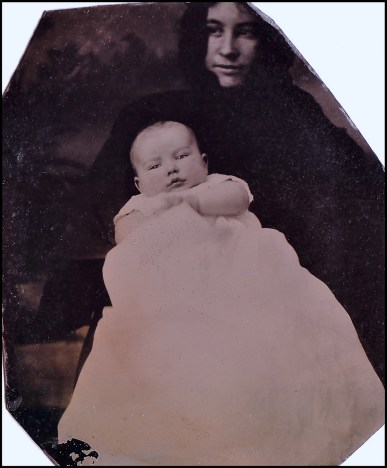
Adeline Young Lillibridge holding her infant son, Clair. Tintype, 1876. Ann Longmore-Etheridge Collection.
Today, the prairies of Iowa are all but gone—their restoration the scheme of environmentalists and concerned volunteers. But when these great grass seas last existed, it was the grandparents of the baby above, Clair Miles Lillibridge, who arrived to radically reshape them.
Clair’s father Leverett Lillibridge, born 25 June, 1851, was the son of John Lillibridge (b. 1816) and Mary Rexford (b. 1815), who married in Lebanon, Madison County, New York, 25 May, 1836, and had seven children, of which Leverett was the fourth. The family went west to what became the town of Manchester, Delaware County, Iowa, almost a decade before Leverett’s birth in 1851. The namesake of John and Mary’s son was his maternal grandfather, early settler Leverett Rexford, who in 1841, according to The History of Delware County, Iowa and Its People, “built a log cabin near the Bailey home, which was later inhabited by John Lillibridge.”
Although there had been settlers in the area since the 1830s, the Lillibridges were part of an immense rush of newcomers to the territory during the 1850s. “Families camped at the Mississippi, waiting their turn for ferryboats to the other side. In only a few years these settlers would turn the forests and prairies into plowed fields,” notes Iowa Public Television. “Farmers arriving from the many different regions of the United States brought their special agriculture with them. Those from New England and New York carried the seeds for plum, apple and pear trees. Kentuckians brought their knowledge of improved seed and livestock breeding. From Pennsylvania and Ohio fine flocks of sheep came to graze in the dry pastures of southern Iowa.”
One harrowing story of the early years of Manchester took place when Leverett Lillibridge was two. “Jane and Eliza Scott, whose home was near Delhi…in the spring of 1853, attempted to ford Spring Branch, a mile above Bailey’s, but the water was so high that their horse and wagon were swept [away] and the horse was drowned. The current carried one of the girls safely to shore, but the other was drawn into the eddy but was finally rescued by her sister, who succeeded in reaching her with a pole and drawing her to shore. One of the girls reached Bailey’s cabin, but was so exhausted she could not for some time explain the situation. As soon as she made herself understood, Mrs. Bailey left her and hastened to the locality where the other girl was expected to be found. On her way she met John Lillibridge and they together carried the insensible girl from where they found her to Mr. Lillibridge’s horse and placing the limp body on the animal’s back, she was conveyed to the Bailey home, where both the unfortunate girls were given every attention.”
James Morley writes of this ambrotype of Channon Post Office & Stationers, Brompton Road, London, circa 1877: “I have found historical records including newspapers, electoral rolls, and street directories that give Thomas Samuel Channon at a few addresses around Brompton Road, most notably 96 and 100 Brompton Road. These date from 1855 until early into the 20th century. These addresses would appear to have been immediately opposite Harrods department store.”
Ann Longmore-Etheridge Collection.
The limited research I have done on this image, which is a stereoview card marked “State Block, New Hampshire, W.G.C. Kimball, Photographer,” leads me to believe it shows mourners of Concord, New Hampshire native Franklin Pierce (November 23, 1804–October 8, 1869), 14th President of the United States (1853–1857).
The banners affixed to the carriage read “We miss him most who knew him best” and “We mourn his loss,” as well as another phrase that ends in the word “forget.” The image also features an upside-down American flag with thirteen stars.
“Poor boy! I never knew you, yet I think I could not refuse this moment to die for you, if that would save you.”―Walt Whitman
John Van Der Ipe Quick, circa-1865 albumen carte de visite copy of an earlier daguerreotype. Ann Longmore-Etheridge Collection.
The carte de visite (CDV) shows the young and almost impossibly handsome John Van Der Ipe Quick, born 27 August, 1829, in Lodi, Seneca County, New York, northwest of Ithaca. The CDV is a copy of an daguerreotype that was taken in about 1850, probably when he reached the age of 18.
John’s parents were farmer and Reformed Dutch Church member Christopher Quick and his wife Ellen Van Der Ipe, who was the daughter of John Van Der Ipe and Harriet Ten Eyck. Christopher Quick was born in South Branch, Somerset County, New Jersey, 14 August, 1798, to Abraham Quick (1766-1819) and Catherine Christopher Beekman (1766-1848). Abraham Quick, was, in turn, the son of farmer and Revolutionary War soldier Joachim Quick (1734-1816), who had been born in Harlingen, Somerset County, New Jersey, 22 July, 1734. His tombstone can be found in Harlingen Reformed Church Cemetery, Belle Mead, New Jersey. His wife, John’s great-grandmother, was Catherine Snedeker (1739-1815).
The final resting place of Joachim Quick, Revolutionary War soldier and John Quick’s great grandfather.
The gravestone of Abraham Quick, John Quick’s grandfather.
John’s father Christopher’s union with Ellen Van Der Ipe, who was born 3 November, 1798, in Neshanic, Somerset County, resulted in three daughters: Harriet Ten Eyck Quick, born 30 November, 1822; Maria (b. 1825, died young); and Catherine (b. 1827). After John arrived two more sons followed: Abram, born in 1832, and James, born in 1838. But the Quicks soon may have felt this verse from Job spoke to them most particularly: “Naked I came from my mother’s womb; naked I will return there. The Lord has given; the Lord has taken; bless the Lord’s name.”
The 1840s began pleasantly. Eldest daughter Harriet married Cornelius Peterson (b. 1823) on 8 December, 1841. Tragedy struck hard, however, when paterfamilias Christopher Quick died at age 44 on 9 January, 1842. At that time, the recorder of deaths at the Farmville Reformed Dutch Church had the habit of noting a biblical verse by the name of each entry; for Christopher Quick, he chose Mathew 6:10, “Thy kingdom come, Thy will be done in earth, as it is in heaven.”
Christopher was buried in Lake View Cemetery, Interlaken, Seneca County, New York. In his Will, he bequeathed each of his children $100. His wife was left in charge of his property until his youngest child turned 21, then his estate was to be evenly divided between the children with one-third for his widow.
Harriet became pregnant at about the time of her father’s death, and her first child, a son named Christopher Quick Peterson in honor of his grandfather, was born 8 November, 1842. A life was taken and a new life given, but the cycle was far from finished: The youngest Quick, James, died 29 November, 1843, aged four years, eight months, and 15 days. (The registrar of deaths chose Isaiah 3:10: “Say ye to the righteous, that it shall be well with him: for they shall eat the fruit of their doings.”) The following year, John’s sister Harriet bore another son, Peter. In 1848, there was the birth of a third son, John Bergen Peterson, as well as the death of John’s little brother, Abram Quick, on 18 April, aged 16.
The 1850 Census enumerated the surviving Quick family in Lodi, with mother Ellen Quick running the family farm valued at $5,500. John was a laborer there, along with 14-year-old William Peterson, who may have been brother-in-law Cornelius’s younger brother. There was one more birth—that of Harriet’s son Abram, on 16 April, followed in short order by the death of John’s sister Catherine Quick on 1 October. A final Peterson child—this time a daughter named Mary, was born 1 November, 1856. (Happily, all of the Peterson children thrived and lived into the 20th century.)
A decade later, on the 1860 Census of Covert—a Seneca County town not far from Lodi—Ellen, John, and William Peterson lived with Hannibal and Maria Osborn and their children—the Quick family farm presumably sold. Osborn was a sawyer—a man who sawed wood, particularly using a pit saw, or who operated a sawmill. John and William were listed as sawyers as well, and this may have been where John’s career rested had the Civil War not removed him from his native state.
John joined the Union Army on 6 August, 1862, at age 29, for a three-year term, entering as a private in the 126th New York Infantry, according Civil War muster roll abstracts. In his enlistment records, John was described as having blue eyes, brown hair, a fair complexion, and standing 5’8″.
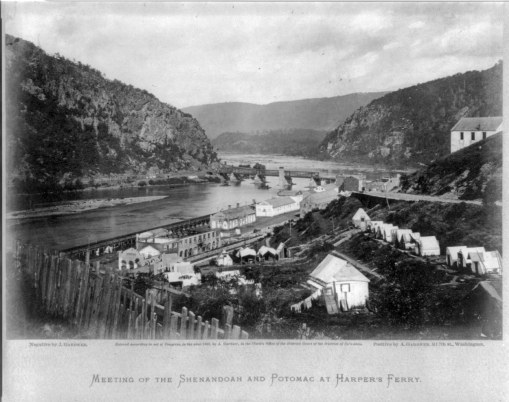
Harpers Ferry, where John Quick first saw battle during the Civil War.
By September 1862, John was in Harpers Ferry, Virginia (now West Virginia). On 12 September, the troops of Confederate Major General Stonewall Jackson attacked and captured the Union garrison stationed there. The muster rolls state that John surrendered to the enemy on 15 September and was paroled 16 September. The Union Army: a History of Military Affairs in the Loyal States, 1861-65, explains, “The men were immediately paroled and spent two months in camp at Chicago, Ill., awaiting notice of its exchange. As soon as notice of its exchange was received in December, it returned to Virginia, encamping during the winter at Union Mills.”
The muster rolls note that John was present during the entirety of 1863, which means that he fought at Gettysburg. According to the regimental history, “In June, 1863, [the 126th] joined the Army of the Potomac, and was placed in Willard’s Brigade, Alex. Hays’ (3d) division, 2nd corps, with which it marched to Gettysburg, where the regiment won honorable distinction, capturing 5 stands of colors in that battle. Col. Willard, the brigade commander, being killed there, Col. Sherrill succeeded him, only to meet the same fate, while in the regiment the casualties amounted to 40 killed, 181 wounded and 10 missing.”
A monument to the 126th can be seen at Gettysburg today. In part, it reads: “The regiment was in position two hundred yards at the left, July 2 until 7 p.m., when the brigade was conducted thirteen hundred yards farther to the left and the regiment with the 111th N.Y. and 125th N.Y., charged the enemy in the swale, near the source of Plum Run, driving them there from and advancing one hundred and seventy-five yards beyond, towards the Emmitsburg Road, to a position indicated by a monument on Sickles Avenue. At dark the regiment returned to near its former position. In the afternoon of July 3rd it took this position and assisted in repulsing the charge of the enemy, capturing three stands of colors and many prisoners.”
Dead horses surround the Trostle House after the Battle of Gettysburg. Courtesy Library of Congress.
From 5 to 24 July, the 126th pursued Gen. Robert E. Lee to Manassas Gap, Virginia. By October, it was fighting in the Bristoe Campaign, followed by the battles of Brandy Station and Mile Run.
The muster rolls state that John Quick was on furlough from 6 to 16 February, 1864, presumably visiting his family in Seneca County. Once he had returned, he was promoted to corporal. His regiment had been hard hit by losses and seasoned men were being elevated to replace the dead. Returns from Fort Wood, Bedloe’s Island, New York City Harbor (where later the Statue of Liberty would be built), place John there in April 1864, where he was amongst the “enlisted men casually at post” on the 25th of that month.
Between 5 and 7 May, John fought in the Battle of the Wilderness, where the regiment lost five men, 62 were wounded, and 9 went missing. Just a few days later, he was at Spotsylvania Court House, where six died, 37 were wounded, and seven went missing.
Wounded solders after the Battle of Spotsylvania Courthouse. Courtesy National Archives.
The 126th saw further action at Totopotomy, Cold Harbor, Petersburg, Weldon Railroad, the Siege of Petersburg, and Deep Bottom. But it was at the Second Battle of Ream’s Station in Dinwiddie County, Virginia, where John’s luck ran out. According to the website for the battlefield’s preservation, “On August 24, Union II Corps moved south along the Weldon Railroad, tearing up track, preceded by Gregg’s cavalry division. On August 25, Maj. Gen. Henry Heth attacked and overran the faulty Union position at Ream’s Station, capturing 9 guns, 12 colors, and many prisoners. The old II Corps was shattered. Maj. Gen. Winfield Scott Hancock withdrew to the main Union line near the Jerusalem Plank Road, bemoaning the declining combat effectiveness of his troops.”
It appears that amongst the many prisoners taken was Corporal John Quick. The muster rolls called him “missing in action at Ream’s Station since Aug. 25 ’64.” Another notation stated, “Captured Aug. 25.” It is believed that more than 2,000 Union soldiers were taken prisoner that day. However, in the correspondence of the Ontario County Times dated three days after his supposed capture, Quick was seemingly still with his unit:
“Casualties of the 126th Regt. N. Y. S. V.
Headquarters 126th N. Y. Vols.,
Camp near Petersburg, Va. Aug. 28, 1864.
To the Times:—The following is a list of the casualties of the 126th in the [battle] of Ream’s Station, Aug. 26th:
Killed—George M. Fuller, Co. D.
Wounded—Corp’l John Quick, Co. C, face; Aaron H. Abeel, Co. E, leg; Chas. Wolverton, Co. E, neck; 1st Sergt. Cornelius Alliger, Co. I, leg.
Missing and supposed to be prisoners: Sergt. Martin McCormick, Co. B; Isaac Miller, Co. C; Alex. Wykoff, Co. C; Michael Cunningham, Co. D; Chester B. Smith, Co. E; Andrew J. Ralph, Co. G; Edgar T. Havens, Co. G; Nathan D. Beedon, Co. B; Charles H. Dunning, Co. B; Frank Dunnigan, Co. G.
None of the wounds are necessarily fatal. I have prepared this list hastily.
Yours truly,
J. H. Wilder, Capt. Comd. Regt.”
The extent of John’s face wound, and how, when, and for how long he remained in Confederate hands is unclear, although the military records all indicate that he was indeed a prisoner of war at some point. After his capture at Ream’s Station, he may have been sent to Libby Prison in the Confederate capital, Richmond. Another soldier taken that day, George E. Albee, 3rd Wisconsin Light Artillery and Company F, 36th Wisconsin Infantry, was sent there, as noted in his 1864 diary. He was eventually exchanged and lived to rejoin his family. Another captured soldier from Ream’s Station was Edward Anthony of the 3rd New York Cavalry; Anthony was also held at Libby then Andersonville Prison, and died of an unknown illness in Macon, Georgia, that September. Others captured that day ended up at Salisbury Prison in North Carolina.
The final muster roll notation was that handsome Johnny died 4 April, 1865, “of disease,” with a note appended beneath, “in Rebel prison.” However, a pension application submitted on his mother’s behalf noted that “John Quick died 4 April, 1865, at Harrisburg, Pa. (Camp Curtin) of typhoid fever and scorbutus [scurvy].”
A Federal training camp named after the Pennsylvania governor Andrew Gregg Curtin, “Over 300,000 soldiers passed through Camp Curtin, making it the largest Federal camp during the Civil War. Harrisburg’s location on major railroad lines running east and west, and north and south made it the ideal location for moving men and supplies to the armies in the field. In addition to Pennsylvania regiments, troops from Maryland, Michigan, Minnesota, New Jersey, New York, Ohio, Wisconsin, and the Regular Army used Camp Curtin. The camp and surrounding area also saw service as a supply depot, hospital and prisoner-of-war camp. At the end of the war, Camp Curtin was used as a mustering-out point for thousands of troops on their way home. It was officially closed on November 11, 1865,” states the Camp Curtin Historical Society.
Camp Curtin’s hospital was John Quick’s last stop on a long road through a terrible war. Weakened by a facial wound and a sojourn as a prisoner of war that resulted in scurvy, this brave man who had survived the carnage of countless battles and skirmishes finally succumbed, so very close to home. His death was not by a bullet or bayonet, but by a disease born of contaminated water or food. Typhoid is excruciating, with high fever and diarrhea that leads to dehydration, delirium, intestinal hemorrhage, septicemia, or diffuse peritonitis. We can only hope that John passed quickly. He was most likely rapidly buried at Camp Curtain in a grave unmarked today.
As for his mother Ellen Quick, the pension application states that “credible witnesses testify that all the property of claimant consists of the income of seven pe’ct interest on $1200. Support by son shown before and after enlistment.” John, it seems, had sent his pay home to his mother. On 13 January, 1866, Ellen was granted a pension of $8 per month, backdated to April 1865.
Four years later, Ellen was listed the 1870 census of Covert, dwelling with her son-in-law, 49-year-old retired farmer Cornelius Peterson, and her daughter Harriet. Ellen, who was then 71, was listed as having no occupation but she had real estate valued at $1,400. She died 8 August, 1878, at age 79. Harriet lived more than three decades afterward, dying 14 December, 1914.
After his tragic death, the 1850s daguerreotype—most likely the only image of John Van Der Ipe Quick in existence—was taken to a studio so that CDV copies could be made for his mother or other relatives. Never a husband and father, the image is John’s only legacy. Ω
This woman in mourning wears a large memorial brooch of gold, pearls, and black enamel with a viewing compartment for a braided hair memento. The albumen CDV, circa 1862, was taken by the studio of R. A. Lewis, 152 Chatham Street, New York City. Ann Longmore-Etheridge Collection.
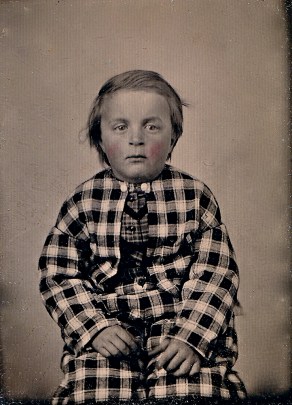
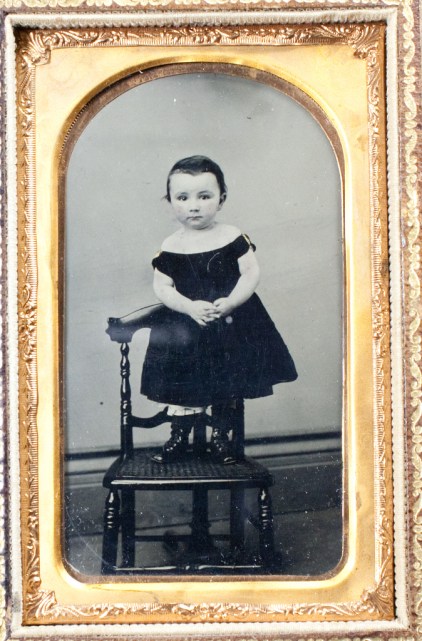
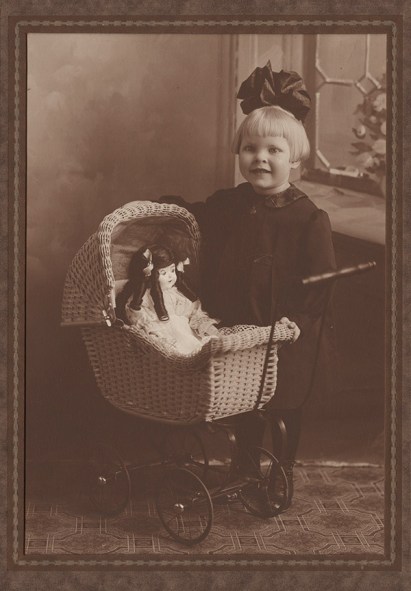
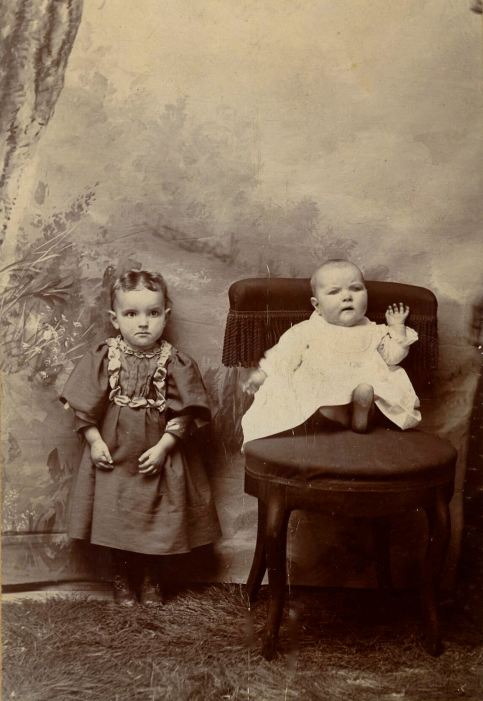
Baby in a barnyard feeding chickens. Glass-plate image, circa 1900. Photo courtesy Price and Zimmer Collection.Boy in checkered suit. Tintype, circa 1870. Ann Longmore-Etheridge Collection.Boy standing on chair. Tintype, circa 1862. Courtesy Price and Zimmer Collection.A doll with a doll. Paper print, circa 1920. Courtesy Jack and Beverly Wilgus Collection.Misses Unimpressed and Fuhgetaboudit. Albumen cabinet card, circa 1875. Ann Longmore-Etheridge Collection.
“And they shall beat their swords into plowshares, and their spears into pruning hooks: nation shall not lift up sword against nation, neither shall they learn war any more.”
Avis Burr Wooster, 1/4th-plate daguerreotype, circa 1851. Ann Longmore-Etheridge Collection.
The above daguerreotype, which includes a 20th-Century handwritten note indicating it was once held in the collection of the Ossining, New York Historical Society, shows Avis Burr Wooster in about the fifty-fifth year of her life.
Avis was born on 26 May, 1796, in Southbury, New Haven County, Connecticut, in the ember glow of a hot century that had seen Connecticut change from a British colony to a sovereign state inside a new nation. By the time the Revolution exploded, Southbury was already a venerable place, having been established on land bought from the Paugusset tribe in 1659. The area remains much as it was in Avis’s day: rural, agricultural, quiet.
The Burr family’s transplantation to the New World was courtesy of Jehue Burr, born in about 1605, who sailed with Governor Winthrop to Roxbury, Massachusetts, in 1630. Jehue eventually removed to Fairfield, Connecticut, and planted the seeds of a lineage that would include the noted vice president and unfortunate dualist Aaron Burr. Avis’s line was through Jehue’s son Nathaniel (1635-1712) to Avis’s great-great-grandfather Colonel John Burr (1673-1750) to her great-grandfather Captain John Burr (1698-1752) to her grandfather of the same name and rank (1728-1771), who married Eunice Booth (abt. 1728-bef. 1786) circa 1750.
Southbury, Connecticut, from the air. Photo courtesy of the Southbury website.
Avis’s father, William Burr (23 June, 1762-28 Jan., 1841), lost his own father tragically when he was less than ten years old. According to the parish record of Stratfield, on 28 July, 1771, “Capt. John Burr, a farmer, son of…John Burr, was killed by lightning at the old Pequonnock meeting-house…. The congregation was standing in prayer. Parson Rose stopped praying, and after a pause he uttered the following words, ‘Are we all here?’ When the congregation moved out it was found that David Sherman and John Burr were dead. They were both in the prime of life, with families (the very pick of the flock). There was no rod on the steeple at that time.”
A mere five years thereafter, when the Revolution began, teenaged William Burr joined the Connecticut Militia, enlisting on 1 April, 1776. His pension files, included in the tome Revolutionary War Records of Fairfield, Connecticut, indicate that his postings were many and varied, and that he served for a time as a substitute for another man, Andrew Curtiss. One of Burr’s postings was to the “Battery at Black Rock,” or Black Rock Fort in New Haven, later Fort Nathan Hale. The Connecticut Sons of the American Revolution note, “Fort Hale is situated upon an insulated rock, two miles from the end of Long Wharf, New Haven…. The Americans [had] a battery of three guns upon this point, which greatly annoyed the enemy when landing.” Many years later, Aaron Turney of Fairfield attested that in 1779, Burr was 1st sergeant at the battery and second-in-command under Captain Jarvis. Burr appears to have left military service sometime in 1780.





 The above detail of the cabinet card allows us to see Abial as he was late in life, as well as his coffin plaque. According to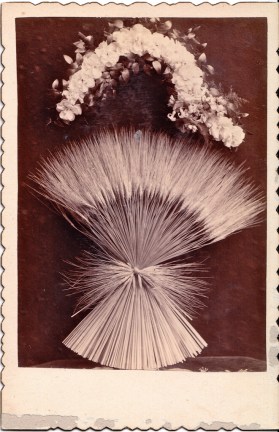









 "Your Dying Charlotte"